
Messaging in B2B Sales Conversion: Proven Strategies
Messaging in B2B Sales Conversion: Proven Strategies
TL;DR:
- Effective messaging is the key to higher B2B sales conversion rates.
- Targeted, pain-focused outreach significantly outperforms generic messaging.
- Layering channels like SMS and email enhances engagement and response rates.
Most outbound sales teams blame their list, their timing, or their tools when deals don’t materialize. The real culprit is almost always messaging. The gap between a 0.25% meeting book rate and a 4%+ rate isn’t a matter of luck or budget. It’s a matter of what you say, to whom, and how. Sales leaders who understand this single truth stop chasing volume and start engineering relevance. This guide breaks down why messaging sits at the center of every conversion decision, which frameworks actually move buyers, and how to layer channels and tactics to turn outbound into a predictable revenue engine.
Table of Contents
- Why messaging is the linchpin in sales conversion
- Pain-centric messaging frameworks: What works and why
- Choosing the right channel: SMS vs email in sales messaging
- Advanced messaging tactics: Objection handling and the power of reframing
- What most B2B teams get wrong about messaging in 2026
- Accelerate your sales conversion with expert messaging
- Frequently asked questions
Key Takeaways
| Point | Details |
|---|---|
| Messaging is leverage | Tailoring messages to buyer pain quadruples B2B sales conversions over generic outreach. |
| Channel choice matters | SMS yields much higher response rates than email when used thoughtfully in outbound. |
| Segmentation wins | Pain-aligned segmentation delivers bigger conversion lifts than copy tweaks alone. |
| Address buyer inertia | Reframing messages to highlight the cost of inaction moves stalled deals forward. |
Why messaging is the linchpin in sales conversion
Every outbound motion depends on one thing going right before anything else happens: your message must connect. Not impress. Not inform. Connect. When messaging misses, even a perfectly segmented list filled with ideal buyers goes cold. When messaging lands, average lists start generating above-average results.
The data makes this concrete. Targeted, pain-focused messaging can achieve book rates above 4%, while generic messaging averages a dismal 0.25%. That’s a 16x performance gap driven purely by message quality. If your team is sending 1,000 outbound touches per month, that gap translates to 2 meetings versus 40. The compounding effect on pipeline and revenue is enormous.
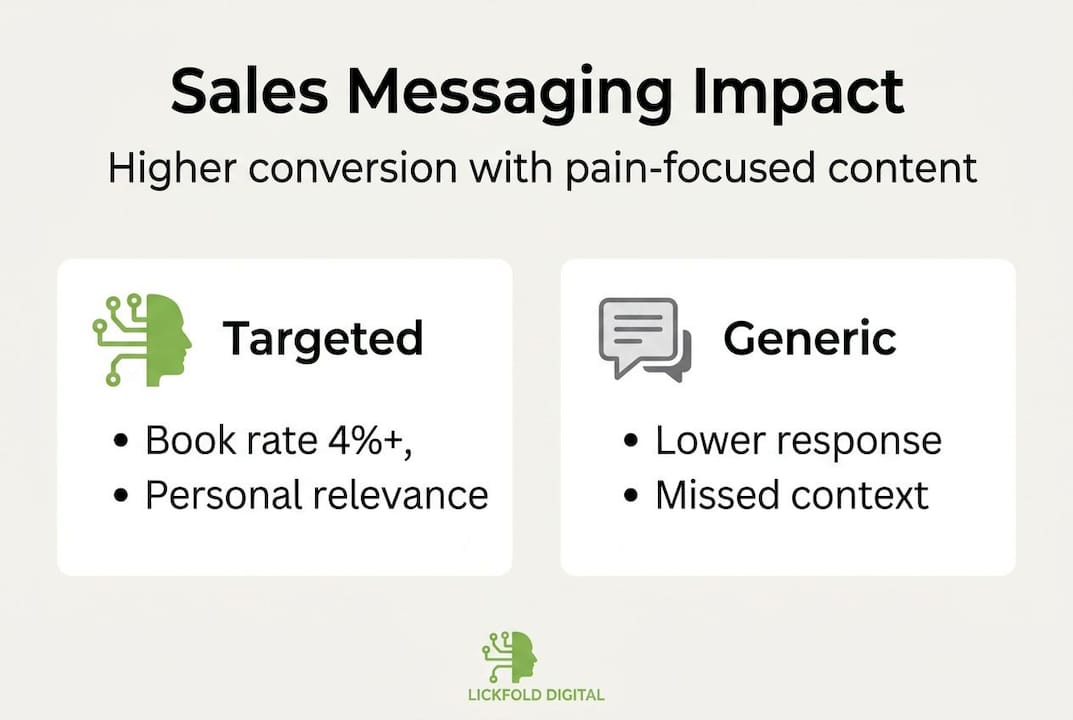
One insight that reshapes how top-performing teams think about this: the list is the message. Who you target signals what pain you’re speaking to. Sloppy segmentation means you’re forcing one message to cover wildly different buyers with different problems. It never fits anyone perfectly. Decision maker targeting done well means your outreach lands with context the reader instantly recognizes as relevant to their world.
| Messaging approach | Avg. meeting book rate | Pipeline impact (1,000 touches) |
|---|---|---|
| Generic, template-based | ~0.25% | ~2-3 meetings |
| Segmented, pain-focused | 4%+ | 40+ meetings |
| Pain-segmented + personalized | 5-6%+ | 50-60+ meetings |
The table above isn’t hypothetical. It reflects the workflow automation impact that happens when teams move from spray-and-pray to structured messaging. The difference shows up within weeks of making the shift.
“Messaging is not a soft skill. It’s the highest-leverage variable in your entire outbound system. Fix the message before you fix anything else.”
Competitors who grasp this are not just tweaking subject lines. They’re rebuilding outreach around specific buyer pain, specific contexts, and specific outcomes. The teams still running batch-and-blast campaigns are leaving most of their potential pipeline on the table. Understanding lead generation messaging at this level is what separates scalable outbound from expensive noise.
Now that you’ve seen just how critical messaging is, let’s break down what makes certain approaches so much more effective.
Pain-centric messaging frameworks: What works and why
With an understanding of messaging’s outsized impact, it’s important to know how structure and focus can supercharge results.
The highest-converting outreach messages share one trait: they lead with a problem the buyer already feels. Not a product. Not a feature. A pain. When a prospect reads your first line and thinks “this person gets what I’m dealing with,” you’ve earned the next sentence. That’s the only goal of your opening.
Here are the core elements of a pain-centric messaging framework:
- Lead with the problem: Name the specific friction your buyer experiences. Be precise, not broad. “Struggling to hit quota with cold email” beats “improving sales performance.”
- Amplify the consequence: Show what it costs them to leave this problem unsolved. Lost revenue, missed targets, team frustration.
- Offer a specific solution: Present your solution in one sentence tied directly to the pain you named. No feature lists.
- Call to a low-friction action: Ask for a short conversation, not a commitment. Reduce the perceived risk of responding.
The real multiplier, though, is audience segmentation. Pain-qualified segmentation can quadruple book rates before you change a single word of copy. Think about what that means. You could take your current message, apply it to a tightly segmented pain-defined list, and see 4x better results without rewriting anything. That’s the power of list-message alignment.
Personalization in outreach goes further than inserting a first name or referencing a LinkedIn post. Real personalization means the entire message reflects the buyer’s industry, role-specific challenge, and likely business context. It requires research, but it doesn’t require hours per prospect. AI can scale this efficiently when the framework is sound.
Pro Tip: Before you personalize cold emails at scale, map your ICP to specific pain categories first. Then write one message per pain category. You’ll spend less time personalizing and get far better results because each message fits its segment like a glove.
Companies that automate for revenue growth using pain-segmented frameworks consistently outperform teams running higher volumes with generic copy. Precision beats volume, every time.
Choosing the right channel: SMS vs email in sales messaging
Of course, the messaging content only shines if delivered through the right channel. Let’s see which methods work best today.

Channel choice isn’t a preference issue. It’s a math issue. SMS outperforms email with average response rates of 34.7% versus just 8.5% for email, and conversational SMS sequences push reply rates to 40-45%. Those numbers are not close. Email still plays a vital role, but treating it as your only channel in 2026 means you’re competing for attention in the most crowded space.
34.7% average SMS response rate vs 8.5% for email. That’s a 4x advantage before you optimize a single word.
| Channel | Avg. response rate | Best use case | Key risk |
|---|---|---|---|
| 8.5% | Longer form, documentation, follow-up | Deliverability, spam filters | |
| SMS | 34.7% | Quick engagement, warm follow-up | Compliance, opt-out rules |
| Combined (layered) | 15-20%+ blended | Multi-touch nurture sequences | Coordination complexity |
SMS works because it’s immediate and personal. When a buyer feels a message is meant for them specifically, and it arrives in their pocket, the friction to respond drops significantly. But SMS carries real compliance obligations. You need proper opt-in consent, clear opt-out options, and strict list hygiene. Ignoring these requirements creates legal exposure that outweighs any conversion gain.
Pro Tip: Don’t treat SMS as email with fewer characters. Write SMS messages conversationally, as if a colleague texted you. Short, direct, and tied to a single clear ask. Combine it with personalizing email outreach in a layered sequence for the strongest blended results.
Layering channels is where sophisticated outbound teams build their edge. A warm email followed by an SMS follow-up, then a final email, consistently outperforms any single-channel approach. The key is keeping the message consistent across channels while adapting the tone to fit each medium.
Advanced messaging tactics: Objection handling and the power of reframing
Once the message lands, the conversation isn’t over. Advanced tactics help you move deals forward when resistance appears.
Most outbound messaging fails not because it never reaches the buyer, but because it stalls once interest forms. Buyers go quiet. They stop responding. Teams interpret this as disqualification when it’s usually something else entirely: status quo bias. This is the human tendency to prefer inaction over change, even when change is clearly beneficial.
Here’s how to address status quo bias directly in your messaging:
- Name the inertia explicitly. Say something like “most teams in your position find it easier to keep the current process running, even when it’s costing them.” This validates the feeling without reinforcing it.
- Quantify the cost of doing nothing. Reframe objections mid-deal to focus on what inaction costs rather than piling on more features. If staying still costs $200K per quarter in missed pipeline, make that number visible.
- Introduce a new urgency signal. A competitor move, a market shift, or a regulatory change gives the buyer a reason to act now rather than later. This isn’t manipulation. It’s context.
“The real objection is rarely about price or fit. It’s about the perceived risk of change. Your job is to make the cost of not changing feel riskier than changing.”
Reframing is more effective than feature stacking because it meets the buyer’s actual psychological resistance. Sending three more slides about product capabilities doesn’t address fear of change. Showing the buyer what remaining still actually costs them does.
For teams using AI-driven sales growth strategies, these reframes can be built into automated follow-up sequences that deploy the right message at the right stall point. AI sales tips focused on objection handling help scale this thinking across every rep on your team. For a broader look at business process optimization, these same reframing principles apply across the entire buyer journey.
What most B2B teams get wrong about messaging in 2026
Here’s the uncomfortable reality: most B2B sales teams are investing in the wrong problems. They buy bigger lists, test more subject lines, and hire more SDRs. Meanwhile, the highest-leverage variable, which is pain segmentation, gets almost no attention.
Volume cannot substitute for message-market fit. Sending 10,000 mediocre messages produces worse results per touch than sending 500 precisely targeted ones. The math is clear. The behavior doesn’t follow.
The best outbound teams we see build messaging around micro-segments: tight clusters of buyers who share a specific pain, a specific business situation, and a specific timeline. They don’t write one email for “VP of Sales.” They write one email for “VP of Sales at a 50-200 person SaaS company who just missed Q1 quota.”
That specificity is what AI in B2B outreach makes scalable. AI can identify those micro-segments, research the relevant pain signals, and personalize messaging at a volume no human team can match manually.
Pro Tip: Spend your next messaging sprint learning your target segment’s core pain rather than buying another contact list. One deeply understood pain point, built into a precise segment, will outperform a list 10x larger with generic copy.
Accelerate your sales conversion with expert messaging
If you’re ready to put these strategies to work, here’s how to accelerate your outcomes with expert support.
The frameworks in this guide work. But implementing pain segmentation, multi-channel sequencing, and AI-powered personalization at scale requires infrastructure, expertise, and the right workflows. That’s exactly what Lickfold Digital delivers.
Lickfold Digital’s AI-driven platform identifies your ideal buyers, maps their core pain signals, and executes personalized multi-touch outreach across email and beyond. From list segmentation to automated follow-up to human-qualified lead handoffs, the system runs like a disciplined outbound team working every hour of the day. If your current outbound isn’t generating the pipeline you need, contact the team and find out what precision messaging can do for your conversion rates.
Frequently asked questions
Why does messaging impact B2B sales conversion rates so much?
Messaging connects directly to relevance and urgency for decision makers, determining whether outreach gets ignored or generates meetings. Targeted, pain-focused messaging can achieve meeting book rates above 4%, while generic approaches average just 0.25%.
Which channel gets the highest response rates for sales outreach?
SMS currently leads with a 34.7% average response rate compared to just 8.5% for email, making it the highest-performing single channel for direct outbound engagement.
What is status quo bias and how should messaging address it?
Status quo bias is the buyer’s tendency to resist change even when change is beneficial. Effective messaging reframes inaction as costly, making the risk of staying still feel greater than the risk of moving forward.
Is segmentation or copywriting more important for B2B sales messaging?
Segmentation by pain points is typically the stronger lever. Pain-qualified segmentation can quadruple book rates before any copy changes are made, proving that who you target matters as much as what you say.