
Why Personalize Cold Emails? 14%+ Response Rate Boost
Why Personalize Cold Emails? 14%+ Response Rate Boost
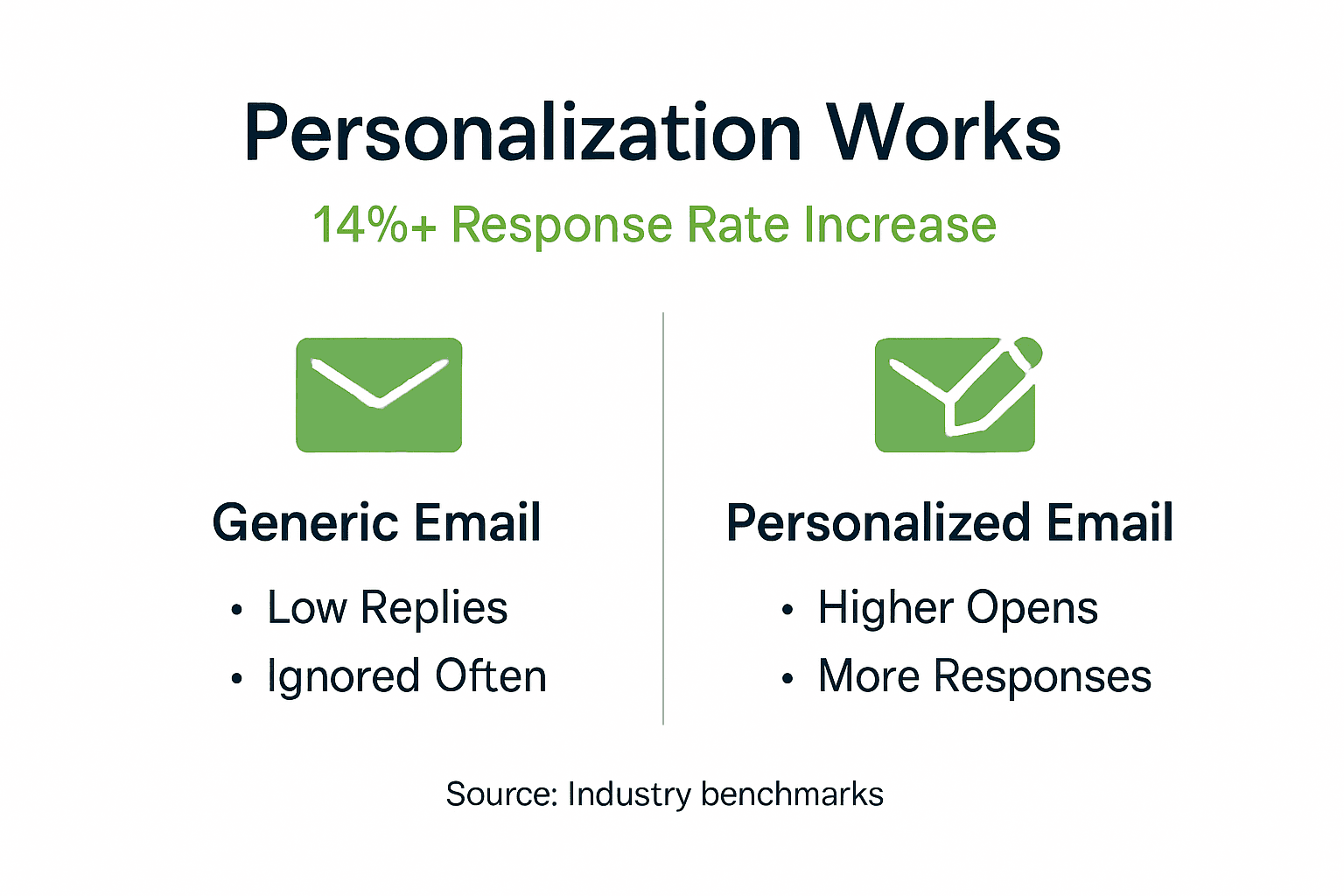
Personalized cold emails improve response rates by over 14% compared to generic emails, yet many B2B sales professionals still rely on templated outreach that decision-makers ignore. This gap represents a massive opportunity for sales teams willing to invest in meaningful personalization. In this article, you’ll discover the psychological drivers behind personalization’s effectiveness, common misconceptions that undermine results, and actionable frameworks for scaling personalized outreach using AI-powered tools in 2026.
Table of Contents
- Understanding Why Personalization Matters in Cold Emails
- The Psychological and Mechanistic Basis of Personalization
Key Takeaways
| Point | Details |
|---|---|
| Personalization drives measurable uplift | Personalized cold emails increase response rates by 14%+ compared to generic templates. |
| Trust and relevance convert decision-makers | Emails referencing specific company context or role challenges build credibility and engagement. |
| AI scales personalization without sacrificing quality | Modern AI tools automate research and message customization while preserving authentic, human tone. |
| Name-only personalization falls short | Adding a recipient’s name alone increases response less than 3%, real relevance requires deeper context. |
| Data-driven segmentation enables efficiency | Grouping prospects by firmographics, role, and pain points allows targeted messaging at scale. |
Understanding Why Personalization Matters in Cold Emails
Generic cold emails face an uphill battle in crowded inboxes. Decision-makers receive dozens of irrelevant pitches daily, training them to scan for any sign of mass outreach and immediately delete or mark as spam. Personalized cold emails improve response rates by over 14% because they signal genuine interest and effort.

Effective personalization references specific company initiatives, the recipient’s role responsibilities, or recent activities that create immediate relevance. When a prospect sees you’ve invested time understanding their business context, they perceive your outreach as valuable rather than intrusive. This shift in perception directly translates to higher engagement and willingness to respond.
The competitive advantage matters more in 2026 than ever before. As inboxes become noisier, standing out requires demonstrating you understand the recipient’s unique challenges and can deliver solutions tailored to their situation. Best lead generation strategies now emphasize quality engagement over volume blasting.
- Decision-makers respond to emails showing understanding of their specific pain points
- Personalization reduces spam perception and improves sender reputation
- Higher response rates compound over time, building predictable pipeline velocity
- Authenticity in messaging creates foundation for ongoing relationship development
The data proves personalization works. The question becomes how to implement it efficiently without sacrificing outreach volume.
The Psychological and Mechanistic Basis of Personalization
Personalization triggers psychological mechanisms that influence decision-maker behavior. When prospects encounter references to their company’s recent achievements, industry challenges, or role-specific responsibilities, their brain registers familiarity. This cognitive response creates an implicit trust signal that generic emails cannot replicate.
Authentic personalization reduces spam perception because it demonstrates research effort. A prospect recognizes when someone has invested time understanding their business versus deploying mass templates. This recognition shifts their mental categorization of your email from