
Personalized email outreach guide: Boost B2B results with AI
Personalized email outreach guide: Boost B2B results with AI
Scaling personalized email outreach is one of the hardest problems in B2B sales. You need every message to feel individually crafted, but you’re working with a list of hundreds or thousands of prospects. The tension between quality and volume kills most outreach programs before they gain traction. AI-driven personalization saves 30-60 min per batch and boosts outreach volume by 60% while keeping quality intact. This guide walks you through the four levels of personalization, the tools you need, a step-by-step campaign execution process, and how to troubleshoot results so your pipeline stays full and your reply rates stay high.
Table of Contents
- Understanding personalization levels for email outreach
- What you need: Tools, templates, and data for personalized outreach
- How to execute personalized campaigns: Step-by-step guide
- Troubleshooting and optimizing your outreach
- The truth about scalable personalization: What most guides miss
- Take your outreach further with Lickfold Digital AI
- Frequently asked questions
Key Takeaways
| Point | Details |
|---|---|
| Choose the right personalization level | ICP segment-based and AI-driven emails deliver top results and scalable impact in B2B outreach. |
| Systemize with tools and templates | Effective outreach requires the right software, enriched data, and compliance-focused ICP templates. |
| Follow best practices for engagement | Personalized subject lines and short, targeted emails maximize open and reply rates. |
| Optimize continuously | Monitor metrics, run A/B tests, and adjust tactics to improve response quality and campaign performance. |
| Balance automation and oversight | AI can scale outreach efficiently but needs human oversight to protect brand and maintain compliance. |
Understanding personalization levels for email outreach
Not all personalization is created equal. Dropping a first name into a subject line is not the same as referencing a prospect’s recent funding round or their company’s expansion into a new market. Understanding where each approach sits on the effort-to-impact spectrum helps you allocate your time and tools correctly.
Personalization levels range from variable-based to AI-assisted, each increasing in both complexity and impact. Here’s how they compare:
| Level | What it uses | Effort | Impact |
|---|---|---|---|
| Variable-based | Name, company, title | Low | Low to moderate |
| Trigger-based | Job change, funding, news | Medium | Moderate to high |
| ICP segment-based | Industry, role, pain point | Medium | High |
| AI-assisted | All of the above, auto-generated | Low (at scale) | Very high |
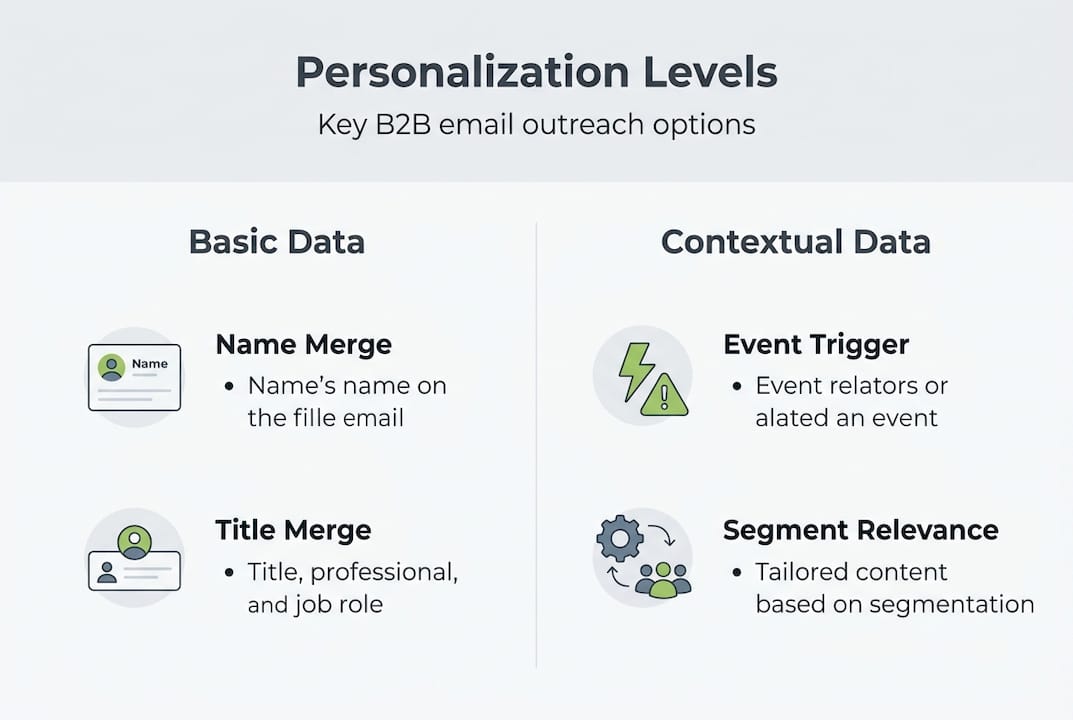
Variable-based personalization is the entry point. You merge fields like {{first_name}} and {{company}} into a template. It’s fast but shallow. Prospects recognize it immediately and it rarely moves the needle on its own.
Trigger-based personalization is more powerful. You reach out because something specific happened: a new hire, a product launch, a funding announcement. This context makes your message feel timely and relevant rather than random.
ICP segment-based personalization groups prospects by shared characteristics, such as industry, company size, or role, and tailors messaging to each group’s specific challenges. This is where personalization techniques in B2B outreach start generating consistently stronger reply rates.
AI-assisted personalization combines all three layers and generates unique openers or entire email bodies at scale. This is where AI strategies for email outreach become a genuine competitive advantage rather than a novelty.
“The goal isn’t to send more emails. It’s to send emails that make the recipient feel like you actually did your homework.” This distinction separates teams that grow pipelines from teams that burn through lists.
Key benefits of moving up the personalization ladder:
- Higher reply rates and meeting bookings
- Better lead quality because messaging attracts the right prospects
- Reduced unsubscribe and spam complaint rates
- Stronger brand perception among decision-makers
What you need: Tools, templates, and data for personalized outreach
After understanding your personalization levels, it’s crucial to have the right resources lined up. Executing at scale without the right stack is like trying to run a factory floor with hand tools.

Here’s the core technology you need:
| Category | Purpose | Examples |
|---|---|---|
| Email automation | Sequencing and sending | Instantly, Smartlead, Lemlist |
| AI writing | Personalized openers and copy | Clay, ChatGPT, Lavender |
| CRM | Tracking and pipeline management | HubSpot, Salesforce |
| Data enrichment | Triggers, firmographics, contacts | Apollo, ZoomInfo, LinkedIn |
Your ICP templates are the backbone of the whole system. Systemize with 3-5 ICP templates built around distinct segments, and enrich each one with data that makes the messaging feel specific. A template for a VP of Sales at a 50-person SaaS company should read nothing like one for a Marketing Director at a 500-person logistics firm.
Data enrichment sources give you the raw material for trigger-based and segment-based personalization. Look for:
- Recent job changes or promotions
- Company funding announcements
- New product launches or market expansions
- Technology stack signals (tools they use)
- Hiring patterns that indicate growth or pain points
For B2B targeting steps to work, your data needs to be clean, current, and matched to the right ICP segment before any email goes out.
Pro Tip: Always have a human review AI-generated emails before they go live in a new campaign. AI is excellent at generating volume, but it can miss brand voice nuances or produce phrasing that feels off. A 10-minute review pass on a new template batch saves you from sending 200 emails that subtly undermine your credibility.
How to execute personalized campaigns: Step-by-step guide
With all tools and templates ready, here’s how to craft and launch effective outreach campaigns.
-
Build your targeting list. Pull prospects from your enrichment tool based on ICP criteria. Filter by role, company size, industry, and any behavioral or trigger signals. Aim for a list where every contact genuinely fits your ideal customer profile.
-
Write subject lines with AI assistance. Personalized subject lines increase opens by 30%, so use AI to generate variations that reference the prospect’s industry, role, or a recent trigger. Test at least two versions per campaign.
-
Draft short, focused email bodies. Keep emails between 50 and 125 words. Longer emails reduce reply rates. Lead with a personalized opener that references something specific about the prospect or their company, then connect it to a single, clear value proposition.
-
Optimize for mobile screens. More than half of B2B emails are opened on mobile. Use short paragraphs, no heavy formatting, and a single call to action. If your email looks cluttered on a phone screen, it gets deleted.
-
Set up A/B testing workflows. Test one variable at a time: subject line, opener, call to action, or send time. Let each test run long enough to reach statistical significance before drawing conclusions.
-
Apply behavioral triggers for follow-ups. If a prospect opens your email three times but doesn’t reply, that’s a signal. Trigger a follow-up sequence that references the original message and adds new value rather than just bumping the thread.
Pro Tip: Batch your sending in groups of 20 to 50 emails at a time. This lets you do a quality check on each batch, catch any data merge errors, and monitor early replies before scaling the full send.
Stat to know: Short emails under 125 words consistently outperform longer ones in reply rate, making brevity one of the highest-leverage optimizations you can make.
For more on AI-powered outreach success and agency prospecting tips, these resources cover advanced tactics worth building into your workflow.
Troubleshooting and optimizing your outreach
Even the best-designed campaigns need ongoing refinement. Here’s how to get the most from your outreach.
The most common mistakes that kill campaign performance:
- Generic copy that ignores ICP segments. Sending the same message to a startup founder and an enterprise procurement manager will underperform for both.
- Emails that run too long. Emails above 125 words reduce reply rates significantly. Trim ruthlessly.
- Skipping A/B tests. Without testing, you’re guessing. Even small improvements in open or reply rates compound into major pipeline differences over time.
- Ignoring deliverability signals. High bounce rates and spam complaints damage your sender reputation and reduce inbox placement for all future sends.
Metrics to track every week:
- Open rate by ICP segment
- Reply rate by template version
- Positive reply rate (interested vs. unsubscribe)
- Bounce rate and spam complaint rate
- Meeting booked rate per 100 sends
“Optimization is not a one-time event. It’s a weekly habit that separates teams generating consistent pipeline from those chasing one-off wins.”
When a segment underperforms, don’t scrap it. Adjust the opener, shorten the body, or test a different subject line angle. AI tools can generate 10 variations in minutes, giving you plenty of material to test without starting from scratch.
Pro Tip: Use full outreach resources to benchmark your metrics against what’s working across industries. Knowing what a strong reply rate looks like for your segment helps you set realistic targets and spot problems early.
Compliance checks matter too. Review your sequences for CAN-SPAM and GDPR alignment, especially if you’re reaching into European markets. AI-generated content can sometimes produce phrasing that creates legal exposure if left unreviewed.
The truth about scalable personalization: What most guides miss
Most B2B outreach guides treat personalization as a volume problem. Send more, personalize more, automate more. But the teams generating the strongest results we’ve seen aren’t winning because they send the most emails. They win because they send the right emails.
Fifty highly targeted, well-researched emails to the right ICP segment will consistently outperform 500 generic sends. The math seems counterintuitive until you factor in reply rates, meeting quality, and the downstream close rate. A 10% reply rate on 50 emails beats a 1% reply rate on 500 every time, and the meetings you book are with people who actually fit your offer.
Human oversight is not optional. AI handles volume beautifully, but it doesn’t know your brand voice, your compliance requirements, or the subtle cultural signals that make a message land in one market and fall flat in another. Build a review step into every new template batch.
The other thing most guides skip: omnichannel strategies boost B2B results by 287%. Email is powerful, but pairing it with LinkedIn touchpoints, voice messages, or even a well-timed call turns a cold sequence into a warm conversation. The prospects who become your best clients rarely came through email alone.
For a deeper look at building this kind of layered approach, email outreach mastery covers the multi-channel frameworks worth adding to your playbook.
Take your outreach further with Lickfold Digital AI
The tactics in this guide work. But executing them consistently, across multiple ICP segments, with proper data enrichment and human quality control, takes infrastructure most B2B teams don’t have in-house.
Lickfold Digital builds that infrastructure for you. Our AI-powered outreach solutions handle everything from ICP research and contact enrichment to personalized multi-touch sequences and human-qualified reply management. You get a scalable pipeline of warm leads without burning your team’s time on manual prospecting. If you’re ready to see what this looks like for your specific market, book a free strategic session and we’ll map out a personalized outreach strategy built around your ideal customer profile.
Frequently asked questions
What’s the most effective level of personalization for B2B email outreach?
ICP segment-based and AI-assisted personalization deliver the highest impact and scale for B2B outreach, combining relevant messaging with efficient execution.
How much time can AI save on personalized email drafting?
AI saves 30-60 minutes per batch of 20 emails and increases outreach volume by 60% without sacrificing the quality that drives replies.
Are there risks in using AI for email personalization?
Yes. AI requires human oversight for compliance and brand voice consistency; generic or unreviewed AI templates can reduce engagement and damage sender reputation.
Should subject lines be personalized in B2B outreach?
Absolutely. Personalized subject lines boost opens by 30% or more in B2B campaigns, making them one of the highest-return optimizations in your outreach.
Is email better than cold calls for B2B prospecting?
Neither channel wins alone. Email scales personalization efficiently, but omnichannel approaches drive 287% better results than single-channel strategies in B2B prospecting.