
Master your email outreach process with AI strategies
Master your email outreach process with AI strategies
Manual email outreach drains your sales team’s time while delivering inconsistent results. You send hundreds of messages, hoping for a handful of replies, but most land in spam folders or get ignored entirely. AI-driven outreach transforms this frustrating cycle into a scalable, personalized system that identifies decision-makers, crafts contextual messaging, and executes multi-touch sequences automatically. This guide walks you through the complete email outreach process tutorial, from preparation through execution and optimization, showing you how to leverage artificial intelligence for predictable lead conversion.
Table of Contents
- Key takeaways
- Preparing for your AI-powered email outreach
- Executing multi-touch, AI-driven email outreach sequences
- Verifying results and optimizing your email outreach process
- Enhance your AI email outreach with expert support
- Frequently asked questions
Key Takeaways
| Point | Details |
|---|---|
| Scalable hyperpersonalization | AI powered outreach identifies decision makers, crafts contextual messages, and executes multi touch sequences automatically. |
| Multi channel sequences | Multi channel sequences across email, LinkedIn, and InMail improve engagement and reply rates. |
| Deliverability and data quality | Achieving scalable deliverability requires proper SPF DKIM DMARC, gradual warmups, and clean enriched prospect data. |
| Test and optimize sequences | Iterative testing and optimization of messages and timing drives better conversions over time. |
Preparing for your AI-powered email outreach
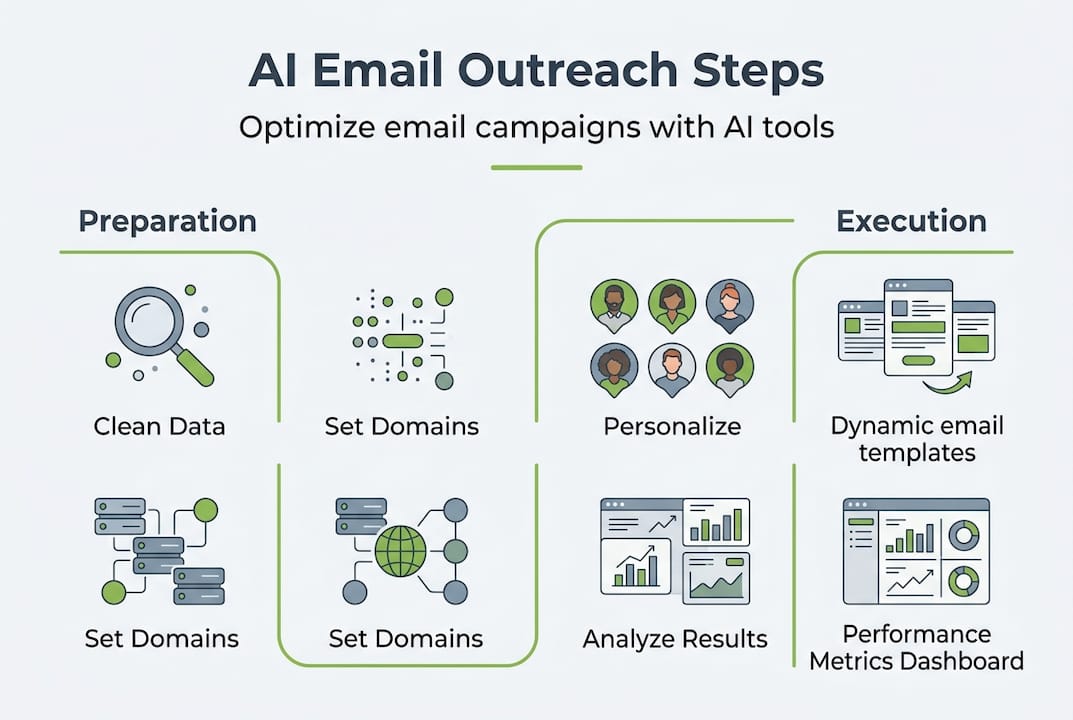
Before launching campaigns, you need solid foundations. AI-powered email outreach involves 4-5 key steps starting with defining your Ideal Customer Profile through AI analysis of your existing customer data. This preparation phase determines whether your outreach generates qualified opportunities or wastes resources on poor-fit prospects.
Start by feeding your CRM data into AI tools that identify patterns among your best customers. These systems analyze firmographics, technographics, buying signals, and engagement history to build a precise ICP. You’ll discover which company sizes, industries, technologies, and pain points correlate with closed deals. This data-driven approach replaces guesswork with statistical confidence.
Next, ensure your lead data meets quality standards. AI personalization requires accurate information about prospects, their companies, and recent activities. Invest in enrichment tools that append missing fields, verify email addresses, and surface engagement signals like job changes, funding rounds, or technology adoptions. Garbage data produces garbage outreach, regardless of how sophisticated your AI becomes.
Your email infrastructure must support deliverability at scale. Configure SPF, DKIM, and DMARC records correctly to authenticate your sending domain. Implement gradual warmup protocols for new email accounts, starting with small volumes and increasing over 10-14 days. Monitor your sender reputation constantly because one spam complaint surge can tank your entire operation.
Pro Tip: Set up dedicated sending domains separate from your primary business domain to protect your core email reputation if deliverability issues arise during outreach experiments.
Finally, map out your multi-channel sequence architecture before writing a single message. Plan how email touches will coordinate with LinkedIn profile views, connection requests, and InMail messages. Decide on sequence length, touch frequency, and exit conditions. This blueprint guides AI tools as they generate personalized variations for each prospect. Working with professional AI experts can accelerate this setup phase and prevent costly mistakes.
Executing multi-touch, AI-driven email outreach sequences
Execution separates theoretical planning from real-world results. Multi-channel automated sequences with 5-8 touches over 10-30 days yield optimal engagement when AI adapts follow-ups based on recipient behavior. Your sequence must balance persistence with respect, providing value at every touchpoint.
AI-generated personalization goes beyond inserting first names and company names into templates. Modern systems analyze prospect LinkedIn activity, company news, technology stack, hiring patterns, and competitive landscape to craft contextual hooks. The AI identifies specific pain points this prospect likely faces and positions your solution as the answer. Each message feels hand-written because the research backing it mirrors what a human sales development representative would discover.
Structure your sequences strategically:
- Initial email establishes relevance with a research-driven insight about their business
- First follow-up adds social proof or case study relevant to their industry
- Second follow-up introduces a different value angle or addresses a separate pain point
- LinkedIn profile view or connection request creates multi-channel presence
- Third follow-up offers specific resource, tool, or framework
- Fourth follow-up uses scarcity or urgency ethically
- Final breakup email gives them an easy out while leaving door open
- LinkedIn InMail serves as alternative channel if email goes cold
Test relentlessly to optimize performance. Run A/B tests on subject lines, comparing question formats against benefit statements. Experiment with email length, testing concise 75-word messages against detailed 150-word versions. Try different calls to action, from scheduling links to simple reply requests. Track which variables move your metrics and double down on winners.
Pro Tip: Front-load your research and context in the first two sentences before introducing yourself or your company, this proves you’ve done homework and earns the right to their attention.
AI-powered dynamic follow-ups react to engagement signals automatically. If a prospect opens three emails but doesn’t reply, the system recognizes interest and adjusts the next message accordingly. If someone clicks a case study link, AI triggers a follow-up specifically about that success story. This behavioral responsiveness mimics how top sales professionals adapt their approach based on prospect reactions. Explore more sales outreach best practices to refine your approach.

Verifying results and optimizing your email outreach process
Measurement transforms activity into accountability. Track open rates, reply rates, bounce rates, and conversion rates religiously. B2B cold email reply rates average 3-10%, with follow-ups adding 40-50% more replies when deliverability and data quality remain strong. Compare your performance against these benchmarks to identify improvement opportunities.
Deliverability issues manifest quickly when metrics deteriorate. Sudden drops in open rates signal spam folder placement. Rising bounce rates indicate data quality problems or blacklist issues. Increased unsubscribe rates suggest targeting misalignment or message fatigue. Address these symptoms immediately before they compound into larger reputation damage.
| Metric | Healthy Range | Warning Signs | Action Required |
|---|---|---|---|
| Open Rate | 40-60% | Below 30% | Check spam placement, test subject lines |
| Reply Rate | 3-10% | Below 2% | Review ICP targeting, improve personalization |
| Bounce Rate | Below 3% | Above 5% | Clean list, verify emails, check domain reputation |
| Unsubscribe Rate | Below 0.5% | Above 1% | Reassess targeting, reduce frequency |
Balance AI automation with human judgment strategically. AI excels at research, personalization at scale, and systematic follow-up. Humans excel at reading between the lines, navigating complex political landscapes, and building authentic relationships. Let AI handle the first 80% of the funnel, qualifying prospects and warming them up. Bring humans in when deals reach meaningful size thresholds or require consultative selling.
Refine your ICP quarterly based on conversion data. Which industries, company sizes, and roles actually convert to customers? Which personas engage but never buy? Tighten your targeting to focus resources on highest-probability prospects. This iterative improvement compounds over time, making each campaign more efficient than the last.
Understand AI limitations honestly. Large enterprise deals involving multiple stakeholders and long sales cycles often require relationship-building that AI cannot replicate. Highly technical products may need subject matter expertise beyond what AI can synthesize. Recognize these edge cases and design hybrid workflows that leverage AI for efficiency while preserving human expertise where it matters most. Review our AI lead generation case study to see real-world optimization results.
Enhance your AI email outreach with expert support
Transforming your outreach process requires more than tools. You need strategic guidance on ICP refinement, sequence architecture, deliverability optimization, and performance analysis. Lickfold Digital’s AI experts specialize in building AI-powered prospecting systems that generate predictable pipelines of qualified opportunities.
Our team handles the technical complexity of infrastructure setup, AI agent configuration, and ongoing optimization so you focus on closing deals. We deploy dedicated warmup accounts, maintain sender reputation, qualify replies, and pass only genuine opportunities to your sales team. Schedule a free strategy call to evaluate your current outreach process and identify immediate improvement opportunities. Download our free business book for additional frameworks on scaling lead generation with AI automation.
Frequently asked questions
How do I define my Ideal Customer Profile using AI?
Feed your CRM data into AI analysis tools that identify common traits among your best customers, including firmographics, technographics, and behavioral patterns. The AI surfaces correlations you might miss manually, like specific technology stacks or growth stages that predict buying intent. Segment your leads based on these discovered traits to target prospects with highest conversion probability. Partner with professional AI experts to accelerate this analysis and avoid common segmentation mistakes.
What is the ideal number of follow-ups in multi-touch email sequences?
Best practice recommends 3-4 follow-ups, which significantly improve reply rates without triggering spam complaints or annoying prospects. Each follow-up should provide new value or approach the conversation from a different angle rather than simply asking again. Going beyond five or six touches risks diminishing returns as engaged prospects have already responded and uninterested ones have tuned out. Test your specific audience to find the optimal balance between persistence and respect.
How can I improve email deliverability in AI-driven outreach?
Authenticate emails with SPF, DKIM, and DMARC records to prove legitimate sending authority to inbox providers. Warm up new domains gradually over 10-14 days, starting with small volumes to build positive sender reputation before scaling. Monitor spam complaint rates obsessively and maintain them below 0.1% by targeting precisely and providing clear unsubscribe options. Clean your lists regularly to remove bounces and inactive addresses that damage reputation metrics.
Should I use AI for all prospect communications or only initial outreach?
Use AI to handle high-volume, early-stage prospecting where personalization at scale creates competitive advantage. Let AI research prospects, generate initial messages, and execute systematic follow-up sequences that would overwhelm human teams. Transition to human involvement when prospects show genuine interest, ask complex questions, or represent high-value opportunities requiring consultative selling. This hybrid approach maximizes efficiency while preserving relationship quality where it matters most for revenue outcomes.
How long does it take to see results from AI-powered email outreach?
Expect initial replies within the first week of launching sequences, with meaningful volume building over 30-45 days as multi-touch sequences complete their cycles. Conversion to qualified opportunities typically occurs 60-90 days after launch once you’ve iterated on messaging, targeting, and deliverability based on early performance data. Plan for a three-month optimization period before judging true ROI, as AI systems improve continuously through testing and refinement. Patience during this learning phase pays dividends in long-term pipeline predictability.