
Step by Step Lead Generation: 65% Cost Reduction with AI
Step by Step Lead Generation: 65% Cost Reduction with AI
B2B sales teams struggle with inconsistent qualified leads and inefficient manual prospecting that drains resources. AI-driven automation can save over 2 hours daily per sales rep and increase lead conversion by 10 to 30%. This guide details a step-by-step approach to implement AI-powered lead generation for scalable pipeline growth and measurable ROI.
Table of Contents
Prerequisites: What You Need Before Starting AI Lead Generation
Conclusion: Future-Proofing Your B2B Lead Generation Strategy
Unlock Scalable AI-Driven Lead Generation with Lickfold Digital
Key Takeaways
PointDetailsTime SavingsAI automation reduces manual prospecting time by up to 70%, freeing sales teams to focus on closing deals.Foundation MattersClean CRM data and clear goals are critical prerequisites for successful AI implementation and accurate targeting.Personalization WorksMulti-touch personalized outreach powered by AI doubles engagement rates compared to generic approaches.Human OversightBalance automation with human review to maintain lead quality and avoid robotic messaging that hurts conversion.Proven ResultsExpect 25 to 30% conversion increases and 65% lower acquisition costs within 3 to 6 months of deployment.
Prerequisites: What You Need Before Starting AI Lead Generation
Successful AI-powered lead generation starts with proper groundwork. You need clean, enriched CRM or lead database records to fuel AI algorithms accurately. Garbage data produces garbage results, so invest time upfront in data hygiene. Your database should include firmographics, contact information, engagement history, and behavioral signals that help AI identify high-quality prospects.
Set up dedicated email infrastructure with warming and reputation management. AI-driven outreach requires multiple email accounts that gradually build sending reputation to avoid spam filters. Work with AI expert consulting services to configure domains, authentication protocols like SPF and DKIM, and automated warming sequences. Without this infrastructure, your carefully crafted messages will land in spam folders instead of inboxes.
Define clear lead generation goals aligned with your sales objectives. What does a qualified lead look like? What conversion rates and pipeline velocity do you need? Establish pilot testing environments where you can experiment with targeting, messaging, and workflows before scaling. Plan human oversight frameworks that provide validation and optimization feedback to your AI systems.
Research shows AI automation can reduce manual prospecting time by 60 to 70% and automate over 70% of manual sales tasks. Your preparation determines whether you capture these efficiency gains or waste resources on poorly configured systems.
Pro Tip: Conduct a data audit before launching AI campaigns. Remove duplicates, standardize formats, and enrich missing fields to give your AI the best possible foundation for targeting accuracy.
Essential prerequisites checklist:
Clean CRM database with enriched contact and company data
Dedicated email infrastructure with warmed sending reputation
Clear ideal customer profile and lead qualification criteria
Pilot testing environment for iterative optimization
Human review process for quality assurance and feedback
Step-by-Step Lead Generation Process with AI Automation
Implementing AI-powered lead generation follows a systematic process that balances automation with strategic oversight. This section walks you through each core step to execute effectively and achieve measurable pipeline growth.
Step 1: Data Preparation and Infrastructure Setup
Start by cleaning your database and setting up email deliverability infrastructure. Verify contact information, remove inactive records, and segment your audience based on firmographics and behavior. Configure dedicated email accounts with proper authentication and begin warming schedules at least two weeks before launching outreach.

Step 2: Define Ideal Customer Profiles
Use AI-powered data segmentation to identify your highest-value prospects. Analyze historical conversion data to understand which industries, company sizes, and roles convert best. Create detailed ICPs that include demographics, pain points, buying signals, and engagement preferences. The AI-powered lead generation process uses these profiles to target efficiently and personalize messaging at scale.
Step 3: Deploy AI Agents for Automated Prospecting
AI agents analyze intent signals like website visits, content downloads, and social engagement to identify prospects showing buying interest. They monitor job postings, funding announcements, and technology adoption signals that indicate timing opportunities. This continuous prospecting runs 24/7 across markets without human intervention, building a steady pipeline of warm leads.
Step 4: Implement Personalized Multi-Touch Outreach
Deploy campaigns across email, LinkedIn, and phone channels with messaging tailored to each prospect’s profile and behavior. AI generates personalized emails referencing specific pain points, recent company news, or relevant case studies. Schedule follow-ups systematically, adjusting frequency and content based on engagement signals. Research confirms that AI-driven tools automate over 70% of manual sales tasks while maintaining personalization quality.
Step 5: Lead Qualification and Handoff
Combine AI chatbots for initial engagement with human review for final qualification. AI scores leads based on engagement, fit, and buying signals, then routes high-quality prospects to sales teams. Human reps validate interest, understand specific needs, and schedule discovery calls. This hybrid approach ensures quality while maintaining efficiency.
Step 6: Continuous Monitoring and Optimization
Track engagement metrics like open rates, reply rates, and conversion percentages. Analyze which messaging resonates, which channels perform best, and which segments convert fastest. Use these insights to refine targeting, adjust messaging, and optimize campaign timing. Schedule weekly reviews where sales teams provide feedback to tune AI workflows.
StepPurposeAI RoleData SetupEnsure accuracy and deliverabilityEnrichment and validationICP DefinitionTarget high-value prospectsPattern analysis and segmentationProspectingIdentify warm leads continuouslyIntent monitoring and researchOutreachEngage prospects at scalePersonalization and sequencingQualificationFilter and validate leadsScoring and initial engagementOptimizationImprove campaign performanceAnalytics and recommendations
Pro Tip: Start with pilot campaigns targeting a narrow segment of your ICP. Learn what messaging and timing work best before scaling to your full target market. This iterative approach minimizes wasted effort and accelerates time to results.
Common Mistakes and Troubleshooting AI Lead Generation
Even well-planned AI implementations face challenges. Understanding common pitfalls helps you avoid costly mistakes and troubleshoot issues quickly.
Over-automation causes robotic, generic outreach that prospects immediately recognize and ignore. When AI generates every message without human input, you lose the authenticity and relevance that builds trust. Engagement drops, unsubscribe rates climb, and your brand reputation suffers. Balance automation with human oversight, especially for high-value accounts that deserve personalized attention.
Poor CRM data quality produces targeting errors and wasted effort. If your database contains outdated contacts, incorrect company information, or missing fields, AI will target the wrong prospects with irrelevant messaging. Studies show that data quality directly impacts the 60 to 70% time savings AI can deliver. Schedule regular data hygiene audits to maintain accuracy.
Email infrastructure misconfigurations cause deliverability and reputation problems. Skipping proper domain authentication, warming sequences, or volume limits triggers spam filters and blacklists. Your carefully crafted campaigns never reach prospects, wasting resources and damaging sender reputation. Work with experts on avoiding AI lead generation pitfalls to configure infrastructure correctly from day one.
Neglecting human review diminishes lead qualification accuracy and personalization. AI scores leads based on signals, but humans understand nuance, context, and relationship dynamics. Without sales team input, you’ll pass unqualified leads or miss opportunities that AI misjudged. Create feedback loops where reps regularly validate AI decisions and suggest improvements.
Common troubleshooting scenarios:
Low open rates indicate deliverability issues or poor subject lines
High unsubscribe rates signal overly aggressive outreach or irrelevant targeting
Poor reply rates suggest messaging lacks personalization or value proposition
Conversion drops point to misalignment between marketing promises and sales reality
Pro Tip: Schedule monthly data hygiene audits and quarterly strategy reviews with your sales team. Their frontline feedback helps you catch issues early and continuously refine your AI workflows for better results.
Expected Results and Success Metrics
AI-powered lead generation delivers measurable improvements across key sales metrics when implemented properly. Understanding realistic benchmarks helps you set expectations and track progress toward ROI.
Increase lead conversion rates by 25 to 30% typically within 3 to 6 months after AI adoption. Better targeting, personalized messaging, and systematic follow-up all contribute to higher conversion. You’ll see improvements first in engagement metrics like reply rates, then in qualified opportunities, and finally in closed deals as optimized leads move through your pipeline.
Achieve up to 65% reduction in customer acquisition costs through optimized targeting and outreach. AI eliminates wasted effort on poor-fit prospects and automates manual tasks that previously required expensive sales resources. Research documents that companies typically see 65% lower acquisition costs as AI scales high-quality lead generation.
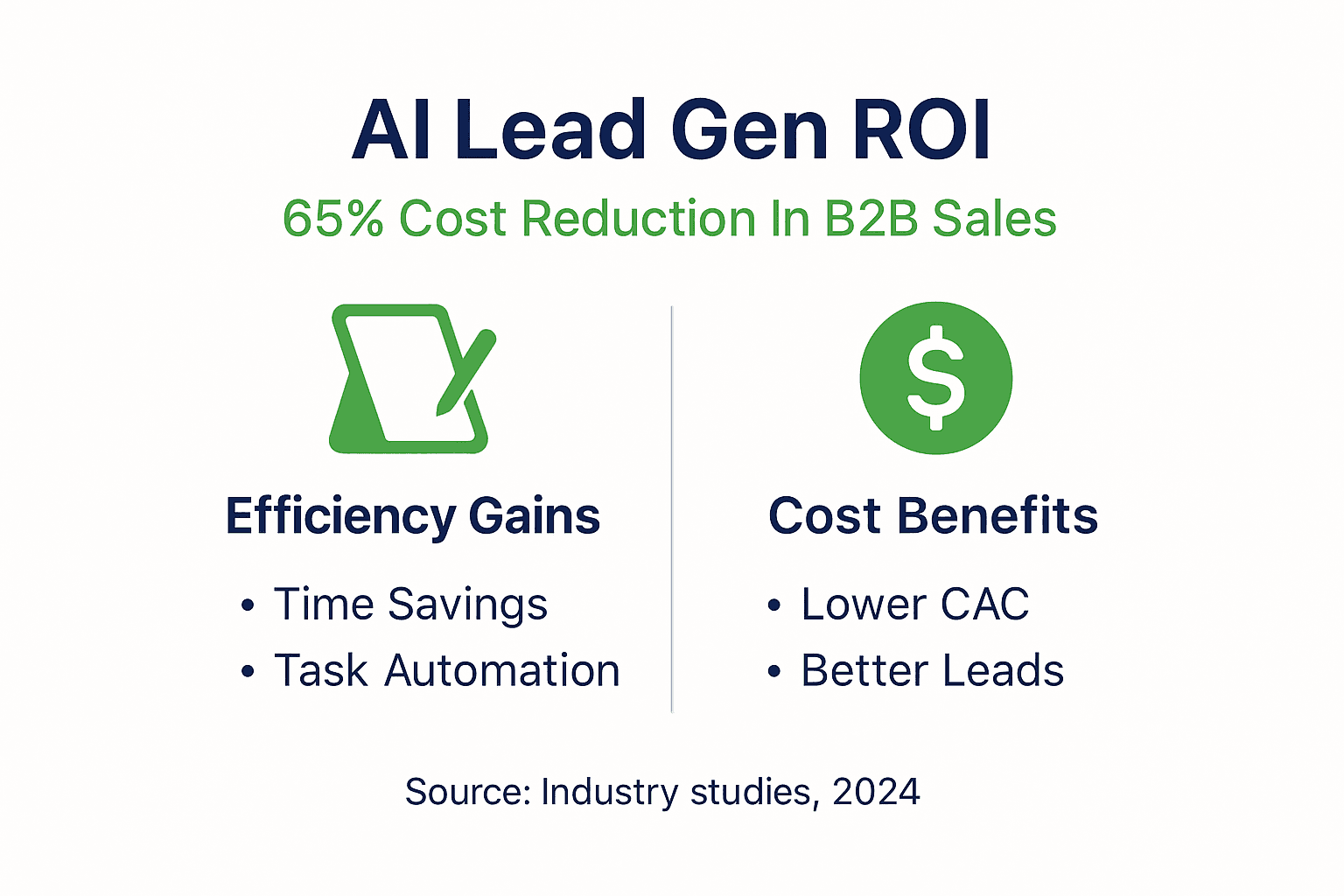
Realize 50 to 70% reduction in time spent on manual prospecting. Sales reps no longer research companies, hunt for contact information, or manually send follow-up sequences. They focus exclusively on qualified conversations and closing deals. This efficiency gain directly impacts revenue per rep and team scalability.
Personalized AI-driven outreach delivers 2x higher engagement rates compared to generic methods. When messages reference specific pain points, recent company news, or relevant case studies, prospects respond. Generic blast emails get ignored or deleted, but thoughtful personalization cuts through inbox noise.
MetricTraditional ApproachAI-Driven AutomationImprovementLead Conversion Rate2 to 5%7 to 15%25 to 30% increaseCustomer Acquisition CostHigh manual effortOptimized targeting65% reductionProspecting Time10+ hours weekly3 to 5 hours weekly50 to 70% decreaseEngagement Rate5 to 10% reply rate15 to 25% reply rate2x improvementPipeline PredictabilityInconsistentSteady flowSignificant increase
“AI-powered lead generation transforms pipeline predictability and efficiency for B2B sales teams, delivering measurable ROI within months of implementation.”
Key performance indicators to track:
Lead conversion rate from initial contact to qualified opportunity
Cost per lead compared to previous manual methods
Email engagement rate including opens, clicks, and replies
Time saved on prospecting activities per sales rep
Pipeline velocity measuring how quickly leads move to closed deals
Monitor AI lead generation ROI benchmarks regularly to ensure your implementation delivers expected results and identify optimization opportunities.
Balancing AI Automation and Human Sales Team Involvement
The most successful AI implementations blend automation efficiency with human expertise and relationship-building skills. Finding the right balance maximizes results while maintaining quality and authenticity.
AI automates repetitive, high-volume lead identification and outreach tasks. It researches thousands of companies, identifies decision-makers, monitors intent signals, and executes multi-touch sequences without human intervention. This continuous operation builds pipeline steadily while freeing sales teams from grunt work.
Humans focus on nuanced relationship-building and closing complex deals. They understand context, read between the lines, handle objections creatively, and build trust through authentic conversations. Sales reps excel at discovery calls, demos, negotiations, and partnership discussions that require emotional intelligence and strategic thinking.
Research shows 80% of sellers exceeding 150% quota use AI sales technology weekly, blending automation with human expertise. Top performers don’t choose between AI and human effort. They strategically combine both to maximize efficiency and effectiveness.
ApproachAI RoleHuman RoleBest ForFully ManualNoneAll prospecting and outreachVery small teams or niche marketsFully AutomatedAll prospecting and outreachOnly closing dealsHigh-volume, transactional salesHybrid (Optimal)Research, targeting, initial outreachQualification, demos, closingComplex B2B sales requiring relationship-building
The critical role of human review for lead qualification prevents robotic messaging and ensures quality. Sales reps validate that AI-scored leads truly match your ICP and show genuine buying interest. They add context that AI might miss and provide feedback that continuously improves targeting accuracy.
Optimal division of responsibilities:
AI handles prospect research, data enrichment, and intent monitoring
AI executes initial outreach sequences and follow-up cadences
Humans review and qualify engaged prospects before deeper conversations
Humans conduct discovery calls, demos, and negotiations
Humans provide feedback to refine AI targeting and messaging
Pro Tip: Schedule weekly review sessions where sales teams give feedback on lead quality, messaging effectiveness, and targeting accuracy. Use their frontline insights to tune AI systems for continuous improvement. Human and AI collaboration in sales produces better results than either approach alone.
Conclusion: Future-Proofing Your B2B Lead Generation Strategy
AI-driven lead generation is essential to remain competitive in 2025 and beyond. Companies that automate prospecting, personalize outreach at scale, and optimize continuously will dominate their markets. Those relying on manual methods will struggle with rising costs and inconsistent pipeline.
Successful implementation hinges on proper preparation and balancing AI with human input. Clean data, clear goals, and robust infrastructure provide the foundation. Strategic human oversight ensures quality, authenticity, and continuous improvement. Together, these elements deliver the measurable results documented throughout this guide.
Ongoing optimization and measurement ensure sustained pipeline growth and ROI. Track key metrics, gather sales team feedback, and refine your approach based on performance data. AI systems improve over time as they learn from results and incorporate human insights.
Start now to reap efficiency gains, improved lead quality, and predictable sales funnel expansion. The competitive advantage goes to teams that act decisively while others hesitate.
Unlock Scalable AI-Driven Lead Generation with Lickfold Digital
Ready to transform your B2B lead generation with proven AI automation? Lickfold Digital provides expert consulting and AI lead generation services tailored for B2B sales teams seeking measurable pipeline growth. Their platform deploys dedicated AI agents that identify decision-makers, execute personalized multi-touch campaigns, and deliver qualified opportunities to your sales team.
Partner with Lickfold Digital for strategy and implementation support that includes infrastructure setup, ongoing optimization, and human qualification of leads. Their custom AI solutions for B2B sales help you pilot, refine, and scale your AI-powered prospecting workflow effectively. Stop wasting resources on manual prospecting and start building a predictable, scalable lead generation engine today.
Frequently Asked Questions
What types of data quality issues most affect AI lead generation?
Outdated contact information, missing firmographic fields, and duplicate records severely impact AI targeting accuracy. Without clean data, AI targets wrong prospects with irrelevant messaging, wasting resources and hurting conversion rates.
How often should AI lead gen campaigns be reviewed and optimized?
Review engagement metrics weekly and conduct comprehensive strategy reviews monthly. Quick weekly checks catch immediate issues like deliverability problems, while monthly reviews identify broader trends and optimization opportunities for messaging and targeting.
Can small sales teams benefit from AI-driven lead generation?
Absolutely. Small teams gain the most because AI multiplies their prospecting capacity without adding headcount. A three-person sales team can achieve the prospecting output of a 15-person team using AI automation effectively.
What is the ideal balance between AI automation and human involvement?
AI should handle all research, initial outreach, and follow-up sequencing. Humans should focus on qualifying engaged prospects, conducting discovery calls, and closing deals. This hybrid approach maximizes efficiency while maintaining relationship quality.
How soon can we expect to see measurable improvements from AI lead gen?
Initial engagement metric improvements appear within 2 to 4 weeks. Qualified opportunity increases become visible in 6 to 8 weeks. Full conversion rate and ROI improvements typically materialize within 3 to 6 months as optimized leads move through your entire sales cycle.