
How personalization drives results in B2B outreach
How personalization drives results in B2B outreach
Generic B2B outreach is quietly draining your pipeline. Response rates as low as 1-2% are the norm for spray-and-pray campaigns, while teams that invest in tailored messaging routinely see 8-12% or higher. The gap is not a mystery. Decision-makers receive dozens of cold messages every week, and they delete anything that feels templated in seconds. This guide breaks down the full personalization spectrum, from basic name-swaps to AI-powered hyper-personalization, and gives you a practical framework to scale what actually works.
Table of Contents
- Why personalization matters in B2B outreach
- Types of personalization: From basic to hyper-personalized outreach
- Common challenges and pitfalls in B2B personalization
- Scalable personalization: Segmentation, ABM, and balancing for committees
- How to implement and measure effective personalization
- Accelerate B2B results with AI-powered personalization
- Frequently asked questions
Key Takeaways
| Point | Details |
|---|---|
| Data-driven personalization wins | Buyers respond far more to tailored outreach that speaks to their real challenges. |
| AI amplifies, but needs review | AI tools can scale personalization if used with human oversight and high-quality data. |
| Segment to personalize at scale | Segmentation and ABM enable relevant personalization for buying committees. |
| Measure meaningful results | Success is best tracked with reply rates, meetings, and pipeline—not opens alone. |
Why personalization matters in B2B outreach
Personalization is no longer a nice-to-have. It is the baseline expectation for any outreach that wants to land a reply. 81% of decision-makers engage with tailored outreach, meaning the majority of your best prospects will simply ignore anything that does not speak directly to their situation. That is a brutal filter, and it rewards teams who do the homework.
“Buyers are not waiting for you to figure out personalization. They are already rewarding the vendors who get it right and ghosting everyone else.”
The numbers behind personalization are hard to argue with. Personalized emails consistently deliver 2-3x higher response rates compared to generic blasts. Nurtured leads, those who receive relevant, sequenced outreach tied to their specific challenges, are 50% more likely to be sales-ready and typically cost less to convert. The math alone should push personalization to the top of your outreach strategy.
Key reasons personalization moves the needle:
- Decision-makers respond to messages that reference their actual business problems
- Relevant outreach builds credibility before the first call
- Tailored follow-up sequences keep prospects engaged across longer sales cycles
- Personalized messaging reduces unsubscribes and spam complaints, protecting your sender reputation
If you want to see what AI outreach results look like when personalization is done at scale, the data consistently points to revenue growth that outpaces traditional outbound by a wide margin. Personalization is not just a messaging tactic. It is a revenue strategy.
Types of personalization: From basic to hyper-personalized outreach
Not all personalization is equal. In fact, the wrong kind can actively hurt your results. Understanding the spectrum helps you invest effort where it actually pays off.
Basic personalization means inserting a first name, company name, or job title into a template. It is better than nothing, but barely. Prospects recognize these tokens instantly, and a poorly merged field (wrong name, outdated company) destroys credibility faster than a generic message ever could.
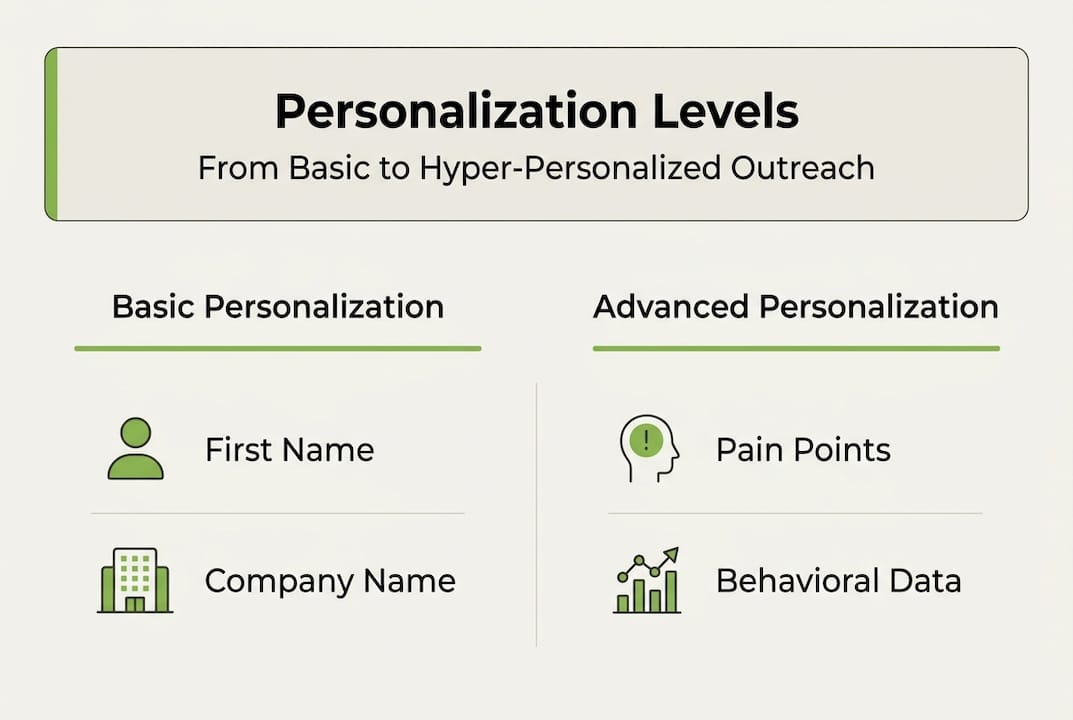
Contextual personalization goes a level deeper. It references something specific to the prospect, such as a recent company announcement, a LinkedIn post they shared, or a challenge common to their industry vertical. This takes more effort but signals that you actually did your research.
Hyper-personalization combines role-specific pain points, behavioral signals, and real-time data to craft messages that feel one-to-one even when delivered at scale. This is where AI tools earn their keep. Advanced personalization can double response rates compared to generic outreach, and AI makes it possible to operate at that level without a team of researchers.
| Personalization level | Effort required | Typical response rate lift | Scalability |
|---|---|---|---|
| Basic (name, company) | Low | Minimal | High |
| Contextual (news, role) | Medium | Moderate | Medium |
| Hyper-personalized (AI-driven) | Low with AI | High | High with AI |
Review personalization case studies from enterprise sales teams and you will see a consistent pattern: the teams winning the most meetings are not sending more emails. They are sending smarter ones.
Pro Tip: Before investing in AI personalization tools, audit your current data. AI is only as good as the inputs it works with. Clean, structured prospect data is the foundation that makes hyper-personalization possible. Check out the AI prospecting steps that high-performing teams use to build that foundation.
Common challenges and pitfalls in B2B personalization
Personalization done poorly is worse than no personalization at all. The most common mistakes are predictable, and they are easy to avoid once you know what to watch for.
Over-personalization is a real risk. Referencing details that feel too specific, such as a prospect’s personal social media activity or information they did not share professionally, crosses a line. Over-personalization can appear creepy, and poor-quality AI-generated messaging often feels inauthentic, which turns buyers off immediately. The goal is relevance, not surveillance.
Common pitfalls to avoid:
- Using outdated or incorrect data (wrong title, old company, irrelevant industry reference)
- Letting AI generate messages without human review
- Personalizing the opening line but leaving the rest of the email generic
- Treating all prospects in a segment identically when their roles differ significantly
- Sending too many touchpoints too quickly, which signals desperation rather than value
“The fastest way to lose a prospect’s trust is to show them you did your research wrong. One bad data point and your credibility is gone.”
Data hygiene is not glamorous, but it is the single biggest factor separating teams that get replies from teams that get ignored. High-performing sales organizations treat data quality as an ongoing process, not a one-time cleanup.
Pro Tip: Build a simple pre-send checklist for your team. Verify the prospect’s current title, confirm the company is still a fit, and have a human read every AI-generated message before it goes out. This takes minutes and prevents reputation-damaging mistakes. For more on protecting your outreach quality, review these AI-powered outreach tips.
Scalable personalization: Segmentation, ABM, and balancing for committees
Most B2B purchases involve more than one person. Complex deals often run through buying committees of six to ten stakeholders, each with different priorities and objections. Personalizing for a single contact while ignoring the rest of the committee is a common and costly mistake.

Only 26% of marketers report success from personalization, and a major reason is that they focus on individuals rather than the full buying group. Account-based marketing (ABM) solves this by treating the entire account as the target, mapping each stakeholder’s role and tailoring messaging to their specific concerns.
Here is a practical framework for scaling personalization across buying committees:
- Map the committee structure. Identify every stakeholder involved in the decision, including economic buyers, technical evaluators, and end users.
- Segment by persona. Group stakeholders by role and function, not just seniority. A CFO cares about ROI; a VP of Sales cares about pipeline velocity.
- Personalize by pain point. Craft messaging that speaks to each persona’s specific challenge, not a generic value proposition.
- Coordinate touchpoints. Ensure outreach to different committee members is timed and sequenced so the account receives a coherent, not contradictory, message.
- Track engagement by role. Monitor which personas are responding and adjust your approach based on where interest is highest.
| Stakeholder role | Primary concern | Personalization focus |
|---|---|---|
| Economic buyer (CFO) | Cost, ROI, risk | Revenue impact, payback period |
| Technical evaluator | Integration, security | Compatibility, implementation |
| End user (Sales VP) | Ease of use, results | Workflow improvement, quota attainment |
| Champion | Internal credibility | Business case support, peer validation |
Segmentation aligns your messaging to unique business drivers rather than forcing every prospect through the same funnel. Review the account-based marketing checklist to structure your ABM approach, and explore decision-maker outreach strategies that address committee outreach challenges directly.
Pro Tip: Do not try to personalize everything at once. Start with your top 20 target accounts, map their committees fully, and run a focused ABM pilot. The learnings from that pilot will sharpen your approach before you scale.
How to implement and measure effective personalization
Strategy without execution is just planning. Here is how to move from concept to a running personalization engine that your team can actually operate and improve over time.
Step-by-step implementation:
- Audit your data. Before writing a single message, assess the quality of your prospect data. Remove duplicates, correct outdated titles, and fill gaps in company information.
- Define your segments. Group prospects by industry, company size, role, and stage in the buying journey. Each segment needs its own messaging track.
- Build persona-specific templates. Create message frameworks (not rigid scripts) for each persona. Leave room for contextual personalization in the opening lines.
- Deploy AI for scale. Use AI tools to research prospects, identify relevant triggers, and generate first drafts. Always have a human review before sending.
- Launch a test sequence. Run a small batch first. Test subject lines, opening hooks, and call-to-action phrasing across segments before rolling out broadly.
- Iterate based on replies. Replies, not opens, tell you what is working. Analyze the quality of responses and adjust messaging accordingly.
Reply quality, meeting show rates, and pipeline velocity matter more than opens. Open rates are a vanity metric in personalized outreach. What you actually want to track:
- Reply rate by segment: Which persona groups are responding most?
- Positive reply rate: Are replies expressing interest, or just asking to be removed?
- Meeting booked rate: How many replies convert to a scheduled conversation?
- Pipeline contribution: What percentage of your open opportunities originated from personalized outreach?
- Sales cycle length: Are personalized leads closing faster than cold leads?
For a deeper look at targeting the right people with the right message, the AI targeting guide walks through how to combine data signals with AI to reach decision-makers more precisely. And for personalization best practices that enterprise teams use, Salesforce’s research offers useful benchmarks to measure your own results against.
Pro Tip: Set up a monthly review cadence where your team analyzes reply quality, not just volume. One insightful reply from a VP of Sales is worth more than fifty auto-replies. Build feedback loops so your messaging improves with every campaign cycle.
Accelerate B2B results with AI-powered personalization
Personalization at scale is not a manual process anymore. The teams consistently winning more meetings are the ones combining clean data, smart segmentation, and AI-powered execution to reach the right people with the right message at the right time. That is exactly what we build at Lickfold Digital.
As AI personalization experts, we deploy dedicated AI agents that research your target accounts, identify decision-makers, and craft personalized multi-touch outreach that does not feel like a template. Every reply is human-qualified before it reaches your sales team, so you spend time on real opportunities, not inbox noise. If you are ready to stop guessing and start building a predictable pipeline, book a free session with our team. We will map out a personalization strategy built around your ideal customer profile and your growth goals.
Frequently asked questions
What’s the difference between personalization and segmentation in B2B outreach?
Personalization customizes messages for individual prospects based on their specific role, challenges, or context. Segmentation groups prospects by shared characteristics so you can tailor messaging to each group rather than every single person. Segmentation and ABM complement personal outreach by making it scalable across large buying committees.
How much personalization is too much in B2B campaigns?
Stay focused on professional context, such as role, industry, and business challenges, rather than personal details that prospects did not share in a professional setting. Over-personalization feels creepy and turns buyers off, so relevance is always the better guide than depth.
What are the most important metrics for measuring B2B outreach personalization success?
Track reply rate, positive reply rate, meetings booked, and pipeline contribution rather than open rates alone. Quality of response and pipeline growth are the best indicators that your personalization is actually resonating with decision-makers.
How can AI tools improve B2B personalization without sacrificing authenticity?
AI handles research, data enrichment, and first-draft generation at a scale no human team can match, but human review is essential before any message goes out. AI-generated content risks sounding inauthentic if not reviewed, so treat AI as a force multiplier for your team, not a replacement for judgment.