
Account-based marketing checklist for B2B success 2026
Account-based marketing checklist for B2B success 2026
Account-based marketing demands precision, coordination, and strategic execution across multiple teams and touchpoints. B2B marketing managers face the challenge of orchestrating complex campaigns that target high-value accounts while maintaining personalization at scale. Without a structured approach, critical steps get overlooked, resources scatter, and opportunities slip away. This comprehensive checklist provides a practical framework to navigate ABM implementation in 2026, ensuring your team executes coordinated campaigns that drive measurable revenue impact and sustainable growth.
Table of Contents
- Defining Criteria For Selecting Target Accounts
- Building Personalized Engagement Plans For Each Account
- Aligning Sales And Marketing Teams For Abm Execution
- Measuring And Optimizing Abm Performance With Data
- Discover Expert Abm Support At Lickfold Digital
- Frequently Asked Questions
Key takeaways
| Point | Details |
|---|---|
| Strategic account selection | Prioritize accounts based on revenue potential, strategic fit, and data-driven criteria to maximize ROI |
| Personalized engagement | Tailor messaging and content to each account’s unique pain points and buying committee dynamics |
| Cross-team alignment | Establish shared goals and communication processes between sales and marketing for seamless execution |
| Data-driven optimization | Track key metrics and continuously refine tactics based on performance insights |
Defining criteria for selecting target accounts
Effective ABM begins with choosing the right accounts to target. You need clear, strategic criteria that balance opportunity size with realistic win probability. Start by identifying accounts that align closely with your product-market fit and strategic business objectives. Companies that match your ideal customer profile deliver higher conversion rates and longer customer lifetime value.
Use firmographic data to filter potential accounts systematically. Industry vertical, company size, geographic location, and technology stack provide essential screening parameters. Account selection criteria should prioritize alignment with business objectives and potential revenue impact. Evaluate each account’s potential deal size against the resources required to win them. Not every large company makes a good ABM target if the probability of success remains low.
Involve stakeholders from sales, customer success, and product teams in the evaluation process. Sales teams bring frontline insights about account accessibility and competitive positioning. Customer success teams identify patterns from existing high-value clients that indicate future fit. This holistic input creates more accurate targeting decisions.
Combine quantitative metrics with qualitative assessment. While revenue potential and firmographics provide hard data, factors like cultural fit, innovation appetite, and decision-making speed require human judgment. Create a scoring model that weights both dimensions appropriately for your business context.
Pro Tip: Review and refine your selection criteria quarterly based on campaign performance data and market shifts. What worked last year may not reflect current buyer behavior or competitive dynamics in 2026.
Building personalized engagement plans for each account
Once you’ve selected target accounts, develop customized engagement strategies that speak directly to their specific needs. Generic campaigns fail in ABM because decision-makers expect relevance and insight tailored to their situation. Map the buying committee within each account, identifying key stakeholders, their roles, priorities, and influence on purchasing decisions.
Align your content and messaging with each account’s documented pain points, business objectives, and industry context. A manufacturing company faces different challenges than a SaaS provider, even if both need similar solutions. Research recent company news, earnings reports, and leadership statements to understand current priorities. This intelligence informs messaging that resonates immediately.

Leverage multiple engagement channels to create rich, varied touchpoints. Email remains foundational, but combine it with social media engagement, industry events, direct mail, and personalized video outreach. Different stakeholders prefer different channels, and multi-channel presence builds credibility faster than single-channel approaches.
Use account insights and behavioral data to adapt messaging dynamically over time. If a prospect downloads a specific whitepaper, follow up with related case studies rather than generic next steps. Personalized messaging and content increase engagement rates and drive better ABM results. Track engagement signals to identify warming accounts and adjust intensity accordingly.
Coordinate closely with sales to ensure messaging continuity and optimal timing. Marketing nurtures accounts through awareness and consideration, but handoffs must feel seamless to prospects. Establish clear triggers for sales involvement and ensure both teams understand the account’s journey stage.
Pro Tip: Deploy AI-driven tools to scale personalization without sacrificing quality. Modern platforms analyze account data and generate customized content variations that maintain authentic voice while addressing specific stakeholder concerns efficiently.
Aligning sales and marketing teams for ABM execution
ABM success depends on tight collaboration between sales and marketing teams operating as a unified revenue engine. Without alignment, prospects experience disjointed messaging, duplicated outreach, and confusing handoffs that damage credibility. Establish shared key performance indicators and success definitions that both teams commit to achieving together. When marketing and sales optimize for the same outcomes, tactical decisions naturally align.
Create joint planning sessions where both teams collaboratively select target accounts and design engagement strategies. These sessions build shared ownership and surface potential conflicts early. Sales brings account intelligence and relationship context, while marketing contributes campaign expertise and content resources. The combination produces stronger strategies than either team develops in isolation.
Develop clear, documented handoff processes for lead nurturing and opportunity management. Define exactly when marketing qualified accounts transition to sales, what information transfers with them, and how both teams continue supporting the account post-handoff. Ambiguity in these processes creates gaps where prospects fall through or receive conflicting messages.
Implement regular performance reviews where both teams analyze campaign data together and optimize tactics collaboratively. Weekly or biweekly syncs keep everyone informed about account progression, engagement trends, and emerging challenges. Cross-team alignment is crucial for delivering a seamless buyer experience and increasing conversion rates in ABM.
Foster a culture of transparency and shared accountability where both teams celebrate wins together and troubleshoot challenges cooperatively. Blame-shifting destroys ABM effectiveness faster than any tactical misstep. Use collaborative platforms and tools that provide real-time visibility into account activity, campaign performance, and pipeline development. When everyone sees the same data, conversations focus on strategy rather than disputes about facts.
Schedule regular sales and marketing alignment sessions to maintain momentum and address friction points before they escalate into systemic problems.
Measuring and optimizing ABM performance with data
Data-driven measurement transforms ABM from hopeful activity into predictable revenue generation. Track account engagement metrics that reveal buying interest and campaign effectiveness. Website visits, content downloads, webinar attendance, and email interactions indicate warming accounts. Monitor these signals at both account and individual stakeholder levels to understand committee dynamics.
Measure pipeline and revenue directly influenced by ABM-targeted accounts. Attribution gets complex in multi-touch B2B journeys, but focus on accounts that entered your pipeline after ABM engagement began. Compare close rates, deal sizes, and sales cycle length between ABM accounts and traditional pipeline sources to quantify program impact.
Analyze channel effectiveness to allocate budget efficiently across email, social, events, and other touchpoints. Some channels excel at awareness while others drive consideration or decision. Data-driven optimization improves ABM campaign ROI by identifying top-performing tactics and areas for adjustment. Understanding channel contribution helps you double down on what works and cut what doesn’t.
Use A/B testing systematically for messaging, creative elements, and outreach timing. Test subject lines, value propositions, content formats, and call-to-action phrasing to continuously improve response rates. Even small percentage improvements compound significantly across large account lists.
Schedule periodic optimization reviews, ideally monthly or quarterly, where you analyze performance trends and adjust strategies accordingly. ABM requires patience, but it also demands responsiveness to data signals. The table below summarizes key ABM metrics and their strategic significance.
| Metric | What It Measures | Why It Matters |
|---|---|---|
| Account engagement score | Cumulative activity across touchpoints | Identifies warming accounts ready for sales outreach |
| Pipeline velocity | Time from first touch to closed deal | Reveals process efficiency and potential bottlenecks |
| Deal size | Average contract value from ABM accounts | Validates targeting criteria and ROI potential |
| Win rate | Percentage of ABM opportunities that close | Indicates campaign relevance and sales effectiveness |
| Customer acquisition cost | Total program spend divided by new customers | Measures overall program efficiency and profitability |
Explore ABM measurement best practices to deepen your analytics capabilities and uncover optimization opportunities others miss.
Discover expert ABM support at Lickfold Digital
Implementing a comprehensive ABM checklist requires expertise, technology, and sustained execution. Lickfold Digital delivers AI-driven ABM solutions that enhance targeting precision, personalization quality, and measurement accuracy. Our platform identifies decision-makers within your ideal accounts and executes multi-touch campaigns that convert warm leads into qualified opportunities.
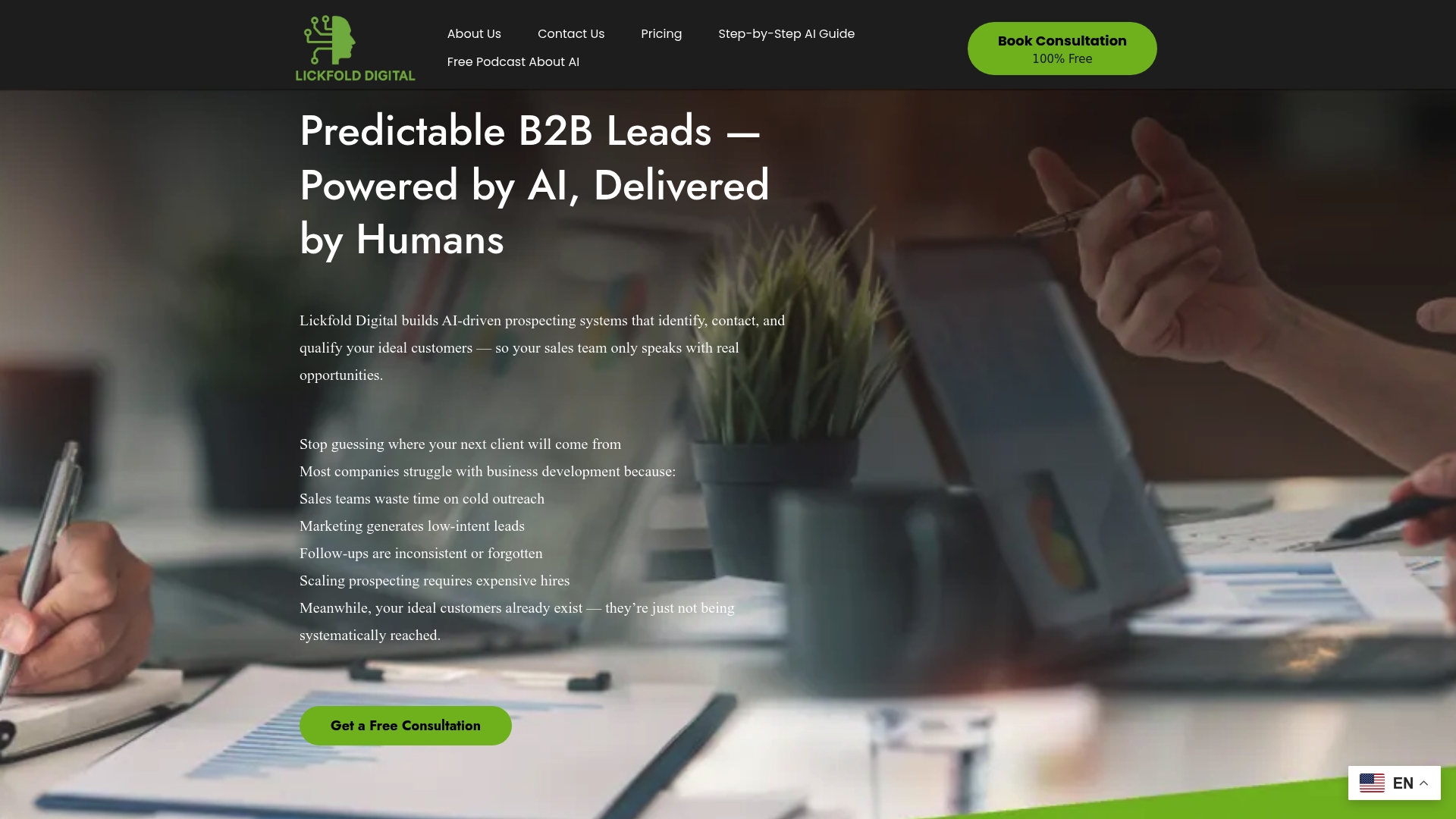
Clients gain access to proven frameworks and dedicated support that accelerate results while reducing acquisition costs. We handle infrastructure setup, reputation management, and reply qualification so your team focuses on closing deals, not campaign logistics. Schedule a free ABM consultation to explore how AI-powered workflows can transform your pipeline predictability. You can also download our digital marketing strategies book for additional insights on scaling B2B growth efficiently in 2026.
Frequently asked questions
What is an account-based marketing checklist?
An account-based marketing checklist is a structured framework that guides teams through essential steps for executing targeted campaigns against high-value accounts. It ensures consistency across account selection, personalization, team alignment, and measurement. By following a systematic checklist, marketing and sales teams avoid overlooking critical tasks and maintain focus on activities that drive revenue impact.
How do I choose which accounts to include in my ABM program?
Select accounts based on strategic fit, revenue potential, and win probability. Use firmographic criteria like industry, company size, and location to create an initial filter, then evaluate each account’s specific needs alignment with your solution. Involve sales and customer success teams in the selection process to incorporate frontline insights and relationship intelligence that pure data analysis misses.
What tools should I use for ABM execution?
Effective ABM requires integrated tools for account research, engagement tracking, content personalization, and performance analytics. CRM platforms provide foundational account management, while specialized ABM software adds targeting intelligence and campaign orchestration. AI-powered prospecting tools automate decision-maker identification and personalized outreach at scale, significantly improving efficiency compared to manual processes.
What are common ABM pitfalls to avoid?
The most frequent mistakes include selecting too many accounts and diluting personalization, failing to align sales and marketing on strategy and timing, and neglecting consistent measurement and optimization. Other pitfalls involve generic messaging that doesn’t reflect account-specific research, inadequate budget allocation for sustained engagement, and expecting immediate results from what is inherently a longer-term strategy.
How long does it take to see results from ABM?
ABM typically requires three to six months before meaningful pipeline impact becomes visible, with full ROI clarity emerging around 12 months. The timeline depends on your sales cycle length, account complexity, and program maturity. Early indicators like engagement rate improvements and meeting bookings appear within weeks, but closed revenue takes longer as accounts progress through buying cycles.
How can AI improve ABM performance?
AI enhances ABM by automating account research, identifying decision-makers accurately, personalizing content at scale, and optimizing outreach timing based on engagement patterns. AI agents continuously analyze market data and account signals to surface high-priority targets and recommend next-best actions. This technology allows small teams to execute sophisticated campaigns that previously required large manual effort, improving both efficiency and effectiveness simultaneously.