
Why use AI-powered messaging for B2B outreach in 2026
Why use AI-powered messaging for B2B outreach in 2026
Many sales teams assume AI messaging automatically boosts lead generation. Yet response rates to cold emails have plummeted as buyers associate quality outreach with automation. This creates a paradox: the tools designed to scale your pipeline can actually reduce engagement. Understanding why AI messaging sometimes fails and how to optimize it transforms your outbound strategy. This guide reveals the psychological barriers affecting AI-powered outreach, practical frameworks for maintaining authenticity at scale, and data-driven methods to measure and improve your messaging effectiveness in 2026.
Table of Contents
- The Promise And Pitfalls Of AI-Powered Messaging
- How The Uncanny Valley Effect Influences Buyer Response
- Best Practices For Effective AI-Powered Messaging
- Measuring AI Messaging Impact And Adapting Strategies
- Discover Expert AI Messaging Solutions With Lickfold Digital
- FAQ
Key takeaways
| Point | Details |
|---|---|
| AI messaging scales outreach but risks lower response rates | Automation can trigger buyer skepticism when messages feel too polished or impersonal |
| The uncanny valley effect reduces message authenticity | Prospects distrust communications that seem almost human but lack genuine personalization |
| Blending AI efficiency with human insight yields best results | Strategic combination of automation and customization maximizes engagement and conversion |
| Continuous measurement and adaptation improve performance | Tracking key metrics and iterating based on data ensures sustained outreach effectiveness |
The promise and pitfalls of AI-powered messaging
AI messaging promises unprecedented scale and efficiency in B2B prospecting. You can reach thousands of decision-makers simultaneously, personalize at volume, and maintain consistent follow-up cadences without expanding your team. The technology identifies ideal customer profiles, locates relevant contacts, and executes multi-touch campaigns that would require dozens of sales development representatives.
Yet this efficiency comes with a hidden cost. Automated messages that feel overly polished trigger immediate suspicion among experienced buyers. They recognize templated language, generic personalization tokens, and formulaic structures. This recognition creates what psychologists call the uncanny valley effect, where something appears almost human but subtle imperfections generate discomfort and distrust.
Buyers increasingly associate robotic outreach with low-quality vendors. When your message reads like it came from a machine, prospects assume you lack genuine interest in their specific challenges. This perception leads to sharply reduced engagement and response rates, undermining the very efficiency gains AI promised.
The data tells a stark story:
- Open rates remain stable but reply rates drop 40-60% for obviously automated messages
- Prospects delete AI-generated emails faster than personalized human outreach
- Trust metrics decline when buyers detect automation patterns
- Conversion rates suffer even when initial engagement occurs
“The irony of modern outbound is that tools designed to improve efficiency often destroy the human connection that drives conversions. Buyers want to feel understood, not processed.”
This dynamic creates a critical challenge for B2B sales teams. You need scale to hit ambitious growth targets, but you cannot sacrifice the authenticity that converts prospects into customers. The solution lies not in abandoning AI messaging but in understanding how to deploy it strategically. When you recognize the psychological barriers and adjust your approach accordingly, AI becomes a powerful amplifier rather than a conversion killer. Visit our professional outreach responses page to see how thoughtful messaging creates genuine engagement.
How the uncanny valley effect influences buyer response
The uncanny valley describes the psychological discomfort people experience when encountering something that appears almost, but not quite, human. Originally applied to robotics and animation, this phenomenon powerfully affects AI-powered sales messaging. When your outreach feels 95% human but includes subtle tells of automation, buyers experience an instinctive negative reaction.
AI-powered outbound tools can create suspiciously polished emails that reduce response rates due to buyer skepticism. This happens because prospects detect micro-patterns that signal automation. Perfect grammar with zero personality. Generic compliments that could apply to anyone. Timing that feels too precise. These elements combine to create messages that seem professionally competent but emotionally hollow.
Buyers detect these authenticity cues through several mechanisms:
- Language patterns that lack natural variation and conversational flow
- Personalization that references publicly available information without deeper insight
- Timing sequences that follow obvious automated cadences
- Subject lines optimized for algorithms rather than human curiosity
- Call-to-action phrasing that mirrors standard templates
The psychological impact extends beyond simple detection. When prospects recognize automation, they make immediate assumptions about your company. They conclude you prioritize volume over relationships, efficiency over understanding, and transactions over partnerships. These perceptions poison the entire sales process before any genuine conversation begins.
Pro Tip: Record yourself reading your AI-generated messages aloud. If you stumble over phrasing or feel awkward saying certain sentences, your prospects will feel that same discomfort when reading them. Natural speech patterns should guide your messaging, not algorithmic optimization.
The solution requires deliberate humanization strategies. Introduce intentional imperfections that signal human authorship. Vary your sentence structure dramatically. Include conversational asides that reference current events or industry developments. Ask questions that demonstrate genuine curiosity rather than qualification checklists. These elements move your messaging out of the uncanny valley and into authentic communication territory.

Understanding AI messaging psychology helps you craft outreach that leverages automation’s efficiency without triggering buyer skepticism. The goal is not to hide AI involvement but to ensure the final message reflects genuine human insight and interest. When you achieve this balance, prospects respond to the value you offer rather than rejecting the method you used to reach them.
Best practices for effective AI-powered messaging
Blending AI efficiency with human-crafted personalization creates the optimal approach for B2B outreach in 2026. Start by using AI for research and targeting while reserving message crafting for human insight. Let algorithms identify companies matching your ideal customer profile and locate decision-makers, but write opening lines that reference specific company initiatives or recent achievements that matter to that individual.
Data-driven timing and segmentation dramatically improve targeting effectiveness. Analyze when prospects in different industries and roles typically engage with emails. Manufacturing executives might review messages early morning before production meetings start, while marketing directors often engage during afternoon planning sessions. Smart AI messaging combines automation with human insight to improve outreach quality and response.
Avoid formulaic or robotic language in your automation. Replace phrases like “I wanted to reach out” or “I hope this email finds you well” with direct, value-focused openings. Instead of generic compliments, reference specific challenges facing their industry or company. Your first sentence should demonstrate you understand their world, not that you found their email address.
Key strategies for maintaining authenticity:
- Write multiple message variations for each campaign segment, not single templates
- Include industry-specific terminology that shows domain expertise
- Reference recent news or developments affecting their business
- Ask questions that require thoughtful answers, not yes/no responses
- Vary sentence length and structure to mirror natural speech patterns
Pro Tip: Create a “human review queue” where team members spot-check AI-generated messages before sending. This quality control catches robotic phrasing and ensures personalization elements actually make sense for each prospect. Even reviewing 10% of messages significantly improves overall campaign quality.
Continuously test and iterate your messaging approaches. Run A/B tests comparing different opening lines, value propositions, and call-to-action phrasing. Track which variations generate higher response rates across different prospect segments. Use these insights to refine your AI training data and human writing guidelines.
| Tactic | Pros | Cons | | — | — | | Full AI automation | Maximum scale and efficiency | High risk of robotic tone and low response | | AI research with human writing | Balanced efficiency and authenticity | Slower than pure automation | | Human-written templates with AI personalization | Consistent quality with scale | Requires ongoing template refinement | | Hybrid approach with human review | Best response rates and brand protection | Most resource intensive |
The most successful teams treat AI as a research assistant and efficiency multiplier rather than a replacement for human judgment. Schedule a personalized AI strategy session to discover which approach fits your team’s capabilities and growth targets. Explore more AI messaging tips to refine your outreach strategy continuously.
Measuring AI messaging impact and adapting strategies
Tracking AI messaging effectiveness requires focusing on metrics that reveal genuine engagement rather than vanity numbers. Open rates tell you whether subject lines work but say nothing about message quality. Reply rates indicate whether your content sparked interest worth responding to. Conversion rates show whether replies translate into qualified opportunities.
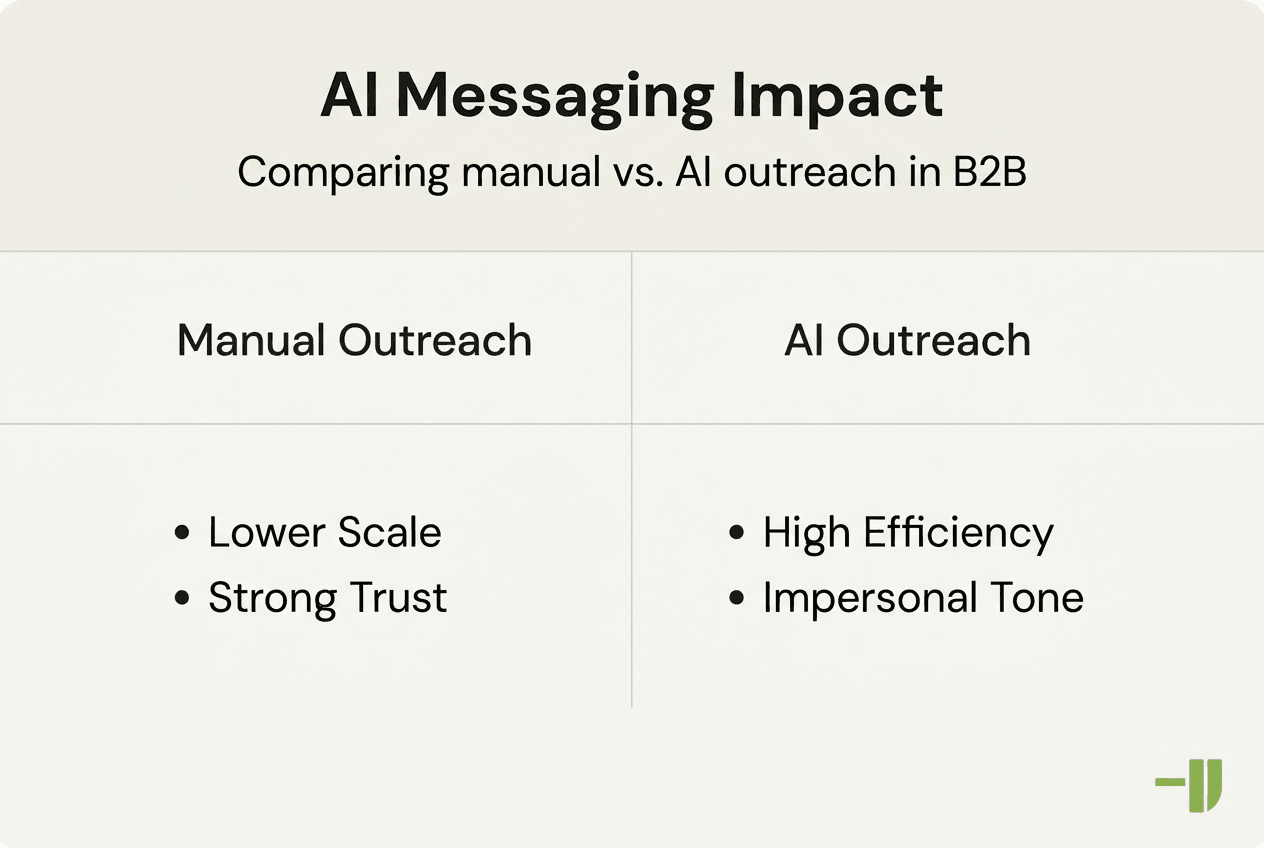
Compare AI-powered versus manual messaging performance across identical prospect segments. Send half your target list AI-generated messages and half human-written outreach. Track not just response rates but response quality. Are AI-generated messages getting more “not interested” replies while human messages generate questions and meeting requests? This qualitative analysis reveals whether automation helps or harms your positioning.
Response data reveals when AI messaging helps or harms outreach; ongoing measurement is key. Establish baseline metrics before implementing AI tools, then monitor changes monthly. Look for trends rather than daily fluctuations. A 5% response rate drop might seem minor until you realize it represents 50 fewer qualified conversations per thousand prospects.
Critical measurement steps:
- Define success metrics beyond opens and clicks, focusing on qualified conversations
- Segment results by industry, company size, and prospect role to identify patterns
- Track time-to-response as an indicator of message relevance and urgency
- Monitor unsubscribe rates and spam complaints as early warning signals
- Calculate cost-per-qualified-lead including tool costs and team time
- Document which message elements correlate with higher conversion rates
Use A/B tests to refine messaging formulas systematically. Test one variable at a time: subject line approach, opening sentence style, value proposition framing, or call-to-action phrasing. Run each test with statistically significant sample sizes, typically 200+ prospects per variation. Document results in a central repository so your entire team learns from each experiment.
Adapt your strategy based on buyer feedback and data trends. When prospects mention your emails feel generic, increase personalization depth. When response rates drop for certain industries, research what changed in their market and adjust messaging accordingly. When conversion rates decline despite stable reply rates, examine whether you are attracting the right type of engagement.
| Metric | Before AI Implementation | After AI Implementation | Interpretation |
|---|---|---|---|
| Open Rate | 24% | 28% | Subject lines improved |
| Reply Rate | 8% | 5% | Message quality declined |
| Qualified Conversation Rate | 3% | 2% | Lower quality engagement |
| Cost Per Lead | $180 | $140 | Efficiency improved |
| Average Deal Size | $45,000 | $38,000 | Lead quality concerns |
This table illustrates a common scenario where AI improves efficiency metrics but reduces lead quality. The lower cost per lead looks attractive until you realize deals are smaller and conversion rates dropped. Smart teams recognize these trade-offs and adjust their AI usage accordingly, perhaps using automation for initial outreach but requiring human involvement for follow-up sequences.
Download our business growth guide for frameworks on building measurement systems that drive continuous improvement. The key is treating AI messaging as an ongoing optimization challenge rather than a set-it-and-forget-it solution. Markets evolve, buyer preferences shift, and competitors adapt. Your measurement and adaptation cadence must match this pace of change.
Discover expert AI messaging solutions with Lickfold Digital
Navigating the complexities of AI-powered messaging requires expertise in both technology and buyer psychology. Lickfold Digital provides tailored AI-driven prospecting solutions that maintain authenticity while achieving scale. Our approach combines dedicated AI agents for research and targeting with human insight for message crafting and qualification.
We help B2B sales teams optimize outreach for better response rates and lead generation without sacrificing the human connection that drives conversions. Our experts analyze your current messaging performance, identify opportunities for improvement, and implement systems that deliver consistent results. Schedule a free AI strategy session to discover how we can transform your outbound prospecting. Download our business growth book for additional frameworks on building scalable, effective outreach systems that work in 2026 and beyond.
FAQ
Is AI-powered messaging replacing human sales outreach?
AI assists and scales outreach but human customization remains essential for building genuine relationships. The best results come from combining AI tools for research and efficiency with human insight for personalization and relationship building. Think of AI as a force multiplier that handles repetitive tasks while humans focus on strategic thinking and authentic connection.
How can I avoid my AI messages sounding robotic?
Incorporate natural language with varied sentence structures that mirror how you actually speak. Add personalized details tailored to each prospect’s specific situation, industry challenges, or recent company developments. Use A/B testing to evaluate message tone and response, continuously refining your approach based on what generates genuine engagement. Visit our AI messaging tips for specific techniques and examples.
What metrics should I track to measure AI messaging success?
Track open rates, reply rates, and conversion rates as your core metrics, but focus most on qualified conversation rates and deal size. Benchmark against your previous manual outreach performance to understand whether AI improves or harms results. Adjust strategies based on metric trends, paying special attention to response quality rather than just quantity. Our business growth metrics guide provides detailed frameworks for building effective measurement systems.
When should I use full automation versus human-written messages?
Use full automation for initial outreach to large prospect lists where you are testing messaging approaches and identifying interested parties. Switch to human-written messages for follow-up sequences with engaged prospects, high-value accounts, or complex sales cycles requiring nuanced positioning. The transition point typically occurs after a prospect shows interest through a reply or meeting request.
How often should I update my AI messaging strategy?
Review performance metrics monthly and make minor adjustments to underperforming elements. Conduct comprehensive strategy reviews quarterly, analyzing trends across industries, prospect roles, and message types. Major market shifts, competitive changes, or significant performance declines warrant immediate strategic reassessment regardless of your regular schedule.