
AI Outreach Personalization Drives 40% Revenue Growth
AI Outreach Personalization Drives 40% Revenue Growth
AI-driven personalization enables B2B companies to achieve up to 40% revenue growth with hyper-tailored messages. Yet most marketers still think personalization means inserting a first name into an email template. True outreach campaign personalization delivers contextually relevant, behavior-based messages at scale using AI-powered automation. This guide unpacks definitions, AI’s transformative role, common myths, proven frameworks, tool comparisons, case studies, and ethical considerations to help you master personalized B2B outreach that converts.
Table of Contents
Key Takeaways
PointDetailsRevenue ImpactAI personalization achieves up to 40% revenue growth and 6x higher transaction rates for B2B outreach.AI AdvantageAI enables dynamic segmentation, real-time optimization, and multi-channel orchestration at scale.Common PitfallSuperficial personalization like name insertion fails; deep context-driven messaging wins.ImplementationFollow a structured framework: define ICP, enrich data, create flexible templates, orchestrate channels, optimize continuously.Ethics MatterMaintain GDPR/CCPA compliance, secure data handling, and human oversight to preserve trust.
Introduction to Outreach Campaign Personalization
Outreach campaign personalization tailors every message based on prospect-specific data like industry, role, behavioral signals, and pain points. Generic blasts no longer work because B2B buyers expect vendors to understand their unique challenges before engaging.
Effective personalization requires:
Data-driven segmentation that groups prospects by firmographics, technographics, and behavioral patterns
Dynamic content that adapts messaging to each prospect’s context and stage in the buyer journey
Multi-touch sequences coordinated across email, LinkedIn, and other channels
Continuous optimization using engagement feedback to refine targeting and messaging
AI acts as the engine that scales these mechanisms. It processes vast datasets, identifies patterns humans miss, and automates content generation while maintaining relevance. AI personalization strategies transform manual, time-intensive personalization into scalable systems that operate 24/7 across thousands of prospects without sacrificing quality.
Why Personalization Matters in Outreach Campaigns
B2B buyers now hold the power. 70% of decision-makers actively seek personalized messaging and ignore generic pitches. They research independently and only engage when vendors demonstrate genuine understanding of their business context.
The data proves personalization works:
Personalized subject lines boost open rates by 26% compared to generic alternatives
Personalized emails deliver 6 times higher transaction rates than non-personalized messages
Companies using advanced personalization report 40% higher revenue from marketing activities
Tailored content shortens sales cycles by addressing specific objections early
Key Stat: Personalized outreach achieves 6x higher transaction rates, directly impacting pipeline velocity and revenue predictability.
The benefits of outreach personalization extend beyond opens and clicks. Personalized campaigns build trust by showing you’ve invested time understanding the prospect’s world. They filter out poor-fit leads early, letting sales focus on qualified opportunities. They create memorable interactions that differentiate your brand in crowded markets.
The Role of AI in Delivering Personalization at Scale
Human teams can’t manually personalize outreach for thousands of prospects. AI solves this scaling challenge through advanced automation that maintains relevance and authenticity.
AI enables:
Dynamic micro-segmentation that continuously updates prospect groups based on real-time behavioral signals and firmographic changes
Intelligent content generation that crafts context-specific messages referencing recent company news, job changes, or industry trends
Predictive send-time optimization that delivers messages when each prospect is most likely to engage
Multi-channel orchestration that coordinates touchpoints across email, LinkedIn, phone, and display ads based on individual preferences
AI-powered outreach systems continuously optimize messaging dynamically based on prospect behavior and support multi-channel orchestration. The technology analyzes response patterns, identifies winning message variants, and automatically adjusts campaigns to maximize engagement.

Pro Tip: Pair AI automation with human oversight. Review AI-generated messages weekly to ensure they maintain brand voice and catch edge cases where automation might miss contextual nuances.
AI-driven multi-channel personalization creates the illusion of a large, dedicated team working each prospect individually. The reality is smarter technology handling repetitive research and initial outreach while humans focus on high-value conversations with engaged prospects.
Common Misconceptions and Pitfalls in Outreach Personalization
Many teams sabotage personalization efforts by misunderstanding what it actually requires. These mistakes waste budget and damage sender reputation.
Avoid these errors:
Name-only personalization: Inserting {{FirstName}} into templates doesn’t qualify as personalization. Prospects instantly recognize mass emails dressed up with basic merge tags.
Over-automation without oversight: Letting AI run completely unsupervised creates robotic messaging that sounds artificial. Human review ensures authenticity.
Assuming personalization can’t scale: Modern AI tools prove you can personalize thousands of messages daily. The limitation isn’t technology but rather data quality and strategic planning.
Ignoring privacy regulations: Scraping data without consent or mishandling personal information destroys trust and violates GDPR/CCPA.
Pro Tip: Test personalization depth systematically. Run A/B tests comparing surface-level personalization (name, company) against deep personalization (recent news, specific pain points). Measure which drives better response rates for your audience.
The goal isn’t perfection in every message. It’s creating enough relevant context that prospects feel the outreach was crafted specifically for them. Avoiding outreach personalization pitfalls starts with setting realistic expectations about what AI can automate and where human judgment remains essential.
Frameworks for Implementing AI-Driven Personalization
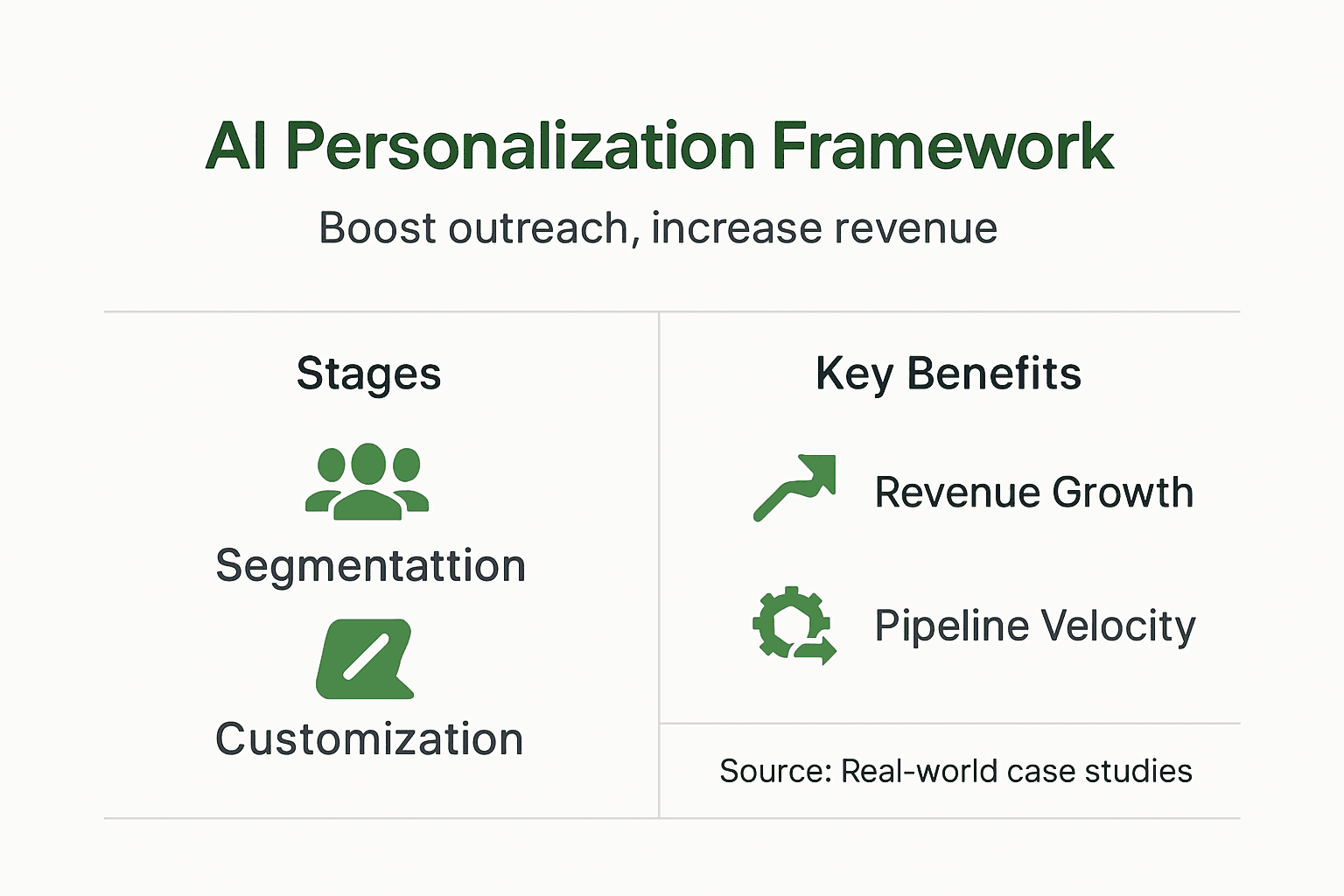
Successful AI personalization requires structured implementation. Follow this proven framework to deploy effective campaigns.
Define your ideal customer profile (ICP) with specific firmographics, technographics, and behavioral indicators that signal buying intent
Build data infrastructure by integrating CRM, marketing automation, and AI enrichment tools to create comprehensive prospect profiles
Create message template libraries that balance automation with customization slots for context-specific details
Design multi-touch sequences coordinating email, LinkedIn, and other channels based on prospect engagement patterns
Implement continuous optimization by monitoring key metrics and feeding performance data back into AI models for improvement
This table shows typical personalization variables by funnel stage:
Funnel StagePersonalization FocusKey Data PointsAwarenessIndustry trends, company growth signalsRecent funding, expansion news, job postingsConsiderationSpecific pain points, competitive contextTech stack, current tools, peer case studiesDecisionROI projections, implementation detailsBudget cycles, decision-maker roles, urgency signals
The AI personalization implementation framework succeeds when you treat it as an iterative process. Start with one segment, test messaging variants, measure results, then expand to additional audiences. Trying to personalize everything at once overwhelms teams and dilutes focus.
AI Tools and Technologies for Outreach Personalization
Choosing the right AI platform depends on your team size, technical capabilities, and channel priorities. These tools lead the market for different use cases.
PlatformBest ForKey StrengthsIntegration CapabilitiesSmartwriter.aiSmall businesses, budget-conscious teamsAutomated research, cost-effectiveBasic CRM connectionsApolloMid-market teams, multi-channel campaignsExtensive database, sales intelligenceSalesforce, HubSpot, native sequencesInstantly.aiEmail-focused teams, deliverability priorityWarm-up automation, detailed analyticsEmail infrastructure, list management
Smartwriter.ai suits startups and small teams new to AI personalization. It automates prospect research by scanning websites, social profiles, and news to generate personalized icebreakers. The tool lacks advanced multi-channel features but provides solid ROI for email-centric campaigns.
Apollo serves mid-market companies needing comprehensive prospecting and engagement. Its 250+ million contact database, combined with AI-powered sequencing and native CRM integration, supports complex workflows across email, phone, and LinkedIn.
Instantly.ai focuses specifically on email deliverability and scale. Teams sending high volumes benefit from built-in warm-up, domain health monitoring, and detailed analytics that prevent sender reputation damage.
Top AI personalization tools continue evolving rapidly. Evaluate platforms based on your specific channel mix, integration requirements, and internal technical expertise rather than chasing the newest features.
Case Studies and Real-World Examples
Real implementations prove AI personalization delivers measurable results when executed properly. These examples show what’s possible.
An educational technology company doubled email click-through rates using AI personalization tailored for school district leads. The system analyzed district size, budget cycles, and recent technology purchases to craft relevant messaging that resonated with administrators.
Key results across industries:
SaaS company increased demo bookings by 47% after implementing behavior-based email sequences that referenced specific product pages visited
Manufacturing firm reduced sales cycle length by 23% using personalized content addressing industry-specific compliance concerns
Professional services provider improved lead quality scores by 35% through AI-enriched targeting that filtered out poor-fit prospects early
These AI personalization case studies share common patterns. Winners invested in data quality first, tested messaging systematically, and balanced automation with human oversight. They measured success through pipeline metrics, not just engagement rates.
Ethical and Privacy Considerations in AI Personalization
Powerful personalization technology demands responsible use. Crossing ethical boundaries destroys trust and invites regulatory penalties.
Ethical personalization requires careful data privacy adherence to maintain trust in AI-driven B2B outreach. Comply with GDPR, CCPA, and industry-specific regulations by obtaining clear consent before processing personal data.
Core principles:
Secure data storage with encryption and access controls protecting prospect information
Transparent data usage explaining how you collect and apply personalization data
Opt-out mechanisms allowing prospects to control their information and preferences
Human review preventing AI from generating manipulative or misleading messages
The line between helpful personalization and creepy surveillance is thin. Reference publicly available information like recent company news or published content. Avoid using data that prospects would reasonably expect to remain private, like leaked internal documents or social media posts from personal accounts.
Ethical AI personalization builds long-term relationships by respecting boundaries. Short-term gains from aggressive tactics aren’t worth the reputational damage and legal risks. Treat prospect data with the same care you’d expect for your own information.
Conclusion and Practical Takeaways
AI-powered personalization transforms B2B outreach from spray-and-pray to precision targeting. The technology delivers measurable improvements in engagement, conversion rates, and revenue growth when implemented thoughtfully.
Start your personalization journey:
Define your ICP with specific, measurable criteria that signal buying intent and fit
Select AI tools matching your team size, budget, and primary outreach channels
Build data infrastructure connecting CRM, enrichment, and automation platforms
Test messaging depth systematically to find the personalization level that resonates with your audience
Monitor ethical boundaries and compliance requirements as you scale
The 40% revenue growth potential is real, but it requires commitment to data quality, continuous optimization, and authentic messaging. Generic outreach no longer works in sophisticated B2B markets. Start AI outreach personalization today to build the scalable pipeline your business needs.
Enhance Your Outreach with Lickfold Digital AI Experts
Ready to deploy AI personalization that actually converts? Lickfold Digital specializes in building intelligent outreach systems that identify decision-makers, craft contextually relevant messages, and nurture prospects through multi-touch sequences.
Our AI personalization services handle everything from infrastructure setup to ongoing optimization. We deploy dedicated AI agents that research prospects, generate tailored messaging, and systematically follow up to deliver qualified opportunities to your sales team. Lickfold Digital AI Experts combine advanced technology with strategic oversight to create AI-powered outreach solutions that scale predictably while maintaining authenticity. Let’s build your personalized pipeline.
Frequently Asked Questions
What is outreach campaign personalization in B2B marketing?
Outreach campaign personalization uses prospect data and AI to deliver tailored messages addressing specific business needs, challenges, and contexts across multiple channels. It goes far beyond inserting names into templates by dynamically adjusting content based on firmographics, behavioral signals, and engagement history.
How does AI improve personalization effectiveness?
AI enables real-time segmentation that continuously updates prospect groups based on behavior and firmographic changes. It automates content generation referencing specific context like recent news or technology changes, orchestrates multi-channel sequences, and optimizes campaigns continuously based on engagement patterns to maximize relevance and ROI.
What are common mistakes to avoid in outreach personalization?
Avoid superficial personalization like name-only inserts that prospects instantly recognize as mass emails. Don’t over-automate without human oversight, which creates robotic messaging that damages trust. Always respect privacy standards through GDPR/CCPA compliance and secure data handling to maintain ethical boundaries.
Which AI tools are best for different B2B personalization needs?
Smartwriter.ai suits small businesses and budget-conscious teams with automated research features and cost-effective pricing. Apollo serves mid-market companies needing multi-channel support, extensive prospect databases, and deep CRM integration. Instantly.ai focuses on email-focused teams requiring deliverability optimization, warm-up automation, and detailed analytics. Choose AI personalization tools based on your channel mix and technical capabilities.
How to maintain ethical standards while personalizing outreach using AI?
Ensure compliance with GDPR, CCPA, and industry regulations through clear consent mechanisms and transparent data usage policies. Implement secure data storage with encryption and access controls. Maintain human oversight to prevent manipulative messaging and respect boundaries by only referencing publicly available information that prospects would expect you to know.