
Master decision-maker targeting with AI in B2B sales
Master decision-maker targeting with AI in B2B sales
Reaching the right person at the right company sounds simple, but 92% of B2B purchase decisions involve multiple stakeholders, turning every deal into a complex navigation exercise. Traditional single-contact targeting wastes time and misses opportunities. AI transforms this challenge by automating identification, prioritizing leads dynamically, and enabling personalized outreach at scale. This guide explains decision-maker roles, AI applications, common misconceptions, collaboration frameworks, and practical steps to boost your sales results.
Table of Contents
- Understanding Decision-Making Dynamics In B2B
- AI Applications For Decision-Maker Identification And Prioritization
- Benefits Of AI-Powered Personalization And Engagement
- Common Misconceptions About Decision-Maker Targeting
- Framework For Human And AI Collaboration In Sales Targeting
- Practical Implementation Of AI Decision-Maker Targeting
- Measuring Impact And Optimizing AI-Driven Decision-Maker Targeting
- Conclusion And Next Steps For Sales Professionals
- Boost Your Sales With Lickfold Digital’s AI Expertise
Key takeaways
| Point | Details |
|---|---|
| B2B complexity | Average buying committees include 7-8 stakeholders across roles like initiators, influencers, and economic buyers. |
| AI efficiency | AI reduces manual research time by up to 90% and uses intent data to prioritize leads dynamically. |
| Personalization impact | AI-powered personalized outreach generates 2-3x higher reply rates and improves conversion accuracy. |
| Human-AI synergy | Hybrid models combining human judgment with AI automation outperform fully autonomous approaches. |
| Optimization metrics | Track reply rates, conversion uplifts, and pipeline velocity to refine targeting strategies continuously. |
Understanding decision-making dynamics in B2B
B2B purchasing rarely involves a lone decision-maker signing off on solutions. The average buying committee now includes 7-8 people, each bringing different priorities and concerns to the table. These roles span initiators who identify needs, influencers who shape opinions, economic buyers controlling budgets, and gatekeepers managing information flow.
Ignoring this reality creates blind spots. You might pitch perfectly to one person only to have your proposal blocked by someone you never contacted. 92% of B2B purchase decisions involve multiple stakeholders, making multi-threaded outreach essential rather than optional.
Successful targeting requires understanding committee dynamics:
- Initiators recognize problems and start solution searches
- Influencers provide technical expertise and recommendations
- Economic buyers make final budget approval decisions
- Gatekeepers control access to other committee members
- Users will directly interact with your solution daily
Navigating these B2B sales targeting challenges manually drains resources and extends sales cycles. Companies spending months researching org charts and tracking down contacts find themselves consistently behind quota. AI changes this equation by automating discovery and keeping pace with committee changes in real time.
AI applications for decision-maker identification and prioritization
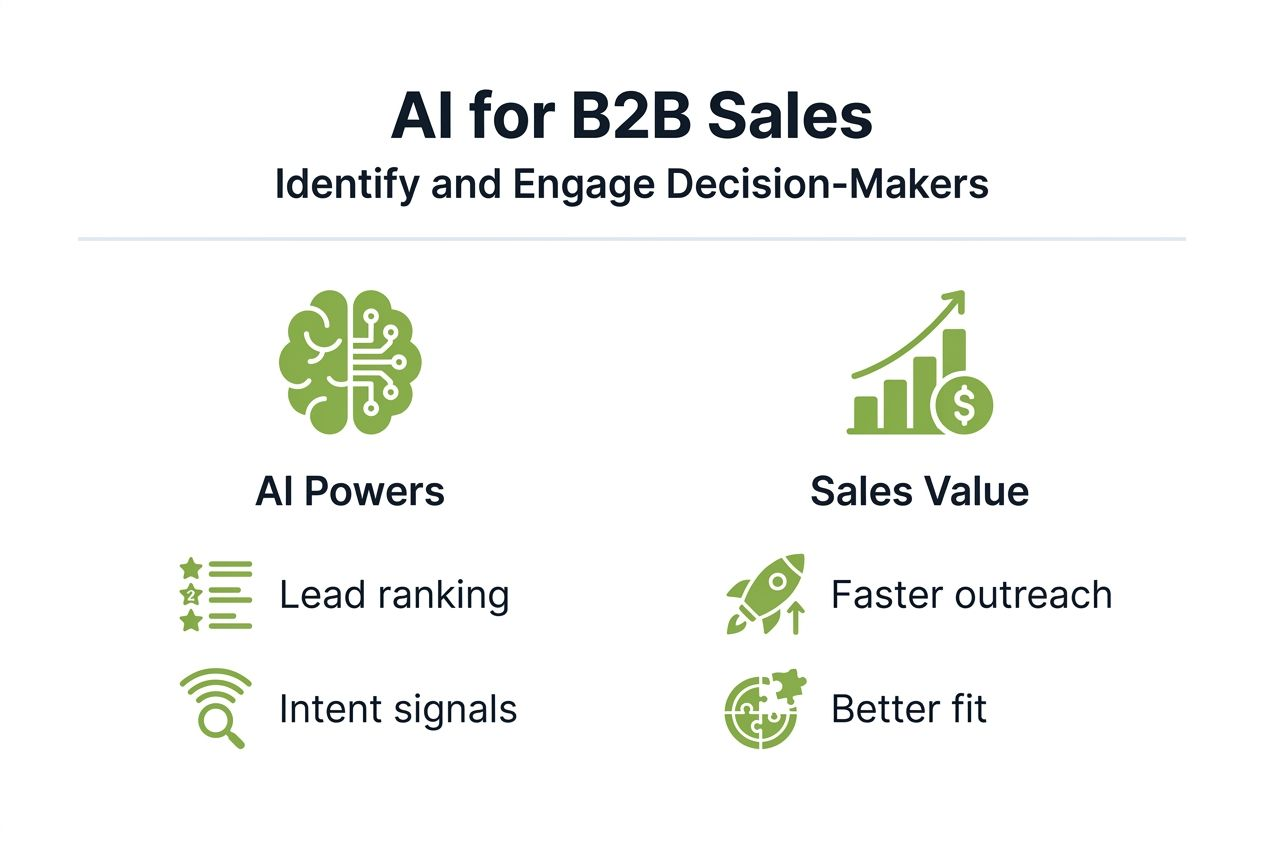
AI technologies transform how sales teams find and rank prospects. Machine learning algorithms scan vast datasets to surface decision-makers matching your ideal customer profile. These systems pull from professional networks, company websites, news sources, and behavioral signals to build comprehensive stakeholder maps.

AI reduces manual research time by up to 90% compared to traditional methods. What used to take hours of LinkedIn scrolling and Google searches now happens automatically. The technology identifies not just names and titles but also decision-making authority and current priorities based on content engagement and company announcements.
Dynamic prioritization separates high-potential leads from time wasters. AI analyzes:
- Intent data showing active solution research
- Firmographic signals like company growth or funding
- Behavioral patterns including website visits and content downloads
- Technographic information revealing compatible tech stacks
- Trigger events such as leadership changes or expansion plans
Real-time updates keep lead scores current as circumstances evolve. A prospect showing weak intent last month might spike to top priority after their company announces a relevant initiative. Systems adapt continuously without manual intervention.
| AI Capability | Traditional Approach | AI-Powered Approach |
|---|---|---|
| Prospect research | 2-3 hours per account | 5-10 minutes automated |
| Data accuracy | Outdated within weeks | Updated in real time |
| Lead scoring | Static, manual updates | Dynamic, signal-based |
| Coverage | Limited contacts | Full committee mapping |
Integrating these AI lead generation benefits with your CRM creates seamless workflows. Sales teams access enriched profiles without jumping between platforms.
Pro Tip: Connect AI prospecting tools directly to your CRM so lead intelligence flows automatically into sales workflows, eliminating manual data entry and ensuring teams work from current information.
Benefits of AI-powered personalization and engagement
Generic outreach dies in crowded inboxes. Decision-makers ignore templated messages that could apply to anyone. AI enables personalized communication at scale by analyzing each prospect’s role, challenges, and interests to craft relevant messaging.
Personalized AI-generated emails achieve 2-3x higher reply rates than standard templates. The technology tailors subject lines, opening hooks, and value propositions based on individual pain points. A CFO receives financial impact messaging while a technical director gets implementation details, all automatically customized.
Multi-channel orchestration maintains consistent engagement across touchpoints:
- Email sequences timed to prospect behavior
- LinkedIn messages referencing shared connections
- Personalized video outreach for high-value targets
- Retargeting ads aligned with email content
- Follow-up sequences adapting to engagement levels
AI conversation intelligence further amplifies results. Natural language processing analyzes sales calls and emails to identify successful patterns. Teams discover which objection handling techniques work best, which value propositions resonate most, and which timing produces optimal responses. This feedback loop improves AI personalization success stories continuously.
Companies using AI conversation tools report 15-20% higher win rates. The systems coach reps in real time during calls, suggest proven responses to objections, and highlight moments requiring human judgment. This combination of automation and guidance elevates entire teams’ performance.
Pro Tip: Map outreach messaging to each committee member’s specific role and concerns rather than sending identical pitches to everyone at the target company.
Common misconceptions about decision-maker targeting
Myths about AI and decision-maker targeting create hesitation around adoption. Understanding reality versus perception helps sales leaders make informed technology choices.
Myth 1: Focusing on one decision-maker is enough
Single-threaded deals carry extreme risk. If your champion leaves, changes roles, or loses internal influence, months of work evaporate. Building relationships across the buying committee creates multiple paths to yes and resilience against personnel changes. Common sales targeting myths like this cost teams deals they thought were locked.
Myth 2: AI will replace salespeople entirely
Technology augments human capabilities rather than eliminating them. AI handles repetitive research and initial outreach while salespeople apply emotional intelligence, build trust, and navigate complex negotiations. The combination outperforms either approach alone. Autonomous systems lack the nuanced judgment needed for enterprise deals.
Myth 3: Personalized outreach at scale is impractical
This belief held true before AI. Manual personalization limits reach severely. Modern tools analyze prospect data and generate customized messaging for thousands of contacts simultaneously. The technology maintains quality while expanding volume, making true scale personalization achievable for the first time.
“The most successful sales organizations view AI as a force multiplier that frees salespeople to focus on relationship-building and strategic thinking rather than administrative tasks.”
Evidence consistently shows multi-stakeholder engagement, AI augmentation, and scalable personalization deliver measurable improvements. Reply rates double or triple. Sales cycles compress. Win rates climb. These aren’t theoretical benefits but documented results across industries.
Framework for human and AI collaboration in sales targeting
Balancing automation with human insight maximizes targeting effectiveness. Three collaboration modes define how teams integrate AI:
- Augmented selling: AI provides intelligence and suggestions while humans make all decisions and conduct outreach
- Assisted selling: AI handles routine tasks like research and initial contact while humans manage qualified conversations
- Autonomous selling: AI executes full workflows with human oversight only for exceptions and complex situations
Most B2B sales benefit from assisted or augmented approaches. Hybrid human-AI models outperform fully autonomous approaches in sales targeting, particularly for high-value accounts requiring relationship depth.
Human oversight remains critical in several areas:
- Reading subtle buying signals AI might miss
- Building trust through authentic relationship development
- Handling complex objections requiring creative problem-solving
- Navigating political dynamics within prospect organizations
- Making judgment calls on pricing and negotiation strategy
The optimal split depends on deal complexity and average contract value. Transactional sales can operate more autonomously while enterprise deals need significant human involvement.
| Approach | Best For | Conversion Rate | Relationship Quality |
|---|---|---|---|
| AI-only | High-volume, low-value | Moderate | Limited |
| Hybrid | Mid-market, enterprise | High | Strong |
| Manual-only | Ultra-complex strategic | Variable | Very strong |
Successful human AI collaboration in sales requires clear role definition. AI excels at data processing, pattern recognition, and consistent execution. Humans bring empathy, strategic thinking, and adaptive communication. Playing to these respective strengths creates systems greater than the sum of their parts.
Practical implementation of AI decision-maker targeting
Transitioning to AI-powered targeting follows a structured path. These steps help sales teams integrate technology without disrupting current operations.
Step 1: Access and enrich high-quality prospect data
Start with reliable data sources. Garbage in equals garbage out with AI systems. Invest in databases offering accurate contact information, verified decision-maker titles, and current company intelligence. Enrichment tools append missing details and validate existing records.
Step 2: Apply dynamic AI lead scoring and prioritization
Configure scoring models reflecting your ideal customer profile and buying signals. Weight factors like company size, technology usage, recent funding, and engagement activity. Let AI continuously recalculate scores as new information emerges.
Step 3: Deploy automated personalized multi-channel outreach
Use AI platforms for continuous prospect research and personalized multi-touch campaigns that grow your pipeline predictably. Set up sequences coordinating email, social, and phone outreach. Customize messaging for different committee roles automatically.
Step 4: Include human review for complex interactions
Route qualified responses to salespeople for personalized follow-up. AI identifies interest and gathers preliminary information. Humans take over once prospects engage seriously, applying judgment to advance conversations strategically.
Pro Tip: Consider partnering with AI-expert providers who handle technical implementation and optimization, letting your team focus on closing deals rather than managing technology.
Many organizations find faster results working with specialists who’ve already solved integration challenges. AI sales consulting sessions can accelerate deployment and avoid common pitfalls.
Measuring impact and optimizing AI-driven decision-maker targeting
Quantifying results guides improvement and justifies investment. Track metrics revealing both efficiency gains and revenue impact.
Key performance indicators for AI targeting include:
- Reply rate improvements: Compare response percentages before and after AI implementation
- Conversion rate uplifts: Measure how many engaged prospects advance to qualified opportunities
- Pipeline velocity: Track time from first contact to closed deal
- Cost per qualified lead: Calculate total targeting expenses divided by quality opportunities generated
- Return on investment: Compare revenue generated against technology and operational costs
Dashboards consolidating these metrics enable data-driven decisions. Weekly reviews identify underperforming segments requiring adjustment. Monthly analyses reveal trends informing strategic changes.
| Metric | Baseline | With AI | Improvement |
|---|---|---|---|
| Reply rate | 3.2% | 8.7% | +172% |
| Qualified leads/month | 45 | 127 | +182% |
| Average sales cycle | 87 days | 62 days | -29% |
| Cost per lead | $320 | $115 | -64% |
Continuous optimization refines AI model inputs. Test different personalization approaches. Experiment with outreach timing. Adjust lead scoring weights based on which signals predict conversions most accurately. Use A/B testing to validate changes before full deployment.
The most effective teams treat AI targeting as an iterative process rather than set-it-and-forget-it technology. Regular tuning compounds improvements over time, steadily increasing measuring AI sales impact and efficiency.
Conclusion and next steps for sales professionals
B2B sales complexity demands smarter approaches than manual single-contact targeting. AI transforms decision-maker identification from time-consuming guesswork into precise, scalable science. The efficiency gains, conversion improvements, and cost reductions are documented and accessible to organizations willing to embrace technology thoughtfully.
Future sales success belongs to teams combining AI capabilities with human strengths. Technology handles research, prioritization, and initial outreach while salespeople focus on relationship-building and strategic deal advancement. This collaboration model consistently outperforms purely manual or fully automated alternatives.
Starting your AI targeting journey requires assessing current processes, selecting appropriate tools, and implementing the framework outlined above. Small pilot programs reduce risk while demonstrating value. Success breeds expansion as results prove the approach.
Explore AI sales targeting insights and practical applications relevant to your specific situation. The learning curve is real but manageable, and the competitive advantage substantial for early adopters.
Boost your sales with Lickfold Digital’s AI expertise
Ready to transform your decision-maker targeting without the trial-and-error phase? Lickfold Digital AI Experts specialize in implementing proven AI prospecting systems tailored to your ideal customer profile. We handle the technical complexity while you focus on closing deals.
Our dedicated AI agents perform continuous market research, identify key decision-makers across buying committees, and execute personalized multi-touch campaigns at scale.
We manage infrastructure setup, email reputation, and lead qualification, delivering warm opportunities directly to your sales team. Book your free session to explore how AI can predictably grow your pipeline. Download our guide 24/7 Business for deeper insights into scaling outbound sales with AI automation.
FAQ
What is decision-maker targeting in B2B sales?
Decision-maker targeting focuses outreach on all key members of a buying committee rather than a single contact. This approach recognizes that B2B purchases involve multiple stakeholders with different priorities and authority levels. Engaging the full committee improves deal success rates and reduces risk from personnel changes.
How does AI improve decision-maker identification?
AI analyzes real-time intent data, firmographic information, and behavioral signals to find and prioritize decision-makers automatically. Machine learning algorithms process vast datasets faster than manual research, identifying not just contact information but also decision-making authority and current priorities. This reduces identification time by up to 90% while improving accuracy.
Why is human oversight still necessary with AI targeting?
AI excels at data processing and pattern recognition but lacks human judgment for complex situations. Salespeople bring emotional intelligence, relationship-building skills, and adaptive thinking that technology cannot replicate. The hybrid approach combining AI efficiency with human insight consistently outperforms fully automated systems, especially for high-value enterprise deals.
What metrics should I track to measure AI targeting success?
Focus on reply rates to gauge engagement quality, conversion rates showing how many prospects become qualified opportunities, and pipeline velocity indicating sales cycle length. Also track cost per qualified lead and overall return on investment. These metrics together reveal both efficiency improvements and revenue impact from AI implementation.