
Maximize Lead Generation with Messaging Customization
Maximize Lead Generation with Messaging Customization
TL;DR:
- Personalized messaging significantly increases response and engagement rates in B2B outreach.
- AI enables scalable, efficient customization by analyzing data and generating targeted messages.
- Ongoing measurement and optimization are essential for effective, relevant outbound campaigns.
Most B2B marketing teams are running the same play: blast a large list, hope for replies, and call it outbound. It rarely works. The average cold outreach campaign generates response rates below 2%, not because the product is wrong, but because the message is. Breakthroughs in AI have made it possible to personalize outbound messaging at a scale that was simply impossible three years ago. This article breaks down why messaging customization is now a core driver of B2B lead generation, how AI makes it scalable, and exactly what your team needs to do to implement it without burning your contact lists.
Table of Contents
- Why messaging customization matters in B2B outreach
- How AI empowers scalable messaging personalization
- Core strategies for customizing outbound messaging
- Measuring impact and optimizing your customized messaging
- The uncomfortable truths about messaging customization in B2B
- Supercharge your outbound results with expert-led messaging customization
- Frequently asked questions
Key Takeaways
| Point | Details |
|---|---|
| Personalization drives results | Tailored messages dramatically boost response and conversion rates in B2B outreach. |
| AI enables scaling | Artificial intelligence lets you personalize outreach at scale without losing quality. |
| Segmentation is key | Dividing your audience by role and intent increases the accuracy and resonance of your messages. |
| Measure and optimize | Constantly track your metrics to refine and improve your customized messaging efforts. |
Why messaging customization matters in B2B outreach
Generic outreach has a trust problem. When a decision-maker receives a cold email that could have been sent to ten thousand other people, they know it. B2B buyers today are sophisticated. They receive dozens of outreach messages per week, and they have developed a sharp instinct for spotting templates. The result: your carefully crafted campaign gets deleted in under three seconds.
The core issue is relevance. A VP of Engineering at a mid-size SaaS company has completely different pain points than a Head of Operations at a logistics firm. Sending them the same message is not just inefficient. It signals that you have not done your homework, and that first impression is very hard to recover from.
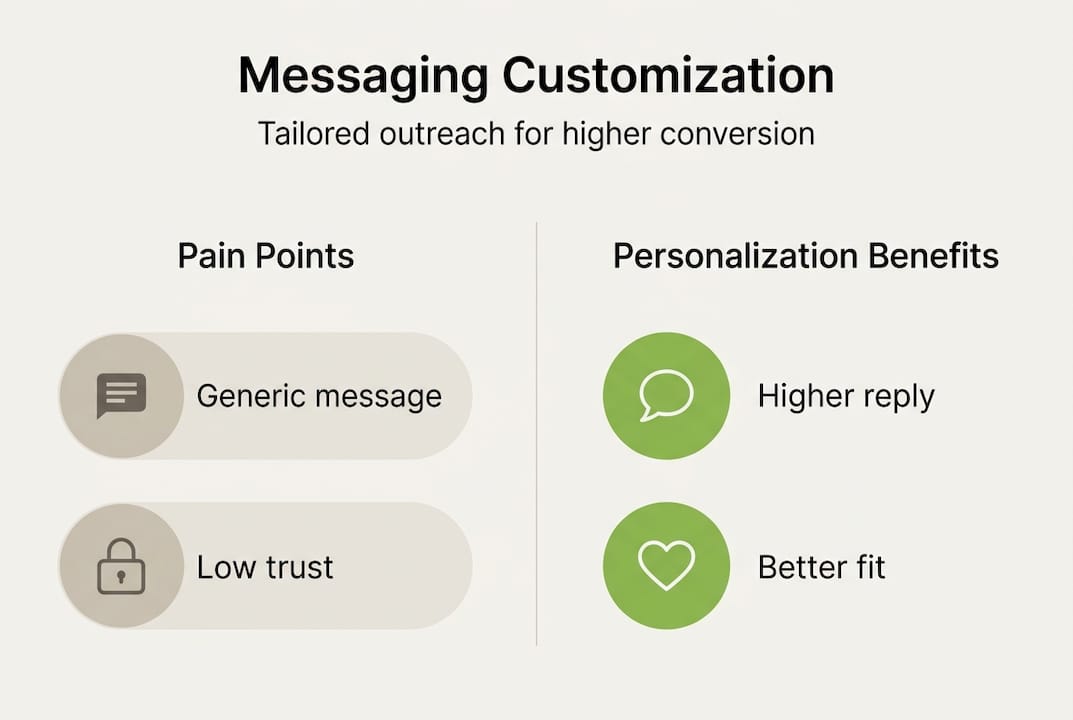
Personalization in B2B outreach addresses this directly. When your message reflects a buyer’s industry, role, and current challenges, it stops feeling like an interruption and starts feeling like a conversation worth having. That shift in perception is everything.
The numbers back this up. Campaigns with personalized messaging see up to 40% higher response rates compared to generic outreach. That is not a marginal improvement. That is the difference between a pipeline that grows and one that stalls.
Here is what tailored messaging actually delivers:
- Higher open rates because subject lines speak to specific roles or industries
- Better reply rates because the content addresses real, recognized pain points
- Shorter sales cycles because prospects arrive pre-educated and pre-qualified
- Stronger brand perception because you look like a company that does its research
And here is what you risk by ignoring customization:
- Burning through contact lists with no return
- Damaging your sender reputation and landing in spam
- Training your market to ignore your brand entirely
B2B buyers are watching for signals. They want to see that you understand their world before you ask for their time. As one outreach strategist put it: “Personalized messaging isn’t a luxury, it’s a necessity for modern B2B teams.” That is not an exaggeration. It is the baseline expectation in 2026.
Now that we have highlighted why generic messaging falls short, let’s look at how AI makes personalization both feasible and scalable.
How AI empowers scalable messaging personalization
The traditional argument against personalization was always time. Writing a tailored message for every prospect is not realistic when you are targeting hundreds or thousands of accounts per month. That is where AI changes the equation entirely.
AI-powered messaging tools can analyze large data sets and craft dynamic segments for targeted outreach, pulling from firmographic data, behavioral signals, and intent data simultaneously. The result is messaging that feels handwritten but scales like automation.
Here is a side-by-side comparison of what manual versus AI-driven personalization actually looks like in practice:
| Factor | Manual personalization | AI-driven personalization |
|---|---|---|
| Time per message | 15 to 30 minutes | Under 60 seconds |
| Accuracy of targeting | Dependent on rep skill | Consistent and data-backed |
| Engagement lift | Varies widely | 30 to 50% average gain |
| Scalability | Limited to team capacity | Unlimited, runs continuously |
| Optimization speed | Slow, manual review | Real-time, self-improving |
The efficiency gains are real. Most teams that integrate AI into their outbound workflow see 30 to 50% efficiency gains within the first 90 days. That frees your team to focus on conversations, not composition.
Here is how to integrate AI into your outbound workflow in three steps:
- Map your audience segments using firmographic and behavioral data. Define the key variables that matter for each segment, including industry, company size, tech stack, and buying stage.
- Feed those segments into your AI tool and let it generate message variations tailored to each group. Review a sample to calibrate tone and accuracy before launching.
- Connect AI outputs to your sequencing platform so that follow-ups are also personalized based on how each prospect engages with prior messages.
Pro Tip: Use AI not just for message text but also for timing, channel selection, and next-best-action prediction. Sending the right message at the wrong time still loses the deal. AI can tell you when a prospect is most likely to engage based on past behavior patterns.
Proper segmentation for marketing success is the foundation that makes all of this work. Without clean, well-defined segments, even the best AI tool will produce mediocre output.
With AI handling the complexity, the next question is how to structure and execute customization strategies that fit your specific market and buyers.
Core strategies for customizing outbound messaging
Knowing that customization matters and having the AI tools to support it is only half the battle. You still need a clear strategic framework for how to apply personalization across your outbound program.
Audience segmentation is the foundational element of effective messaging customization. Before you write a single message, you need to know exactly who you are writing for and what they care about most.

Here is how three common approaches compare:
| Approach | Personalization depth | Conversion potential | Resource requirement |
|---|---|---|---|
| One-size-fits-all | None | Low | Minimal |
| Tiered by segment | Moderate | Medium | Moderate |
| Fully personalized | High | High | AI-assisted |
Fully personalized outreach consistently outperforms the alternatives, but it only becomes practical at scale when AI is doing the heavy lifting on content generation and sequencing.
The key variables your messages should incorporate include:
- Prospect name and role to establish immediate relevance
- Industry-specific language that reflects how they think about their problems
- Known challenges tied to their company size, growth stage, or market position
- Timing signals such as recent funding, hiring activity, or product launches
- Intent data showing what topics or solutions they have been researching
These variables are not just nice to have. They are the difference between a message that gets a reply and one that gets ignored.
Pro Tip: If your team uses account-based marketing, build your personalization variables directly into your ABM framework. This creates alignment between marketing and sales and ensures that every touchpoint across the buyer journey feels consistent and intentional.
Once your strategy framework is defined, it is crucial to measure and continuously optimize your customized outreach.
Measuring impact and optimizing your customized messaging
Customization without measurement is just guesswork. The teams that consistently win in outbound are the ones that treat their messaging like a living system, always tracking, always testing, always improving.
Start by benchmarking these core metrics before you launch any personalized campaign:
- Open rate: Are your subject lines compelling enough to earn attention?
- Reply rate: Is your message relevant enough to prompt a response?
- Conversion rate: Are replies turning into qualified meetings?
- Engagement trend: Are later touchpoints in your sequence performing better or worse than the first?
Here is what the data typically looks like before and after implementing customized messaging:
| Metric | Generic outreach | Customized outreach |
|---|---|---|
| Open rate | 18 to 22% | 35 to 45% |
| Reply rate | 1 to 2% | 5 to 9% |
| Meeting conversion | Under 1% | 3 to 5% |
| Unsubscribe rate | High | Significantly lower |
Data-driven optimization increases response rates and pipeline quality, and the compounding effect over time is significant. Every campaign teaches you something that makes the next one sharper.
Follow these three steps for continuous improvement:
- Measure every variable at the segment level, not just overall campaign averages. Segment-level data reveals which audiences are responding and which need a different approach.
- Run structured A/B tests on subject lines, opening sentences, and call-to-action phrasing. Change one variable at a time so you know what is actually driving the difference.
- Feed results back into your AI system so that future message generation reflects what has worked. This creates a self-improving loop that gets smarter with every send.
As one performance-focused outreach leader put it: “The most successful teams treat messaging as a living experiment.” That mindset is what separates teams with growing pipelines from those stuck in a plateau.
Your personalized email outreach guide and ongoing personalization case studies should inform every iteration. Real-world performance data beats theory every time.
The uncomfortable truths about messaging customization in B2B
Here is something most guides will not tell you: more personalization is not always better. We have seen teams invest heavily in AI-driven customization and still see flat results. The reason is almost always the same. They confused technical personalization with genuine relevance.
It is entirely possible to craft a message that includes a prospect’s name, company, recent news mention, and industry-specific language, and still have it feel hollow. Buyers are not fooled by a checklist of personalization tokens. They respond to messages that demonstrate real understanding of their situation.
Over-automation is a real risk. When every message in your sequence is optimized to the point of feeling engineered, it loses the human quality that makes outreach work. The AI outreach revenue insight is compelling, but the teams achieving those results are using AI as an enabler, not a replacement for customer understanding.
Teams fixated on volume over fit burn through their best contact lists in months. The goal is not to send more messages. It is to send better ones to the right people at the right moment. That distinction is what separates outbound programs that scale from ones that collapse under their own weight.
Supercharge your outbound results with expert-led messaging customization
Most B2B teams hit a wall when they try to scale personalization on their own. The tools are available, but the strategy, infrastructure, and execution discipline required to make it work consistently is a different challenge entirely.
Lickfold Digital builds and runs AI-driven outbound systems that deliver exactly the kind of personalized, multi-touch outreach this article has covered. From audience segmentation and message crafting to delivery infrastructure and human-qualified lead handoff, the entire system is designed to fill your pipeline with prospects who are already warm. If you are ready to move from theory to a working outbound engine, get in touch and let’s build something that actually performs.
Frequently asked questions
What is messaging customization in B2B sales?
Messaging customization means tailoring outreach content to specific industries, roles, or pain points using data, often powered by AI. Customized messages consistently drive higher engagement than generic alternatives.
How does AI improve messaging customization?
AI analyzes audience data to automate and scale personalized messages, boosting efficiency and response rates. AI enables deeper personalization at a speed and consistency no manual team can match.
Which metrics should I track when customizing outbound messages?
Monitor open rates, reply rates, conversions, and engagement trends to spot improvement opportunities. Tracking and optimizing metrics is what separates campaigns that improve from those that plateau.
What is the main risk of automating messaging personalization?
Over-automation can result in messages that appear personalized but feel generic or irrelevant to the recipient. The fix is to use AI to support human judgment, not replace it.
Can smaller teams benefit from AI-driven messaging customization?
Yes, AI tools help small teams personalize at scale, leveling the playing field with larger competitors. Even a two-person outbound team can run campaigns that feel like they came from a full sales floor.