
How to segment B2B audiences for marketing success
How to segment B2B audiences for marketing success
Wasting budget on broad B2B marketing campaigns that miss the mark is frustrating. Without proper audience segmentation, your outreach falls flat, leads remain cold, and conversion rates stagnate. This guide walks you through practical, data-driven methods to segment your B2B audiences effectively. You’ll learn how to identify the right criteria, implement step-by-step segmentation strategies, and measure results that drive targeted outreach and improved lead conversion for your mid-sized company.
Table of Contents
- Understanding The Problem With Broad B2B Audience Targeting
- Preparing For Effective B2B Audience Segmentation: Data And Tools You Need
- Step-By-Step Guide To Segmenting Your B2B Audience
- Common Mistakes To Avoid And How To Verify Your Segmentation Success
- Discover Expert B2B Segmentation Support With Lickfold Digital
Key takeaways
| Point | Details |
|---|---|
| Segmentation drives engagement | Tailored messaging based on audience segments significantly increases engagement and conversion rates. |
| Data-driven criteria are essential | Using firmographics, technographics, and behavioral data creates accurate, actionable segments. |
| Stepwise execution optimizes campaigns | Following a methodical segmentation process ensures precision targeting and better resource allocation. |
| Continuous monitoring improves ROI | Regularly reviewing segment performance allows ongoing refinement and higher marketing returns. |
Understanding the problem with broad B2B audience targeting
B2B buyers operate in vastly different contexts. A software startup founder has different needs than a manufacturing VP, even if both seek similar solutions. When you treat these distinct audiences the same, your messaging becomes generic and ineffective. Poor segmentation causes wasted marketing spend and ineffective outreach in B2B markets, leaving your team frustrated and your pipeline empty.
One-size-fits-all campaigns fail because they ignore fundamental differences in buyer behavior, decision-making processes, and pain points. A mid-market healthcare company evaluates vendors differently than a tech firm. Company size, industry vertical, and buyer role all influence how prospects respond to your outreach. Without acknowledging these variations, you’re essentially shouting into a void, hoping someone relevant hears you.
The consequences are measurable and painful. Your marketing budget gets spread thin across audiences that will never convert. Sales teams waste time chasing unqualified leads. Your conversion rates remain stubbornly low while competitors with smarter segmentation capture market share. The real tragedy is that the data to fix this already exists in your systems, you just need to organize and apply it strategically.
Common symptoms of poor targeting include:
- Low email open rates across campaigns
- High unsubscribe rates and spam complaints
- Sales rejecting leads as unqualified
- Long sales cycles with minimal progress
- Budget exhaustion without pipeline growth
“When everyone is your target audience, no one is your target audience. B2B success requires precision, not reach.”
The segmentation challenges in B2B marketing stem from treating complex business buyers like uniform consumers. B2B purchases involve multiple stakeholders, longer consideration periods, and higher stakes. Your CFO cares about ROI, your CTO evaluates technical fit, and your operations director focuses on implementation ease. Broad messaging fails to address any of these specific concerns effectively, resulting in campaigns that resonate with no one.
Preparing for effective B2B audience segmentation: data and tools you need
Successful segmentation starts with gathering the right data from multiple sources. Your CRM holds valuable information about existing customers and prospects, including company details, interaction history, and deal progression. Marketing automation platforms track behavioral signals like email engagement, website visits, and content downloads. Third-party data providers offer firmographic and technographic enrichment to fill gaps in your knowledge.

Firmographic data includes company size, revenue, industry, location, and growth stage. These attributes help you identify organizations that match your ideal customer profile. Technographic data reveals the technology stack prospects use, showing compatibility with your solution and potential integration opportunities. Behavioral data tracks how prospects interact with your content, indicating interest level and readiness to buy. Using multiple data types such as firmographics and technographics improves segmentation accuracy significantly.
Buyer personas add qualitative depth to quantitative data. Map out the roles involved in purchase decisions for your product. Understand their individual goals, challenges, and decision criteria. A marketing director seeks campaign performance metrics, while a CEO wants strategic business impact. Create personas that reflect these distinct perspectives, then align your segmentation criteria accordingly.
Essential data sources for B2B segmentation:
- CRM records with contact and company information
- Marketing automation engagement metrics
- Sales team notes and call recordings
- Customer support interaction logs
- Third-party enrichment databases
- Website analytics and behavior tracking
Data quality matters more than data volume. Outdated contact information, duplicate records, and incomplete profiles undermine segmentation efforts. Implement regular data hygiene practices to maintain accuracy. Validate email addresses, update job titles, and merge duplicate entries. Enrich existing records with missing firmographic and technographic details using reliable data providers.
| Data Type | Key Attributes | Segmentation Value |
|---|---|---|
| Firmographic | Company size, industry, revenue, location | Identifies ideal customer profile matches |
| Technographic | Software stack, technology adoption, digital maturity | Reveals compatibility and integration potential |
| Behavioral | Email engagement, website visits, content consumption | Indicates interest level and buying stage |
| Demographic | Job title, role, seniority, department | Enables role-based personalized messaging |
Pro Tip: Start with the data you already have rather than waiting for perfect information. You can refine segments as you gather more insights, but acting on existing data beats paralysis from seeking completeness.
The right tools streamline segmentation execution. Modern CRM platforms like Salesforce and HubSpot offer built-in segmentation features. Marketing automation tools enable dynamic list building based on multiple criteria. AI-powered audience segmentation tools analyze patterns humans might miss, uncovering hidden segments with high conversion potential. Choose tools that integrate seamlessly with your existing tech stack to avoid data silos.
Step-by-step guide to segmenting your B2B audience
Defining clear segmentation goals aligns your efforts with business objectives. Ask yourself what you want to achieve. Are you trying to increase conversion rates for a specific product? Improve engagement with dormant prospects? Expand into a new industry vertical? Your goals determine which segmentation criteria matter most and how you’ll measure success.
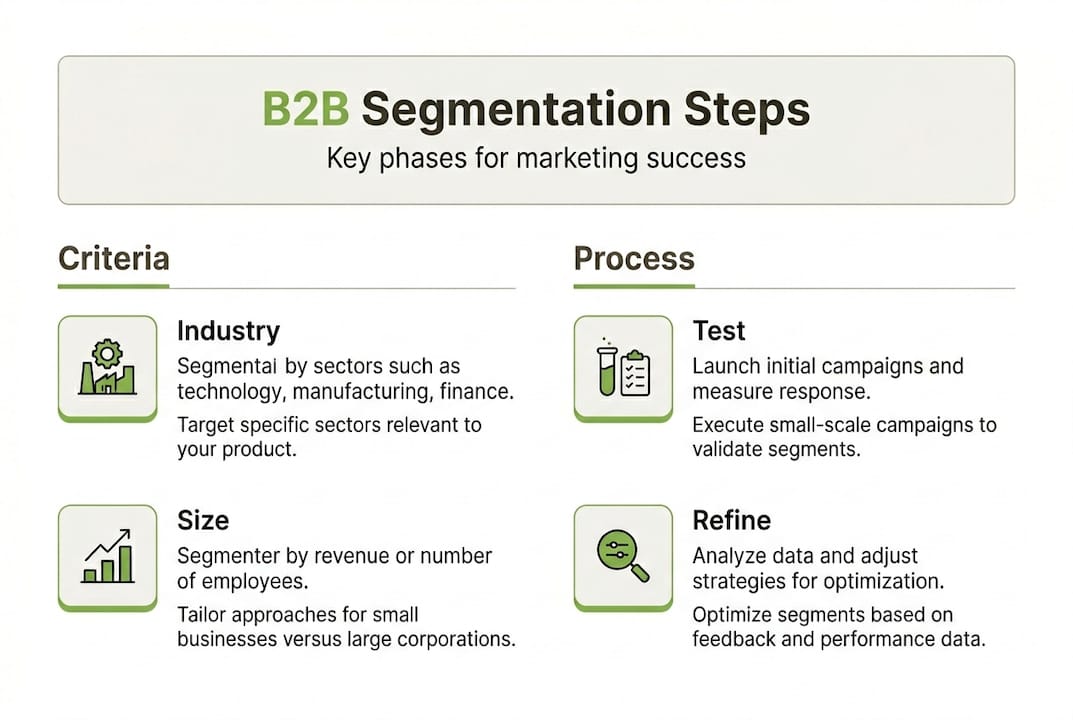
Selecting the right segmentation criteria requires matching data attributes to your goals. For product launches targeting specific industries, prioritize firmographic segments like industry vertical and company size. For nurturing campaigns aimed at decision-makers, emphasize demographic criteria like job title and seniority. Behavioral segmentation works well for identifying high-intent prospects ready for sales outreach.
- Define your segmentation objectives tied to specific business outcomes and marketing goals.
- Identify the most relevant criteria from firmographic, technographic, demographic, and behavioral data.
- Create segment definitions with clear inclusion and exclusion rules for each audience group.
- Build segments in your CRM or marketing automation platform using the defined criteria.
- Validate segment size and composition to ensure they’re neither too broad nor too narrow.
- Develop tailored messaging and content for each segment addressing their specific needs.
- Launch targeted campaigns to test segment responsiveness and gather performance data.
- Monitor key metrics like open rates, click-through rates, and conversion rates by segment.
- Refine segments based on performance data and evolving business priorities.
A methodical, criteria-driven segmentation process leads to higher lead engagement and conversion. The key is starting simple and adding complexity as you learn what works. Begin with one or two primary criteria, test campaigns, and expand based on results.
Pro Tip: Create a segment hierarchy starting with broad categories, then subdivide into more specific groups. This approach lets you test messaging at different levels of granularity and identify which specificity drives the best results.
Applying segmentation in your marketing automation platform transforms static lists into dynamic audiences. Set up filters that automatically update as prospect data changes. A company growing from 50 to 200 employees should move from your SMB segment to mid-market automatically. Someone promoted from manager to director should receive messaging appropriate to their new decision-making authority.
| Segmentation Approach | Best Use Case | Complexity Level |
|---|---|---|
| Single criterion (industry only) | Initial testing, broad campaigns | Low |
| Dual criteria (industry + company size) | Focused targeting, resource optimization | Medium |
| Multi-criteria (firmographic + behavioral) | Precision targeting, high-value accounts | High |
| Predictive (AI-driven pattern recognition) | Advanced personalization, scale optimization | Very High |
Testing segments with small-scale campaigns before full deployment reduces risk. Select a representative sample from each segment and run pilot outreach. Measure response rates, engagement quality, and conversion velocity. Compare performance across segments to identify your highest-value audiences. Use these insights to allocate budget and effort where they’ll generate the strongest returns.
The lead generation segmentation methods you choose should evolve with your business. What works today might need adjustment as markets shift, products evolve, and buyer behaviors change. Build flexibility into your segmentation strategy from the start.
Common mistakes to avoid and how to verify your segmentation success
Over-segmentation fragments your audience into groups too small to target efficiently. Creating 50 micro-segments might feel precise, but it becomes operationally unmanageable. You lack the resources to develop unique content and campaigns for each tiny group. The result is diluted effort and minimal impact. Aim for the minimum number of segments that capture meaningful differences in buyer needs and behaviors.
Relying on outdated data produces segments that no longer reflect reality. Companies get acquired, people change jobs, and technology stacks evolve. If your segmentation criteria reference information from two years ago, you’re targeting ghosts. Implement regular data refresh cycles to maintain accuracy. Quarterly updates work for most B2B contexts, though fast-moving industries may require monthly reviews.
Ignoring segment performance metrics means flying blind. You might assume your segmentation strategy works without evidence to support that belief. Track concrete outcomes for each segment: email open rates, click-through rates, meeting booking rates, and ultimately conversion rates and deal velocity. Regularly reviewing segmentation strategy improves ROI and lead quality by identifying what’s working and what needs adjustment.
Key metrics to monitor for segmentation success:
- Engagement rates by segment compared to unsegmented campaigns
- Lead quality scores and sales acceptance rates
- Conversion rates from lead to opportunity to customer
- Average deal size and sales cycle length per segment
- Customer acquisition cost by segment
- Lifetime value by segment
Failing to align sales and marketing on segment definitions creates friction. Marketing generates leads based on one set of criteria while sales prioritizes prospects using different standards. This misalignment wastes both teams’ time and damages lead conversion. Establish shared definitions for each segment and agree on handoff criteria before launching campaigns.
| Mistake | Consequence | Solution |
|---|---|---|
| Over-segmentation | Resource spread too thin, operational complexity | Consolidate into 5 to 8 meaningful segments maximum |
| Stale data | Targeting wrong contacts, wasted outreach | Implement quarterly data refresh and validation |
| No performance tracking | Unable to optimize, missed opportunities | Define KPIs per segment and review monthly |
| Sales/marketing misalignment | Lead rejection, process friction | Create shared segment definitions and handoff criteria |
Verifying segmentation success requires comparing segmented campaign performance against baseline metrics. Run A/B tests where one group receives segmented, personalized messaging and another gets generic content. Measure the performance gap. Effective segmentation should show measurably better engagement and conversion rates, typically 20% to 50% improvement over broad targeting.
“The best segmentation strategy is the one you can execute consistently. Complexity without execution capability is just theoretical exercise.”
Continuous refinement keeps your segmentation relevant as your business evolves. Schedule quarterly reviews to assess segment performance, validate data quality, and adjust criteria based on market changes. New competitors, economic shifts, and technology trends all influence buyer behavior. Your segmentation strategy must adapt to remain effective. The segmentation optimization strategies you implement today should include built-in mechanisms for ongoing improvement.
Look for segments that consistently underperform despite multiple campaign iterations. These might indicate poor criteria selection or audiences that simply don’t align with your value proposition. Don’t be afraid to eliminate segments that drain resources without delivering results. Focus your energy on the segments showing the strongest response and highest conversion potential.
Discover expert B2B segmentation support with Lickfold Digital
Segmenting B2B audiences effectively requires expertise, tools, and ongoing optimization. Lickfold Digital AI experts specialize in helping mid-sized companies implement advanced segmentation strategies powered by artificial intelligence. Our platform identifies high-value prospects within your ideal customer profile, then executes personalized outreach campaigns tailored to each segment’s specific needs and behaviors.
Ready to transform your B2B marketing with precision segmentation? Book a free AI marketing session to discuss your specific challenges and discover how AI-driven segmentation can improve your lead quality and conversion rates. We’ll analyze your current approach and identify opportunities for immediate improvement.
Want to learn more about building scalable B2B growth systems? Download the 24/7 Business free book to discover how AI automation can power your outbound prospecting while you focus on closing deals. Our proven frameworks help you segment smarter, target better, and convert more efficiently.
FAQ
What are the best criteria to segment a B2B audience?
The most effective B2B segmentation criteria include firmographics like company size, industry, and revenue, along with buyer role and seniority. Behavioral data showing engagement levels and technographic information about their existing software stack add precision. Choose criteria that align with your specific business goals and available data quality.
How can I use AI to improve my B2B audience segmentation?
AI in B2B segmentation analyzes massive datasets to uncover patterns and correlations humans might miss, revealing hidden high-value segments. It creates dynamic, predictive segments that automatically update as prospect behavior changes, ensuring your targeting stays current. AI also personalizes messaging at scale, tailoring content to each segment’s specific characteristics and needs.
What common pitfalls should I avoid when segmenting B2B audiences?
Avoid creating too many micro-segments that become operationally unmanageable and dilute your marketing resources. Don’t rely on outdated or incomplete data, as this leads to targeting the wrong contacts with irrelevant messaging. Common B2B segmentation mistakes also include failing to align sales and marketing on segment definitions and neglecting to track performance metrics that validate your approach.
How often should I update my B2B audience segments?
Review and refresh your segments quarterly to maintain accuracy as companies evolve, people change roles, and market conditions shift. Fast-moving industries or rapidly growing companies may need monthly updates to stay current. Implement automated data enrichment to keep firmographic and technographic information fresh between manual reviews.
What’s the ideal number of segments for a mid-sized B2B company?
Most mid-sized companies achieve optimal results with five to eight distinct segments that balance precision targeting with operational manageability. Too few segments miss important differences in buyer needs, while too many fragments your resources and complicates execution. Start with fewer segments and add complexity only when you have the resources to support tailored campaigns for each group.