
Sales follow-up automation: Boost conversions with AI
Sales follow-up automation: Boost conversions with AI
Most B2B sales professionals know that closing deals requires persistence, yet 80% of B2B sales require 5+ follow-ups while traditional automation systems fail after the third touch. The gap between knowing follow-up matters and executing it effectively has cost countless opportunities. Modern sales follow-up automation powered by AI and buying signals changes this equation entirely, delivering measurable conversion lifts by responding to real buyer behavior rather than arbitrary calendars. This guide explains what sales follow-up automation truly means, why legacy methods underperform, and how to implement signal-driven systems that turn warm leads into qualified opportunities.
Table of Contents
- Defining sales follow-up automation
- Why traditional follow-up methods fall short
- Signal-driven and AI-based automation: Mechanisms and benchmarks
- Building your automated follow-up: Framework and best practices
- How Lickfold Digital helps optimize sales follow-up automation
- Frequently asked questions
Key Takeaways
| Point | Details |
|---|---|
| Signal-driven beats time-based | Automation triggered by buyer signals consistently outperforms static calendar sequences in B2B sales. |
| 5-8 follow-ups are optimal | Empirical benchmarks confirm that multiple, multi-channel touches drive superior conversion rates. |
| AI boosts personalization and velocity | AI enables smarter timing, message tailoring, and contact velocity—leading to up to 83% higher revenue. |
| Human oversight prevents failures | Balancing automation with expert review protects high-value accounts and avoids silent outreach breakdowns. |
| Clean CRM data is mission-critical | Maintaining accurate CRM records ensures automation relevance, effectiveness, and observability. |
Defining sales follow-up automation
Sales follow-up automation refers to software-driven sequences that leverage AI, behavioral triggers, and CRM data to nurture prospects through multi-touch campaigns. Unlike simple email schedulers, modern automation orchestrates outreach across email, phone, and social channels while adapting to each prospect’s engagement patterns.
Core functions include:
- Scheduling and sequencing that coordinates touchpoints across days or weeks
- Dynamic personalization using AI to tailor messaging based on prospect data and behavior
- Multi-channel coordination ensuring consistent presence without overwhelming contacts
- Signal-based triggers that respond to opens, clicks, website visits, and inbound responses
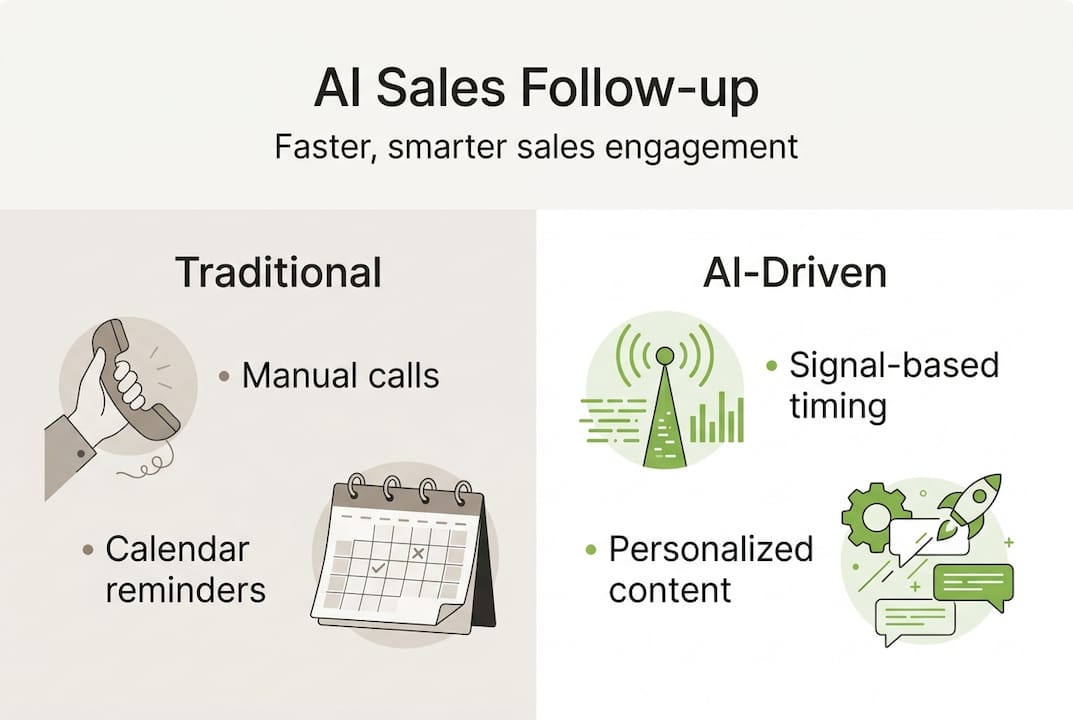
The shift from calendar-based to signal-based automation represents a fundamental change in approach. Rather than sending message three on day five regardless of context, modern systems build sequences around sales motions and trigger on buying signals, allowing AI to handle personalization at scale while human oversight protects high-value deals.
For B2B teams exploring AI prospecting strategies, understanding how to automate B2B prospecting workflows creates the foundation for conversion optimization.
Pro Tip: Start with a simple three-touch sequence triggered by specific actions before building complex multi-channel campaigns. Master signal recognition first, then scale.
Why traditional follow-up methods fall short
Time-based follow-up sequences ignore the most important variable in B2B sales: actual buyer interest. Sending message four on day seven because the calendar says so wastes opportunities when prospects showed engagement on day five, and annoys those who’ve gone silent.
The empirical evidence is stark. Static cadences automate spam and drop replies after the third touch, while signal-driven systems achieve 35-42% velocity gains by responding to real buying signals. Traditional methods create four critical problems:
- Signal blindness that misses engagement opportunities when prospects show interest
- Deliverability damage from persistent outreach to unengaged contacts flagging messages as spam
- Resource waste as sales teams follow rigid schedules instead of hot leads
- Lack of observability making it impossible to diagnose why sequences fail
| Traditional Approach | Signal-Driven Approach |
|---|---|
| Fixed timing regardless of engagement | Responds to opens, clicks, visits |
| Generic messaging at scale | AI-personalized based on behavior |
| Single-channel focus | Coordinated multi-channel presence |
| Manual intervention required | Automated with human oversight |
| Declining reply rates after touch 3 | Sustained engagement through relevant timing |
“The biggest mistake in sales automation is treating all prospects the same. Buyers engage at different speeds, and your follow-up system must recognize and respond to those differences.”
For teams tracking AI-driven sales trends, understanding these limitations explains why legacy tools underperform despite widespread adoption. The solution lies in systems that observe, learn, and adapt to individual buyer journeys.
Signal-driven and AI-based automation: Mechanisms and benchmarks
Signal intelligence transforms follow-up from guesswork into science. Modern automation platforms monitor dozens of behavioral indicators: email opens and read time, website visits and page depth, content downloads, social media engagement, and inbound responses. Each signal provides context about buyer interest and readiness.
AI optimizes three critical dimensions:
- Timing: Analyzing historical patterns to determine when prospects are most likely to engage
- Content: Generating personalized messaging that references specific behaviors or interests
- Channel: Selecting email, phone, or social based on past response patterns
The performance difference is substantial. Signal-driven automation boosts contact rates 70%, while AI-enhanced teams report up to 83% higher revenue compared to manual approaches. These gains come from matching outreach intensity to actual buying signals rather than arbitrary schedules.

| Metric | Manual Follow-up | Time-Based Automation | Signal-Driven AI |
|---|---|---|---|
| Contact rate | 23% | 31% | 53% |
| Reply rate (touch 1-3) | 12% | 15% | 21% |
| Reply rate (touch 4+) | 4% | 3% | 14% |
| Conversion velocity | Baseline | +18% | +42% |
| Sales cycle length | Baseline | -8% | -27% |
Benchmark data reveals that 5-8 touches yield optimal conversions, with the first follow-up alone boosting replies 49%. Multi-channel cadences achieve 28% higher conversions than email-only sequences. The key is multi-threading for buying committees while maintaining human oversight for high-value accounts.
Statistic Spotlight: Teams using signal-triggered sequences report 70% higher contact rates and 42% faster deal velocity compared to calendar-based automation.
For organizations implementing AI sales strategies, these benchmarks provide clear targets. The goal is not more touches, but smarter ones that align with buyer readiness. Understanding how to build effective AI-driven sales campaigns requires mastering these signal-response patterns.
Building your automated follow-up: Framework and best practices
Implementing high-performing sales follow-up automation requires a structured framework that balances technology capabilities with sales process realities. Follow this five-step approach:
- Map the buyer journey by documenting typical touchpoints from first contact to closed deal, identifying where prospects typically engage or disengage
- Define signal triggers that indicate buying interest, such as email opens within 2 hours, multiple website visits, content downloads, or direct replies
- Segment accounts by value and complexity, applying different cadence intensities and human oversight levels based on deal size
- Set cadence logic that specifies which signals trigger which follow-ups, including pause rules when prospects go cold
- Establish guardrails for deliverability, spam risk, and human escalation thresholds to protect both prospects and sender reputation
Best practices from high-performing teams include maintaining clean CRM data as essential, A/B testing timing and content variations, monitoring reply rates over open rates, and balancing automation with value-added human touches. The most effective systems use rule-based triggers for simple signals and AI-driven decisions for complex pattern recognition.
Critical guardrails prevent common failures:
- Deliverability monitoring to catch spam flags before they damage sender reputation
- Frequency caps preventing multiple sequences from bombarding the same contact
- Human review triggers for high-value accounts or unusual engagement patterns
- Opt-out enforcement ensuring compliance and respecting prospect preferences
As one sales automation expert notes, success needs unified data, guardrails, and human-AI hybrid approaches rather than full automation. The goal is augmenting sales teams, not replacing them.
Pro Tip: Start with a 5-touch sequence over 14 days, triggered by specific engagement signals. Measure reply rates at each touch, then optimize timing and content based on actual performance before scaling to more complex cadences.
For agencies exploring prospecting optimization, these frameworks provide the foundation. Combining automation with effective decision maker targeting ensures follow-ups reach the right people at the right time with relevant messaging.
How Lickfold Digital helps optimize sales follow-up automation
Building signal-driven automation that actually converts requires more than software. It demands expertise in AI implementation, deliverability management, and B2B sales process design. That’s where Lickfold Digital’s specialized approach makes the difference.
Our AI-powered platform combines dedicated agents for market research and decision-maker identification with sophisticated multi-touch outreach that responds to real buying signals. We handle the infrastructure complexity, from warm-up email accounts to reputation management, while our systems execute personalized campaigns that avoid generic templates.
The Lickfold Digital team brings deep expertise in signal-based automation, helping B2B sales teams implement frameworks that drive measurable conversion lifts. We qualify replies before passing opportunities to your sales team, ensuring you focus on genuine prospects rather than sorting through automated responses. Reach out for a consultation to explore how AI-backed automation can transform your follow-up effectiveness and create a predictable pipeline of qualified opportunities.
Frequently asked questions
How does sales follow-up automation improve conversion rates?
Sales follow-up automation boosts contact rates by responding to buying signals rather than arbitrary schedules, with signal-driven systems achieving 70% higher contact rates and AI-enhanced teams reporting up to 83% higher revenue. The key is matching outreach intensity to actual buyer engagement.
What are the risks of automated follow-up?
Over-reliance on automation without proper guardrails creates irrelevant outreach, damages sender reputation through spam flags, and misses opportunities requiring human judgment. Risks include poor data quality and lack of observability into why sequences fail, making human oversight essential for high-value accounts.
How many follow-ups are optimal in B2B sales?
Benchmark data shows 5-8 touches across multiple channels yield the best lead conversion rates, with the first follow-up alone boosting replies 49%. The optimal number depends on engagement signals rather than fixed rules, with signal-driven systems maintaining effectiveness beyond touch three where traditional methods fail.
What role does AI play in automated follow-ups?
AI analyzes buyer signals to optimize timing, generates personalized content based on prospect behavior, and selects appropriate channels for each touchpoint. Modern systems use AI for personalization at scale while triggering on buying signals, enabling higher velocity and effectiveness compared to rule-based automation alone.
How do I prevent automated follow-ups from damaging deliverability?
Maintain clean CRM data, implement frequency caps to prevent multiple sequences from overwhelming contacts, monitor spam flags and bounce rates continuously, and use dedicated warm-up email accounts with proper infrastructure. Balance automation with human oversight for high-value accounts and enforce opt-out requests immediately to protect sender reputation.