
Why automate B2B prospecting in 2026: boost efficiency
Why automate B2B prospecting in 2026: boost efficiency
Manual B2B prospecting still dominates most sales teams, yet AI-driven automation can triple email reply rates within 90 days. Sales leaders spend countless hours on repetitive outreach tasks while competitors leverage artificial intelligence to scale personalized engagement. This article explains how AI-powered automation transforms prospecting efficiency, accelerates pipeline creation, and drives measurable revenue growth for mid-sized B2B companies in 2026.
Table of Contents
- How Manual B2B Prospecting Limits Sales Growth
- Benefits Of AI-Driven Prospecting Automation
- Technological Advancements Enabling Smarter Automation
- Implementing AI Automation To Accelerate Pipeline And Revenue Growth
- Why Choose Lickfold Digital For AI Prospecting Automation
- FAQ
Key takeaways
| Point | Details |
|---|---|
| Automation triples reply rates | AI-driven systems boost email responses from 3% to 9% within three months |
| Massive time savings | Sales teams recover 60-80% of prospecting time for strategic work |
| Higher conversion quality | AI-powered lead generation delivers 3-5x better conversion rates than manual methods |
| Scalable personalization | Automation creates unique prospect messages at volumes impossible manually |
| Faster pipeline velocity | Automated workflows accelerate opportunity creation and revenue growth |
How manual B2B prospecting limits sales growth
Manual prospecting requires 15-20 minutes per outreach attempt, capping daily volume at 20-30 prospects per rep. This fundamental limitation creates a bottleneck that restricts pipeline growth regardless of team size or motivation.
The math reveals the problem clearly. A sales rep working eight hours daily dedicates perhaps four hours to prospecting activities. At 15 minutes per attempt, that yields just 16 quality outreach efforts. Multiply across a five-person team and you reach only 80 daily touches, barely scratching the surface of addressable markets.
Low volume compounds with inconsistent follow-up. Manual processes struggle to track engagement signals, schedule timely touchpoints, or maintain personalized context across dozens of concurrent conversations. Prospects slip through cracks. Opportunities vanish before reps can respond.
Personalization at scale becomes nearly impossible. Each custom message demands research, drafting, and revision. Sales professionals face a brutal tradeoff: invest time crafting tailored outreach for higher response rates, or sacrifice quality for volume using generic templates that prospects ignore.
Key limitations of manual prospecting include:
- Restricted daily outreach volume caps pipeline potential
- Inconsistent follow-up timing reduces conversion rates
- Generic messaging fails to engage decision-makers
- Repetitive tasks consume hours better spent closing deals
- Slow prospect research delays time to first contact
These inefficiencies directly impact revenue. Pipeline velocity stalls when opportunities enter slowly. Sales cycles extend as reps juggle administrative work instead of strategic selling. The Lickfold Digital blog explores how automation addresses these fundamental constraints.
Benefits of AI-driven prospecting automation
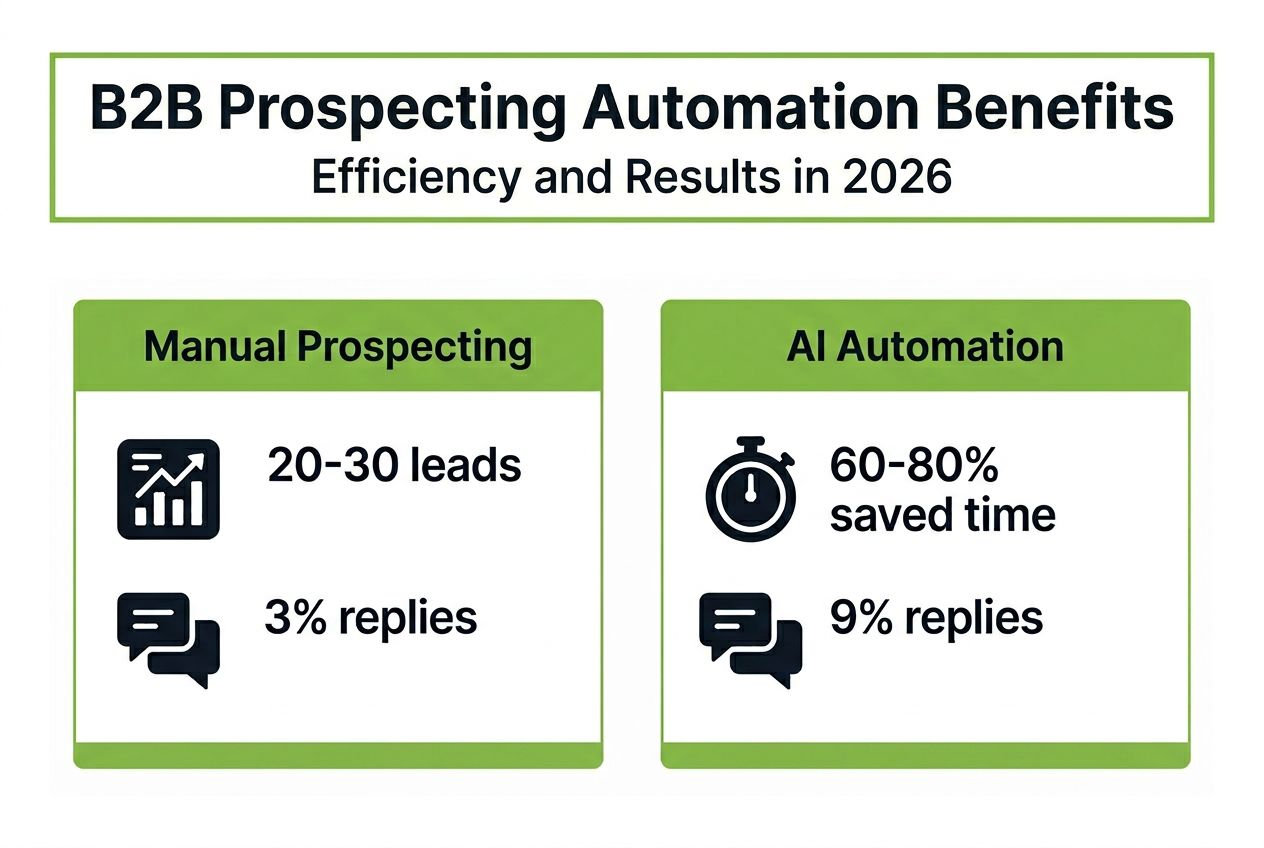
AI-driven outbound automation increases email reply rates from 3% to 9% within 90 days, fundamentally changing prospecting economics. This improvement means every 100 outreach attempts generate six additional qualified conversations compared to manual methods.

Time savings prove equally dramatic. Companies using AI-powered lead generation report 60-80% time savings on prospecting activities. Sales professionals redirect recovered hours toward high-value activities: qualifying leads, conducting discovery calls, negotiating contracts, and closing deals.
Conversion quality improves alongside efficiency. AI-powered systems deliver 3-5x higher conversion rates than manual lead generation by identifying best-fit prospects through data-driven analysis. Algorithms evaluate firmographic signals, technographic indicators, and behavioral patterns that predict purchase intent.
Core automation benefits include:
- Triple reply rates accelerate qualified conversation volume
- Massive time savings enable strategic selling focus
- Data-driven targeting improves prospect fit quality
- Scalable personalization maintains message relevance
- Consistent follow-up maximizes opportunity conversion
AI excels at personalization at scale. Natural language models analyze prospect data to craft unique messages referencing company initiatives, industry challenges, or recent news. Each outreach feels individually written while automation handles hundreds daily. Generic templates become obsolete.
Reply Rate Improvement: AI automation generates 6 additional qualified conversations per 100 outreach attempts compared to manual prospecting, creating predictable pipeline growth.
The AI lead generation cost savings extend beyond labor efficiency. Automated systems reduce customer acquisition costs by targeting higher-quality prospects, shortening sales cycles, and improving win rates. Revenue per sales rep increases as automation amplifies individual productivity.
Technological advancements enabling smarter automation
Retrieval-augmented generation and large multimodal models reduce hallucination risk while supporting secure data handling. These AI breakthroughs enable factually accurate, context-aware messaging that maintains credibility with sophisticated B2B decision-makers.
Retrieval-augmented generation connects language models to verified knowledge bases. When crafting prospect messages, the system queries current company information, recent news, and industry data before generating text. This architecture prevents fabricated claims that damage sender reputation and reduces embarrassing factual errors.
Large multimodal models process diverse data types simultaneously. Text, images, structured databases, and behavioral signals combine to build comprehensive prospect profiles. An AI agent might analyze a target company’s website design, job postings, technology stack, social media presence, and financial filings to identify specific pain points and craft relevant outreach.
Security and compliance capabilities have matured substantially:
- End-to-end encryption protects sensitive prospect data
- GDPR and CCPA compliance features ensure regulatory adherence
- Role-based access controls limit data exposure
- Audit trails document all automated actions for accountability
Automation workflows now integrate human oversight checkpoints. Sales leaders review AI-generated messaging strategies before launch. Reps qualify inbound responses before scheduling meetings. This hybrid approach balances efficiency with quality control, ensuring automation enhances rather than replaces human judgment.
Pro Tip: Start with AI-assisted drafting rather than full automation. Let algorithms generate initial outreach messages, then have reps personalize final touches. This approach builds team confidence while delivering immediate productivity gains.
These AI technology insights reveal how modern systems combine speed with sophistication. Data-driven personalization operates at scale without sacrificing message quality or compliance standards. The technology foundation now exists for truly intelligent prospecting automation.
Implementing AI automation to accelerate pipeline and revenue growth
AI automation increases revenue 3-15% with ROI gains of 10-20% by accelerating pipeline creation and improving conversion efficiency. Practical implementation requires structured stages and clear metrics to realize these outcomes.
Successful automation follows a defined deployment sequence:
- Target identification: AI analyzes ideal customer profiles to build prospect lists matching firmographic and behavioral criteria
- Message personalization: Algorithms craft unique outreach incorporating company-specific context and pain points
- Outreach execution: Automated systems send emails, LinkedIn messages, and follow-ups according to optimized cadences
- Response qualification: AI flags interested replies and routes qualified opportunities to sales reps for human engagement
- Continuous optimization: Machine learning refines targeting, messaging, and timing based on performance data
Volume capabilities transform pipeline economics. AI systems execute 200-500 daily outreach attempts per configured profile, compared to manual limits of 20-30. This 10x capacity expansion fills pipelines faster while maintaining personalization quality.
Tracking key metrics enables continuous improvement:
- Reply rates: Monitor response percentages to evaluate message effectiveness
- Pipeline velocity: Measure time from initial contact to qualified opportunity
- Conversion rates: Track progression from conversation to closed deal
- Revenue impact: Calculate incremental revenue attributed to automation
| Metric | Manual Prospecting | AI Automation | Improvement |
|---|---|---|---|
| Daily outreach volume | 20-30 attempts | 200-500 attempts | 10-15x increase |
| Email reply rate | 3% average | 9% average | 3x improvement |
| Time per prospect | 15-20 minutes | 2-3 minutes | 80% reduction |
| Conversion rate | Baseline | 3-5x higher | 300-500% gain |
AI insights combine with human judgment for optimal results. Algorithms identify high-potential prospects based on data patterns, but sales leaders apply market knowledge and relationship context to refine targeting. AI drafts personalized messages, yet reps review and adjust tone for specific audiences.
Pro Tip: Run parallel campaigns comparing AI-generated messaging against your current manual approach. Measure reply rates, meeting bookings, and pipeline contribution over 60 days to quantify specific improvements for your market.
Practical frameworks help integrate automation without disrupting existing processes. Start with a single market segment or buyer persona. Validate AI messaging quality with small batches before scaling. Gradually expand automation scope as teams build confidence and refine workflows. The Lickfold Digital AI solutions offer structured implementation pathways for mid-sized B2B companies.
Why choose Lickfold Digital for AI prospecting automation
B2B sales leaders need proven AI expertise to implement prospecting automation that delivers measurable pipeline growth. Lickfold Digital specializes in deploying AI-driven outbound systems tailored specifically for mid-sized companies seeking scalable, efficient prospecting solutions.
Our platform combines intelligent prospect targeting, personalized multi-touch campaigns, and human-qualified lead handoffs to create predictable revenue growth. Dedicated AI agents research markets, identify decision-makers, and execute outreach at scale while maintaining the delivery rates and message quality that manual teams cannot match.
We handle the technical complexity: warm-up email infrastructure, reputation management, compliance protocols, and ongoing optimization. Your sales team focuses on closing qualified opportunities while AI agents work continuously across markets and industries.
Schedule a free consultation to explore how AI automation fits your specific sales process. Download the 24/7 Business Guide for deeper insights into building automated growth systems. Partner with AI experts who maximize pipeline velocity and sales ROI through intelligent automation.
FAQ
Is automation suitable for all B2B companies?
Automation benefits most mid-sized B2B firms but requires tailored strategy aligned with existing sales processes and buyer journeys. Companies with defined ideal customer profiles, repeatable sales motions, and sufficient addressable market size see strongest results. Smaller firms or highly specialized niche markets may need customized approaches that blend automation with relationship-driven selling.
How quickly can I expect results from automating prospecting?
Email reply rates can triple within 90 days of implementing AI-driven automation. Pipeline acceleration and time savings appear rapidly once consistent workflows launch. Most companies observe meaningful improvements in qualified conversation volume within the first month, with full ROI realization occurring over 3-6 months as systems optimize and teams refine processes.
What key metrics should be tracked to measure automation success?
Track email reply rates, pipeline creation speed, conversion rates from conversation to opportunity, and overall sales ROI attributed to automated prospecting. Meeting booking rates, response time to inbound interest, and cost per qualified lead provide additional insight. Regularly reviewing these metrics enables continuous process refinement, messaging optimization, and better resource allocation decisions that compound results over time.
How does AI personalization compare to manual customization?
AI personalization analyzes hundreds of data points per prospect to craft contextually relevant messages at scale, matching or exceeding manual quality for most outreach scenarios. Algorithms reference company news, job postings, technology stacks, and industry trends to create unique messaging that resonates with decision-makers. Human customization remains valuable for strategic accounts or complex relationship situations, but AI handles volume personalization more consistently and efficiently.
What compliance considerations apply to automated B2B prospecting?
Automated prospecting must comply with CAN-SPAM, GDPR, CCPA, and industry-specific regulations governing electronic communications and data privacy. Modern AI systems include built-in compliance features: unsubscribe mechanisms, consent tracking, data minimization, and audit trails. Work with providers who prioritize regulatory adherence and can demonstrate security certifications relevant to your industry and target markets.