
B2B Lead Generation: 2026 Sales Automation Trends
B2B Lead Generation: 2026 Sales Automation Trends
TL;DR:
- Smarter automation with strategic guardrails outperforms faster, higher-volume outreach.
- Building a six-layer system enhances predictive sales automation effectiveness and scalability.
- Personalization and compliance are critical for automation success, not just volume or speed.
Most B2B sales leaders assume that scaling automation means scaling results. Run more sequences, send more emails, book more meetings. But the data tells a different story. More automation can actually drive response rates down when it’s deployed without strategic guardrails. In 2026, the teams winning at outbound aren’t the ones sending the most messages. They’re the ones sending the right ones. This guide breaks down why smarter automation beats faster automation, and how you can restructure your outreach approach to generate better leads, not just more activity.
Table of Contents
- Decoding the productivity paradox in sales automation
- Building effective AI-driven sales automation layers
- Personalization at scale: Solving context and compliance risks
- From theory to ROI: Applying 2026 sales automation trends for real results
- The uncomfortable truth: Automation isn’t a shortcut—it’s a strategy
- Partner with automation experts for your next B2B leap
- Frequently asked questions
Key Takeaways
| Point | Details |
|---|---|
| More automation isn’t always better | Without smart system design, increased automation can actually reduce response rates and damage brand trust. |
| Six layers drive success | Effective B2B sales automation in 2026 relies on structured layers from data to monitoring. |
| Context equals compliance | Providing AI with clear context and guardrails is key to avoiding compliance and reputational risks. |
| Practical ROI requires rigor | Combining process discipline with creative personalization turns new automation trends into real pipeline gains. |
Decoding the productivity paradox in sales automation
More volume feels like progress. Your sequences are running, your CRM is logging activity, and your team looks busy. But if your reply rates are dropping while your send volume climbs, you’re caught in what researchers call the productivity paradox.
The core problem is simple: when automation makes outreach cheap and easy, everyone uses it. Inboxes get flooded. Decision-makers develop sharper filters. And more automation leads to lower response rates when it isn’t managed with discipline. This isn’t a hypothetical edge case. It’s the reality most mid-sized B2B teams are navigating right now.
Several factors accelerate this decline:
- Poor data quality: Outdated contact lists mean your messages hit the wrong people or bounce entirely.
- Generic messaging: Templates that don’t reference specific pain points get deleted in seconds.
- Deliverability drops: High send volumes from cold domains tank your sender reputation, pushing emails to spam before anyone reads them.
- Misaligned timing: Automating outreach without understanding where a prospect is in their buying journey creates friction instead of interest.
“The goal of automation isn’t to replace human judgment. It’s to apply human judgment at a scale that wouldn’t otherwise be possible.”
Setting realistic expectations matters here. Automation won’t manufacture demand that doesn’t exist. It amplifies what’s already working, or what’s already broken. If your messaging is weak, automation makes it fail faster and at greater scale.
The fix starts with treating your AI sales workflow tools as precision instruments, not fire hoses. Pair that with automated follow-up best practices that respect prospect behavior and timing, and you’ll start reversing the paradox instead of deepening it.
Pro Tip: Before scaling any sequence, run a 50-contact test batch and measure reply rates, bounce rates, and spam complaints. Let the data tell you whether to accelerate or adjust.
Building effective AI-driven sales automation layers
Understanding the paradox of automation sets up why thoughtful systems matter. Let’s explore how industry leaders are structuring automation in 2026.
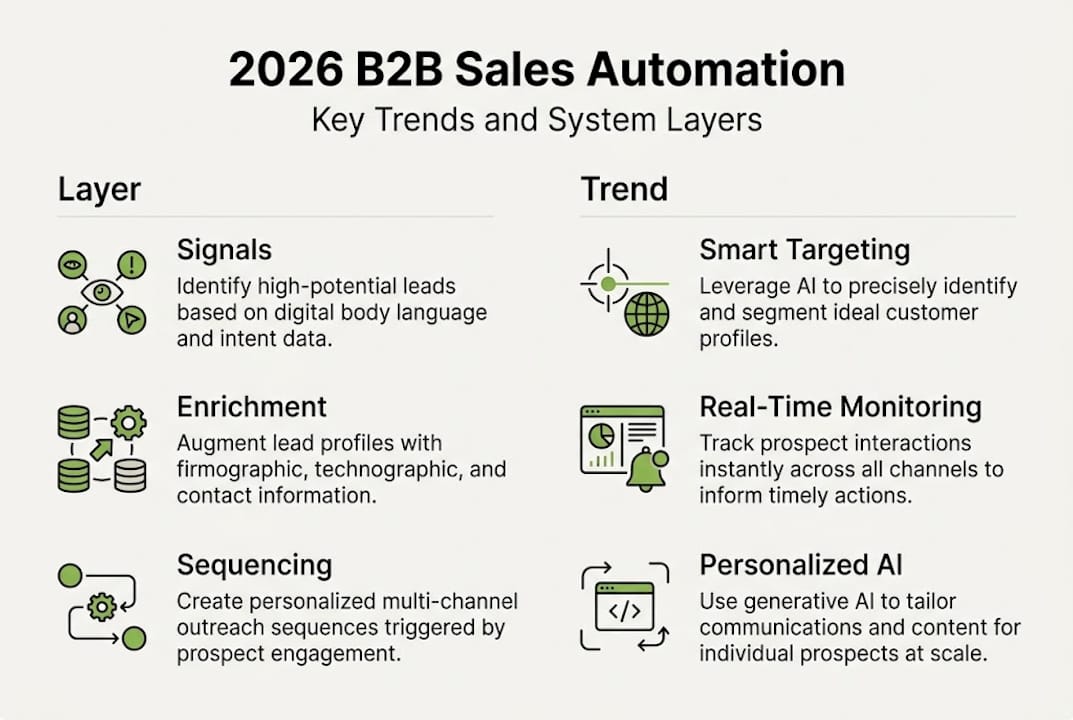
The teams seeing consistent pipeline growth aren’t running single-layer automation. They’re building systems with six distinct layers, each one reinforcing the next. Six-layer systems covering signals, data, decisions, actions, CRM, and monitoring are what separate scalable pipelines from fragile ones.
Here’s how each layer functions in practice:
- Signals: Trigger points that indicate buying intent, such as job changes, funding announcements, or technology stack shifts.
- Data: Enriched, validated contact and company information that feeds every downstream action.
- Decisions: Logic rules and AI scoring that determine who gets contacted, when, and with what message.
- Actions: The actual outreach, whether email, LinkedIn, or phone, executed based on the decision layer’s output.
- CRM: The system of record that logs every interaction, updates lead status, and keeps your team aligned.
- Monitoring: Ongoing tracking of deliverability, reply rates, and conversion metrics that feeds back into the decision layer.
| Layer | B2B use case example | Why it matters |
|---|---|---|
| Signals | Prospect raises Series B funding | Identifies high-intent timing |
| Data | Waterfall enrichment validates email | Reduces bounce rates |
| Decisions | AI scores lead as high priority | Focuses rep time efficiently |
| Actions | Personalized sequence launches | Drives relevant engagement |
| CRM | Interaction logged automatically | Maintains pipeline visibility |
| Monitoring | Reply rate drops trigger review | Prevents silent failures |
This architecture is what predictive sales automation is built on. Without monitoring feeding back into decisions, your system runs blind. Without quality data feeding actions, your outreach misfires. Every layer depends on the one before it.
If you’re building or auditing your stack, the automated sales process guide offers a practical framework for mapping your current tools to each of these layers.
Pro Tip: Start your audit at the monitoring layer. If you can’t measure it, you can’t improve it. Most teams skip this layer entirely and wonder why their automation plateaus.

Personalization at scale: Solving context and compliance risks
Building robust architectures only works if messages resonate and comply. Next, let’s address personalization and compliance in automation.
AI can write fast. But speed without context creates real risk. Compliance and brand risks emerge when AI tools lack sufficient context about your audience, your offer, and your legal obligations. A message that references the wrong industry, uses outdated data, or violates GDPR can damage your brand faster than any cold email ever built pipeline.
The framework for avoiding this has three components:
- Structured data inputs: Feed your AI tools with verified firmographic and behavioral data, not just names and email addresses. The richer the input, the more relevant the output.
- Use-case mapping: Define exactly which message types apply to which prospect segments. A CFO at a 200-person SaaS company shouldn’t receive the same sequence as a VP of Sales at a logistics firm.
- Compliance guardrails: Build opt-out logic, data retention policies, and regional regulation checks directly into your automation workflows before launch, not after a complaint.
Here’s a quick comparison of how leading approaches handle this balance:
| Approach | Personalization depth | Compliance handling | Best for |
|---|---|---|---|
| Template-based automation | Low | Manual review needed | Small teams, simple offers |
| AI with basic context | Medium | Partial guardrails | Growing mid-sized teams |
| AI with layered context | High | Built-in compliance logic | Scaling B2B operations |
For mid-sized firms, the practical priority is this: invest in personalized AI outreach infrastructure before you scale volume. Personalization isn’t a nice-to-have feature. It’s the mechanism that keeps your automation from becoming noise.
Agencies and consulting firms face additional complexity here. Outreach that works for one client’s audience may actively harm another’s. The agency prospecting tips on managing multi-client automation contexts are worth reviewing if you’re managing outreach across multiple verticals.
Statistic to note: Teams using context-rich AI personalization report up to 3x higher reply rates compared to generic sequence automation, according to 2026 outbound benchmarks.
From theory to ROI: Applying 2026 sales automation trends for real results
With compliance and personalization under control, you’re ready to drive results. Here’s how to move from concept to measurable gains.
Knowing the right architecture is one thing. Implementing it without breaking your current pipeline is another. Here’s a practical checklist for mid-sized B2B teams:
- Audit your data quality first. Bad data is the single biggest reason automation underperforms. Validate and enrich your contact lists before building sequences.
- Map your six layers. Identify which tools handle which layers today and where the gaps are.
- Define your KPIs before launch. Reply rate, meeting booked rate, deliverability score, and pipeline value per sequence are your core metrics in 2026.
- Implement waterfall enrichment. Waterfall enrichment and guardrails prevent 80% of common automation failures by layering multiple data validation steps before any message goes out.
- Schedule monthly reviews. Markets shift. Buyer personas evolve. Your automation needs to evolve with them.
For a mid-sized B2B team running outbound to 500 prospects per month, this approach typically surfaces 15 to 25 qualified conversations within the first 60 days when all six layers are functioning correctly.
Common failure points to watch:
- Skipping the monitoring layer and missing deliverability decay
- Over-automating early-stage touches before trust is established
- Ignoring CRM hygiene, which corrupts decision-layer logic over time
- Treating automation setup as a one-time project rather than an ongoing system
The resources on B2B prospecting automation and AI for B2B prospecting go deeper on implementation specifics if you’re ready to move from planning to execution.
Pro Tip: Treat your first automation build as a learning sprint, not a permanent system. Plan to rebuild 30% of it after your first 90 days of live data.
The uncomfortable truth: Automation isn’t a shortcut—it’s a strategy
Here’s something most vendors won’t tell you: buying a better automation tool won’t fix a broken outreach strategy. We’ve seen teams invest in the most sophisticated AI platforms available and still produce flat pipelines. Why? Because they treated the tool as the solution instead of treating it as an amplifier of a solution they hadn’t yet built.
The teams that win with automation in 2026 share one trait. They’re disciplined about process before they’re excited about technology. They define their ideal customer profile with precision. They write messaging that earns attention. They review performance weekly, not quarterly. And they treat their long-term automation strategy as a living system that requires ongoing investment, not a one-time deployment.
Automation rewards the prepared. If your fundamentals are strong, it scales your results. If they’re weak, it scales your problems faster.
Partner with automation experts for your next B2B leap
If you’re ready to translate insight into action, here’s how our team can help.
The gap between knowing what good automation looks like and actually building it is where most mid-sized B2B teams get stuck. At Lickfold Digital, we specialize in closing that gap. Our AI-driven prospecting systems are built on the exact layered architecture covered in this article, from signal detection and data enrichment to personalized outreach and human-qualified lead handoffs.
We don’t hand you a tool and wish you luck. We build and manage the full system, so your sales team receives qualified conversations, not raw automation output. If you’re serious about building a predictable pipeline in 2026, start your automation journey with a consultation and see what a properly engineered outbound system can do for your growth targets.
Frequently asked questions
What is the biggest risk with AI-driven sales automation in 2026?
The main risks are declining response rates, brand compliance violations, and data privacy issues caused by context-poor automation. Without sufficient input data and guardrails, AI tools produce messages that damage sender reputation and brand trust simultaneously.
How can B2B teams increase ROI from sales automation tools?
Focus on layered system design with careful monitoring and regular use-case reviews. Teams that build all six layers and audit them monthly consistently outperform those running flat, single-layer sequences.
What is ‘waterfall enrichment’ and why does it matter for automation?
Waterfall enrichment runs contact data through multiple validation sources in sequence, keeping only verified records. This approach, combined with guardrails, prevents 80% of failures in B2B outbound automation before they reach your prospects.
Is more automation always better for sales in 2026?
No. More automation volume without strategic design actively lowers response rates. Intelligent personalization and disciplined system architecture consistently outperform raw send volume in every meaningful outbound metric.