
Why use AI for sales: boost B2B prospecting in 2026
Why use AI for sales: boost B2B prospecting in 2026
Most sales leaders think AI is just about automating repetitive tasks. That’s a costly misconception. In reality, AI fundamentally transforms how B2B teams identify prospects, personalize outreach, and forecast revenue. When implemented strategically, AI-driven sales tools don’t just save time. They enhance lead quality, align sales with finance, and create predictable growth pipelines that manual methods simply can’t match.
Table of Contents
- The Sales Challenge: Understanding Why Traditional Methods Fall Short
- How AI Transforms Sales Prospecting And Lead Generation
- AI-Driven Forecasting And Cross-Team Alignment: The Hidden Benefit
- Choosing And Integrating AI For Your Sales Team
- Discover Expert AI Sales Solutions With Lickfold Digital
- Frequently Asked Questions
Key takeaways
| Point | Details |
|---|---|
| AI-powered prospecting cuts manual effort | Automated agents handle research and initial outreach, freeing reps to close deals. |
| Personalized AI messaging boosts lead quality | Scale customized outreach without generic templates, increasing engagement rates. |
| AI forecasting aligns sales and finance teams | Shared metrics and transparency reduce volatility and improve strategic planning. |
| Success requires integrated agentic AI systems | Combine internal tools with task-specific AI agents for maximum impact. |
| Multi-LLM approaches optimize sales tasks | Different AI models handle prospecting, coaching, and forecasting with specialized intelligence. |
The sales challenge: understanding why traditional methods fall short
Sales leaders face mounting pressure in 2026. Manual prospecting devours hours that should be spent closing deals. Your team researches companies, hunts for decision-maker contact information, and crafts individual emails one at a time. This approach simply doesn’t scale when you need to reach hundreds or thousands of qualified prospects monthly.
Forecasting adds another layer of frustration. Traditional methods create distrust between sales and finance teams. Sales projects optimistic numbers while finance demands conservative estimates. Without shared data and transparent metrics, neither side trusts the other’s projections. This misalignment causes budget disputes and missed growth opportunities.
Cross-functional collaboration suffers too. Marketing, sales, and customer success operate in silos, reacting to problems instead of proactively driving growth. When teams lack unified intelligence about prospects and customers, you miss signals that could accelerate deals or prevent churn.
The personalization problem compounds these issues. Buyers expect tailored messaging that addresses their specific challenges. Generic templates get ignored or deleted. Yet manually personalizing outreach for every prospect is impossible at scale. Your team faces a choice: sacrifice quality for volume or limit reach to maintain relevance.
These challenges create an urgent need for innovation. Sales lead generation can’t rely on outdated manual processes when competitors adopt AI-powered solutions. The transition from traditional SaaS tools to AI-first approaches addresses forecasting inefficiencies and reactive cross-team dynamics that hold B2B companies back.
Key pain points include:
- Limited prospecting capacity constraining pipeline growth
- Forecast inaccuracy undermining strategic planning
- Siloed teams missing collaborative opportunities
- Inability to personalize outreach at meaningful scale
- Rising customer acquisition costs from inefficient processes
How AI transforms sales prospecting and lead generation
AI-powered tools fundamentally change the prospecting game. Instead of your reps spending hours on research, AI agents automate prospecting workflows by identifying ideal customer profiles, finding decision-makers, and gathering relevant company intelligence. Your team focuses on high-value activities like relationship building and deal negotiation.

Personalization becomes scalable with AI. These systems analyze prospect data to craft messaging that resonates with specific pain points and business contexts. You’re not sending cookie-cutter templates. AI improves lead quality by enabling personalized messaging at scale that feels genuinely tailored to each recipient. Response rates climb when prospects see you understand their unique challenges.
Multi-LLM approaches provide another advantage. Different AI models excel at different tasks. One might specialize in market research while another optimizes email subject lines. By combining specialized models, you get task-specific intelligence that outperforms generic AI solutions. Your prospecting becomes more precise and effective.
Scalability reaches new levels. AI systems operate continuously, reaching prospects across time zones without fatigue. They execute multi-touch campaigns with perfect consistency, following up systematically until prospects engage. This persistence converts warm leads that manual outreach would miss due to time constraints.
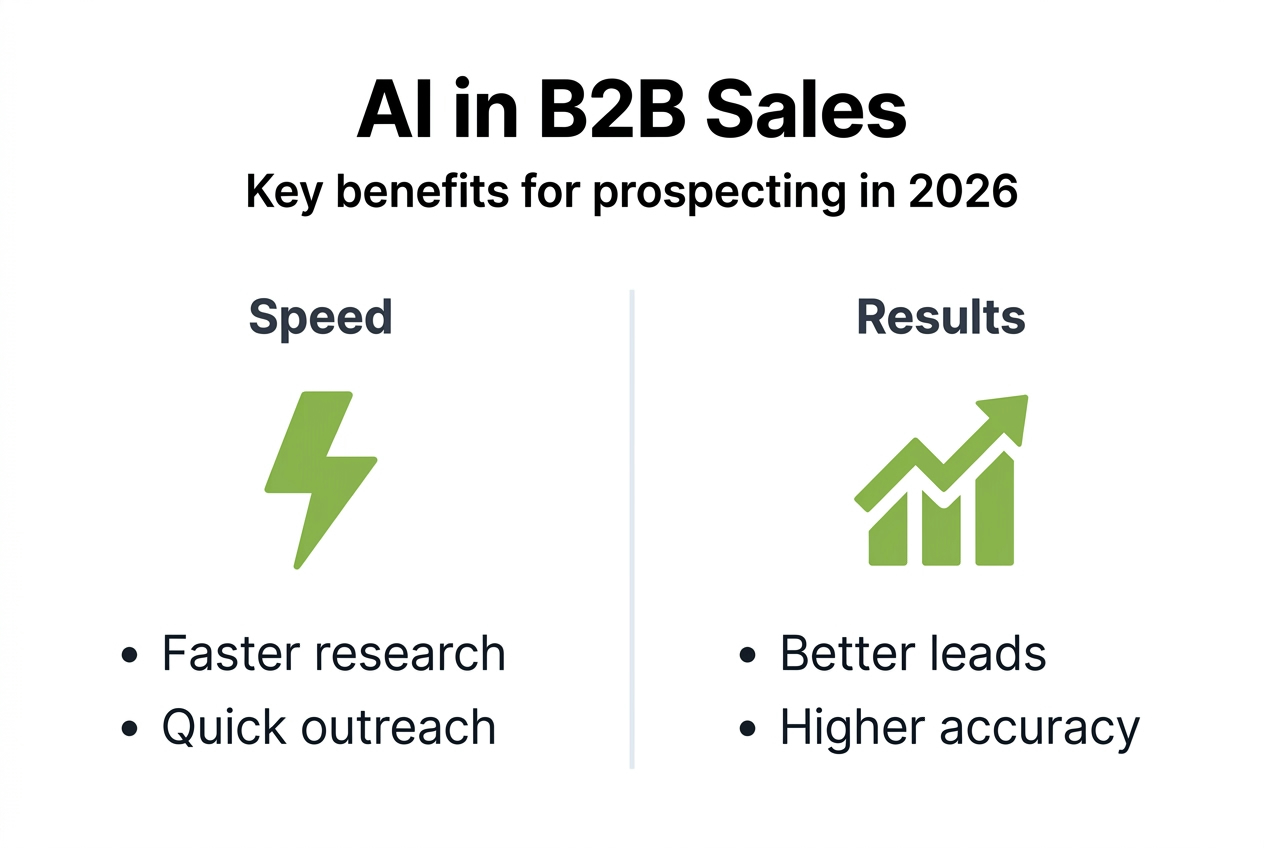
Real-world results speak volumes. Companies implementing AI prospecting report significant cost reductions in lead generation while improving lead quality metrics. The combination of automation and personalization creates a competitive advantage that manual methods can’t match.
Pro Tip: AI handles scale and consistency brilliantly, but human relationship building still matters. Use AI to identify and warm up prospects, then have your best reps take over for strategic conversations. This hybrid approach combines AI efficiency with human emotional intelligence for optimal results.
Key AI prospecting capabilities:
- Automated ideal customer profile matching
- Decision-maker identification and contact enrichment
- Personalized multi-touch campaign execution
- Systematic follow-up without manual tracking
- Continuous operation across markets and time zones
- Integration with AI messaging strategies for optimized engagement
AI-driven forecasting and cross-team alignment: the hidden benefit
Accurate forecasting transforms how sales and finance collaborate. Traditional methods rely on gut feelings and spreadsheet manipulation. AI brings data-driven precision that both teams can trust. When sales and finance share AI-driven forecasting tools that create alignment, they speak the same language using consistent metrics.
Transparency replaces tension. AI tools provide real-time pipeline visibility with probabilistic deal scoring. Finance sees exactly which opportunities are likely to close and when. Sales gets credit for realistic projections instead of being pressured to inflate numbers. This mutual understanding accelerates strategic decisions about hiring, budgets, and market expansion.
Revenue planning becomes more reliable. AI analyzes historical patterns, rep performance, and market signals to project future performance. These models adapt as conditions change, alerting leaders to risks and opportunities earlier than manual tracking allows. You can adjust strategy proactively instead of reacting to missed targets.
The impact extends beyond numbers. When teams trust the forecast, they collaborate more effectively on growth initiatives. Marketing aligns campaigns with sales capacity. Customer success prioritizes retention efforts based on predicted expansion opportunities. Agentic AI systems create a unified operational rhythm across functions.
One CFO described using an AI Commit tool daily to monitor forecast accuracy:
“For the first time, I don’t need to question whether sales numbers are wishful thinking or reality. The AI gives us a shared truth that drives better decisions across the entire company.”
Implementation success depends on buy-in. Finance teams often resist new tools, especially from sales-led initiatives. Starting the conversation early and demonstrating quick wins builds trust. Show finance leaders how AI reduces their workload while improving accuracy, and adoption accelerates.
Pro Tip: Involve your CFO or finance leader from day one when evaluating AI forecasting tools. Their early input ensures the solution meets financial reporting requirements and increases the likelihood they’ll champion adoption across the organization.
Choosing and integrating AI for your sales team
Selecting the right AI tools requires evaluating capabilities across multiple functions. Forecasting, coaching, and prospecting each demand different approaches. Look for solutions that address your specific pain points rather than chasing feature-rich platforms you won’t fully utilize.
Agentic AI solutions deserve special attention. Unlike simple automation, agentic systems combine internal tools with AI agents that make autonomous decisions about prospecting and outreach. These systems learn from results and optimize strategies continuously without constant human oversight.
Multi-LLM platforms offer flexibility. Different large language models excel at different sales tasks. One might generate better email subject lines while another creates more compelling value propositions. Platforms that let you deploy specialized models for specific tasks deliver better results than one-size-fits-all approaches.
Integration with existing systems matters enormously. Your AI tools must connect seamlessly with your CRM, marketing automation, and communication platforms. Data silos kill AI effectiveness. Prioritize solutions with robust APIs and pre-built integrations for your current tech stack.
Change management can make or break implementation. Sales teams resist new tools that complicate their workflow or feel like surveillance. Frame AI as a force multiplier that eliminates grunt work, not a replacement for human judgment. Provide thorough training and celebrate early wins to build momentum.
| Tool Type | Primary Function | Key Benefits | Best For |
|---|---|---|---|
| Prospecting AI | Automate research and outreach | Scale personalization, reduce manual work | High-volume B2B sales |
| Forecasting AI | Predict revenue and deal closure | Align teams, improve planning | Sales operations and finance |
| Coaching AI | Analyze calls and provide feedback | Accelerate rep development | Sales enablement |
| Multi-LLM Platforms | Task-specific AI deployment | Optimize each sales function | Comprehensive AI transformation |
Successful implementation follows a structured approach:
- Audit current sales processes to identify highest-impact opportunities for AI
- Evaluate tools based on integration capabilities and task-specific performance
- Run limited pilots with top performers to validate effectiveness and gather feedback
- Document workflows and create training materials before broader rollout
- Monitor metrics closely and iterate based on results and user input
Don’t try to transform everything overnight. Start with one high-impact use case like prospecting automation. Prove value, build confidence, then expand to forecasting and coaching. Incremental wins create organizational momentum that sustains long-term AI adoption.
Need guidance on which tools fit your specific sales model? Schedule an AI consultation to get expert recommendations tailored to your team’s needs. Resources like AI integration strategies provide additional implementation insights from real-world deployments.
Discover expert AI sales solutions with Lickfold Digital
Transforming your B2B sales with AI doesn’t require guesswork. Lickfold Digital specializes in AI-driven prospecting and outbound sales automation designed specifically for B2B companies seeking predictable growth. Their platform deploys dedicated AI agents that identify decision-makers, execute personalized outreach campaigns, and systematically convert prospects into qualified opportunities.
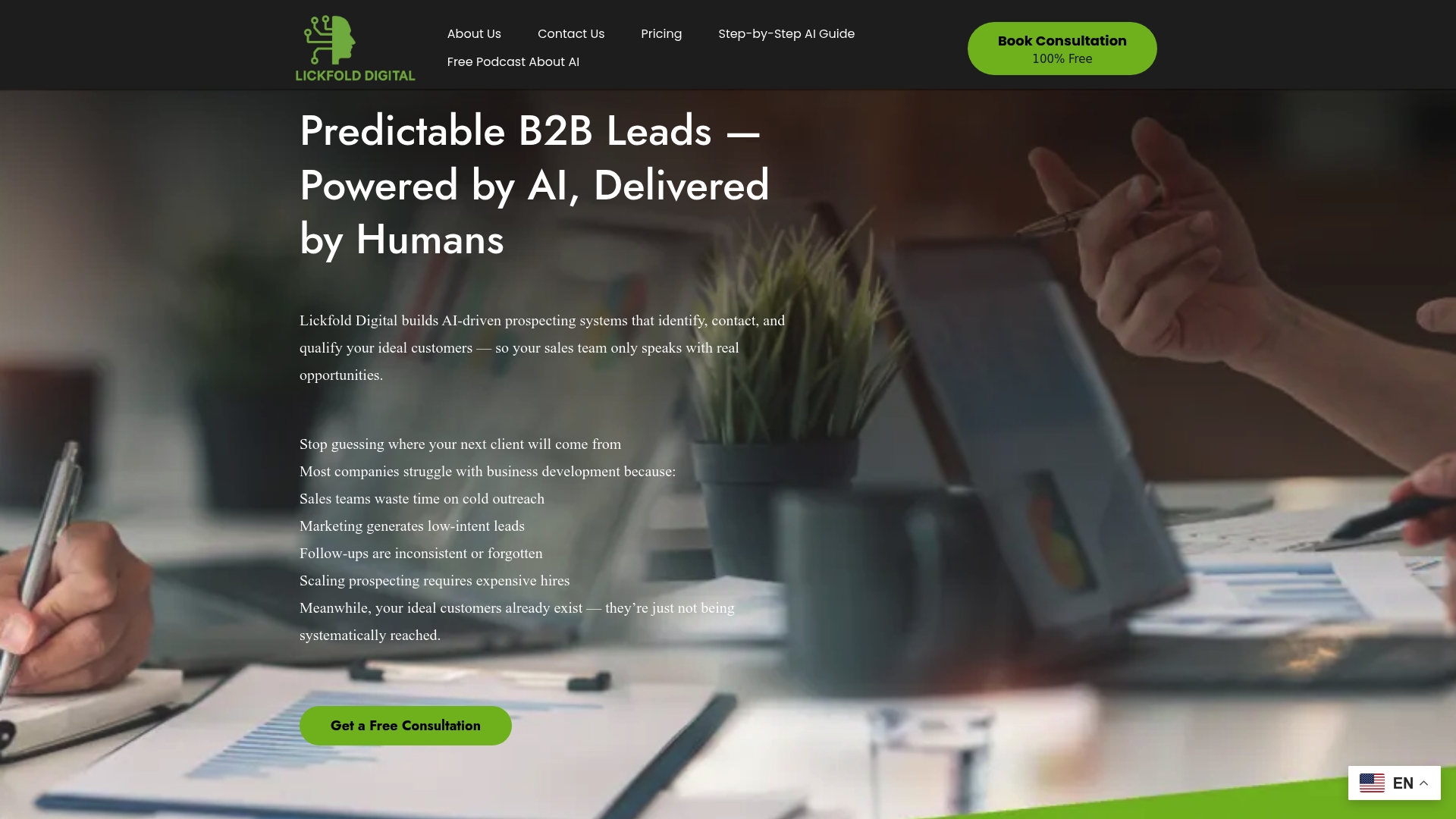
Their expertise covers the complete AI sales stack from infrastructure setup to ongoing optimization. You get dedicated warm-up email accounts, reputation management, and human qualification of replies before opportunities reach your sales team. This approach maintains high delivery rates while scaling personalized messaging that actually resonates with prospects.
Ready to see how AI can transform your prospecting efficiency? Book a free AI consultation to discuss your specific challenges and goals. Want deeper insights into AI-driven business growth? Download the 24/7 Business book for frameworks and strategies that help B2B companies leverage AI for sustainable competitive advantage.
Frequently asked questions
What types of AI tools can improve B2B sales prospecting?
Agentic AI prospecting agents automate the entire research and outreach process by identifying ideal customers, finding decision-makers, and executing personalized multi-touch campaigns. Forecasting AI creates alignment between sales and finance teams through shared metrics and transparent pipeline visibility. AI coaching tools analyze sales calls to provide real-time feedback that accelerates rep development and improves close rates.
How does AI personalization differ from template-based outreach?
AI analyzes prospect data including company information, role-specific challenges, and recent business events to craft genuinely relevant messages. Templates rely on basic field replacements like name and company, which prospects easily recognize as mass outreach. AI-generated messages reference specific business contexts and pain points, creating the perception of individual research and thoughtful customization that drives higher engagement.
Can AI really improve sales forecasting accuracy?
Yes, AI forecasting tools analyze historical deal patterns, rep performance trends, and real-time pipeline signals to generate probabilistic revenue projections. These systems continuously learn from outcomes to refine predictions, typically achieving accuracy rates that exceed manual forecasting methods. The key benefit is creating shared visibility between sales and finance teams, reducing the political tension around competing projections.
What’s the biggest challenge when implementing AI in sales?
Change management typically presents the greatest obstacle. Sales reps resist tools they perceive as surveillance or threats to their autonomy. Success requires framing AI as a force multiplier that eliminates tedious prospecting work, allowing reps to focus on relationship building and closing. Pilot programs with top performers, thorough training, and celebrating early wins help build organizational momentum.
How do multi-LLM AI approaches benefit sales teams?
Different large language models excel at different tasks based on their training data and architecture. One model might generate superior email subject lines while another creates better value propositions or analyzes call transcripts more effectively. Multi-LLM platforms let you deploy specialized models for specific sales functions, optimizing performance across prospecting, messaging, forecasting, and coaching rather than relying on a single general-purpose AI.
Should small sales teams invest in AI tools?
Absolutely, AI levels the playing field by giving small teams capabilities that previously required large prospecting organizations. A team of five reps with AI prospecting agents can reach as many qualified prospects as a team of twenty using manual methods. The key is choosing tools that integrate easily with existing systems and provide quick time-to-value rather than requiring extensive implementation resources.