
What is automated sales process? A 2026 guide for B2B leaders
What is automated sales process? A 2026 guide for B2B leaders
Closing deals in B2B sales has become exponentially harder. The average B2B buying committee now includes 11 to 13 stakeholders, each with distinct priorities and timelines. Traditional manual outreach struggles to keep pace with this complexity, leaving sales teams overwhelmed and opportunities lost. Automated sales processes powered by artificial intelligence offer a transformative solution, enabling teams to engage multiple decision makers simultaneously with personalized, timely outreach that converts warm leads into qualified opportunities at scale.
Table of Contents
- Understanding The Automated Sales Process
- Why Automate B2B Sales? Benefits And Business Impact
- Key Factors For Successful Automated Sales Processes
- Choosing The Right Mix: Human And AI Collaboration In Sales
- Transform Your Sales With Lickfold Digital AI Experts
- Frequently Asked Questions About Automated Sales Processes
Key takeaways
| Point | Details |
|---|---|
| AI-driven workflows streamline prospecting | Automated sales processes use artificial intelligence to handle repetitive outbound tasks, freeing sellers to focus on high-value relationship building. |
| Data-driven personalization boosts conversions | Targeting precision and message customization powered by AI can dramatically improve response rates and lead quality. |
| Human oversight remains essential | Strategic judgment and relationship nuances require human sellers working alongside AI agents for optimal outcomes. |
| Success depends on foundational factors | Data quality, omnichannel integration, continuous testing, and team upskilling determine whether automation delivers results. |
Understanding the automated sales process
An automated sales process is a system of AI-driven workflows that handles repetitive outbound sales tasks without constant manual intervention. Instead of sales reps spending hours researching prospects, crafting individual emails, and tracking follow-ups manually, artificial intelligence agents execute these activities systematically across your entire target market. The technology identifies ideal customer profiles, locates decision makers within those organizations, and deploys personalized multi-touch campaigns that adapt based on prospect behavior.
AI agents in sales come in different forms, each serving distinct functions. Some augment human sellers by providing real-time insights during conversations. Others assist by automating administrative tasks like scheduling and data entry. The most advanced operate autonomously, managing entire outreach sequences from initial contact through qualification. Humans and AI working together in sales can deliver significant improvements in new customer acquisition, upselling and cross-selling, churn reduction, pricing realization, and seller productivity.
The core components of an effective automated sales process include:
- Market research automation that continuously scans for companies matching your ideal customer profile
- Decision maker identification using AI to pinpoint the right contacts within target organizations
- Personalized outreach generation that tailors messaging based on prospect data without generic templates
- Multi-touch campaign orchestration managing email sequences, follow-ups, and channel coordination
- Lead scoring and qualification filtering responses to surface genuinely interested prospects
- CRM integration ensuring seamless handoff between automated workflows and human sellers
This approach accelerates lead engagement dramatically. Where a human seller might contact 20 prospects per day, an AI-powered system can reach hundreds while maintaining personalization quality. The key difference from traditional automation lies in adaptive intelligence. Modern AI agents learn from response patterns, adjusting messaging and timing to optimize conversion rates continuously.
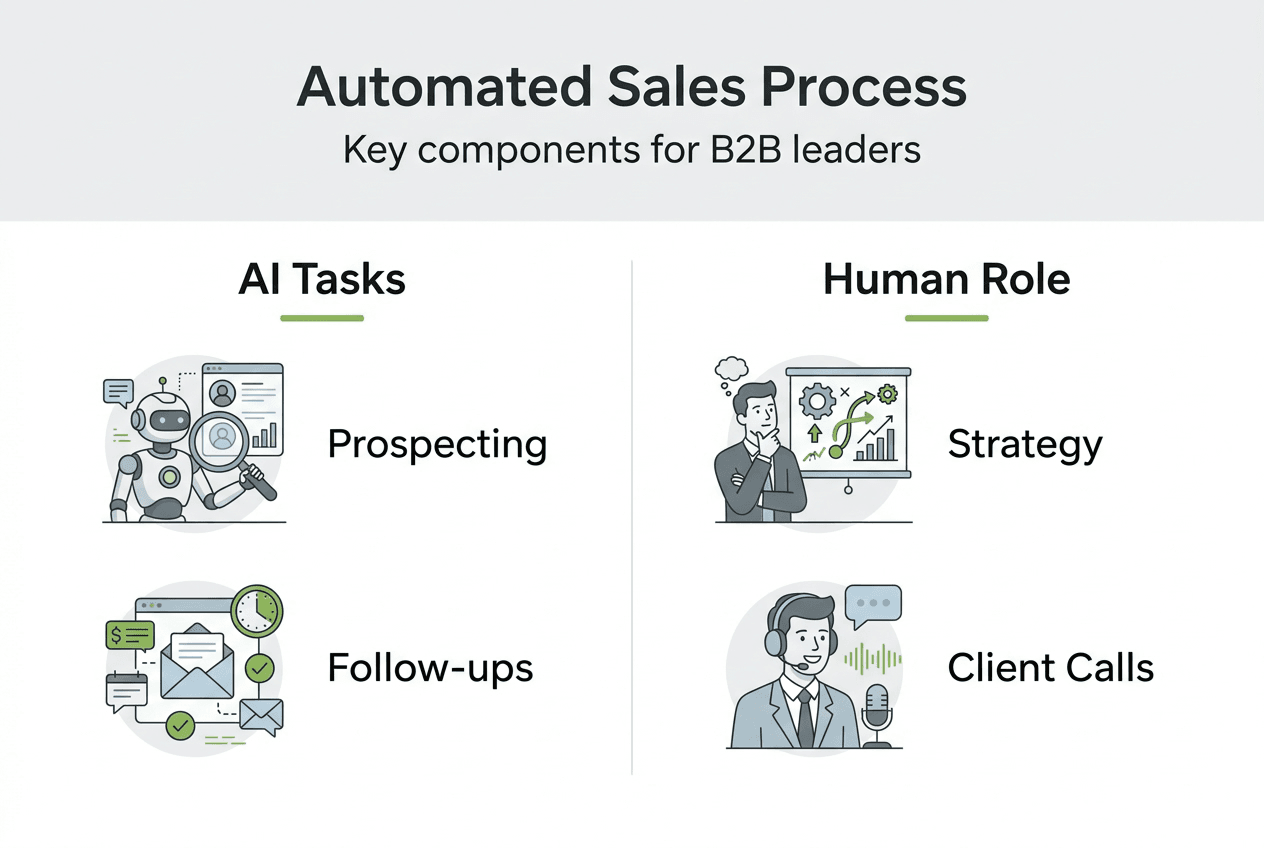
The most successful implementations combine AI efficiency with human expertise. Machines excel at scale, consistency, and data processing. Humans provide strategic thinking, relationship building, and nuanced judgment. Explore more strategies on the digital sales strategies blog to see how leading B2B companies balance these strengths.
Why automate B2B sales? Benefits and business impact
Efficiency gains represent the most immediate benefit of sales automation. Manual prospecting consumes 21% of a typical seller’s day, time that could be spent on high-value activities like discovery calls and deal negotiation. AI-driven workflows eliminate this burden by handling research, initial outreach, and follow-up sequences automatically. Your team focuses exclusively on qualified conversations with engaged prospects rather than chasing cold leads.
Conversion rates improve substantially when automation leverages data-driven targeting and personalization. Companies that use detailed buyer personas see 73% higher conversion rates from response to MQL. AI agents analyze firmographic data, behavioral signals, and engagement patterns to identify prospects most likely to convert, then craft messaging that resonates with their specific pain points and priorities. This precision targeting eliminates wasted outreach to poor-fit prospects.
Managing complex buying committees becomes feasible at scale with automation. When deals involve 11 to 13 stakeholders, manual coordination quickly becomes overwhelming. Automated workflows track each stakeholder’s engagement level, role, and concerns, orchestrating personalized touchpoints that keep everyone informed and moving forward. The system ensures no decision maker falls through the cracks due to bandwidth constraints.
Seller productivity and retention improve when AI handles tedious tasks. Top performers spend their time where they add unique value: building relationships, navigating objections, and closing deals. Junior reps accelerate their learning curves by focusing on live conversations rather than administrative work. This shift reduces burnout and churn while improving team morale.
Pro Tip: Start measuring time saved per rep after implementing automation. Most teams reclaim 10-15 hours weekly, equivalent to adding two full-time sellers without hiring costs. Track this metric to quantify ROI and justify further investment in AI tools.
Cost reduction becomes significant as automation scales. Traditional outbound teams require substantial investment in headcount, training, and management overhead. AI-powered systems deliver comparable or superior output at a fraction of the cost. Learn how leading companies achieve AI lead generation cost reduction of 65% or more while improving lead quality.
Key factors for successful automated sales processes
Data quality forms the foundation of any effective sales automation system. AI algorithms are only as good as the information they process. Incomplete contact records, outdated firmographics, and duplicate entries poison your workflows, resulting in misdirected outreach and wasted opportunities. Invest in data enrichment services and establish regular cleaning protocols before deploying automation. Verify email deliverability, validate phone numbers, and confirm decision maker roles to ensure your AI agents work with accurate intelligence.

Human oversight preserves relationship nuances and strategic judgment that machines cannot replicate. While AI excels at pattern recognition and scale, it lacks the contextual understanding to navigate sensitive situations or recognize when to deviate from standard playbooks. Key success factors for AI-powered outreach include data quality, human oversight, continuous testing, and omnichannel integration. Establish clear escalation paths where human sellers review flagged conversations, handle objections, and make judgment calls on deal progression.
Continuous A/B testing and KPI monitoring refine your automation workflows over time. What works today may underperform tomorrow as market conditions shift and prospects become desensitized to certain approaches. Test subject lines, message length, send times, and call-to-action phrasing systematically. Track metrics like open rates, response rates, meeting booking rates, and conversion to qualified opportunity. Use these insights to iterate your AI agent instructions and improve performance incrementally.
Omnichannel integration ensures prospects receive consistent, coordinated touchpoints across email, phone, social media, and other channels. Siloed automation creates disjointed experiences where prospects receive redundant or contradictory messages. Your AI system should orchestrate sequences that blend channels strategically: an initial email followed by a LinkedIn connection request, then a phone call, then a personalized video message. This multi-touch approach mirrors how top human sellers operate, dramatically improving engagement rates.
Upskilling sales teams and aligning incentives foster AI adoption rather than resistance. A successful transformation depends on a bold vision, AI governance, and upskilling frontline sellers. Reps fear automation will replace them or diminish their value. Address this by positioning AI as a force multiplier that makes them more effective, not obsolete. Train teams on how to interpret AI insights, when to override automated recommendations, and how to leverage freed-up time for strategic activities. Adjust compensation structures to reward outcomes rather than activity metrics.
Pro Tip: Create a feedback loop where sales reps report AI mistakes or missed opportunities. Use these reports to refine your automation rules and build trust that human judgment remains valued and incorporated.
Infrastructure setup requires attention to technical details that impact deliverability and reputation. Dedicated warm-up email accounts, proper SPF/DKIM/DMARC configuration, and gradual volume ramp-ups prevent your domains from being flagged as spam. See client success stories demonstrating how proper infrastructure enables sustainable outreach at scale. Review sales optimization best practices 2026 for current technical standards.
Choosing the right mix: human and AI collaboration in sales
Understanding the three forms of AI sales agents helps you match technology to your specific sales context. Three forms of agentic selling are displacing traditional B2B selling approaches: augmented, assisted, and autonomous. Each offers distinct advantages depending on deal complexity, customer relationship requirements, and team capabilities.
Augmented AI agents provide real-time intelligence and recommendations while human sellers maintain full control of interactions. During a discovery call, the AI might surface relevant case studies, suggest questions based on prospect responses, or flag buying signals in the conversation. The seller decides whether to act on these suggestions. This approach works well for complex, high-value deals where relationship building and strategic thinking dominate.
Assisted AI agents handle specific tasks within the sales process while humans manage overall strategy and key touchpoints. The AI might schedule meetings, update CRM records, generate follow-up emails for seller approval, and research prospect backgrounds. This frees sellers from administrative burden without removing them from the customer relationship. Mid-market sales teams often find this balance optimal.
Autonomous AI agents manage entire workflows from initial contact through qualification with minimal human intervention. They research prospects, craft personalized outreach, handle initial responses, qualify leads based on predefined criteria, and only escalate to humans when a prospect meets qualification thresholds. This approach maximizes efficiency for high-volume, lower-complexity sales motions like SMB outbound prospecting.
| Agent Type | Human Role | AI Role | Best For |
|---|---|---|---|
| Augmented | Leads all interactions | Provides real-time insights | Enterprise deals, complex sales |
| Assisted | Manages strategy and key touchpoints | Handles administrative tasks | Mid-market, moderate complexity |
| Autonomous | Focuses only on qualified leads | Manages full prospecting workflow | High-volume SMB, simple products |
Sales complexity, deal size, and customer relationship requirements determine your optimal mix. Enterprise software sales with six-figure contracts and year-long cycles demand human-led approaches with AI augmentation. Transactional products with shorter sales cycles and lower price points benefit from autonomous AI handling most of the process. Most B2B companies fall somewhere in between, requiring a hybrid model.
Implementing AI agents progressively maintains seller confidence and control while building organizational capability:
- Start with assisted AI handling administrative tasks to demonstrate value without threatening seller autonomy
- Introduce augmented AI for specific use cases like discovery call preparation or competitive intelligence
- Pilot autonomous AI on a subset of your total addressable market, typically lower-priority segments
- Expand autonomous coverage as you validate performance and refine workflows
- Continuously gather seller feedback to identify friction points and optimization opportunities
Pro Tip: Let your top performers test AI tools first. Their endorsement carries weight with the broader team and they provide higher-quality feedback on what works and what needs refinement.
The goal is not to replace human sellers but to amplify their impact. AI handles repetitive, data-intensive tasks at machine speed and scale. Humans focus on relationship building, strategic thinking, and complex problem solving. Schedule AI sales consultation to discuss which agent types align with your sales model and growth objectives.
Transform your sales with Lickfold Digital AI experts
Implementing automated sales processes requires more than just technology. You need strategic guidance on workflow design, data infrastructure, team training, and continuous optimization. Lickfold Digital AI Experts specialize in building AI-powered outbound prospecting systems tailored to your ideal customer profile and sales motion.
Our approach combines dedicated AI agents with human expertise to deliver a scalable pipeline of qualified B2B leads. We handle the technical complexity of email infrastructure, deliverability optimization, and reputation management so your team focuses on closing deals. Whether you’re launching your first automated campaign or scaling existing efforts, schedule a call with AI sales experts to explore how we can accelerate your growth with predictable, cost-effective lead generation.
Frequently asked questions about automated sales processes
What are the main benefits of automating sales processes?
Automated sales processes deliver efficiency gains by eliminating manual prospecting tasks, allowing sellers to focus on qualified conversations. They improve conversion rates through data-driven targeting and personalization that resonates with specific buyer pain points. Teams can manage complex buying committees at scale with coordinated multi-touch campaigns across all stakeholders.
How do AI agents improve sales team productivity?
AI agents handle time-consuming activities like prospect research, initial outreach, follow-up sequences, and data entry automatically. This reclaims 10-15 hours per week for each seller, time they redirect toward high-value activities like discovery calls and deal negotiation. Productivity improvements often equal adding multiple full-time reps without hiring costs.
What challenges should companies expect when implementing automation?
Data quality issues represent the most common obstacle, as AI requires accurate contact information and firmographics to function effectively. Change management challenges arise when sellers fear automation threatens their roles. Technical complexity around email deliverability and infrastructure setup can delay launches if not addressed proactively with proper warm-up protocols.
How is data quality maintained in automated workflows?
Regular data enrichment services update contact records with current information and fill gaps in firmographic details. Automated validation checks verify email deliverability and phone number accuracy before outreach begins. Feedback loops capture bounces, unsubscribes, and response data to continuously refine your database and remove outdated records.
Can small sales teams effectively use automated sales processes?
Small teams often benefit most from automation because it multiplies their limited bandwidth dramatically. A three-person sales team with AI-powered workflows can execute outreach equivalent to a 15-person manual team. The key is starting with assisted or autonomous agents on high-volume, lower-complexity segments while founders and senior sellers focus on strategic accounts.