
What is predictive sales automation? A 2026 guide for B2B
What is predictive sales automation? A 2026 guide for B2B
Many sales leaders assume automation guarantees higher conversions. This common misconception overlooks a critical truth: automation scales behavior, not intelligence. Predictive sales automation takes a smarter approach, combining AI-driven insights with data analytics to qualify and prioritize leads more effectively. Rather than simply automating tasks faster, this technology helps you focus resources on prospects most likely to convert. This guide explains what predictive sales automation is, how it works, the benefits it delivers, and practical strategies for applying it within your B2B sales organization to drive measurable results.
Table of Contents
- What Is Predictive Sales Automation And Why It Matters
- How Predictive Sales Automation Works: Data, AI, And Lead Scoring
- Pitfalls And Best Practices: Balancing Automation With Human Judgment
- Applying Predictive Sales Automation Effectively In Your B2B Organization
- Frequently Asked Questions About Predictive Sales Automation
Key takeaways
| Point | Details |
|---|---|
| Predictive automation prioritizes leads using AI models | Machine learning analyzes patterns in lead data to score conversion probability and focus sales efforts. |
| Volume without judgment fails to boost conversions | Automation scales outreach but requires human expertise to interpret signals and engage at the right moments. |
| Lead source and status drive accurate scoring | These data features consistently predict conversion likelihood better than most other variables in predictive models. |
| Implementation improves resource allocation | Focusing on high-scoring leads maximizes sales time and budget efficiency across your organization. |
| Human oversight with AI signals maximizes results | Combining predictive insights with sales judgment creates the most effective engagement strategy. |
What is predictive sales automation and why it matters
Predictive sales automation uses AI, machine learning, and data analytics to score and prioritize leads based on their likelihood to convert. This approach focuses your sales efforts on prospects with the highest potential, optimizing both time and resources. Unlike basic automation that simply speeds up repetitive tasks, predictive automation applies intelligent insights to determine which leads deserve attention first.
By 2030, 70% of routine sales tasks will be automated, fundamentally changing how sales teams operate. Routine activities like data entry, initial outreach sequencing, and follow-up scheduling increasingly run without human intervention. This shift frees salespeople to concentrate on high-value interactions where human judgment, creativity, and relationship building make the biggest impact.
Sales teams using AI-driven qualification can prioritize leads effectively, directing energy toward prospects showing genuine buying signals. The technology analyzes patterns across thousands of data points, identifying subtle indicators that predict conversion success. These patterns often remain invisible to human reviewers working manually through lead lists.
Predictive models learn from historical outcomes, continuously refining their accuracy as they process more data. A lead that matches characteristics of past successful conversions receives a higher score. This scoring mechanism transforms how you allocate sales resources, replacing gut instinct with data-informed prioritization.
Pro Tip: Partner with Lickfold Digital AI experts to implement predictive models tailored to your ideal customer profile, ensuring your automation learns from the right success patterns.
The distinction matters because automation without prediction simply does more of the same faster. Predictive automation does the right things at the right time. It identifies when a lead shows intent, when engagement timing matters most, and which prospects warrant personalized attention versus automated nurturing. This intelligence layer separates effective automation from wasted effort.
For B2B sales leaders, predictive sales automation addresses a fundamental challenge: too many leads, not enough time. By surfacing the highest-potential opportunities, you ensure your team invests effort where it generates returns. The sales automation blog explores additional strategies for maximizing this technology’s impact across different sales scenarios.
How predictive sales automation works: data, AI, and lead scoring
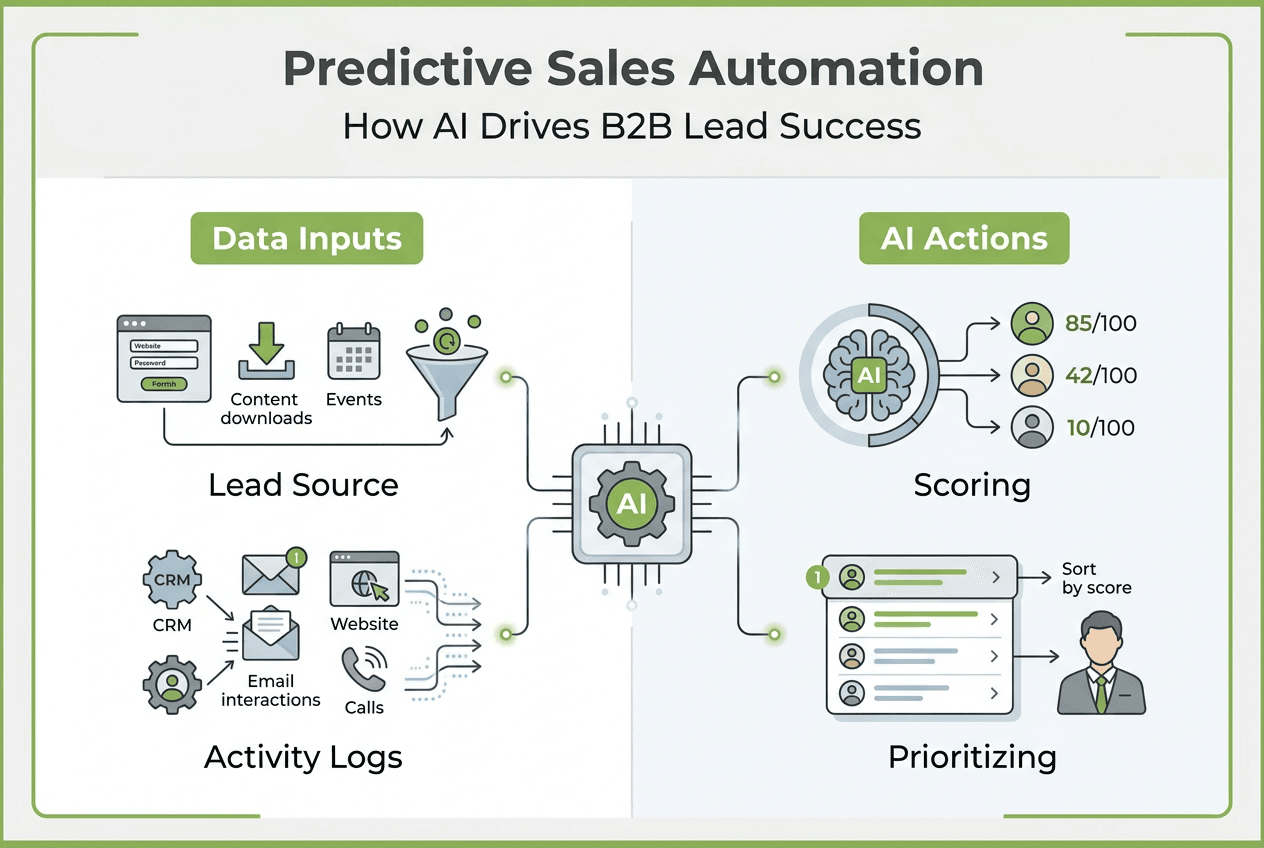
Predictive sales automation operates through three core components: quality data inputs, machine learning models, and lead scoring outputs. Understanding these elements helps you implement the technology effectively and troubleshoot when results fall short of expectations.

Data features such as lead source and status help machine learning classify leads by conversion likelihood. These variables consistently predict outcomes better than demographic data alone. A lead from a targeted industry event scores differently than one from a generic web form. Status indicators like email engagement, content downloads, or demo requests signal buying intent more reliably than job title or company size.
Gradient boosting classifiers and similar models analyze historical data to predict conversion probabilities. These algorithms examine thousands of past leads, identifying which combinations of features correlated with closed deals. A B2B software company used machine learning to improve identification of high-quality leads, reducing wasted outreach while increasing qualified pipeline.
The process follows these steps:
- Collect clean, structured lead data including source, engagement history, firmographic details, and behavioral signals.
- Train machine learning models on historical conversion data, teaching algorithms which patterns predict success.
- Apply trained models to new leads, generating probability scores that rank conversion likelihood.
- Route high-scoring leads to sales teams while nurturing lower-scoring prospects through automated sequences.
- Monitor model performance and retrain periodically as market conditions and ideal customer profiles evolve.
Lead scoring funnels top prospects to sales, aligning marketing efforts with sales priorities. A lead scoring 85 out of 100 gets immediate attention, while a 40-scorer enters a long-term nurture campaign. This prioritization ensures your best salespeople engage with your best opportunities.
| Data Feature | Impact on Scoring | Why It Matters |
|---|---|---|
| Lead source | High | Indicates quality and intent level of initial contact |
| Engagement status | High | Shows active interest and buying stage progression |
| Company size | Medium | Helps qualify budget and decision complexity |
| Job title | Medium | Identifies decision-making authority and influence |
| Geographic location | Low to Medium | Affects timing, compliance, and market fit |
Pro Tip: Review the AI lead generation case study to see how proper data structuring improved lead quality by 65% while reducing acquisition costs.
Automation supports scaling lead qualification but requires ongoing model evaluation and data updates. Models trained on 2024 data may perform poorly in 2026 if buyer behavior shifts or your product positioning changes. Regular retraining keeps predictions accurate and relevant.
The sales AI insights blog provides deeper technical guidance on selecting features, avoiding overfitting, and interpreting model outputs. Understanding these mechanics helps you ask the right questions when evaluating predictive automation platforms or building internal capabilities.
Pitfalls and best practices: balancing automation with human judgment
Over-automation can decrease reply rates and trust in sales outreach. When prospects receive obviously templated messages at scale, they disengage. Automation that ignores context, timing, or individual circumstances damages your brand and wastes opportunities. The technology amplifies whatever process you automate, good or bad.
As one sales expert notes:
“Automation scales behavior, not intelligence. If your manual process is broken, automation just breaks it faster and at higher volume.”
This insight captures why many automation initiatives fail. Leaders assume technology fixes poor processes, but automation simply executes existing workflows more efficiently. A confusing qualification process becomes chaotic at scale. Generic messaging becomes spam when multiplied across thousands of prospects.
Automation should inform human decisions, not replace sales judgment. Predictive scores tell you which leads deserve attention, but salespeople decide how to engage. A high score indicates potential, not a guarantee. Your team must interpret signals, adapt messaging, and apply relationship-building skills that no algorithm replicates.
Clear, data-driven signals help salespeople act at the right time. Intent signals like repeated website visits, specific content downloads, or pricing page views indicate readiness. Engagement metrics like email opens, link clicks, or event attendance show interest level. These signals guide when to reach out, what to discuss, and how aggressively to pursue.
Common pitfalls to avoid:
- Automating outreach without personalizing messages to prospect context and pain points
- Ignoring negative signals like unsubscribes, bounces, or spam complaints that damage sender reputation
- Setting and forgetting automation sequences without monitoring performance or updating based on results
- Over-relying on scores without human review of edge cases or unusual high-value opportunities
- Failing to align sales and marketing on qualification criteria, creating handoff confusion
Best practice combines AI to automate signals and humans to decide engagement. Let technology handle data processing, pattern recognition, and lead scoring. Reserve human effort for strategic decisions, creative problem solving, and relationship building. This division of labor maximizes both efficiency and effectiveness.
Pro Tip: The automation pitfalls blog explores specific failure modes and how to design processes that avoid them from the start.
When balancing AI and sales expertise, establish clear rules for when automation hands off to humans. A score above 75 might trigger immediate sales contact. Scores between 50 and 75 enter nurture sequences with periodic human review. Scores below 50 receive minimal automated touches until engagement increases.
These thresholds prevent automation from either overwhelming sales teams with marginal leads or missing genuine opportunities buried in lower scores. Regular calibration ensures the balance stays optimal as your market and offerings evolve.
Applying predictive sales automation effectively in your B2B organization
Lead prioritization maximizes resource allocation, focusing sales on viable opportunities. In practice, this means your top performers spend time on leads most likely to close rather than chasing cold prospects. The impact shows up in higher conversion rates, shorter sales cycles, and improved revenue per sales rep.
Digital marketing in B2B emphasizes personalized outreach supported by predictive insights. Marketing generates leads, automation scores them, and sales engages with context. This workflow ensures every touchpoint builds on previous interactions rather than starting from zero each time.
Implementation follows these practical steps:
- Audit your current lead data quality, identifying gaps in tracking, inconsistent fields, or missing engagement metrics.
- Define clear qualification criteria with sales and marketing aligned on what constitutes a quality lead.
- Select or build predictive models appropriate to your data volume, technical capabilities, and budget constraints.
- Integrate scoring into your CRM and sales workflows so scores appear where salespeople make decisions.
- Train your team on interpreting scores, understanding confidence levels, and knowing when to override automated recommendations.
- Monitor results weekly at first, then monthly, adjusting thresholds and retraining models as patterns emerge.
| Approach | Strengths | Best For |
|---|---|---|
| Off-the-shelf platform | Quick deployment, proven algorithms, ongoing support | Teams without data science resources |
| Custom-built model | Tailored to specific business, full control, proprietary advantage | Organizations with technical expertise |
| Hybrid solution | Balance of speed and customization, vendor partnership | Mid-sized B2B companies scaling rapidly |
Integrate AI-driven signals with personalized, timely sales outreach. When a lead scores high due to recent engagement, reach out within hours, not days. Reference the specific content they consumed or action they took. This responsiveness and relevance dramatically improve connection rates compared to generic delayed follow-up.
Align marketing and sales teams on shared data-driven qualification criteria. Disagreement on what makes a quality lead creates friction, wasted effort, and missed revenue. Predictive scoring provides objective standards both teams accept, reducing handoff conflicts and improving collaboration.
Regularly review and refine automation models and workflows for accuracy and relevance. Markets shift, competitors change tactics, and buyer preferences evolve. A model accurate in January may drift by June. Schedule quarterly reviews at minimum, more frequently during rapid growth or market disruption.
Balance automation volume with quality, ensuring human follow-up where it counts. You can automate initial outreach to thousands of prospects, but personalized follow-up to engaged leads requires human touch. Allocate resources accordingly, using automation to create opportunities and humans to close them.
Pro Tip: Book a free sales automation session to assess where predictive automation fits your current sales process and identify quick wins.
The B2B sales automation tips library offers specific playbooks for different industries, company sizes, and sales motions. These resources help you adapt general principles to your unique situation, avoiding one-size-fits-all approaches that rarely work in practice.
Measure success through metrics like conversion rate by score tier, time to first response, pipeline value from automated sources, and sales team satisfaction with lead quality. These indicators reveal whether your predictive automation delivers real business value or just generates activity without results.
Elevate your B2B outbound sales with expert AI solutions
Applying predictive sales automation effectively requires both technical capability and strategic insight. Lickfold Digital specializes in AI-driven prospecting and outbound sales automation tailored to B2B companies seeking measurable growth. Our platform deploys dedicated AI agents that identify, target, and engage decision-makers matching your ideal customer profile.
We handle the complete infrastructure, from dedicated warm-up email accounts to ongoing reputation management, ensuring your automated outreach maintains high delivery rates and genuine engagement. Human qualification of replies ensures sales teams receive only genuine opportunities, not false positives or low-intent responses.
Book your free session with Lickfold Digital AI experts to assess how predictive sales automation can maximize your efficiency and pipeline quality. We’ll analyze your current process, identify automation opportunities, and map a practical implementation path.
For deeper insights into AI-driven business growth, download the free ‘24/7 Business’ book, exploring how intelligent automation transforms sales, marketing, and operations across modern B2B organizations.
Frequently asked questions about predictive sales automation
What differentiates predictive automation from basic sales automation?
Basic automation executes predefined tasks like sending email sequences or logging activities without intelligent decision making. Predictive automation uses AI to analyze data, score leads, and recommend actions based on conversion likelihood. The predictive layer adds intelligence to determine which tasks matter most for each prospect.
How does predictive sales automation impact sales team workload?
It reduces time spent on low-potential leads and administrative tasks, allowing teams to focus on high-value activities like strategic conversations and relationship building. Salespeople receive pre-qualified, scored leads with context, eliminating manual research and guesswork. Overall workload shifts from quantity to quality interactions.
What data privacy considerations apply when using AI in sales?
You must comply with regulations like GDPR, CCPA, and industry-specific rules governing how you collect, store, and use prospect data. Ensure your automation platform provides data encryption, consent management, and audit trails. Transparency with prospects about data usage builds trust and reduces legal risk.
How do you measure success for predictive sales automation initiatives?
Track conversion rates by lead score tier, comparing high-scoring versus low-scoring lead performance. Monitor sales cycle length, pipeline value from automated sources, and cost per qualified opportunity. Sales team feedback on lead quality provides qualitative validation of quantitative metrics.
What are the initial steps for integrating predictive automation into existing workflows?
Start by auditing current lead data quality and identifying which sources and fields predict conversions. Define qualification criteria with sales and marketing alignment. Pilot with a small segment before full rollout, learning from results and refining models. The sales automation blog offers detailed implementation guides for various scenarios.
Can small B2B teams benefit from predictive sales automation or is it only for enterprises?
Small teams often benefit more because automation multiplies limited resources. A three-person sales team can engage hundreds of prospects simultaneously with proper automation, competing effectively against larger competitors. The key is starting with focused use cases rather than trying to automate everything at once.