
What is customer profile targeting? The B2B guide
What is customer profile targeting? The B2B guide
TL;DR:
- Most B2B sales teams mistake broad industry lists for effective targeting, leading to wasted effort.
- Customer profile targeting requires defining precise ICPs and buyer personas to improve outreach quality.
Most B2B sales teams believe they are doing customer profile targeting. They have a spreadsheet of industries, a rough idea of company size, and a list of titles to cold email. That is not targeting. That is hoping. What is customer profile targeting, really? It is the practice of defining your best-fit accounts with enough precision that every outreach decision, every message, and every prioritization call is guided by a clear picture of who will actually buy from you, and why.
Table of Contents
- Understanding customer profile targeting in B2B sales
- How to build rich customer profiles for more precise outreach
- Why specificity and precise segmentation matter in customer profile targeting
- Leveraging AI and unified data for personalized customer profile targeting
- Practical steps to implement effective customer profile targeting strategies
- The uncomfortable truth about customer profiles most teams ignore
- Stop guessing who your best customers are
- Frequently asked questions
Key Takeaways
| Point | Details |
|---|---|
| Customer profiles explained | An ideal customer profile targets companies most likely to buy, differentiated from buyer personas which focus on individuals. |
| Specificity drives success | Narrowing focus to specific customer segments improves engagement and sales efficiency. |
| Rich data matters | Combining direct feedback and behavior data creates actionable customer profiles for better targeting. |
| Unified data enables AI | Single Customer View across channels empowers AI to deliver personalized and predictive outreach. |
| Practical implementation | Segmentation, data integration, AI outreach, and team alignment are key to effective customer profile targeting. |
Understanding customer profile targeting in B2B sales
Customer profile targeting starts with a concept most sales directors have heard but fewer have applied correctly: the Ideal Customer Profile, or ICP. An ICP is account-level. It describes the type of company that gets the most value from your product, converts fastest, and stays longest. Think industry vertical, annual revenue, headcount, tech stack, geographic market, and growth stage.
A buyer persona is different. Where the ICP describes a company, the persona describes a person inside that company. Salesforce makes this distinction explicitly: the ICP defines the type of company, while the buyer persona is a semi-fictional representation of the ideal people inside those companies. Both serve different purposes and both are necessary in B2B.
Segmentation and targeting are also not the same thing. Segmentation is the act of grouping accounts by shared characteristics. Targeting is what you do with those groups: activating them with messaging that speaks directly to their situation. Many teams treat segmentation as the finish line. It is not. It is the starting line. True segmenting B2B audiences requires you to do something with each segment once you have defined it.
Here is why combining ICP and buyer persona matters in practice:
- Your ICP tells you which companies belong in your pipeline
- Your buyer persona tells you which person to contact at each company
- Together, they tell you what to say and why it will land
- Without both, your outreach becomes generic, and generic gets ignored
- B2B decision maker targeting fails when you reach the right company with the wrong message for the wrong person
The intersection of a tight ICP and a well-built persona is where lead quality actually improves.
How to build rich customer profiles for more precise outreach
Most customer profiles are built from the inside out: sales teams guess at what their best customers look like based on who they already work with. That produces a biased, narrow picture. The goal is to build profiles from multiple data sources so they reflect reality, not assumption.
Qualtrics recommends blending direct feedback like surveys and interviews with indirect signals like behavioral data, and using technology to pull the full picture together in one place. That combination matters because what customers say they care about and what their behavior reveals are often different. A VP of Sales may say pricing is the top concern but consistently engage with content about integration complexity. That gap is where your real message lives.
The practical steps to build a usable profile:
- Define firmographics first. Industry, revenue band, headcount, geography, and tech stack form the skeleton of your ICP.
- Identify pain points. What specific problems does your product solve? Interview five to ten current customers about the exact moment they decided to buy.
- Gather behavioral signals. Which pages do prospects visit before converting? What email subject lines drive replies? Behavioral patterns reveal intent.
- Collect direct feedback. Run structured interviews with both won and lost deals. Lost deal interviews are often more valuable.
- Consolidate everything in your CRM. Zendesk’s five-step approach includes identifying pain points, mapping common demographics and behaviors, gathering feedback, and then integrating all of it into a CRM to track the full customer journey.
The last step is the one teams skip most. A profile that lives in a slide deck does nothing. A profile that lives in your CRM shapes every touchpoint.
Pro Tip: Schedule a quarterly profile review. Markets shift, buyer priorities evolve, and the ICP that worked 18 months ago may now be attracting the wrong companies. Stale profiles produce stale pipelines.
Once your profiles are built, the real payoff comes from applying them to messaging customization for lead generation. A message written for a specific pain point at a specific company type will always outperform a template.
Why specificity and precise segmentation matter in customer profile targeting
There is a trap sales directors fall into when they first build an ICP: they make it too broad because they are afraid of excluding potential revenue. “We work with B2B companies in North America” is not a profile. It is a continent.
“Specificity is the key risk-reducer for ICPs. Targeting everybody fails because prospects ignore generic messaging.” — Salesforce
Salesforce’s guidance on specificity is direct: the more precise your ICP, the less likely prospects are to disengage. When a message speaks to your exact situation, your team size, your industry, and your current growth stage, it does not feel like outreach. It feels like someone has done their homework.
The cost of broad targeting is not just low reply rates. It is also wasted time. Sales reps chasing accounts that will never close are not chasing accounts that will. A tight ICP shortens the sales cycle because qualification happens before outreach, not during it.
Here is what precise segmentation actually unlocks for your team:
- Shorter qualification calls. You already know the account fits before you dial.
- Higher reply rates. Messages written for a specific segment resonate more than generic sequences.
- Better sales and marketing alignment. When both teams agree on the ICP, campaign targeting and outreach priorities stay in sync.
- Lower cost per lead. Fewer wasted contacts means better return on every outreach dollar.
Brandwatch highlights a gap many teams fall into: they stop at segmentation but skip the activation step. Grouping accounts is not the same as reaching them with messages tailored to each group. That activation step is what turns AI outreach tactics for B2B leads from a volume play into a precision instrument.
Understanding audience targeting concepts at this level separates sales directors who generate predictable pipeline from those who are always guessing.
Leveraging AI and unified data for personalized customer profile targeting
You can build a perfect ICP and still produce inconsistent outreach if your data lives in silos. A prospect who downloaded a whitepaper last month, attended a webinar this week, and replied to a cold email yesterday should be treated as a warm, engaged lead. If your CRM, marketing automation platform, and email tool do not talk to each other, that context disappears and your next message treats them like a stranger.

This is where the Single Customer View (SCV) becomes critical. An SCV merges all data about a contact and their company into one unified record. To build one, you need to match data across systems. There are two methods:
| Matching method | How it works | Best for |
|---|---|---|
| Deterministic | Exact match on email, phone, or unique ID | High confidence, low coverage |
| Probabilistic | Pattern-based matching using name, company, behavior | Higher coverage, some margin of error |
A CDP implementation approach notes that without reliable identity resolution across these methods, personalization can feel generic or fragmented, even when teams believe they are being targeted. Prospects notice. A message that references the wrong pain point or ignores a recent interaction signals that you are not paying attention.
Once data is unified, AI can do things that manual outreach cannot. It can score accounts by propensity to buy based on behavioral patterns. It can predict the best time to reach a specific contact. It can identify which message angle worked best for similar accounts and apply that learning automatically. The result is B2B personalization results that scale without requiring a larger team.
Pro Tip: Start with deterministic matching as your foundation. Get emails and company domains consistent across your tools first. Probabilistic matching becomes more reliable once your clean data layer is in place.
Without data unification, even the most detailed ICP produces AI-driven sales campaigns that underperform because the system cannot connect the dots between touchpoints.
Practical steps to implement effective customer profile targeting strategies
Understanding the theory is one thing. Building a system that runs continuously is another. Here is how to move from concept to execution.
Step 1: Run a segmentation sprint. Pull your last 50 closed-won deals. Identify the three to five firmographic and behavioral characteristics they share. That is your working ICP. It is grounded in reality, not assumption.
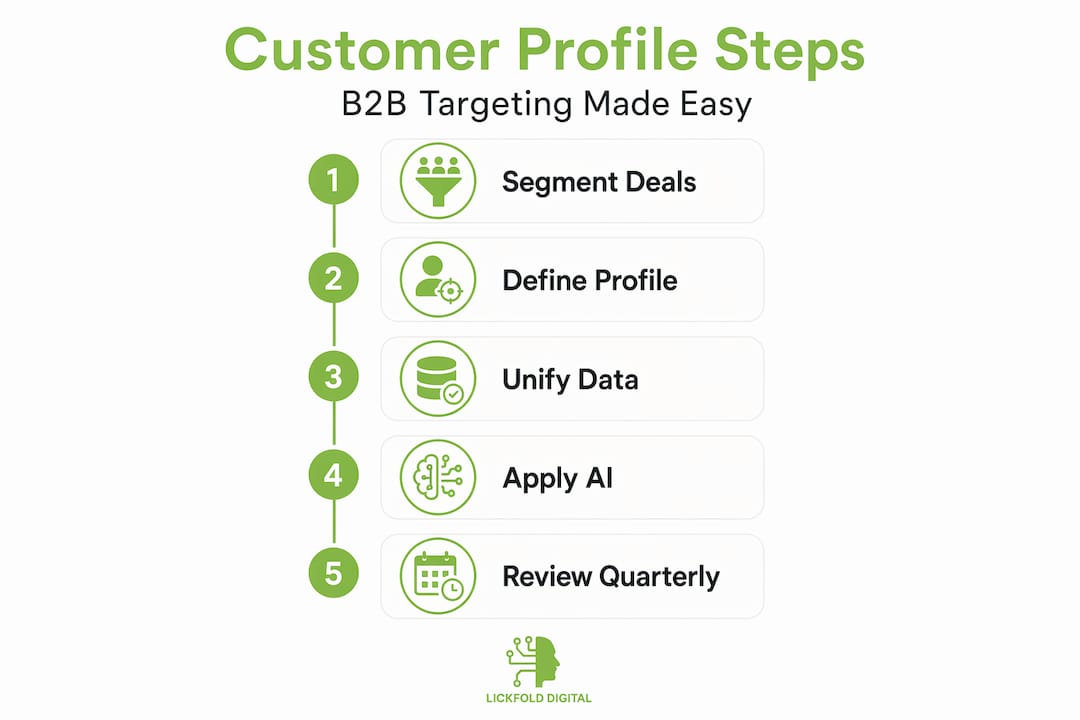
Step 2: Build your data infrastructure. Your CRM should hold the ICP criteria as filterable fields. Every account should be scored against your ICP before it enters your pipeline. Use a Customer Data Platform (CDP) if you are running outreach across multiple channels. The goal is one clean record per account.
Step 3: Deploy AI-powered outreach by segment. Audience targeting done right means each segment gets messages written for its specific pain points, not a personalization token swapped into a generic template. AI can generate and sequence these messages at scale, adjusting based on engagement signals in real time.
Step 4: Measure leading indicators, not just closed deals. Track reply rate by segment, meeting rate by ICP tier, and pipeline velocity by persona. These numbers tell you which profiles are working before you wait for revenue data.
Step 5: Iterate quarterly. Update your profiles based on what the data shows. If your top segment is shifting from Series B SaaS companies to growth-stage logistics firms, your ICP needs to reflect that.
The operational checklist that keeps this running:
- Weekly review of ICP match rate for new pipeline entries
- Monthly audit of outreach reply rates by segment
- Quarterly ICP refinement session with sales and marketing
- Ongoing data enrichment to keep contact records current
- Multi-channel outreach strategies reviewed against ICP performance data
Pair this with a personalized email outreach guide to ensure your messaging execution matches the precision of your targeting.
The uncomfortable truth about customer profiles most teams ignore
Here is an opinion grounded in watching B2B sales teams operate at scale: most companies build their ICP once, present it in a kickoff meeting, and never look at it again. The profile becomes a document rather than a living system. And then, six months later, the team wonders why lead quality has dropped.
The real failure mode is not building a bad ICP. It is treating the ICP as a finished product instead of a hypothesis that the market continuously tests. Every reply you get, every deal you lose, and every sales call that ends in “not the right fit” is data that should feed back into your profile. Most teams never close that loop.
There is also a pattern we see regularly: teams confuse targeted with narrow. A precise ICP does not mean you are limiting your market. It means you are concentrating your effort where conversion probability is highest. You can still pursue adjacent segments, but you do it with full awareness that conversion rates will be lower until you understand those segments as well as your core one.
The most effective sales directors we work with treat their ICP as they would treat a pricing model: reviewed regularly, updated based on evidence, and never assumed to be permanent. When you combine that discipline with AI-powered outreach that reads engagement signals in real time and adjusts messaging accordingly, you stop guessing about lead quality and start engineering it.
Stop guessing who your best customers are
If you are building outreach campaigns without a tightly defined ICP and segment-specific messaging, you are funding a volume experiment instead of a targeting system. Lickfold Digital’s AI-driven platform changes that equation.
The platform identifies accounts that match your ICP, locates the right decision-makers within those organizations, and runs personalized multi-touch outreach campaigns at scale — without generic templates or spray-and-pray sequencing. Dedicated AI agents handle market research, outreach execution, and follow-up while your team focuses on qualified conversations. If you want a pipeline built on precision rather than volume, see how it works.
Frequently asked questions
What is the difference between an ideal customer profile and a buyer persona?
An ideal customer profile defines the type of company your business targets, focusing on firmographics like industry and revenue, while a buyer persona represents the individual decision-makers within those companies. Salesforce describes ICPs as defining the company type and personas as defining the people inside it you need to influence.
Why is data unification important for personalized outreach?
Data unification creates a Single Customer View across channels, enabling AI to deliver consistent, context-aware messages at every touchpoint. Without it, personalization feels generic or contradictory because systems cannot connect the dots between interactions.
How can AI improve customer profile targeting in B2B sales?
AI analyzes unified customer data to predict buying behavior, score leads by propensity to convert, and automate the most effective outreach sequence for each profile at scale. The predictive modeling and next best action logic built into modern AI tools makes personalization automatic rather than manual.
What are common mistakes when creating customer profiles?
The two most costly mistakes are confusing buyer personas with ICPs and building ICPs that are too broad to guide real targeting decisions. Overly broad ICPs reduce lead quality because they fail to filter out accounts that will never convert, wasting sales capacity on the wrong companies.