
How to identify decision makers for B2B sales success
How to identify decision makers for B2B sales success
Finding the right person to talk to can make or break your B2B sales efforts. Many marketing professionals waste valuable time and resources reaching out to contacts who lack purchasing authority, only to discover weeks later that they’ve been speaking with the wrong people. This guide walks you through proven strategies to accurately identify decision makers within target organizations, verify their authority, and engage them effectively to improve your lead generation outcomes and conversion rates.
Table of Contents
- Key takeaways
- Understanding who the decision makers are
- Preparing to identify decision makers: tools and data sources
- Step-by-step process to identify decision makers
- Common challenges and verification strategies
- Enhance your decision maker targeting with expert support
- How to identify decision makers - FAQ
Key Takeaways
| Point | Details |
|---|---|
| Identify decision makers | Combine multiple data sources to accurately identify who holds budget authority within target organizations. |
| Verify authority before outreach | Cross reference titles across LinkedIn, company sites, CRM data, and industry databases to confirm current roles. |
| Personalize outreach by role | Tailor messages to decision maker priorities based on their role and budgeting authority. |
| Leverage AI powered tools | Use AI powered tools to automate data collection and keep contact information current, improving accuracy and saving time. |
Understanding who the decision makers are
A decision maker is someone with the authority to approve purchases, sign contracts, or allocate budget for your solution. They hold the final say in whether your proposal moves forward or gets rejected. In contrast, influencers provide input and recommendations but cannot make binding commitments. Gatekeepers control access to decision makers, screening calls and emails to protect their time.
Distinguishing between influencers and final decision makers is essential for targeting in B2B sales. Misidentifying roles leads to prolonged sales cycles and missed opportunities. A marketing manager might champion your product internally, but the VP of Marketing or CFO typically controls the budget. Understanding this distinction prevents you from pitching to someone who can only pass your message along.
Organizational hierarchy varies significantly by company size and industry. Startups often have flat structures where founders make all purchasing decisions. Mid-sized companies typically involve department heads and finance teams. Enterprise organizations use buying committees with multiple stakeholders, each playing a specific role in the evaluation process.
“In complex B2B sales, you’re rarely selling to one person. You’re selling to a committee where each member has different priorities, concerns, and levels of authority.”
Recognize these common decision maker profiles:
- C-suite executives for strategic initiatives and large investments
- Department heads for operational tools and team resources
- Procurement officers for vendor selection and contract terms
- Finance directors for budget approval and payment authorization
Preparing to identify decision makers: tools and data sources
Successful identification requires combining multiple data sources to build accurate contact profiles. LinkedIn remains the most valuable professional network for researching job titles, responsibilities, and organizational relationships. Company websites provide official organizational charts, leadership bios, and press releases announcing personnel changes. Your CRM system stores historical interaction data that reveals buying patterns and internal champions.

Industry databases like ZoomInfo, Crunchbase, and industry association directories offer verified contact information and company intelligence. These platforms aggregate data from multiple sources, reducing the manual effort required to build prospect lists. However, data accuracy varies, making verification essential before outreach.
Research tools for decision makers improve accuracy when used strategically. Cross-reference information across at least three sources to confirm current roles and responsibilities. A contact listed as Marketing Director on LinkedIn might have been promoted to VP six months ago, information reflected on the company website but not yet updated in third-party databases.
| Data source | Best use case | Typical accuracy |
|---|---|---|
| Job titles, professional background, network connections | 85-90% current | |
| Company websites | Official roles, organizational structure, recent announcements | 95% current |
| Industry databases | Contact details, company size, technology stack | 70-80% current |
| CRM historical data | Past interactions, buying behavior, internal relationships | Varies by maintenance |
Verify job titles carefully because similar titles carry different authority across organizations. A Director at a 50-person company might have decision-making power equivalent to a VP at a Fortune 500 firm. Look beyond the title to understand actual responsibilities and budget control.
Pro Tip: Use AI-powered tools to automate data collection and continuously update contact information, saving hours of manual research while maintaining higher accuracy rates than static databases.
Step-by-step process to identify decision makers
Follow this systematic approach to pinpoint the right contacts within your target accounts:
-
Research the company’s organizational chart and identify key departments relevant to your solution. Most companies publish leadership information on their About Us or Team pages. Note reporting structures to understand who holds budget authority.
-
Identify individuals with job titles typically associated with purchasing decisions in your category. For marketing technology, look for CMOs, Marketing Directors, or Marketing Operations Managers. For HR solutions, target Chief People Officers or HR Directors.
-
Validate contacts through social media profiles and professional networks. Review LinkedIn activity to confirm they’re actively engaged in their role. Check for recent posts, job changes, or promotions that might affect their current responsibilities.
-
Map relationships between influencers, gatekeepers, and decision makers. Document who reports to whom and identify potential champions who can facilitate introductions. Understanding these connections helps you navigate organizational politics effectively.
-
Confirm the decision maker’s current authority through direct outreach or secondary sources. A brief exploratory call or email can clarify whether they have budget approval or if additional stakeholders need involvement. Industry contacts or mutual connections can provide insider knowledge about buying processes.
A methodical identification process improves lead targeting and sales success. Document your findings in a structured format that your entire team can access and update. This prevents duplicate outreach and ensures everyone understands the account’s buying dynamics.
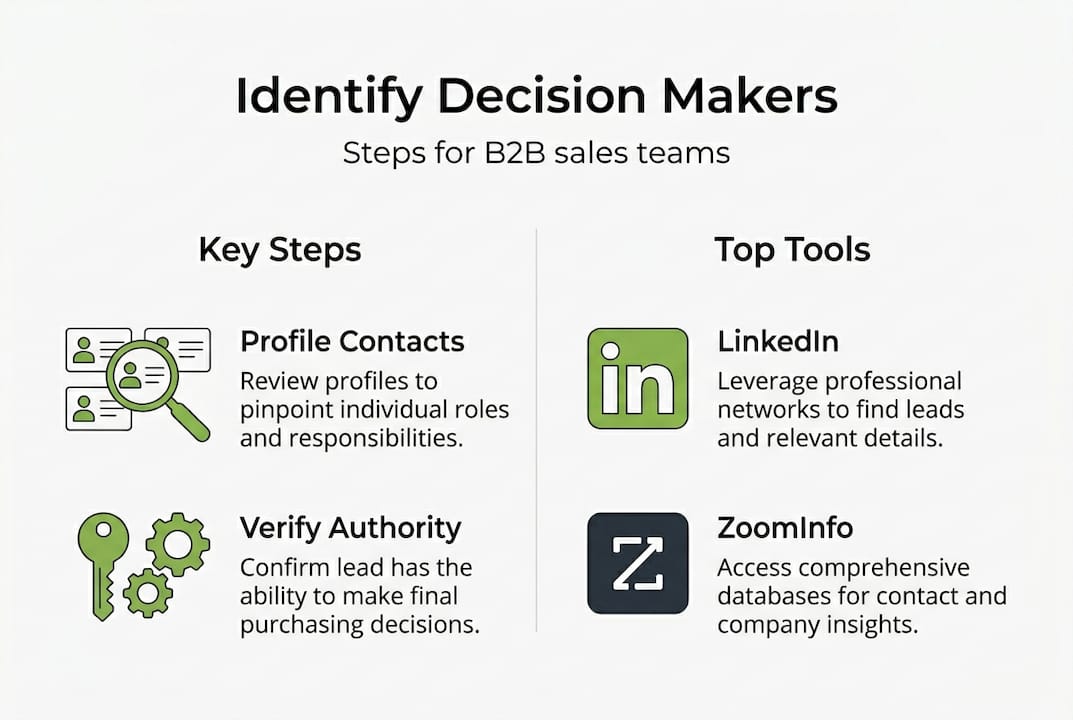
Pro Tip: Keep detailed notes in your CRM tracking each contact’s role, authority level, and relationship to other stakeholders. Include dates of verification so you know when to refresh your research.
Common challenges and verification strategies
Outdated contact information represents the most frequent obstacle in decision maker identification. People change roles, companies restructure, and databases lag behind reality. Verify information through multiple data points before investing time in personalized outreach. Check LinkedIn profile updates, company press releases, and recent social media activity to confirm current positions.
Misidentified roles due to ambiguous titles create wasted effort and damaged credibility. A “Head of Growth” might own marketing decisions at one company but report to the CMO at another. Before reaching out, research the individual’s actual responsibilities through their LinkedIn posts, conference speaking topics, or published articles. These activities reveal what they truly care about and control.
Gatekeepers blocking access frustrate even experienced sales professionals. Executive assistants and office managers protect their executives’ time by filtering communications. Treat gatekeepers as valuable allies rather than obstacles. Respectful, transparent communication about your purpose and value often earns their support in facilitating introductions.
Verification techniques reduce wasted effort on wrong contacts and improve conversion rates. Use these methods to confirm decision maker status:
- Direct confirmation calls asking, “Are you the right person to discuss [specific solution category]?” Most professionals appreciate the directness and will redirect you if appropriate.
- LinkedIn endorsements and recommendations revealing actual responsibilities and expertise areas
- Cross-referencing with industry reports, conference speaker lists, and trade publication quotes
- Monitoring company announcements for organizational changes and new appointments
| Challenge | Impact | Verification strategy |
|---|---|---|
| Outdated contact info | 30-40% of outreach bounces | Check multiple sources, verify within 30 days of outreach |
| Ambiguous job titles | Misaligned messaging, low response rates | Research actual responsibilities through content and activity |
| Gatekeeper barriers | Delayed or blocked access | Build rapport, demonstrate clear value proposition |
| Multiple decision makers | Incomplete stakeholder mapping | Ask current contacts about buying process and committee members |
When you encounter resistance or uncertainty, ask direct questions about the buying process. Most professionals respect transparency and will explain who else needs involvement. This approach builds trust while gathering intelligence about the complete decision-making unit.
Enhance your decision maker targeting with expert support
Identifying decision makers manually consumes significant time and resources that could be spent on actual selling. Lickfold Digital AI experts automate the entire research and identification process using artificial intelligence trained to recognize buying authority patterns across industries and company sizes.
Our AI agents perform continuous market research, locate relevant decision makers, and verify their current authority before initiating contact. This eliminates the guesswork and outdated data that plague traditional prospecting methods. The system maintains dedicated infrastructure including warm-up email accounts and reputation management to ensure your messages reach inboxes.
Ready to transform your lead generation with precision targeting? Book your free session to discover how our AI-powered platform identifies and engages decision makers at scale. You can also download our free business book exploring strategies for building predictable B2B growth through intelligent automation.
How to identify decision makers - FAQ
What is the difference between a decision maker and an influencer?
A decision maker holds final authority to approve purchases and sign contracts, while an influencer provides recommendations and input without binding commitment power. Decision makers control budget allocation and can say yes definitively. Influencers champion solutions internally but must escalate to decision makers for approval.
How can I verify if someone is the actual decision maker?
Ask directly during initial conversations whether they have authority to approve purchases in your solution category, or if additional stakeholders need involvement. Cross-reference their LinkedIn profile, company organizational charts, and recent announcements to confirm their role. Check if they’ve signed contracts or made similar purchases based on public records or industry contacts.
What tools provide reliable data on decision makers?
LinkedIn Sales Navigator offers the most current professional information and organizational insights. ZoomInfo and Crunchbase provide comprehensive company intelligence and verified contacts. Industry association directories and company websites deliver official role confirmations. Combining at least three sources significantly improves accuracy over relying on single databases.
How should I approach gatekeepers effectively?
Treat gatekeepers as professional allies by being transparent about your purpose and respectful of their role protecting executive time. Clearly articulate the specific value you offer and why a conversation benefits their executive. Ask for their guidance on the best way to connect rather than trying to bypass them, which builds rapport and often earns their support.
Can job titles be misleading when identifying decision makers?
Yes, identical titles carry vastly different authority levels across organizations based on company size, industry, and structure. A Director at a startup might have C-suite equivalent power, while the same title at an enterprise requires VP approval. Always research actual responsibilities, budget control, and reporting relationships rather than assuming authority based solely on title.