
Multi-channel outreach strategies for faster lead generation
Multi-channel outreach strategies for faster lead generation
TL;DR:
- Multi-channel outreach increases response rates and pipeline speed compared to single-channel strategies.
- AI-driven personalization optimizes timing and messaging, boosting revenue growth and engagement.
- Coordinating channels effectively builds trust and familiarity, converting cold leads into qualified prospects.
Single-channel outreach is no longer a viable strategy for B2B sales teams serious about growth. Buyers today interact across email, LinkedIn, phone, and more before they ever respond to a vendor. If your team is still relying on one channel to carry the entire pipeline, you are leaving a significant portion of your addressable market untouched. AI-driven multi-channel outreach changes this equation entirely, allowing you to reach the right decision-makers, at the right time, through the channels they actually prefer. This article walks you through the frameworks, tools, and metrics that make it work.
Table of Contents
- What is multi-channel outreach and why does it matter?
- Key channels for B2B outreach in 2026
- How AI transforms multi-channel outreach
- Integrating and measuring your multi-channel outreach
- Why most B2B teams underestimate multi-channel outreach’s true value
- Accelerate your lead generation with expert AI-powered outreach
- Frequently asked questions
Key Takeaways
| Point | Details |
|---|---|
| Multi-channel means more touchpoints | Engaging prospects across multiple platforms increases your chances of response and conversion. |
| AI boosts personalization | Artificial intelligence enables tailored messages and smart timing that drive better results. |
| Metrics drive improvement | Tracking detailed channel performance helps optimize outreach for maximum lead generation. |
| Integration beats volume | Orchestrated, insight-driven campaigns outperform sporadic multi-channel efforts. |
What is multi-channel outreach and why does it matter?
Multi-channel outreach is the practice of engaging prospects across more than one communication platform, coordinating touchpoints so that each interaction reinforces the last. Instead of sending a cold email and waiting, you follow it with a LinkedIn connection request, a personalized message, a phone call, and possibly a direct mail piece. Each channel builds on the credibility of the previous one.
The difference between single-channel and multi-channel outreach is not just about reach. It is about resonance. A prospect who ignores an email might respond to a LinkedIn message hours later. The same person might pick up the phone because they already recognize your name from two prior touchpoints. That recognition effect compounds over time and dramatically improves conversion rates.
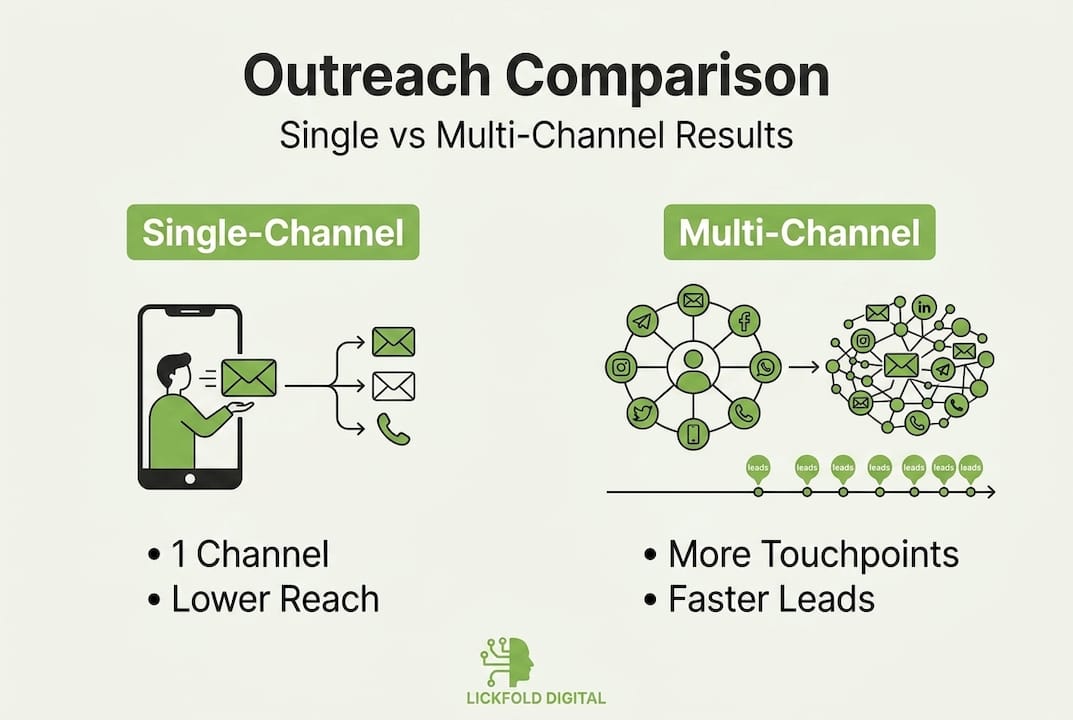
| Approach | Channels used | Average response rate | Pipeline velocity |
|---|---|---|---|
| Single-channel | 1 (e.g., email only) | 1% to 3% | Slow |
| Multi-channel | 3 or more | 8% to 15% | 2x to 3x faster |
| AI-powered multi-channel | 4+ with dynamic sequencing | 18% to 25% | 3x to 5x faster |
B2B buyers today expect what researchers call “seamless interactions” across every touchpoint they use with a vendor. According to multi-channel outreach benefits, buyers who encounter a brand across multiple consistent channels are far more likely to trust that brand enough to book a call. The expectation is not just presence across channels. It is coherent presence, where the message adapts to the platform but the core value proposition remains constant.
Here is why this matters for sales and marketing directors specifically:
- Your competitors are already running multi-channel sequences.
- Decision-makers receive dozens of cold emails daily. Differentiation requires more than good copy.
- Channel diversity protects your pipeline from algorithm changes, inbox filtering, or LinkedIn connection limits.
- Coordinated outreach creates a perception of scale and professionalism, even for smaller teams.
AI-driven personalization is what separates an effective multi-channel strategy from a chaotic one. Without intelligence guiding which channel to use, when to reach out, and what to say, you risk bombarding prospects and damaging relationships before they start. With AI, timing and messaging adapt to prospect behavior in real time. The 40% revenue growth seen in AI-driven outreach programs is not accidental. It reflects the compounding effect of personalization across multiple coordinated channels.
“The goal of multi-channel outreach is not to be everywhere. It is to be exactly where your buyer is, at exactly the right moment, with the right message.”
Key channels for B2B outreach in 2026
Understanding why multi-channel outreach is effective raises an important question: which channels should you prioritize? The answer depends on your audience, your offer, and your sales cycle. But in 2026, five channels consistently produce results in B2B environments.
| Channel | Best for | Key advantage | Main limitation |
|---|---|---|---|
| Detailed offers, long sales cycles | Scalable, measurable | High inbox competition | |
| Senior decision-makers, SaaS | Warm context, professional trust | Volume limits per account | |
| Phone | Mid-to-late funnel, relationship building | High conversion if answered | Time-intensive, low pick-up rates |
| SMS | Fast follow-ups, event reminders | High open rates (98%) | Requires prior consent |
| Direct mail | High-value accounts, executive tier | Standout, physical engagement | Higher cost per touch |
Email remains the backbone of most B2B outreach strategies. Personalized email outreach consistently outperforms generic blasts, particularly when subject lines reference a specific pain point or trigger event. The key is treating each email as the start of a conversation, not a broadcast. Optimize your email outreach process to ensure you are sequencing follow-ups correctly and maintaining deliverability by warming up dedicated sending accounts.
LinkedIn is particularly powerful for reaching VP and C-suite buyers in technology, finance, and professional services. A connection request followed by a non-salesy opening message, then a value-add resource, and finally a soft CTA performs significantly better than jumping straight to a pitch. The platform also allows you to engage with a prospect’s content before making direct contact, which builds familiarity.

Phone outreach is underused by digital-first teams, yet it often accelerates deals in the mid-to-late stages of a sales cycle. When a prospect has already seen your name in their inbox and on LinkedIn, they are more likely to engage on a call. Cold calls without prior touchpoints have pick-up rates below 5%. Multi-channel primed calls can reach 20% or higher.
SMS deserves serious consideration for time-sensitive follow-ups or event-based outreach. Open rates for SMS exceed 90% within the first three minutes of delivery. Used sparingly and appropriately, it can move a stuck conversation forward quickly.
Direct mail is having a resurgence for account-based marketing (ABM) at the enterprise level. A well-crafted physical piece targeting a specific executive creates a tactile impression no digital channel can replicate.
Good messaging customization techniques ensure that what you say on each channel feels native to that platform, not copy-pasted from a template.
Pro Tip: Do not launch all five channels simultaneously. Start with email and LinkedIn as your primary pair. Add phone in week two. Introduce direct mail for your top 10% accounts. Test SMS only after you have explicit consent and a compelling reason to use it.
How AI transforms multi-channel outreach
Once the channels are in place, the next advancement is using AI to maximize their impact across every touchpoint. Without AI, multi-channel outreach becomes a manual coordination nightmare. With it, your entire sequence operates like a disciplined, data-driven team working around the clock.
70% of sales campaign growth in 2026 is attributed to AI-powered systems. That figure reflects a fundamental shift in how outbound sales is executed. AI is not just automating tasks. It is making intelligent decisions about when to act, what to say, and which channel to use based on live behavioral data.
Here is how AI integrates into a typical multi-channel outreach workflow:
- Prospect identification. AI scans target markets to identify companies that match your ideal customer profile (ICP). It analyzes firmographic data, technographic signals, and intent data to prioritize accounts most likely to convert.
- Contact enrichment. Once a target account is identified, AI locates the decision-makers within that organization, their roles, communication preferences, and recent activity across public platforms.
- Sequence building. AI determines the optimal channel order and timing for each prospect, based on historical engagement patterns and industry benchmarks. A manufacturing CFO might respond better to phone after two emails. A SaaS marketing director might engage on LinkedIn first.
- Message generation. AI drafts personalized messages for each touchpoint using data points specific to the prospect, such as a recent funding announcement, a new product launch, or a role change.
- Adaptive follow-up. When a prospect opens an email three times without replying, AI flags that behavior and triggers a different channel or a refined message variant. Static sequences miss this signal entirely.
- Qualification routing. Replies are reviewed, warm leads are separated from unsubscribes or objections, and qualified conversations are passed to your sales team with full context.
AI-driven prospecting tips emphasize the importance of using AI not as a replacement for human judgment but as an amplifier. Your sales team’s expertise becomes more valuable, not less, when AI handles the volume and they handle the conversations.
AI sales workflow tools that integrate CRM data, email sequencing, LinkedIn automation, and analytics into a single platform are now table stakes for competitive outbound teams.
Pro Tip: Use AI-generated engagement scoring to rank your prospect list weekly. Focus your human effort on the top 20% of accounts showing behavioral signals like profile visits, email opens, or content engagement. Let automation handle the rest until they warm up.
Integrating and measuring your multi-channel outreach
With smart technology powering outreach, the last piece is ensuring seamless integration and ongoing optimization. A multi-channel strategy that is not measured is just expensive guessing.
Here is a practical step-by-step approach to integrating your channels and teams:
- Define your ICP and segmentation. Before touching any tool, agree on who you are targeting, which verticals, company sizes, job titles, and pain points. This shapes everything else.
- Map the sequence. Decide the order of channels and the timing between each touchpoint. A typical sequence might be: Day 1 email, Day 3 LinkedIn connect, Day 5 LinkedIn message, Day 8 email follow-up, Day 12 phone call.
- Set up your infrastructure. This includes dedicated sending domains for email, warmed-up accounts to protect deliverability, and LinkedIn accounts calibrated to avoid platform restrictions.
- Brief your team on handoffs. Decide exactly what constitutes a qualified lead and who picks it up after AI qualification. Ambiguity here kills momentum.
- Launch, monitor, and test. Run two or three message variants per channel. Let data tell you which works better within the first two weeks. Adjust accordingly.
Following decision-maker engagement tips for B2B contexts helps ensure your outreach respects the buying process rather than steamrolling it.
Once your sequence is live, track these metrics consistently:
- Response rate per channel and per sequence step
- Positive reply rate as a separate metric from total replies
- Meeting booked rate from first contact to calendar invite
- Channel attribution showing which touchpoint drove the final conversion
- Pipeline velocity measuring average days from first contact to qualified opportunity
- Bounce and unsubscribe rates to protect sender reputation
“What gets measured gets managed, and in outreach, what gets managed consistently generates compounding returns over time.” — Experienced B2B growth strategist
Measuring AI-driven campaign performance gives you the feedback loop needed to stop guessing and start optimizing with precision. When you see that LinkedIn messages sent on Tuesday mornings produce a 22% response rate compared to 9% on Friday afternoons, you act on that insight immediately.
The real power of measurement is not in the individual data points. It is in the patterns that emerge over 30, 60, and 90 days of consistent outreach. Those patterns tell you where your ICP actually lives, what message resonates with them, and which channel sequence produces the fastest pipeline movement. That is where your competitive advantage compounds.
Why most B2B teams underestimate multi-channel outreach’s true value
Here is the uncomfortable truth: most teams treat multi-channel outreach as a volume game. They add LinkedIn to their email sequences, pat themselves on the back, and call it multi-channel. The results are predictably mediocre.
True multi-channel mastery is about orchestration, not just coverage. Each channel should reinforce the last, building familiarity and trust in a deliberate arc. When you approach it this way, the amplification effect is real. A prospect who has seen your brand across three coordinated touchpoints before your first call is not a cold lead anymore. They are already pre-sold on paying attention.
We have seen teams double their qualified pipeline not by adding more channels but by tightening the coordination between the channels they already use. The sequence logic, the timing, the message adaptation, and the behavioral triggers all matter far more than raw outreach volume.
Personalization-led growth is the engine behind this. Generic messaging across multiple channels is still generic. The teams that win are the ones testing constantly, adapting based on real data, and seeing the compounding effect of small improvements made consistently over time. Sporadic multi-channel activity is just noise. Coordinated, insight-driven campaigns are the signal your buyers actually respond to.
Accelerate your lead generation with expert AI-powered outreach
Ready to go beyond theory? Here is how you can implement these strategies with expert help.
Building an effective multi-channel outreach system from scratch takes time, infrastructure, and deep expertise in AI-driven sequencing. Many B2B directors have the strategy right but lack the execution capacity to run it consistently at scale.
Lickfold Digital AI outreach experts help B2B sales and marketing leaders turn outreach strategies into fully operational, high-performing systems. From ICP research and AI agent deployment to personalized messaging, deliverability management, and human-qualified lead handoffs, every element is handled for you. If you are ready to build a predictable pipeline without expanding your headcount, visit our contact page to start a conversation about a customized outreach strategy that fits your market and growth goals.
Frequently asked questions
What is the best channel for B2B multi-channel outreach?
The best channel depends on your audience, but combining email with LinkedIn and phone outreach significantly increases engagement rates compared to relying on any single platform.
How does AI personalize outreach at scale?
AI enables dynamic, data-driven personalization of messages and timing across channels, producing more relevant interactions. This level of personalization drives up to 40% revenue growth when applied consistently across outreach sequences.
What metrics should I track to measure multi-channel outreach success?
Key metrics include response rate, engagement per channel, lead conversion rate, and pipeline velocity. Tracking AI campaign performance over time is what separates teams that optimize from teams that guess.
Is multi-channel outreach only for large teams or budgets?
Even small teams can run effective multi-channel outreach by using AI tools to automate sequencing, personalization, and follow-up, keeping overhead low while maintaining consistent prospect engagement across every touchpoint.