
Automated market entry: Streamline B2B expansion with smarter tech
Automated market entry: Streamline B2B expansion with smarter tech
TL;DR:
- Automated market entry uses digital tools and AI to identify and engage new markets faster.
- Human oversight remains essential for strategy, quality control, and interpreting complex buying signals.
- Important metrics include qualified lead rate, engagement, conversion rates, and time-to-first-contact.
Automated market entry sounds like a marketer’s dream: point your tools at a new region or sector, press go, and watch qualified leads flow in. The reality is more nuanced, and that’s actually good news for your team. While some vendors now promote fully autonomous execution as a replacement for human-operated workflows, the most durable and effective B2B market entry strategies treat automation as an accelerator, not a replacement. This guide breaks down exactly what automated market entry means, how it works across the full prospecting cycle, and where your team’s judgment is still the deciding factor.
Table of Contents
- Defining automated market entry: Balancing tech and human strategy
- Core components: How automated market entry works in practice
- Automation vs. autonomy: The strategic role of human oversight
- Measuring success: What to track in automated market entry
- Why “set and forget” automation falls flat in real B2B market entry
- Unlock your team’s market entry potential with expert automation
- Frequently asked questions
Key Takeaways
| Point | Details |
|---|---|
| Automation needs oversight | Combining technology with human expertise is the most effective approach to B2B market entry. |
| Optimize the process | Automated tools can streamline key market entry steps and improve scalability. |
| Measure what matters | Track qualified leads, engagement rates, and conversions—not just overall volume. |
| Augmentation beats autonomy | Winning teams use automation as support, not as a full replacement for human strategy. |
Defining automated market entry: Balancing tech and human strategy
Automated market entry, in a B2B context, is the use of digital tools, AI systems, and process automation to identify, approach, and engage new markets faster and more consistently than a manual team could manage alone. The key word is faster, not hands-free. There’s a spectrum here, and understanding where your approach sits on that spectrum is the first step toward using it well.
At the basic end, you might automate simple workflow steps: routing a new contact into a CRM, triggering a follow-up email after a form submission, or scraping a list of companies from a target vertical. These workflows save time but require constant human configuration and update. At the more advanced end, AI-driven systems can autonomously research target companies, identify decision-makers by role and seniority, score contacts based on fit, build personalized outreach sequences, and log engagement data back into your pipeline in real time. Reviewing a solid automated sales process guide shows just how many manual steps can be systematically handled without sacrificing quality.
What never disappears from the equation is human governance. Multi-stakeholder B2B deals involve complex buying signals: a VP of Sales may champion your solution, but the CFO controls the budget and the IT team must approve security requirements. Algorithms can surface these contacts and trigger the right touch at the right moment, but interpreting the signals and deciding how to respond takes expertise that no automation stack currently replaces. The goal of smart market entry automation is to automate market research and early prospecting so your team has more time and energy for exactly that kind of strategic, relationship-driven work.
“Most durable B2B automation concepts emphasize augmentation and governance rather than full autonomy, especially when dealing with multi-stakeholder deals and lead-quality definitions.” This distinction matters enormously when you’re committing resources to a new market.
Here’s a quick comparison of automation maturity levels:
| Automation level | What it handles | Human role |
|---|---|---|
| Basic workflow | Task routing, email triggers | Configure, monitor, adjust |
| AI-assisted prospecting | Lead research, contact scoring | Review, prioritize, approve |
| Full AI outreach | Personalized sequences, follow-ups | Qualify replies, manage strategy |
| Autonomous (emerging) | Lead-to-revenue pipeline | Light oversight, exception handling |
Most B2B teams operate most effectively in the AI-assisted to full AI outreach range, with humans actively steering the strategy and quality-checking the output.
Core components: How automated market entry works in practice
Understanding the individual building blocks of an automated market entry approach helps you see where each part contributes value and where bottlenecks typically form. A well-sequenced system moves through these stages in order, with automation handling volume and humans handling judgment.
-
Market research automation. AI tools scan industry databases, company websites, news sources, and professional networks to map the landscape of your target market. They identify which companies match your ideal customer profile (ICP) based on criteria like industry, headcount, revenue range, tech stack, and growth signals. This alone can replace weeks of manual analyst work.
-
Lead list generation. Once target companies are identified, the system locates relevant decision-makers by job title, seniority level, department, and buying authority. It validates contact data in real time, reducing bounce rates and protecting your sender reputation. Reviewing AI workflow automation examples in sales and marketing shows just how precise modern lead generation has become.
-
Multi-channel outreach sequencing. Personalized email sequences go out at optimal send times, with messaging tailored to the contact’s role, company context, and known pain points. Automation handles the timing, cadence, and variation testing across multiple touches, none of which require manual scheduling once configured.
-
Engagement tracking. Every open, click, reply, and calendar booking is logged automatically. The system flags warm signals: a contact who opened three emails and visited your pricing page is treated differently from someone who has never engaged. These signals feed back into the scoring model continuously.
-
Qualification workflows. When a prospect replies or takes a meaningful action, an automated qualification layer can ask initial discovery questions or route the contact to a human for live conversation. This is where the lead generation AI cost savings really compound: your sales team only receives contacts who have already been pre-screened and confirmed as relevant.
Pro Tip: Don’t try to automate every stage simultaneously when entering a new market. Start with research and list generation, validate your ICP assumptions manually with a small test batch, then layer in outreach automation once you’ve confirmed the targeting logic works for that specific market.
The sequencing of these components is what separates a high-performing automated market entry system from a noisy spam operation. When each stage feeds cleanly into the next, with human review checkpoints at key transitions, you get a pipeline that scales without sacrificing quality.

Automation vs. autonomy: The strategic role of human oversight
Here’s where many teams get into trouble. They invest in a capable automation platform, configure it well, and then step back too far. The distinction between automation and autonomy is subtle but consequential.
Automation means tools augment and accelerate what your team does. Autonomy means the system operates without meaningful human direction. In early-stage new market entry especially, autonomy is a significant risk. You’re testing assumptions about buyer needs, messaging resonance, competitive positioning, and market timing. All of those assumptions need human review as data comes in.
Common mistakes teams make when they lean too far into autonomy:
- Running outreach at scale before validating ICP fit, burning through a market’s contact list with poorly targeted messaging
- Ignoring reply sentiment and treating any response as a positive signal
- Letting automation continue sequences past the point where a prospect has clearly disengaged or objected
- Failing to update messaging when competitive dynamics shift or a market event changes buyer priorities
The better approach treats automation as an engine and your team as the driver. Automation handles the grunt work at scale. Humans manage quality, read nuance, and make strategic adjustments. Reviewing the lead qualification for B2B process in detail shows how critical the human qualification layer is even in the most automated pipelines.
| Dimension | Automation | Autonomy |
|---|---|---|
| Speed | High | Very high |
| Quality control | Human-guided | Algorithm-only |
| Adaptability | Requires human input | Limited without retraining |
| Risk in new markets | Manageable | High |
| Best for | Scaling proven processes | Mature, stable markets only |
Pro Tip: Set a weekly review cadence for any automated outreach campaign targeting a new market. Look at reply rates, bounce rates, unsubscribe reasons, and message sentiment. These signals tell you whether your automation is surfacing opportunity or just generating noise.
The best teams using automate B2B prospecting tools successfully are those who treat automation as a discipline, not a shortcut. They configure carefully, monitor continuously, and refine based on what the data tells them.
Measuring success: What to track in automated market entry
Lead volume is the most tempting metric to watch. It’s also one of the least useful on its own. A pipeline full of poorly targeted contacts creates more work for your sales team, not less. The metrics that actually tell you whether your automated market entry is performing well are more specific.
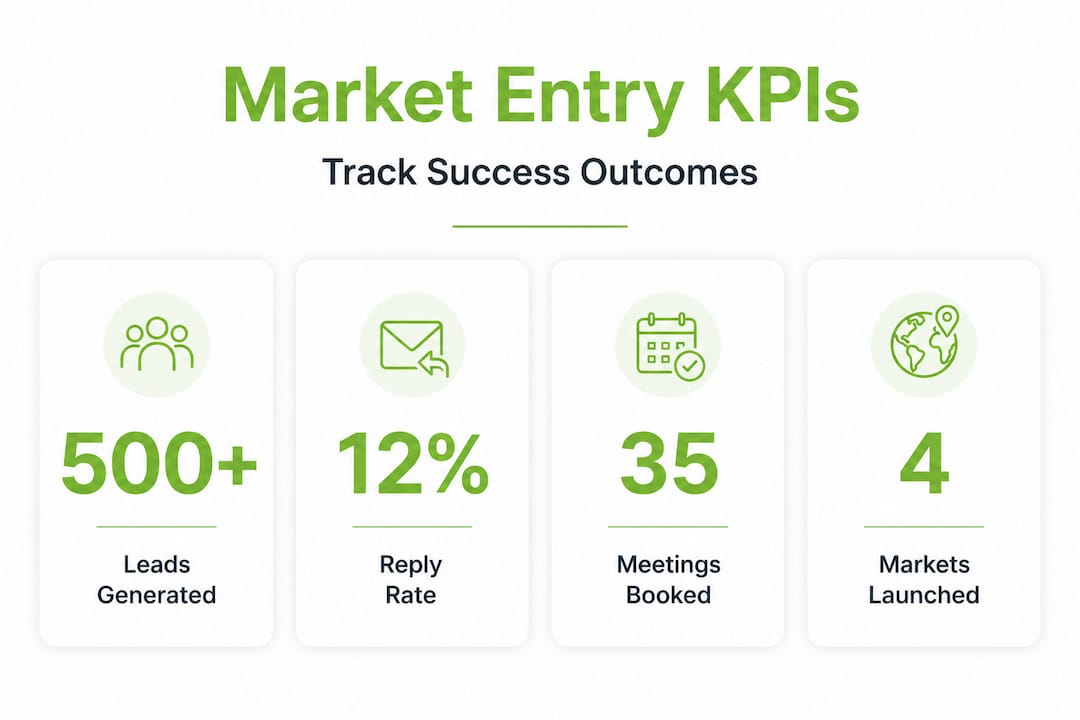
Key performance indicators (KPIs) to track:
- Qualified lead rate: What percentage of outreach-generated contacts meet your ICP criteria and show genuine buying intent? This is your most important signal.
- Engagement rate: Opens, replies, and meaningful interactions as a proportion of contacts reached. Low engagement in a new market often signals a messaging or targeting problem, not a volume problem.
- Conversion to meeting or demo: How many qualified leads actually book a call or agree to a next step? This is where revenue potential becomes visible.
- Time-to-first-contact: How quickly does your system reach a new prospect after they match your ICP criteria? Speed matters in competitive markets.
- New pipeline generated: Total value of opportunities added to your sales pipeline through automated outreach within a defined period.
Automated tracking systems improve the accuracy of all these metrics by removing manual logging errors and capturing behavioral data that humans would miss. According to 2026 automation trends, automated workflows can reduce manual effort by up to 60% compared to legacy processes, freeing your team to focus on high-value activities instead of data entry and follow-up scheduling.
The biggest measurement pitfall is optimizing for the wrong metric. If you celebrate high lead volume without checking qualified lead rate, you create a treadmill: more contacts going in, but the same number of real opportunities coming out. The role of AI in market expansion is precisely to improve the quality of what reaches your sales team, not just the quantity.
Stat to remember: Teams that track qualified lead rate and time-to-first-contact alongside volume consistently outperform those focused on volume alone, because they catch ICP drift early and correct it before resources are wasted at scale.
Build a simple weekly dashboard that shows all five KPIs side by side. Trends matter more than point-in-time snapshots. A qualified lead rate dropping over three consecutive weeks signals that your ICP definition or market targeting needs to be revisited, regardless of how high your raw lead volume looks.
Why “set and forget” automation falls flat in real B2B market entry
We’ve worked closely enough with B2B market expansion to have a clear opinion on this: the promise of fully autonomous, hands-off lead generation is genuinely seductive, and genuinely dangerous for teams entering unfamiliar markets.
Here’s the uncomfortable truth. Automation tools don’t know that your target market just experienced a sector-wide budget freeze. They don’t notice that a competitor just released a product that directly addresses your main value proposition. They can’t sense that the messaging that worked beautifully in your home market feels tone-deaf in a new geography because the cultural context is different. These are real dynamics that boost B2B growth when handled well, and destroy pipeline momentum when ignored.
The teams that get the best results from automated market entry treat automation the way a skilled pilot treats autopilot. Autopilot handles the routine, stable leg of the flight. The pilot is present, alert, and ready to take control when conditions change. They’re not asleep in the back of the plane.
What that looks like practically: your AI prospecting system surfaces a wave of new contacts that match your ICP in a target sector. Before letting outreach sequences run at full scale, a human reviews a sample of the contacts, reads a few of the proposed messages, checks whether the targeting logic still reflects your current ICP, and gives a deliberate go-ahead. That review takes 20 minutes. It prevents the scenario where automation burns through an entire market segment with messaging that was correct three months ago but is off-target today.
The most durable automation concepts in B2B, as practitioners and analysts consistently confirm, emphasize augmentation over replacement. The marketer who understands this becomes more powerful with automation, not obsolete. The marketer who tries to step back entirely and let the tools run without oversight tends to find out too late that the engine was pointed in the wrong direction.
Use automation to surface opportunity at a scale you could never achieve manually. Then bring your expertise to bear on inspecting, qualifying, and personalizing the most promising leads before they reach your sales team. That’s the combination that produces reliable, repeatable results in new markets.
Unlock your team’s market entry potential with expert automation
Bridging the gap between capable automation tools and genuine market entry results requires both the right technology and experienced oversight. Most B2B marketing teams have the ambition but not always the infrastructure: warmed email accounts, AI agents calibrated to specific ICPs, human qualification layers, and ongoing reputation management all working together.
At Lickfold Digital, we specialize in building exactly that kind of system for B2B companies expanding into new markets. Our AI-driven platform identifies and engages decision-makers that match your ideal customer profile, while experienced human reviewers qualify every reply before it reaches your sales team. As B2B automation specialists, we handle the infrastructure and the discipline so your team can focus on closing. If you’re ready to build a scalable, reliable pipeline into your next target market, get in touch and let’s map out what your automated market entry strategy should look like.
Frequently asked questions
What exactly does automated market entry mean for B2B marketing?
It refers to using digital tools and process automation to identify, approach, and engage new B2B markets more efficiently, with human oversight guiding strategy and decision-making. While some platforms position fully autonomous execution as the goal, the most effective approaches keep experienced humans in the loop.
Can automation fully replace human decision-making in B2B market entry?
No. While automation accelerates prospecting and outreach at scale, human expertise is still required for strategy, quality control, and handling the complex, multi-stakeholder decisions that define B2B sales cycles.
What are the benefits of automating market entry?
Benefits include faster, more accurate market research, scalable lead generation with consistent follow-up, and automated engagement tracking that surfaces warm prospects automatically, freeing your team to focus on closing quality opportunities rather than manual prospecting.
Which metrics matter most in evaluating automated market entry?
Qualified lead rate, engagement rate, conversion to meeting or demo, time-to-first-contact, and new pipeline value are the metrics that matter. Lead volume alone tells you very little about whether your automated market entry is actually working.
Recommended
- Why automate B2B prospecting in 2026: boost efficiency
- Why automate market research? Boost B2B growth & efficiency
- How to use AI market research for B2B outreach success
- B2B Lead Generation: 2026 Sales Automation Trends
- How automation transforms B2B marketing for professional services - The Lead Lab