
Harness AI's role in B2B market expansion success
Harness AI’s role in B2B market expansion success
Expanding into new markets remains one of the most challenging initiatives for B2B companies in 2026. Traditional prospecting methods drain resources, produce inconsistent results, and fail to scale efficiently. Many sales teams still rely on manual research, generic email blasts, and cold calling tactics that yield diminishing returns. Meanwhile, artificial intelligence has evolved from a futuristic concept into a practical tool that transforms how businesses identify prospects, engage decision-makers, and accelerate market entry. This guide reveals how AI streamlines B2B market expansion through automated prospecting, precise targeting, and personalized outreach that delivers measurable growth.
Table of Contents
- Understanding AI’s Impact On Market Expansion
- Key AI Technologies Driving New Market Entry
- Comparing AI-Driven Market Expansion Strategies
- Applying AI Effectively In Your B2B Market Expansion Plan
- Enhance Your Market Expansion With Expert AI Solutions
- Frequently Asked Questions About AI In Market Expansion
Key takeaways
| Point | Details |
|---|---|
| AI enhances efficiency | Automated market research and lead scoring reduce manual work while improving accuracy |
| Precise targeting capability | Advanced AI tools enable personalized outreach to ideal customer profiles across new markets |
| Cost reduction benefits | Integrating AI lowers lead generation expenses and accelerates market entry timelines |
| Strategic implementation | Successful adoption requires understanding tools, workflows, and alignment with business goals |
Understanding AI’s impact on market expansion
Artificial intelligence fundamentally reshapes how B2B companies approach new market opportunities. Rather than relying on intuition or limited data sets, AI systems analyze vast amounts of market information to identify patterns, predict customer needs, and prioritize high-value prospects. Machine learning algorithms continuously improve their accuracy by learning from successful interactions and adjusting strategies in real time. This capability transforms prospecting from a labor-intensive guessing game into a data-driven process that scales effortlessly.
The most significant advantage AI brings to market expansion is automation of repetitive research tasks. Sales teams traditionally spend hours manually searching LinkedIn, company websites, and databases to build prospect lists. AI automates repetitive market research tasks, enabling faster lead identification and scoring. These systems scan multiple data sources simultaneously, extract relevant information about company size, industry, recent funding rounds, and technology stack, then compile comprehensive prospect profiles in minutes rather than days.
Lead scoring represents another area where AI dramatically outperforms manual methods. Algorithms evaluate dozens of variables to determine which prospects are most likely to convert based on historical patterns. They assign numerical scores that help sales teams prioritize outreach efforts toward accounts with the highest probability of becoming customers. This precision eliminates wasted time on unqualified leads and focuses resources where they generate the greatest return.
Traditional prospecting differs from AI-enhanced approaches in several critical ways:
- Manual research limits the number of prospects you can evaluate daily
- Generic messaging fails to resonate with diverse market segments
- Inconsistent follow-up allows warm leads to go cold
- Limited data analysis prevents optimization of outreach strategies
- High costs per lead make scaling prohibitively expensive
Pro Tip: Start with a pilot program targeting a single market segment to test AI tools before committing to full-scale implementation. This approach minimizes risk while providing valuable insights into which features deliver the most value for your specific business model.
Key AI technologies driving new market entry
Several specific technologies power the AI revolution in B2B prospecting and market expansion. Predictive analytics stands at the forefront, using historical data and machine learning models to forecast which companies are most likely to need your solution. These systems analyze buying signals such as recent executive hires, funding announcements, technology adoptions, and market movements to identify organizations entering a buying cycle. Sales teams receive alerts about high-priority prospects before competitors even know these opportunities exist.
Natural language processing enables AI systems to understand and generate human-like communication at scale. Chatbots powered by NLP engage website visitors in real-time conversations, qualifying leads through intelligent questioning while capturing valuable information about their needs and timeline. Email personalization engines use NLP to craft messages that reference specific details about each prospect’s business, creating the impression of individually researched outreach even when contacting thousands of companies simultaneously.
The practical applications of these technologies span the entire prospecting workflow:
- Market segmentation algorithms identify untapped niches within broader industries
- Contact discovery tools locate decision-makers and extract verified email addresses
- Sentiment analysis evaluates prospect responses to optimize follow-up timing
- A/B testing automation continuously refines messaging for maximum engagement
- Pipeline prediction models forecast revenue based on current lead quality and velocity
| Technology | Primary Capability | Key Benefit | Common Use Case | | — | — | | Predictive Analytics | Forecast buying behavior | Prioritize high-intent prospects | Lead scoring and timing | | Natural Language Processing | Understand and generate text | Personalize communication at scale | Email outreach and chatbots | | Machine Learning | Pattern recognition | Improve accuracy over time | Market segmentation | | Computer Vision | Analyze visual data | Extract information from documents | Company research automation |
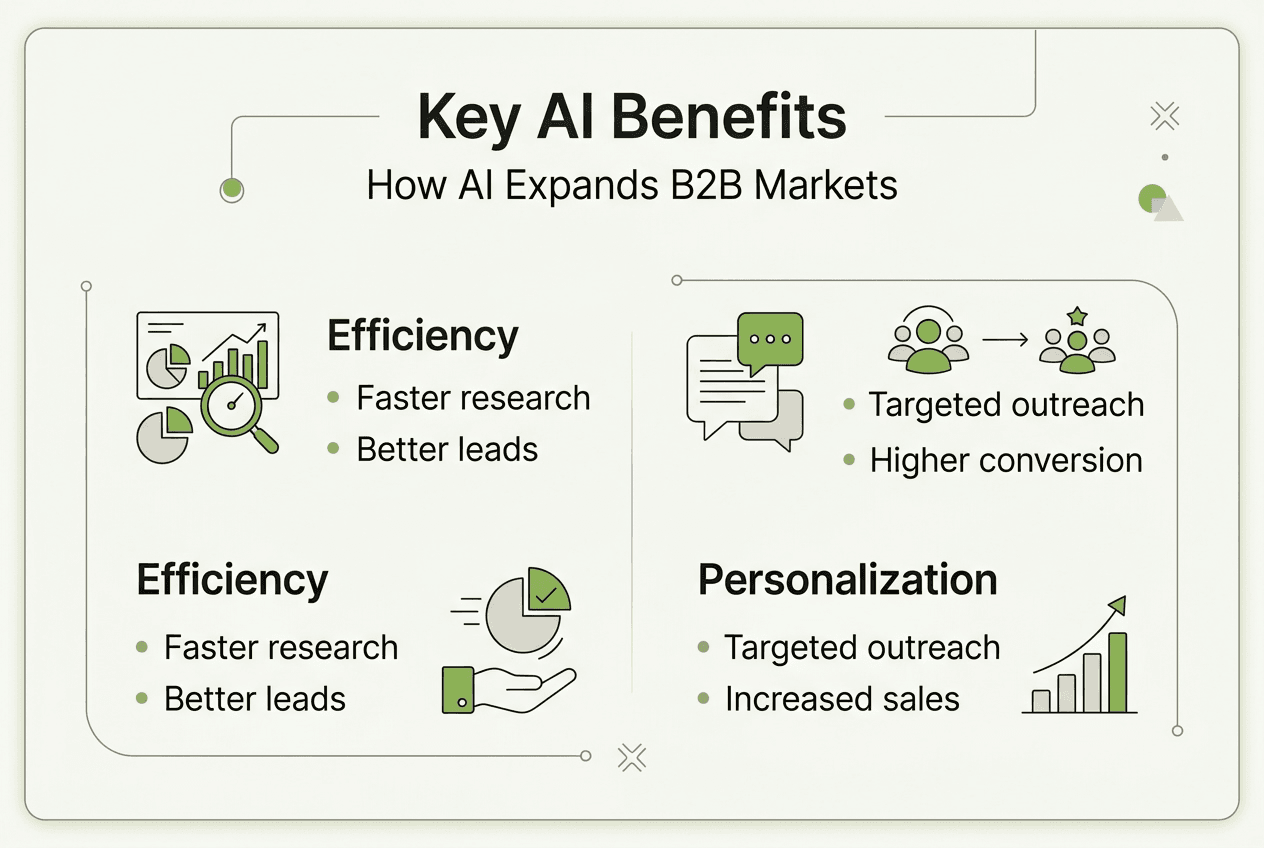
AI technologies improve targeting accuracy and personalize outreach, increasing conversion rates across diverse market segments. The sophistication of these tools continues advancing rapidly, with 2026 bringing enhanced integration capabilities that connect AI systems directly to CRM platforms, marketing automation tools, and sales engagement software.
Pro Tip: Evaluate your current technology stack before selecting AI tools to ensure compatibility with existing systems. The best AI solution integrates seamlessly with your CRM and enriches data you already collect rather than creating isolated information silos.
Comparing AI-driven market expansion strategies
B2B companies have multiple options when implementing AI for market expansion, each with distinct advantages depending on your goals, budget, and existing infrastructure. Automated outreach platforms represent the most comprehensive solution, handling everything from prospect identification to multi-touch email sequences and reply management. These systems deploy AI agents that research companies, find decision-makers, craft personalized messages, and systematically follow up until receiving a response. They excel at generating high volumes of qualified leads with minimal manual intervention.

AI-powered CRM enhancements offer a middle-ground approach for companies with established sales processes. Rather than replacing your entire workflow, these tools augment existing systems with intelligent features like predictive lead scoring, automated data enrichment, and smart task prioritization. Sales representatives continue using familiar interfaces while benefiting from AI insights that guide their daily activities. Integrated AI CRM solutions streamline multi-channel lead management, improving efficiency without requiring complete process overhauls.
AI analytics platforms focus specifically on market intelligence and strategic planning rather than tactical execution. These systems analyze competitor movements, identify emerging market trends, and recommend optimal timing for market entry based on economic indicators and industry dynamics. They provide the strategic foundation that informs which markets to target and how to position your offering, leaving the execution details to human teams or other automation tools.
| Strategy | Key Features | Ideal For | Investment Level |
|---|---|---|---|
| Automated Outreach Platform | End-to-end prospecting automation | Companies needing rapid lead generation | Medium to High |
| AI-Enhanced CRM | Intelligent augmentation of existing workflows | Teams with established sales processes | Low to Medium |
| AI Analytics Platform | Market intelligence and strategic insights | Strategic planning and market research | Medium |
| Hybrid Approach | Combination of multiple AI tools | Large enterprises with complex needs | High |
Several factors should guide your selection of AI market expansion strategies:
- Current team size and capacity for managing new tools
- Budget available for software subscriptions and implementation
- Complexity of your ideal customer profile and buying process
- Geographic scope of your market expansion plans
- Integration requirements with existing technology infrastructure
The most successful implementations align AI capabilities with specific business objectives rather than adopting technology for its own sake. A company targeting enterprise accounts in regulated industries needs different AI tools than a startup pursuing mid-market SaaS customers across multiple verticals. Define your expansion goals clearly before evaluating which AI strategies best support those outcomes.
Applying AI effectively in your B2B market expansion plan
Successful AI implementation follows a structured approach that minimizes disruption while maximizing learning opportunities. Start by documenting your current prospecting process in detail, identifying bottlenecks where manual work slows progress or limits scale. These pain points represent the highest-value opportunities for AI automation. Map out your ideal workflow with AI handling repetitive tasks while sales professionals focus on relationship building and deal closing.
Follow these steps to integrate AI into your market expansion efforts:
- Select one market segment as a pilot program to test AI tools with controlled risk
- Configure AI systems with your ideal customer profile criteria and messaging guidelines
- Launch a small-scale campaign targeting 200-500 prospects to validate performance
- Monitor key metrics including response rates, meeting bookings, and lead quality scores
- Gather feedback from sales teams about lead readiness and fit with target profile
- Adjust AI parameters based on results and expand gradually to additional market segments
- Establish regular review cycles to optimize messaging, targeting, and follow-up sequences
Performance monitoring separates successful AI implementations from disappointing ones. Track metrics that directly correlate with revenue rather than vanity numbers like email open rates. Focus on qualified leads generated, meetings scheduled with decision-makers, pipeline value created, and ultimately closed deals attributed to AI-sourced prospects. Successful AI adoption in marketing requires planning, training, and iterative improvement based on measurable outcomes.
Data quality determines AI effectiveness more than any other factor. Systems trained on incomplete or outdated information produce poor results regardless of algorithmic sophistication. Invest time in cleaning existing prospect databases, establishing data governance policies, and implementing validation rules that maintain information accuracy. AI tools amplify the quality of input data, so garbage in truly means garbage out.
Pro Tip: Schedule monthly training sessions where your team reviews AI performance reports together and shares insights about what’s working. This collaborative approach builds organizational buy-in while surfacing optimization opportunities that individual users might miss. Select AI vendors who provide dedicated support and regular product updates rather than set-it-and-forget-it solutions.
Alignment between AI capabilities and overall business strategy ensures technology serves your goals rather than dictating them. If your expansion plan prioritizes building deep relationships with a small number of strategic accounts, configure AI for account-based marketing that researches specific companies exhaustively. If you need to test multiple market segments quickly, optimize AI for broad reach and rapid qualification. The flexibility to adjust AI behavior based on strategic priorities separates powerful tools from rigid systems that force you into predefined workflows.
Enhance your market expansion with expert AI solutions
Navigating the AI landscape requires expertise that most B2B companies lack internally. Lickfold Digital specializes in deploying AI-driven prospecting systems that generate qualified leads while you focus on closing deals. Our platform combines advanced market research, decision-maker identification, and personalized outreach campaigns that maintain high deliverability and response rates. We handle the technical complexity of AI implementation, from infrastructure setup to ongoing optimization, so you benefit from cutting-edge technology without building specialized teams.
Schedule a free AI consultation to explore how our approach fits your specific market expansion goals. Our team analyzes your ideal customer profile, competitive landscape, and growth targets to design a customized AI prospecting system. We also offer a comprehensive guide to building scalable business systems. Download the 24/7 business guide for proven frameworks that complement AI automation with strategic planning.
Partnering with AI experts accelerates your market expansion timeline while reducing the trial-and-error costs of self-implementation. Our clients typically see qualified leads flowing within weeks rather than months, supported by dedicated account management and continuous system refinement.
Frequently asked questions about AI in market expansion
What industries benefit most from AI in market expansion?
AI delivers value across virtually all B2B sectors, but technology, professional services, manufacturing, and financial services see particularly strong returns. These industries have complex buying processes, multiple decision-makers, and long sales cycles where AI’s ability to maintain consistent engagement and provide detailed prospect intelligence creates significant competitive advantages.
How long does it take to see ROI from AI prospecting tools?
Most companies observe measurable results within 60-90 days of implementation, with qualified leads entering the pipeline and initial meetings scheduled. Full ROI typically materializes within 6-9 months as early-stage leads progress through the sales cycle and convert to customers. The timeline depends heavily on your sales cycle length and how quickly your team adapts to working with AI-generated leads.
Can small B2B companies afford AI-driven lead generation?
AI solutions now exist at multiple price points, making them accessible to businesses of all sizes. Entry-level platforms start around $500-1,000 monthly, while enterprise solutions can exceed $5,000 monthly. Many providers offer usage-based pricing that scales with your lead volume, allowing small companies to start conservatively and expand investment as results justify it.
Is AI replacing sales teams or augmenting them?
AI augments rather than replaces sales professionals by handling time-consuming research and outreach tasks. This allows salespeople to focus on relationship building, complex negotiations, and strategic account planning where human judgment and emotional intelligence remain irreplaceable. The most successful teams use AI to multiply their effectiveness rather than viewing it as a threat to job security.
What are the top beginner-friendly AI tools for market expansion?
Beginners should explore AI-enhanced CRM features from platforms like HubSpot or Salesforce before committing to specialized tools. These familiar interfaces introduce AI capabilities gradually without overwhelming users. For dedicated prospecting automation, platforms offering guided setup wizards, template libraries, and responsive customer support help newcomers achieve results quickly while learning AI fundamentals through practical application.