
Master step by step lead qualification for B2B sales
Master step by step lead qualification for B2B sales
TL;DR:
- Building a structured, repeatable lead qualification process improves pipeline quality and forecast accuracy.
- Using automation tools and clear criteria helps filter high-value prospects efficiently.
- Regularly reviewing qualification criteria and integrating human validation ensure sustained scalability and accuracy.
Every B2B sales team has felt it: hours burned chasing a lead that was never going to close. Poor-fit prospects clog your pipeline, drain your reps’ energy, and distort your forecasts. The fix is not hiring more salespeople or sending more emails. It is building a repeatable, step by step lead qualification process that filters out the noise before it reaches your team. When you combine a structured framework with modern automation tools, you stop gambling on gut instinct and start making data-driven decisions that shorten cycles, raise close rates, and make your pipeline genuinely predictable.
Table of Contents
- Why step by step lead qualification matters
- What you need before you start: tools, data, and criteria
- The step by step lead qualification process
- Verifying qualified leads and avoiding common pitfalls
- The uncomfortable truth about scaling lead qualification
- Accelerate your results with AI-powered lead qualification
- Frequently asked questions
Key Takeaways
| Point | Details |
|---|---|
| Structured qualification wins | Following a defined step by step process increases your sales pipeline efficiency and close rates. |
| Right tools are essential | Using modern CRMs, AI scoring, and clear criteria helps automate and streamline qualification. |
| Combine automation and judgment | Leverage technology for speed, but always validate sales-ready leads with human input and feedback. |
| Continuous improvement | Regularly review and adjust your qualification process to reflect changing markets and buyer cues. |
Why step by step lead qualification matters
Lead qualification is the process of evaluating whether a prospect fits your ideal customer profile and is genuinely ready to engage with sales. In B2B environments, where deal cycles are long and stakeholder counts are high, getting this wrong is expensive. A single misqualified opportunity can occupy a rep for weeks, crowding out prospects that would have closed.
The core problem with ad hoc qualification is inconsistency. Without a defined process, two reps on the same team will evaluate the same prospect differently. Some will advance a lead because the contact seemed enthusiastic on a call. Others will disqualify the same account because the company was slightly below a revenue threshold. That inconsistency creates pipeline distortion and makes forecasting almost impossible.
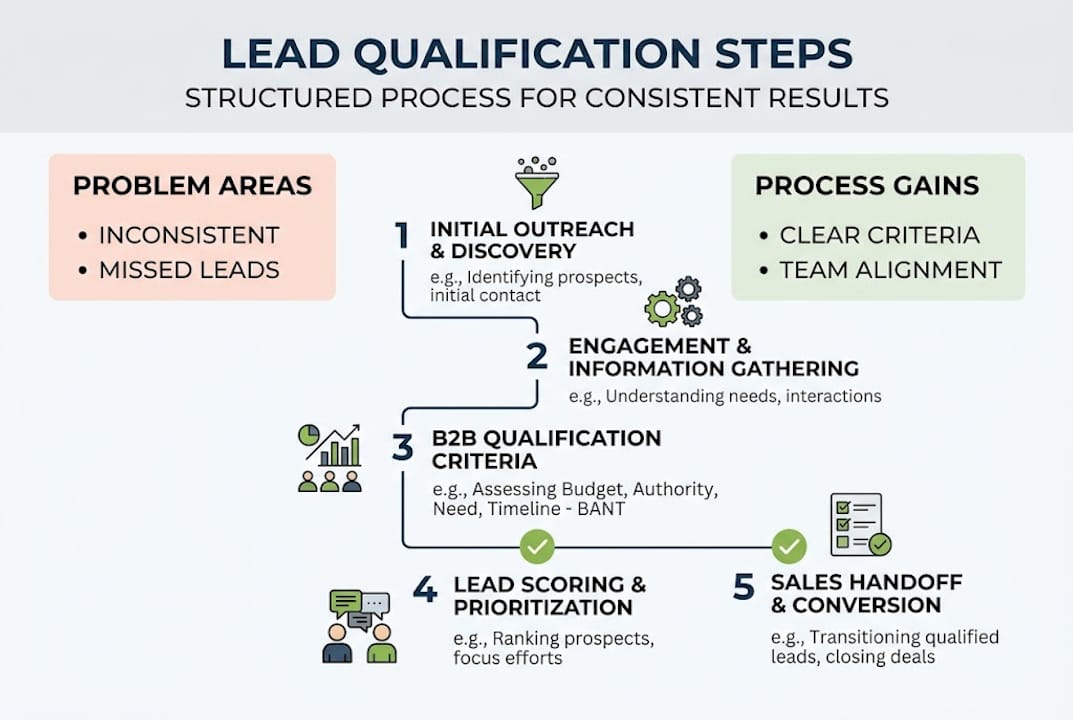
Teams lacking systematic qualification close fewer high-value deals, and the gap widens as teams scale. The more reps you add to a broken process, the more amplified the problem becomes.
A structured, step by step approach solves this by creating shared criteria, clear handoff rules, and measurable checkpoints. Here is how the two approaches compare:
| Factor | Ad hoc qualification | Step by step qualification |
|---|---|---|
| Consistency | Low, rep-dependent | High, criteria-driven |
| Pipeline accuracy | Unreliable | Predictable |
| Resource efficiency | Wasted hours | Focused effort |
| Scalability | Poor | Strong |
| Close rate potential | Variable | Systematically higher |
The benefits of getting this right are not marginal. Structured B2B decision maker targeting consistently produces higher close rates, shorter average sales cycles, and better resource allocation across both marketing and sales functions. Teams also report that reps are more motivated when they know the leads in their queue are genuinely worth pursuing.
Common mistakes include misaligning qualification criteria between marketing and sales, skipping early-stage steps to rush deals forward, and failing to integrate qualification data into a central CRM. Each of these errors quietly erodes your pipeline quality over time.
“A structured lead qualification process is not a nice-to-have. For B2B teams competing on efficiency, it is the foundation of sustainable pipeline growth.”
With that foundation understood, the next step is gathering the tools, data, and criteria you need before running a single lead through your process.
What you need before you start: tools, data, and criteria
Running a qualification process without the right infrastructure is like trying to run a race before lacing your shoes. Before your first lead enters the workflow, you need three categories of resources in place: tools, data, and documented criteria.
Tools you need:
- A CRM to log interactions and track status (Salesforce, HubSpot, or similar)
- CRM and automation platforms that support workflow rules and scoring
- An AI scoring tool or native scoring module within your CRM
- An email and engagement tracking platform for measuring intent signals
Data points you must capture:
- Firmographics: company size, industry, revenue, geography
- Contact details: role, seniority level, department
- Buying signals: content downloads, pricing page visits, demo requests
- Technology stack (if relevant to your offering)
Accurate data and modern tools are vital for scalable qualification, and skimping here creates compounding errors downstream. Gaps in firmographic data mean your scoring model operates on assumptions rather than facts.

Documenting your qualification criteria is equally critical. Most teams use a framework like BANT (Budget, Authority, Need, Timing) or MEDDIC (Metrics, Economic Buyer, Decision Criteria, Decision Process, Identify Pain, Champion). Whichever you choose, write it down and get explicit agreement from both marketing and sales before you start.
Here is a quick data readiness table to check before you begin:
| Data category | Minimum requirement | Ideal state |
|---|---|---|
| Firmographics | Industry, size | Full company profile |
| Contact info | Name, email, title | Verified direct contact |
| Buying signals | Form fill | Multi-touch engagement |
| Budget indicators | Self-reported | Third-party verified |
You should also build a simple account-based marketing checklist aligned to your ideal customer profile before scoring begins. This keeps your criteria consistent across campaigns.
Pro Tip: Start with automation to capture and enrich data at scale, but always validate high-value leads with a human review before advancing them to sales. Automation handles volume; humans handle judgment.
With your resources organized, you are ready to walk through the actual qualification process from start to finish.
The step by step lead qualification process
A repeatable workflow turns qualification from a guessing game into a system. Here are the five core steps that structured workflows outperform unstructured approaches in consistently delivering.
-
Initial data capture and enrichment. When a lead enters your system, trigger an automated enrichment sequence that fills in missing firmographic and contact fields. Tools like Clay, Clearbit, or Apollo can append data in real time. Never let a lead advance with incomplete core fields.
-
Scoring against qualification criteria. Assign point values to each criterion: fit score (does the company match your ICP?), need score (do they have the problem you solve?), authority score (is the contact a decision-maker?), and potential score (does the deal size justify the effort?). Set thresholds. Leads above 70 points advance automatically. Leads below 40 go to nurture. Everything in between gets a manual review.
-
Early-stage engagement. Use templated but personalized outreach to assess intent. Ask questions that uncover need and timing without being pushy. Strong signals include quick reply times, specific questions about pricing or implementation, and references to internal projects or deadlines.
-
Verify and validate. Cross-reference engagement signals with your data profile. A lead that visits your pricing page three times but has no budget authority is not sales-ready. Check for AI prospecting step by step indicators that confirm readiness. Let your reps apply their intuition here, because they often catch what scoring models miss.
-
Hand-off to sales or nurture streams. Qualified leads go to sales with a complete context brief: company profile, engagement history, score, and recommended talking points. Unqualified leads enter a structured nurture sequence with content matched to their stage. Use prospecting with AI tools to keep nurture sequences active without manual effort.
Pro Tip: Set hard scoring thresholds before you launch. When a lead hits the threshold automatically, your reps stop debating and start selling. That clarity alone can cut internal friction dramatically.
Automating your scoring step can reduce qualification time by over 50%, freeing reps to focus on conversations that actually move deals forward. With the process mapped out, the next critical step is making sure what enters sales is genuinely ready.
Verifying qualified leads and avoiding common pitfalls
Getting a lead to the top of the scoring model does not automatically make it sales-ready. Verification is where you confirm that the signals match reality. Look for BANT alignment: confirmed budget, a contact with real decision-making authority, a clearly articulated need, and a defined timeline for a decision.
Strong positive signals include:
- The prospect has initiated contact at least twice without prompting
- They have referenced internal stakeholders or approval processes
- They can articulate the specific problem your product solves
- They have asked about implementation timelines or contract terms
Human validation is essential for high-value opportunities. A score of 85 means the data fits. A conversation with the prospect confirms whether that data reflects intent.
Common pitfalls to watch for:
- Over-reliance on automation. Scores reflect data inputs, not human nuance. A lead can score well because they downloaded three assets but have zero purchase intent.
- Ignoring red flags. Vague answers about budget, multiple delayed follow-ups, or unclear decision processes are warnings. Do not advance a lead just because the score qualifies them.
- Moving too fast. Rushing to hand off saves time in the short run but creates frustrated reps and wasted proposals.
Top reasons leads fail after initial qualification include misidentified decision-makers, budget approval bottlenecks, and timing misalignment. Review your sales opportunity qualification data regularly to spot patterns.
Best practices from experienced teams: run a bi-weekly review of recently disqualified leads alongside recently closed-won deals. The contrast reveals where your criteria need adjustment.
Pro Tip: Every quarter, pull your closed-won data and compare those accounts against your current qualification criteria. If top customers would not have passed your filter, your filter needs updating.
“The teams that win long term are not the ones with the most leads. They are the ones that stay most disciplined about which leads deserve attention.”
For deeper guidance on identifying decision makers accurately, review best practices for improving the accuracy of your authority scoring at every stage.
The uncomfortable truth about scaling lead qualification
Here is what most B2B teams discover too late: automation alone does not solve the qualification problem. It solves the volume problem. The real bottleneck is almost always alignment between marketing and sales, and no scoring model fixes a team that cannot agree on what a qualified lead looks like.
We have seen companies deploy sophisticated AI tools only to find their pipeline quality unchanged six months later. The reason is always the same. Marketing defines a qualified lead by engagement score. Sales defines it by deal potential. Those two definitions never formally converge.
What experienced teams actually do is run weekly, structured reviews where sales feeds specific objections back into the scoring criteria. They update qualification definitions after major deals close or fall apart. They treat their scoring model as a living document, not a fixed rulebook. Reviewing B2B AI sales tips can sharpen how you integrate AI judgment with human feedback loops.
The teams that scale lead qualification effectively do not trust their tools. They trust their process, and they keep improving it.
Accelerate your results with AI-powered lead qualification
You now have a clear framework: structured criteria, the right tools, a five-step workflow, and a verification layer to keep your pipeline clean. The next move is connecting that process to automation that actually executes it at scale.
At Lickfold Digital, we build AI-powered systems that handle data enrichment, lead scoring, personalized outreach, and human-qualified handoffs so your sales team only talks to prospects worth their time. If you want to see how this works for your specific market and ICP, explore our AI lead qualification solutions or contact our team for a personalized assessment. Stop guessing. Start qualifying with precision.
Frequently asked questions
What is lead qualification in B2B sales?
Lead qualification is the process of assessing if a potential customer fits your ideal profile and is ready for sales engagement. Teams lacking systematic qualification consistently close fewer high-value deals, regardless of total lead volume.
What are the key criteria for qualifying a lead?
Key criteria include the lead’s budget, authority, need, timing, and fit with your ideal customer profile. Accurate data and modern tools are what allow you to evaluate those criteria reliably at scale.
How can automation help in the lead qualification process?
Automation quickly scores and segments large volumes of leads, reducing manual effort and speeding up your pipeline. Structured workflows consistently outperform manual approaches in both speed and accuracy.
How often should qualification criteria be reviewed or updated?
Review criteria at least quarterly or after major changes in your target market, offering, or average deal profile. Routinely reviewing closed and won deals reveals exactly where your criteria need to be tightened or broadened.