
B2B market research: How it drives real lead quality
B2B market research: How it drives real lead quality
TL;DR:
- Market research helps B2B teams understand buyer needs better than competitors do.
- Combining AI and human insights provides scalable, nuanced understanding to improve outreach.
- Regular quarterly updates and clear action plans are essential to turn data into revenue.
Most B2B marketing teams are drowning in data but starving for direction. You have survey results, CRM exports, LinkedIn analytics, and industry reports stacked up, yet your pipeline still feels unpredictable. The problem is not a lack of information. It is a gap between data and action. This article breaks down why market research matters for real lead generation, how to choose the right research approach, which frameworks actually convert insight into pipeline, and the most common mistakes that keep smart teams stuck. If you want research that moves deals, not just dashboards, keep reading.
Table of Contents
- Why market research matters for B2B success
- Traditional vs. AI-driven market research: Which works best?
- Core frameworks: Turning market data into B2B pipeline growth
- Common pitfalls and expert tips for actionable B2B research
- The hard truth: Where most B2B market research fails (and what actually works)
- Next steps: Get expert-backed B2B market research tailored to your growth
- Frequently asked questions
Key Takeaways
| Point | Details |
|---|---|
| Action trumps data volume | Market research only drives results when it leads to sales actions, not just bigger databases. |
| Hybrid models work best | Combining AI with human methods uncovers both patterns and motivations for better prospecting. |
| Quarterly updates are crucial | Refresh market data every quarter to stop decay and keep targeting sharp. |
| Avoid over-relying on AI | Let AI surface opportunities but always validate insights through human research and sales feedback. |
Why market research matters for B2B success
With that challenge in mind, let’s start by clarifying exactly why robust market research is mission-critical for effective B2B prospecting.
Market research in B2B is not about knowing your industry better than your competitor. It is about knowing your buyer better than they know themselves. When you understand what your ideal customer is struggling with right now, what they have already tried, and what they are afraid to get wrong, you can build outreach that feels less like a pitch and more like a solution arriving at exactly the right moment.
Here is what strong market research actually does for your pipeline:
- Clarifies customer priorities: You learn what problems buyers are actively trying to solve, not just what they said six months ago.
- Identifies competitive gaps: You spot where competitors are falling short and position your offer directly against those gaps.
- Enables precise segmentation: You group prospects by behavior, intent, and context rather than just firmographics like company size or industry.
- Improves message relevance: Personalized outreach built on real insight consistently outperforms generic templates.
- Reduces wasted spend: Targeting the right accounts from the start cuts your cost per qualified lead significantly.
The ROI case for market research is not theoretical. Experts emphasize proving ROI for B2B market research by linking research directly to measurable sales and lead outcomes, not just awareness metrics. That means every research initiative should have a clear downstream action: a refined prospect list, a new message angle, a repositioned offer.
“Research that does not change what you do next is just an expensive report.”
One often overlooked point: market research has a shelf life. Buyer priorities shift, competitors pivot, and economic conditions change. If you are running campaigns on insights that are 12 months old, you are essentially navigating with an outdated map. Best practice is to treat research as a quarterly discipline, not a one-time project. Explore how automated market research for B2B growth can make that cadence sustainable without adding headcount.
Pro Tip: Tie every research output to a specific sales action. If a finding does not change who you target, what you say, or how you follow up, deprioritize it.
Traditional vs. AI-driven market research: Which works best?
Understanding the value of market research sets the stage for the key debate: should you depend on time-tested traditional techniques, the latest AI analytics, or a blend of both?
Traditional research methods, including in-depth interviews, focus groups, and structured surveys, give you something AI cannot easily replicate: context. When a CFO tells you they rejected a vendor because the onboarding process felt chaotic, that is a signal no algorithm would surface from behavioral data alone. Human research captures tone, hesitation, and the unspoken politics inside buying committees.
The downside is scale. Traditional methods are slow, expensive, and subject to interviewer bias. You might get 20 deeply nuanced responses when you need signal across 2,000 accounts.
AI-driven research flips that equation. Machine learning models can process thousands of data points, from intent signals and job change alerts to content engagement patterns, in the time it takes to schedule a single interview. But AI excels at pattern detection while struggling with underlying motivations. It tells you that a prospect is showing buying signals. It rarely tells you why.

| Dimension | Traditional research | AI-driven research |
|---|---|---|
| Scale | Low | Very high |
| Speed | Slow | Fast |
| Depth of insight | High | Moderate |
| Cost per insight | High | Low |
| Bias risk | Moderate | Data quality dependent |
| Best use case | Understanding “why” | Identifying “who” and “when” |
Hybrid market research methods are now preferred by leading experts because they capture the best of both worlds. Use AI to identify which accounts are showing intent and prioritize your outreach list. Then use targeted human research, even just a handful of discovery calls, to validate the “why” before you build your messaging. This combination is what separates high-performing B2B teams from those still guessing.
Pro Tip: Do not let AI replace your discovery calls. Use it to decide who deserves those calls, so your human conversations are always with the highest-potential prospects.
For a deeper look at how this plays out in practice, see our guides on AI in B2B market research and AI’s impact on B2B sales research.
Core frameworks: Turning market data into B2B pipeline growth
With the strengths and limitations of both research approaches in mind, how exactly do leading B2B teams transform data into pipeline results?
Raw insight does not fill your pipeline. Structured action does. Here are the frameworks that consistently bridge the gap between research and revenue.
1. Ideal customer profile (ICP) scoring Build a scorecard that weights firmographic, technographic, and behavioral attributes. Assign points to each signal: company size, tech stack, recent funding, leadership changes, and content engagement. Prospects above a threshold score go into active outreach. Those below get nurtured or deprioritized.
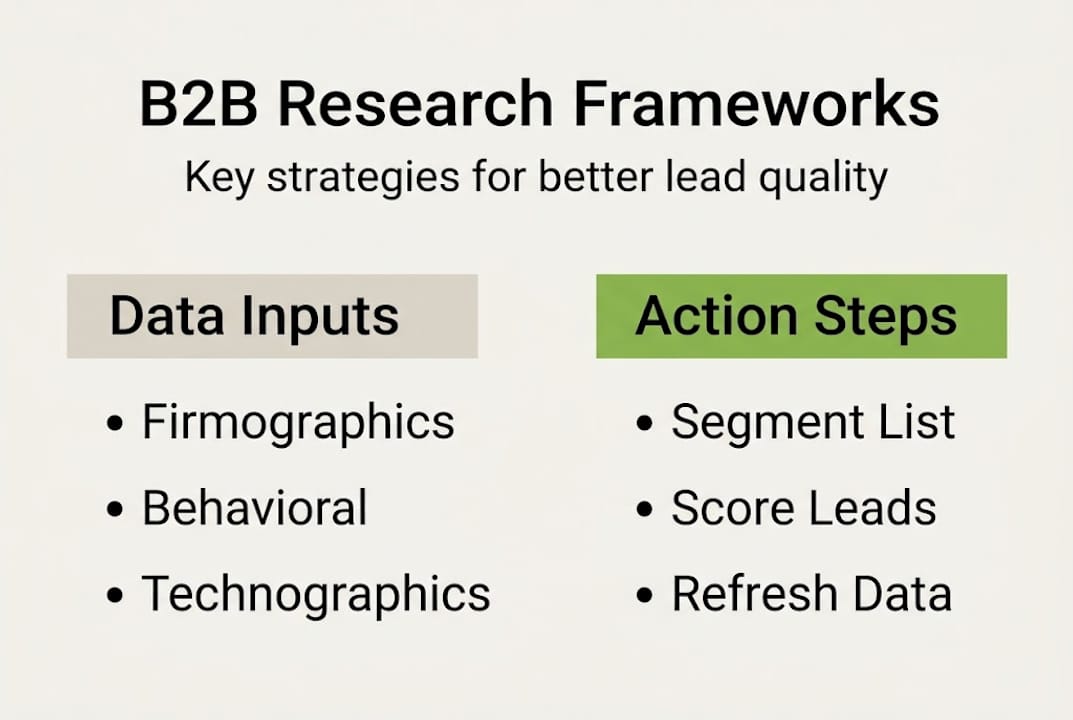
2. Segment-first messaging Do not write one message for all prospects. Segment your list by pain point cluster, then build a distinct message track for each. A VP of Sales at a Series B SaaS company has different anxieties than a procurement director at a mid-market manufacturer. Personalization strategies for B2B research show that tailored messaging consistently outperforms volume-based spray-and-pray approaches.
3. Quarterly data refresh cycle Data decays faster than most teams realize. Job titles change, companies restructure, and priorities shift. Quarterly data refreshes are essential to combat data decay and keep campaigns relevant. Build a calendar reminder into your planning cycle to audit your ICP criteria, validate your contact lists, and update your message tracks.
| Framework | Input required | Output | Refresh cadence |
|---|---|---|---|
| ICP scorecard | Firmographic and intent data | Prioritized prospect list | Quarterly |
| Segment messaging | Pain point research | Message tracks per segment | Per campaign |
| Competitive gap map | Win/loss data, competitor intel | Positioning angles | Bi-annually |
| Data validation audit | CRM and contact data | Clean, current contact list | Quarterly |
Here is a quick checklist to make these frameworks operational:
- Define your ICP with at least five weighted attributes
- Map each segment to a specific pain point and outcome
- Assign ownership for quarterly data refresh to a named team member
- Cross-reference research outputs with recent sales wins and losses
- Review B2B audience segmentation frameworks to refine your approach over time
Common pitfalls and expert tips for actionable B2B research
Even with best frameworks, there are common mistakes and missed opportunities. Here is how to avoid them and get the most from your research investment.
The most expensive mistake in B2B market research is not getting the data wrong. It is getting the data right and then doing nothing useful with it. Teams spend weeks on research, produce a detailed report, present it in a quarterly meeting, and then watch it sit in a shared drive untouched. That is data hoarding, and it is more common than anyone wants to admit.
Here are the pitfalls that consistently derail B2B research programs:
- Over-reliance on AI outputs: AI surfaces patterns, but patterns without context lead to misaligned campaigns. Always validate AI findings with at least one human touchpoint.
- Neglecting qualitative input: Numbers tell you what is happening. Conversations tell you why. Skipping interviews or sales debriefs leaves critical subtext on the table.
- Ignoring organizational politics: In B2B, the person you are targeting is rarely the only decision-maker. Research that ignores the buying committee misses the real blockers.
- Using outdated contact data: Data can decay quickly, and human research with regular validation prevents stale insights and misaligned campaigns.
- Treating research as a one-time event: A single annual study cannot keep pace with how fast markets and buyer priorities shift.
“The best research is not the most thorough. It is the most connected to what your sales team does next Monday.”
Pro Tip: After every research cycle, hold a 30-minute session with your top two or three sales reps. Ask them what surprises them and what confirms what they already knew. Their reaction is your best quality check.
For practical application, review our resources on decision maker targeting steps and AI sales tips for lead generation to see how research translates directly into outreach execution.
The hard truth: Where most B2B market research fails (and what actually works)
All of this advice is practical, but let’s step back and look honestly at why solid B2B research so often falls short and how to make it deliver at last.
Here is what we see repeatedly: companies invest in research, produce genuinely good insights, and then fail to act on them because no one owns the bridge between the insight and the sales motion. The research team hands off a report. The sales team is already running their existing playbook. Nothing changes.
Conventional wisdom says the fix is better data. We disagree. The fix is better handoffs. Proving ROI from market research requires moving from merely collecting data to closing the insight-to-action gap in prospecting. That means assigning a specific sales initiative to every research output before the research even begins.
The other uncomfortable reality is that most teams treat market research as an event rather than a system. One big study per year, followed by 11 months of assumptions. Markets do not work that way. Buyer priorities shift with every earnings cycle, leadership change, and competitive move.
Our honest recommendation: start small and iterate fast. Take one insight from your next research cycle and test it with a targeted outreach sequence to 50 accounts. Measure reply rates and meeting conversions. That feedback loop is worth more than any static report. See how AI’s role in B2B market expansion supports this kind of continuous, iterative approach.
Next steps: Get expert-backed B2B market research tailored to your growth
If you are ready to transform your B2B market research into channel-ready, actionable outcomes, here is how to access the right expertise.
At Lickfold Digital, we work with B2B teams who are tired of research that sits on a shelf. Our AI-driven platform identifies your ideal accounts, surfaces intent signals, and builds personalized outreach sequences grounded in real market insight, not guesswork. We also help you build the quarterly refresh cadence that keeps your data current and your campaigns sharp.
Lickfold Digital’s AI market research experts combine automated intelligence with human validation so you never sacrifice context for scale. Whether you need a full prospecting system or a focused research audit, we tailor the approach to your growth stage. Ready to close the gap between insight and action? Contact our team for a no-pressure assessment of your current research and outreach setup.
Frequently asked questions
How often should B2B market research data be refreshed?
Quarterly refreshes are the recognized best practice for maintaining data accuracy in B2B market research, preventing contact decay and keeping your prospecting campaigns aligned with current buyer priorities.
What is the main advantage of combining AI with traditional research methods in B2B?
Hybrid models capture large-scale behavioral patterns through AI while preserving the nuanced client motivations that only human research can uncover, resulting in higher-quality lead insights overall.
How does market research improve B2B lead quality?
Market research improves B2B lead quality by enabling precise audience segmentation and ensuring your outreach messaging speaks directly to verified, current buyer priorities rather than assumptions.
What is the biggest mistake B2B teams make with market research?
The biggest mistake is collecting data without synthesis, producing detailed reports that never connect to a specific sales action, campaign adjustment, or targeting decision.