
How AI transforms market research for B2B sales in 2026
How AI transforms market research for B2B sales in 2026
AI can reduce market research time by up to 70% in B2B contexts, yet many mistakenly believe it fully replaces human decision-making. This guide explains how AI enhances prospect targeting, personalization, and sales outcomes for marketing and sales teams. You’ll discover practical frameworks, measurable benefits like 25% lower acquisition costs, and implementation strategies that position AI as a powerful collaborator rather than a replacement for human expertise.
Table of Contents
- Introduction To AI In Market Research
- How AI Enhances Market Research Efficiency And Accuracy
- Implementing AI For Automated Prospecting And Personalized Outreach
- Common Misconceptions And Ethical Considerations In AI Market Research
- Frameworks And Metrics For Evaluating AI-Driven Market Research Impact
- Practical Steps To Integrate AI Into B2B Market Research And Sales Workflows
- Conclusion: Unlocking Sales Growth With AI-Enhanced Market Research
- Enhance Your B2B Market Research With AI Experts
Key takeaways
| Point | Details |
|---|---|
| Speed and accuracy gains | AI drastically speeds up market research while improving targeting accuracy by 30% through automated data integration. |
| Enhanced personalization | Automated AI tools enable personalized multi-touch campaigns that increase engagement by up to 40%. |
| Cost reduction impact | Measurable benefits include up to 25% lower acquisition costs and higher conversion rates when AI supplements human workflows. |
| Human oversight essential | Successful AI adoption requires ethical governance, team training, and ongoing human validation of AI-generated insights. |
Introduction to AI in market research
AI in market research refers to machine learning algorithms and automated systems that collect, analyze, and interpret customer and prospect data at scale. For B2B teams, this means moving from manual spreadsheet analysis and siloed databases to integrated platforms that continuously process firmographic data, behavioral signals, and engagement patterns. Traditional methods rely on researchers spending weeks gathering information from disparate sources, while AI-augmented approaches consolidate these tasks into hours.
The relevance for marketing and sales teams centers on three capabilities. First, AI identifies decision-makers within target accounts by analyzing org charts, job changes, and company news. Second, it scores prospects based on fit and intent signals that humans might miss. Third, it personalizes outreach by analyzing past interactions and predicting messaging that resonates. These capabilities directly address the B2B challenge of reaching the right person with the right message at the right time.
Think of AI market research as operating on three layers. The data acquisition layer scrapes and structures information from public databases, social platforms, and proprietary sources. The insight generation layer applies AI-driven segmentation frameworks with 90% accuracy to classify prospects against your ideal customer profile. The augmented outreach layer crafts personalized campaigns and optimizes timing based on engagement patterns. Each layer amplifies human capabilities rather than replacing them.
For teams exploring AI adoption, the Lickfold Digital Blog offers case studies and implementation guides tailored to B2B sales contexts.
How AI enhances market research efficiency and accuracy
Automated data collection eliminates the most time-consuming aspect of traditional research. AI tools simultaneously pull information from LinkedIn, company websites, funding databases, and news sources. What once required a researcher to manually visit dozens of sites now happens in seconds. Research time drops by up to 70% compared to traditional methods, freeing teams to focus on strategy and relationship building.
Integration of diverse data sources improves lead accuracy by 30%. AI recognizes patterns across behavioral signals, firmographics, and engagement history that humans struggle to connect manually. For example, it might identify that prospects who attend specific webinars and work at companies with recent Series B funding convert 3x faster. These correlations become targeting rules that continuously refine as new data flows in.

Speed matters beyond just saving time. Faster trend detection enables proactive strategy adjustments before competitors react. AI monitors shifts in buyer behavior, emerging pain points in target industries, and changes in competitive messaging. When a new regulation affects your target market, AI surfaces relevant prospects experiencing that pain point within days, not months.
The accuracy gains stem from removing human inconsistency. One researcher might score a prospect as high value while another rates them medium based on the same data. AI applies consistent scoring criteria across thousands of prospects, then flags edge cases for human review. This hybrid approach, detailed in guides on lead generation with AI, boosts precision without eliminating judgment.
Pro Tip: Start by automating your most repetitive research tasks, like company size verification or contact enrichment, to demonstrate quick wins before tackling complex scoring models.
Implementing AI for automated prospecting and personalized outreach
AI agents autonomously identify high-potential prospects by analyzing multi-dimensional signals that go far beyond basic firmographics. They monitor funding announcements, leadership changes, technology stack additions, and content engagement to pinpoint companies entering buying cycles. An AI system might flag a prospect because they recently hired a VP of Sales, posted a job for sales development reps, and visited your pricing page twice, indicating active evaluation of solutions like yours.
Personalized multi-touch campaigns leverage these insights to craft messaging that references specific triggers. Instead of generic templates, AI generates variations that mention the prospect’s recent product launch, their company’s expansion into new markets, or challenges their industry faces. Testing shows these tailored approaches increase engagement by up to 40% compared to one-size-fits-all outreach.
Combining AI workflows with human sales input creates the most powerful conversion engine. AI handles initial research, sequences follow-up touches, and surfaces warm responses. Sales reps then apply relationship-building skills and business acumen to convert interest into meetings. This division of labor can boost conversions by 35% because each party focuses on their strengths.
Practical integration starts with connecting your CRM to AI tools that enrich contact records and suggest next actions. Map your existing sales stages to AI capabilities: prospecting, initial outreach, follow-up sequencing, and opportunity qualification. Train your team to interpret AI confidence scores and override recommendations when their experience suggests a different approach. Resources on the Lickfold Digital Blog walk through specific integration patterns.
Pro Tip: Establish clear handoff protocols between AI and human touchpoints, so prospects experience seamless transitions rather than disjointed interactions that damage credibility.
Teams ready to implement these strategies can book a free session to map AI capabilities to their specific sales processes.
Common misconceptions and ethical considerations in AI market research
The biggest myth suggests AI eliminates the need for human researchers and guarantees instant ROI. Reality proves more nuanced. AI excels at pattern recognition and data processing but lacks contextual understanding that experienced professionals bring. A human researcher recognizes when a high-scoring prospect actually has budget frozen due to internal politics, something AI might miss despite strong surface signals.
Human validation remains essential for accuracy and context at critical decision points. AI might recommend prioritizing a Fortune 500 company based on fit scores, but a sales leader knows that account requires six months of relationship building before any outreach succeeds. Review AI-generated prospect lists, validate messaging recommendations against brand voice, and confirm targeting criteria align with actual market conditions rather than just historical patterns.
Ethical concerns around data privacy affect 60% of AI users according to industry surveys. B2B teams must verify their AI tools comply with GDPR, CCPA, and industry-specific regulations. Questions arise about scraping publicly available data versus purchasing contact databases, storing prospect information securely, and obtaining proper consent for outreach. Ignoring these compliance requirements risks legal penalties and reputation damage that far outweigh any efficiency gains.
Risks of neglecting data governance include using outdated information, contacting prospects who opted out, and making decisions based on biased training data. If your AI learned patterns from a customer base that skewed toward one industry, it might miss promising prospects in adjacent markets. Establish oversight committees, conduct regular audits of AI recommendations, and maintain transparency about how systems make decisions.
Pro Tip: Create an AI ethics checklist covering data sources, consent mechanisms, bias testing, and human review triggers before deploying any automated prospecting campaign.
The Lickfold Digital Blog features detailed frameworks for responsible AI adoption in B2B sales contexts.
Frameworks and metrics for evaluating AI-driven market research impact
A comprehensive framework for AI market research consists of three integrated stages with human oversight at each transition. The data acquisition stage gathers information from approved sources using ethical scraping and enrichment. The insight generation stage applies machine learning to segment prospects, score fit, and predict conversion likelihood. The augmented outreach stage crafts personalized messaging and optimizes campaign timing. Human oversight validates data quality, reviews segmentation logic, and approves campaign strategies before execution.
Key performance metrics track engagement rates, conversion improvements, and acquisition cost reduction. Monitor how AI-sourced prospects progress through your pipeline compared to traditional sources. Track reply rates to personalized versus generic outreach. Calculate cost per qualified lead before and after AI implementation. Acquisition costs drop by up to 25% when targeting precision improves and manual research hours decrease.
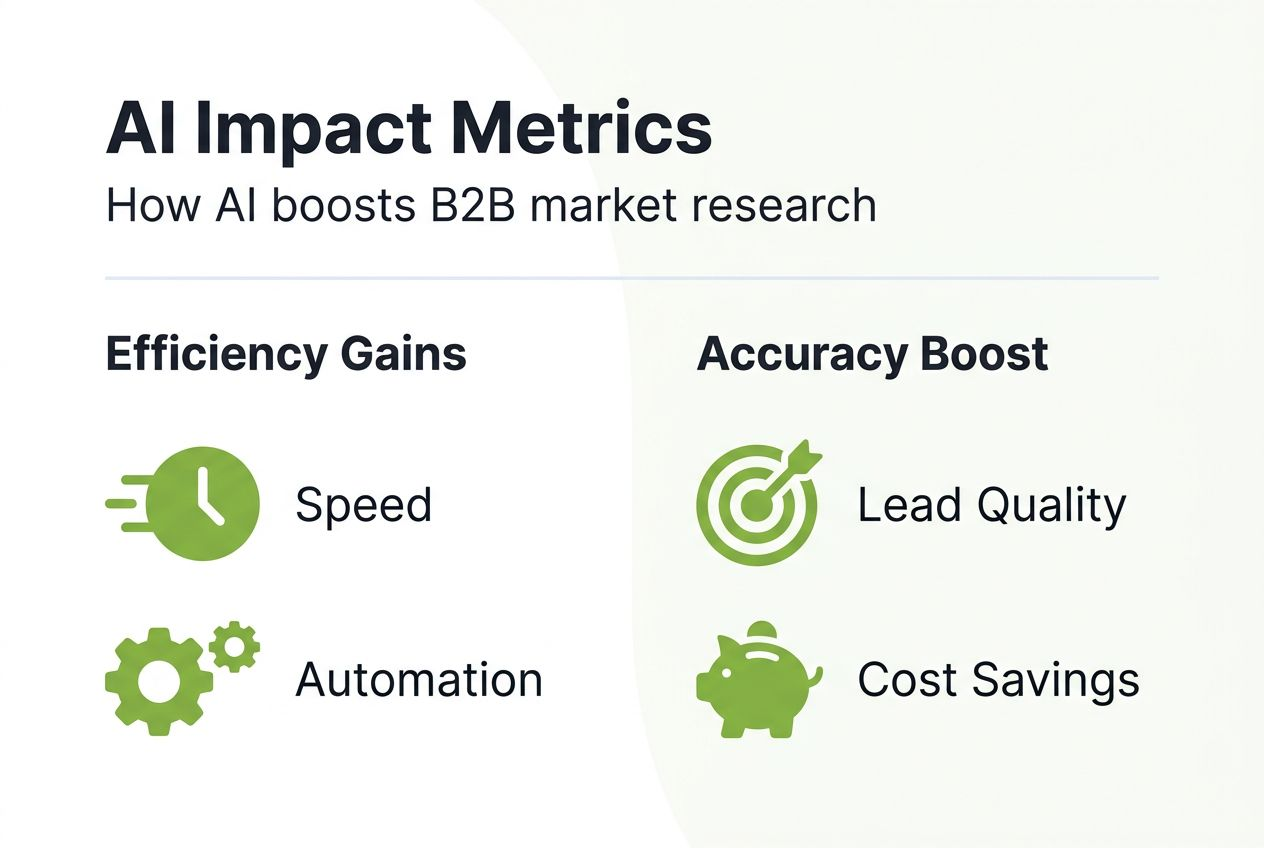
| Dimension | Traditional Research | AI-Driven Research |
|---|---|---|
| Speed | Weeks per campaign | Hours per campaign |
| Accuracy | 60-70% targeting precision | 85-95% targeting precision |
| Scalability | Limited by team size | Scales with data volume |
| Personalization | Template-based | Dynamic, trigger-based |
| Cost per lead | Higher due to manual effort | 25% lower with automation |
Cost-benefit analysis should account for technology investments, training time, and process changes alongside efficiency gains. Calculate total research hours saved monthly, multiply by average researcher cost, then subtract AI tool expenses and implementation overhead. Most B2B teams reach positive ROI within 4 to 6 months as workflows mature and targeting improves.
The Lickfold Digital Blog provides spreadsheet templates and calculation guides for measuring AI impact across different sales scenarios.
Practical steps to integrate AI into B2B market research and sales workflows
Start by assessing current workflows to identify bottlenecks where AI delivers maximum impact. Map each stage of your research and outreach process, noting time spent, error rates, and team frustration points. Common integration opportunities include contact enrichment, company research, email personalization, and follow-up sequencing. Prioritize areas where manual effort is high and decision rules are clear enough to automate.
Select tools aligned to B2B prospecting needs and existing technology infrastructure. Evaluate whether platforms integrate with your CRM, support your data sources, and offer the personalization capabilities your campaigns require. Request trials to test accuracy against your specific ideal customer profile. Avoid over-investing in enterprise features before proving value with focused pilots.
Establish data privacy and ethical governance frameworks before deploying AI at scale. Document data sources, verify compliance with relevant regulations, and create approval processes for new data types. Define what constitutes acceptable use, how long to retain prospect information, and when to purge outdated records. Assign governance responsibility to specific team members rather than assuming everyone understands requirements.
Train marketing and sales teams for AI-human collaboration through hands-on workshops and gradual capability rollout. Teach teams how to interpret confidence scores, when to override recommendations, and how to provide feedback that improves AI performance. Start with AI handling research tasks while humans control all outreach, then gradually automate more touchpoints as confidence grows.
Monitor metrics and iteratively improve AI use by reviewing performance weekly and adjusting targeting criteria, messaging templates, and sequencing logic. Track which AI recommendations convert and which fall flat. Investigate false positives where prospects looked perfect but never engaged. Use these insights to refine scoring models and data inputs.
Pro Tip: Assign an AI champion within your team who becomes the expert on your tools, troubleshoots issues, and shares best practices to accelerate adoption.
Teams ready to accelerate implementation can schedule a free AI integration session to develop a customized deployment roadmap.
Conclusion: unlocking sales growth with AI-enhanced market research
AI transforms B2B market research by delivering speed, accuracy, personalization, and cost reduction that manual methods cannot match. These benefits compound when AI handles data-intensive tasks while humans apply strategic thinking, relationship skills, and contextual judgment. The most successful teams view AI as a force multiplier rather than a replacement, establishing clear roles for technology and people.
Human oversight remains non-negotiable for validating insights, ensuring ethical compliance, and making nuanced decisions AI cannot replicate. The framework of AI handling research and initial outreach while humans manage relationship building and deal closing creates sustainable competitive advantage. B2B teams that adopt this hybrid approach systematically outperform those relying solely on traditional methods or expecting AI to operate autonomously.
Now is the time to evaluate where AI fits your workflows, pilot focused implementations, and train teams for this new collaboration model. The competitive advantage goes to organizations that move decisively while maintaining ethical standards and human-centered design.
Enhance your B2B market research with AI experts
Transforming market research with AI requires more than just technology. It demands expertise in B2B sales workflows, ethical governance, and change management. Lickfold Digital AI Experts specialize in helping marketing and sales teams integrate AI-driven prospecting and outreach systems that deliver measurable results.
We offer free strategy sessions to assess your current workflows, identify high-impact AI integration opportunities, and develop customized implementation roadmaps. Our team supports you with training programs that prepare your people for AI-human collaboration and governance frameworks that ensure responsible, compliant AI use.
Ready to accelerate your B2B sales growth? Book your free session today or download our 24/7 business guide to explore AI strategies for sales automation and market research optimization.
FAQ
What are the main benefits of using AI in B2B market research?
AI increases efficiency by reducing research time by up to 70% and improves lead targeting accuracy by 30% through automated data integration. It enables personalized outreach that boosts engagement by 40% and reduces acquisition costs by up to 25%. These benefits help teams reach the right decision-makers faster with messaging that resonates.
How does AI improve the quality of prospects identified?
AI integrates behavioral signals, firmographic data, and engagement patterns to classify prospects with 90% accuracy against your ideal customer profile. This precision comes from analyzing thousands of data points simultaneously and recognizing patterns humans miss manually. Higher accuracy translates to better lead qualification and more efficient sales cycles.
What ethical considerations should teams keep in mind when using AI?
Ensure compliance with data privacy regulations like GDPR and CCPA when collecting and using prospect information. Maintain human oversight to validate AI outputs, catch potential biases, and provide contextual judgment that algorithms lack. Implement transparent data governance frameworks that document sources, consent mechanisms, and retention policies to protect both your organization and prospects.
What practical steps are crucial for successful AI adoption in sales workflows?
Assess existing workflows to identify where AI delivers maximum impact, then select tools suited to your specific B2B prospecting needs and technology stack. Establish ethical governance frameworks and train teams for AI-human collaboration through hands-on workshops. Regularly monitor performance metrics and iteratively improve targeting criteria and messaging based on results. Schedule an AI integration session to develop your customized roadmap.