
How to use AI market research for B2B outreach success
How to use AI market research for B2B outreach success
TL;DR:
- AI-driven market research automates lead prioritization, saving time and increasing outreach efficiency.
- Clean CRM data and team training are crucial prerequisites for successful AI implementation.
- Most mid-sized enterprises should focus on AI augmentation, not full automation, to maximize results.
Manual prospecting drains your sales team’s time on tasks that rarely convert. For mid-sized B2B enterprises, the math is brutal: reps spend hours building lists, verifying contacts, and crafting messages that land in the wrong inbox. AI-driven market research uses intent data, enrichment, predictive scoring, and personalization to identify in-market buyers and prioritize leads automatically. This guide walks you through the tools you need, a step-by-step execution plan, the pitfalls that trip up most teams, and the benchmarks that tell you whether your investment is actually working.
Table of Contents
- Essential tools and prerequisites for AI-driven B2B market research
- Step-by-step: Automating B2B prospect discovery with AI market research
- Avoiding common pitfalls in AI-powered B2B market research
- Measuring impact: Benchmarks and what success looks like
- Our take: Why AI should augment—not replace—your B2B team
- Scale your B2B outreach with expert-backed AI guidance
- Frequently asked questions
Key Takeaways
| Point | Details |
|---|---|
| Start with the right tools | Pick off-the-shelf AI solutions and ensure your data is clean before automating B2B outreach. |
| Automate, but monitor | Set up signal-driven workflows but keep human oversight to avoid costly data or governance errors. |
| Measure results early | Track lead quality, reply rates, and ROI to benchmark the success of your automation. |
| Focus on augmentation | Let AI handle research so your team can focus on closing deals, not just chasing contacts. |
Essential tools and prerequisites for AI-driven B2B market research
With the efficiency challenge clear, it’s vital to know what tools and preparations you need before automating your B2B outreach. Jumping into AI without the right foundation is one of the fastest ways to waste budget and frustrate your team.
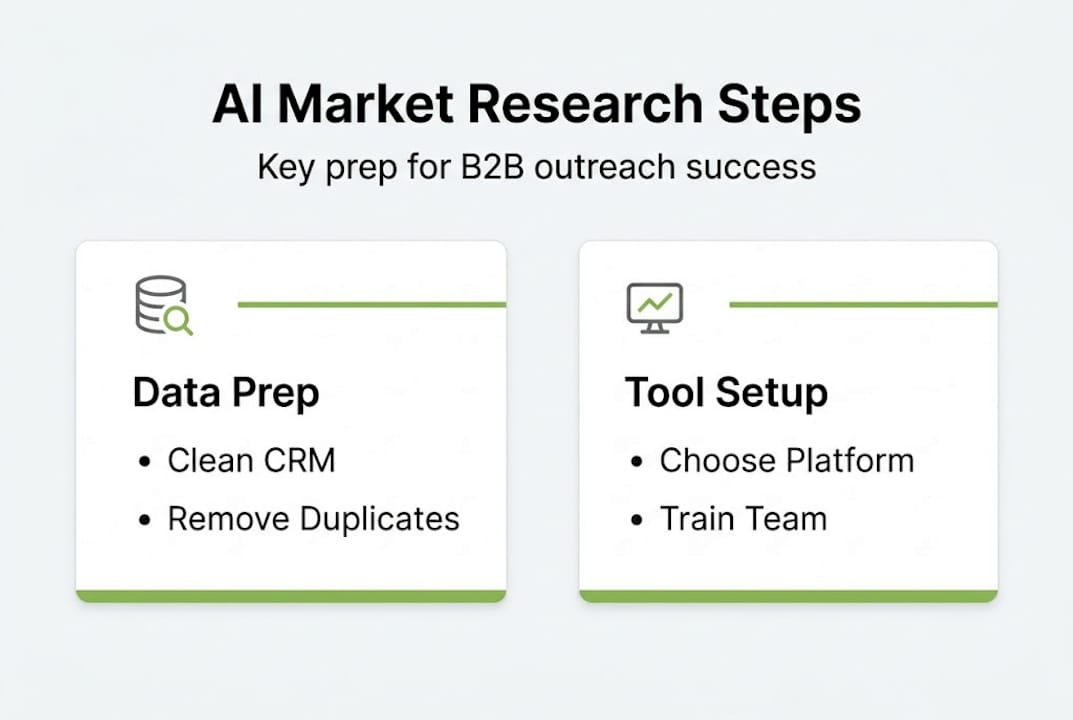
Before you touch any automation platform, your CRM data needs to be clean. Duplicate records, outdated job titles, and missing firmographic fields will poison every AI output downstream. Spend time standardizing fields, removing dead contacts, and enriching existing records before connecting any tool.
For most mid-sized teams, off-the-shelf tools like Apollo or Clay for enrichment and prospecting run between $49 and $149 per month and integrate with most CRMs without custom development. Layering in an intent data source like ZoomInfo helps you catch buyers who are actively researching solutions like yours.
Here’s a quick overview of the core stack:
| Tool | Purpose | Price range | Integration complexity |
|---|---|---|---|
| Apollo.io | Prospecting and enrichment | $49–$99/mo | Low |
| Clay | Data enrichment and workflows | $99–$149/mo | Medium |
| ZoomInfo | Intent data and contact data | Custom pricing | Medium |
| HubSpot or Salesforce | CRM and pipeline management | $50–$150/mo | Low |
| Instantly or Smartlead | Email sequencing and warmup | $37–$97/mo | Low |
Beyond tools, you need team buy-in. AI sales intelligence platforms only deliver value when reps understand how to interpret signals and act on them. Skills training is not optional.
Key prerequisites before going live:
- Clean and enriched CRM data with standardized fields
- Defined ideal customer profile (ICP) with firmographic and technographic criteria
- Assigned ownership for data governance and tool management
- At least one team member trained on AI workflow configuration
- Integration tested between enrichment tools and CRM before launch
If you want a deeper look at how AI prospecting steps fit together or need to evaluate Apollo and Clay alternatives, both resources will sharpen your tool selection process.
Pro Tip: Block two to three weeks for team skills training before your first campaign goes live. Adoption barriers, not tool limitations, are what kill most AI rollouts.
Step-by-step: Automating B2B prospect discovery with AI market research
Once your tools and team are ready, move on to setting up and executing automated prospecting. Here’s how to do it without creating a fragile, manual-dependent workflow.
Multi-signal AI for account prioritization uses firmographics, technographics, intent data, and timing signals together to score accounts dynamically. Static ICP definitions become outdated fast, so the best teams treat their ICP as a living document updated by behavioral triggers.
Here’s the step-by-step process:
- Define your ICP using firmographic data (company size, industry, revenue), technographic data (tools they use), and behavioral signals (content downloads, job postings, competitor reviews).
- Connect your intent data source to your CRM so that accounts showing buying signals are automatically flagged and prioritized in your pipeline.
- Build enrichment workflows in Clay or Apollo that automatically pull verified contact data for decision-makers at flagged accounts.
- Set up trigger-based sequences so that when an account hits a scoring threshold, a personalized outreach sequence launches without manual input.
- Score and segment leads by fit and timing, routing high-intent accounts to senior reps and nurture sequences to early-stage prospects.
- Review and refine your ICP and scoring model monthly using reply data, conversion rates, and lost deal feedback.
To see how AI transformation in B2B research reshapes the entire prospecting workflow, that resource goes deeper on signal capture and agentic research models.
Here’s how the two approaches compare:
| Factor | Manual research | AI-driven research |
|---|---|---|
| Speed | Days per list | Minutes per list |
| Data freshness | Stale within weeks | Real-time updates |
| Personalization | Generic templates | Signal-based messaging |
| Scalability | Limited by headcount | Scales without hiring |
| Cost per lead | High | Significantly lower |
AI-augmented outreach boosts pipeline velocity by removing the manual bottlenecks that slow every stage from discovery to first reply.

Pro Tip: Revisit your ICP scoring model every 30 days using actual reply and conversion data. The teams that treat ICP as dynamic outperform static-list teams within two quarters.
Avoiding common pitfalls in AI-powered B2B market research
Automating research can accelerate results, but ignoring these pitfalls risks losing time and data integrity. Most teams hit at least two of these in their first 90 days.
The five most common mistakes are:
- Dirty data: Feeding AI tools records with missing or incorrect fields produces inaccurate scoring and misdirected outreach. Garbage in, garbage out applies here more than anywhere else.
- Insufficient training: Reps who don’t understand how AI signals work will override or ignore recommendations, undermining the entire system.
- Over-trusting AI outputs: No model is perfect. Automated research still needs human review before messages go out, especially for high-value accounts.
- Lack of governance: Without clear ownership of data quality and model outputs, errors compound silently over time.
- Poor integration: Tools that don’t talk to each other create data silos that break automation workflows and require manual reconciliation.
The governance risk is especially serious. Mid-sized enterprises lag large firms by roughly three times in AI adoption maturity, which means they also have fewer guardrails in place when things go wrong.
“Skills gaps and low confidence in AI use, despite high adoption rates, remain the leading cause of failed automation projects. Bad AI outputs already cost organizations over $10 billion annually.”
For mid-sized businesses, a phased rollout is the safest path. Start by automating one workflow, like contact enrichment, before expanding to full prospecting cycles. This limits exposure to potential automation traps and gives your team time to build confidence in the system.
Governance frameworks that cover data access, output review, and escalation paths are not bureaucratic overhead. They are what separates teams that scale AI successfully from those that quietly abandon it after a costly mistake. Governance risks in B2B AI are growing as adoption accelerates, making early investment in oversight a competitive advantage.
Measuring impact: Benchmarks and what success looks like
After overcoming common pitfalls, you need to measure outcomes. Here’s what to track and what success actually looks like for mid-sized B2B teams.
The numbers are compelling when AI market research is set up correctly. AI boosts qualified leads by 50 to 70%, shortens sales cycles by 20 to 30%, lifts ROI by 10 to 20%, and pushes reply rates to 15 to 25%. Those are not aspirational figures. They are benchmarks from teams already running these workflows.
Key performance indicators to track from day one:
| KPI | Baseline (manual) | Expected lift with AI | Measurement frequency |
|---|---|---|---|
| Qualified leads per month | 20–40 | 50–70% increase | Weekly |
| Reply rate | 3–6% | 15–25% | Per campaign |
| Sales cycle length | 60–90 days | 20–30% shorter | Monthly |
| Cost per qualified lead | $150–$300 | 30–50% reduction | Monthly |
| ROI on outreach spend | Baseline | 10–20% lift | Quarterly |
For efficiency metrics that go beyond top-of-funnel numbers, tracking pipeline velocity and deal stage conversion rates gives you a fuller picture of where AI is actually moving the needle.
The teams that see the strongest results also track negative signals: unsubscribe rates, spam complaints, and bounce rates. These tell you whether your data quality and personalization are holding up at scale. For outbound success benchmarks specific to AI-driven campaigns, those numbers provide useful context for setting realistic targets.
Review your KPIs at three levels: campaign level weekly, program level monthly, and strategic level quarterly. This cadence catches problems early and gives you enough data to make confident adjustments. Sales pipeline benchmarks from AI-augmented teams show that consistent measurement is what separates sustained growth from a one-quarter spike.
Our take: Why AI should augment—not replace—your B2B team
With the benchmarks clear, it’s time for a reality check on how AI should fit into your process and where it shouldn’t.
The promise of full AI autonomy in B2B sales is real but premature for most mid-sized teams. Agentic AI may automate 80% of prospecting tasks in the near future, but right now, 40% of autonomous AI projects are projected to fail by 2027 due to costs and governance risks. That’s not a reason to avoid AI. It’s a reason to be deliberate about where you deploy it.
The teams winning today are using AI to give reps back 60% or more of their selling time, not to eliminate reps entirely. AI handles research, enrichment, scoring, and initial outreach. Humans handle relationship nuance, objection handling, and deal strategy. That division of labor is where the real productivity gains live.
We’ve seen this play out in case studies of AI campaign results where the biggest wins came from augmentation, not replacement. Start by automating the rote tasks your team hates most. Build trust in the outputs before expanding scope. The goal is a system your team relies on, not one they work around.
Pro Tip: Invest in building your team’s AI literacy before expanding automation scope. Reps who understand why AI recommends a prospect are far more likely to act on it effectively.
Scale your B2B outreach with expert-backed AI guidance
If you’re ready to scale outreach and need hands-on expertise, our team can help you move faster and avoid the costly trial-and-error phase most teams go through alone.
At Lickfold Digital, we deploy dedicated AI agents that perform precise market research, identify decision-makers that match your ICP, and execute personalized multi-touch outreach campaigns that convert. Our system handles infrastructure setup, email warmup, reputation management, and human qualification of replies before any lead reaches your sales team. You get a predictable pipeline of qualified opportunities without building the system from scratch. If you want to see exactly how it works for your market, contact our team and we’ll map out a plan specific to your goals.
Frequently asked questions
What is the fastest way to start AI-driven market research for B2B outreach?
Most mid-sized enterprises see results fastest by cleaning CRM data first, then choosing off-the-shelf tools like Apollo or ZoomInfo, and training teams on AI workflows before launching any campaign.
How much can reply rates and lead quality improve with AI automation?
Hyper-personalized AI outreach can push reply rates to 15 to 25% and increase qualified leads by 50 to 70% compared to traditional manual methods.
What are the biggest risks when automating B2B market research with AI?
The largest risks are dirty data, lack of human review, and skills gaps in AI use, all of which can quietly undermine accuracy and erode ROI before you notice.
Should I aim for full AI autonomy or start with augmentation in B2B sales?
Start with augmentation. 40% of autonomous AI projects are projected to fail by 2027, so prioritizing AI as an assistant for research and enrichment before full autonomy is the lower-risk, higher-return path.