
Boost B2B sales efficiency with AI-driven prospecting
Boost B2B sales efficiency with AI-driven prospecting
Most B2B sales teams track revenue and pipeline, but few understand how to measure the efficiency of their sales engine. Without clear metrics, you can’t identify bottlenecks, justify investments, or scale predictably. This guide breaks down B2B sales efficiency measurement, industry benchmarks, proven optimization methods, and how AI-driven prospecting automation transforms lead generation. You’ll learn practical formulas, key ratios, and actionable strategies to improve your sales ROI while reducing acquisition costs.
Table of Contents
- Key takeaways
- What is B2B sales efficiency and how is it calculated?
- Benchmarks and what healthy B2B sales efficiency looks like
- How to improve B2B sales efficiency with AI and process optimization
- Comparing traditional vs AI-driven sales efficiency approaches
- Enhance your sales efficiency with Lickfold Digital AI experts
- Frequently asked questions
Key Takeaways
| Point | Details |
|---|---|
| Efficiency formula | B2B sales efficiency equals revenue divided by total sales and marketing costs to measure return on investment. |
| Benchmark ranges | Healthy efficiency for B2B teams typically ranges from 1.0 to 3.0, with SaaS medians around 0.7. |
| Key performance drivers | Improvements come from tracking CAC payback period, sales cycle length, and conversion rates. |
| AI driven automation | AI driven prospecting automation can save time, triple pipelines, and improve lead generation. |
What is B2B sales efficiency and how is it calculated?
B2B sales efficiency measures the ratio of revenue generated to sales and marketing costs spent. It tells you how much return you get for every dollar invested in acquiring customers. A higher ratio means you’re generating more revenue per dollar spent, which signals a healthy, scalable sales operation.
The basic formula is straightforward: divide your revenue by your total sales and marketing expenses. If you generated $500,000 in revenue and spent $250,000 on sales and marketing, your efficiency ratio is 2.0. This means every dollar invested returned two dollars in revenue.
However, different formulas serve different purposes. The basic sales efficiency calculation uses total revenue, while gross sales efficiency focuses on new revenue only, excluding renewals. Net sales efficiency subtracts churn from new revenue to account for customer losses. SaaS companies often use the Magic Number, which divides net new annual recurring revenue by the previous quarter’s sales and marketing spend, then multiplies by four to annualize the result.
Understanding these variations matters because each reveals different aspects of your sales performance. The basic formula shows overall ROI, gross efficiency highlights new customer acquisition effectiveness, and net efficiency accounts for retention challenges. Choose the formula that aligns with your business model and growth stage.
Key terms you need to know:
- Revenue: Total income from sales, or specifically new revenue depending on your formula
- S&M costs: Combined sales and marketing expenses including salaries, tools, advertising, and overhead
- LTV: Lifetime value, the total revenue expected from a customer over their entire relationship
- CAC: Customer acquisition cost, the total cost to acquire one new customer
- Magic Number: SaaS-specific metric measuring efficiency of revenue growth relative to spending
To calculate sales efficiency accurately:
- Define your measurement period, typically quarterly or annually
- Sum all revenue generated during that period
- Add up all sales and marketing costs including salaries, commissions, software, advertising, and allocated overhead
- Divide revenue by total costs to get your efficiency ratio
- Compare your result to industry benchmarks and your historical performance
- Analyze trends over multiple periods to identify patterns
Pro Tip: Update your calculations monthly even if you report quarterly. This helps you spot efficiency drops early and adjust tactics before they impact your bottom line. Many teams discover seasonal patterns or campaign effects they’d miss with less frequent analysis.
For deeper insights into optimizing your sales processes, explore digital sales insights that cover advanced measurement techniques and automation strategies.
Benchmarks and what healthy B2B sales efficiency looks like
Healthy sales efficiency ratios typically range from 1.0 to 3.0 for established B2B companies. A ratio of 1.0 means you’re breaking even, generating one dollar of revenue for every dollar spent. Ratios above 1.0 indicate profitable growth, while anything below 1.0 signals you’re spending more than you’re earning, which is unsustainable long term.
SaaS companies often see lower ratios during growth phases, with the median around 0.7. This makes sense because SaaS businesses invest heavily upfront to acquire customers who generate recurring revenue over time. Early stage companies might accept ratios below 1.0 temporarily, but they need a clear path to profitability as they scale.
| Efficiency Ratio | Interpretation | Action Required |
|---|---|---|
| Below 0.5 | Critical inefficiency | Immediate cost reduction or strategy overhaul |
| 0.5 to 1.0 | Unprofitable but potentially viable | Optimize conversion rates and reduce CAC |
| 1.0 to 2.0 | Healthy and sustainable | Maintain current approach while testing improvements |
| 2.0 to 3.0 | Excellent efficiency | Scale investment to capture market share |
| Above 3.0 | Exceptional or underinvesting | Consider increasing spending to accelerate growth |
The LTV:CAC ratio provides complementary insight into long term sustainability. This metric divides customer lifetime value by customer acquisition cost. A ratio of 3:1 or higher is ideal, meaning each customer generates at least three times what you spent to acquire them. Ratios below 3:1 suggest you’re either spending too much on acquisition or not retaining customers long enough to justify the investment.
Other efficiency indicators to monitor:
- Median win rates hover around 21% for B2B sales teams
- MQL to SQL conversion rates typically reach 15% for well-qualified leads
- Sales cycle length varies by deal size, with SMB deals closing in 1 to 2 months and enterprise sales taking 6 to 12 months
- CAC payback period should be under 12 months for healthy cash flow
Pro Tip: Watch for efficiency ratios dropping below 1.0 for more than two consecutive quarters. This pattern signals fundamental problems with your sales model, pricing, or market fit that require strategic changes, not just tactical adjustments.
“Companies that track sales efficiency alongside CAC and LTV make data-driven decisions that compound over time. The teams that ignore these metrics often discover problems too late to correct them without major disruption.”
For real-world examples of efficiency improvements through AI automation, review this AI lead generation case study showing 65% cost reduction.
How to improve B2B sales efficiency with AI and process optimization
Improving sales efficiency requires tracking the right indicators and implementing targeted optimizations. Start by measuring these key performance metrics that directly impact your efficiency ratio:
- CAC payback period: How long it takes to recover the cost of acquiring a customer
- Sales cycle length: Time from first contact to closed deal
- Win rates: Percentage of opportunities that convert to customers
- Conversion rates at each funnel stage: MQL to SQL, SQL to opportunity, opportunity to close
- Average deal size: Revenue per closed deal
- Sales rep productivity: Deals closed per rep per quarter
To shorten your sales cycle and boost efficiency:
- Implement tighter ideal customer profile criteria to focus on high-fit prospects
- Automate qualification processes to route leads faster to appropriate reps
- Use AI-powered lead scoring to prioritize prospects most likely to convert
- Create standardized sales playbooks that reduce decision time at each stage
- Eliminate manual data entry tasks that consume rep time without adding value
- Deploy multi-touch nurture sequences that keep prospects engaged between conversations
AI applications transform sales efficiency by automating time-intensive prospecting and qualification workflows. Modern AI tools handle lead research, data enrichment, personalized outreach, and follow-up scheduling. This frees your sales team to focus on high-value activities like discovery calls, demos, and closing deals.
Specific AI capabilities that drive efficiency gains:
- Automated prospecting that identifies decision makers within target accounts
- Predictive lead scoring using historical conversion data and behavioral signals
- Personalized email generation that maintains brand voice while scaling outreach
- Intelligent meeting scheduling that eliminates back-and-forth coordination
- Real-time conversation intelligence that surfaces objections and buying signals
- Pipeline forecasting that predicts close dates and revenue with higher accuracy
AI workflows deliver measurable results, with teams reporting 78% time savings on prospecting tasks, 3x pipeline growth, and 52% higher lead generation. Reply rates for AI-personalized outreach typically range from 2% to 10%, significantly outperforming generic templates.

Pro Tip: Integrate AI tools gradually with human oversight to maximize ROI and avoid automation pitfalls. Start by automating your most repetitive, low-value tasks like data entry and initial outreach. Monitor results closely and adjust personalization parameters before scaling. Teams that rush full automation often sacrifice quality for volume, damaging deliverability and brand perception.
For expert guidance on implementing AI in your sales process, connect with AI sales automation experts who specialize in B2B prospecting workflows. You can also schedule a free consultation to discuss your specific efficiency challenges.
Comparing traditional vs AI-driven sales efficiency approaches
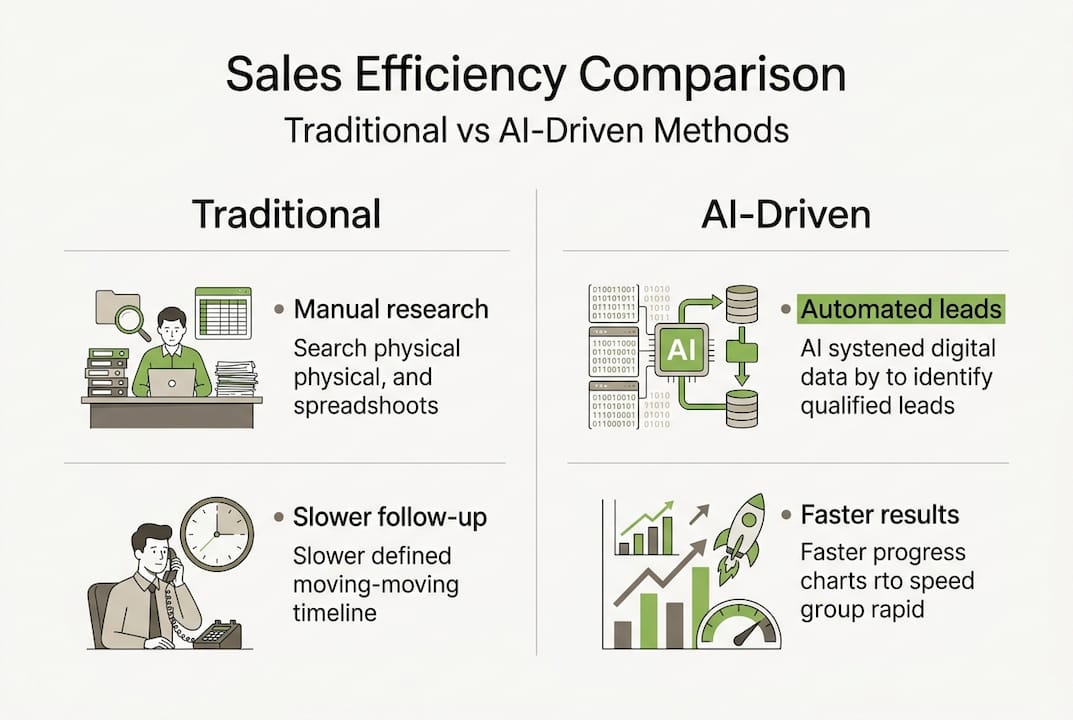
Traditional sales methods rely heavily on manual prospecting, cold calling, and relationship building through repeated personal touchpoints. Reps spend hours researching prospects, crafting individual emails, and tracking follow-ups in spreadsheets or basic CRMs. This approach works but scales poorly because human capacity limits how many prospects one rep can effectively manage.
Traditional sales characteristics:
- Manual research consuming 3 to 5 hours per day per rep
- Limited daily outreach volume, typically 20 to 40 personalized contacts
- Longer response times due to human scheduling constraints
- Inconsistent messaging quality depending on rep experience and workload
- Higher cost per lead due to labor-intensive processes
- Difficulty maintaining follow-up discipline across large prospect lists
AI-driven sales approaches automate repetitive tasks while maintaining personalization at scale. AI systems save 78% of prospecting time by handling research, data enrichment, initial outreach, and follow-up sequences. Reps receive qualified, engaged prospects ready for meaningful conversations, dramatically improving their productivity and efficiency.
AI-driven sales features:
- Automated prospect identification across multiple data sources
- Instant lead scoring based on fit and engagement signals
- Scalable personalized outreach reaching hundreds of prospects daily
- 24/7 follow-up sequences that never miss a touchpoint
- Consistent messaging aligned with proven templates and brand guidelines
- Real-time analytics showing what works and what needs adjustment
| Metric | Traditional Approach | AI-Driven Approach | Improvement |
|---|---|---|---|
| Time on prospecting | 60-70% of rep time | 15-20% of rep time | 78% reduction |
| Daily outreach volume | 20-40 contacts | 100-200+ contacts | 3-5x increase |
| Lead generation rate | Baseline | 52% higher | 52% gain |
| Pipeline size | Baseline | 3x larger | 200% growth |
| Reply rate | 1-3% | 2-10% | 2-3x improvement |
| Cost per qualified lead | Higher | 40-65% lower | Major savings |
Common challenges with traditional sales and how AI addresses them:
- Challenge: Reps waste time on unqualified leads. AI solution: Predictive scoring identifies high-fit prospects before outreach.
- Challenge: Inconsistent follow-up leads to lost opportunities. AI solution: Automated sequences ensure every prospect receives timely touchpoints.
- Challenge: Personalization doesn’t scale. AI solution: Dynamic content generation maintains relevance across hundreds of contacts.
- Challenge: Limited visibility into what’s working. AI solution: Real-time analytics track performance by message, channel, and segment.
- Challenge: New reps take months to ramp. AI solution: Proven playbooks and automated workflows reduce learning curve.
The most effective approach combines AI automation with human expertise. AI handles research, outreach, and qualification at scale while experienced reps focus on discovery, objection handling, and closing. This hybrid model delivers the efficiency of automation with the relationship-building power of personal interaction.
Explore more strategies and case studies in our collection of sales technology articles covering AI implementation, automation best practices, and efficiency optimization.
Enhance your sales efficiency with Lickfold Digital AI experts
If you’re ready to transform your B2B sales efficiency through AI-driven prospecting, Lickfold Digital offers specialized consulting and automation solutions tailored to your business. Our AI agents perform comprehensive market research, identify decision makers, and execute personalized multi-touch campaigns that convert cold prospects into qualified opportunities.
We handle the complete infrastructure setup including dedicated email accounts, reputation management, and ongoing optimization. Our approach maintains high deliverability while scaling your outreach to hundreds of prospects daily. Human qualification ensures only genuine opportunities reach your sales team, so you focus on closing deals instead of chasing dead ends.
Book a free consultation to discuss your specific efficiency challenges and explore how AI automation can reduce your acquisition costs while growing your pipeline. You can also download our free business book for additional insights on scaling B2B sales operations.
Frequently asked questions
What is B2B sales efficiency?
B2B sales efficiency measures the revenue generated relative to sales and marketing costs spent. It’s calculated by dividing total revenue by S&M expenses, producing a ratio that shows ROI on sales investments. Higher ratios indicate you’re generating more revenue per dollar spent, signaling a healthy, scalable sales operation.
Why is measuring sales efficiency essential?
Measuring sales efficiency helps you identify bottlenecks, justify investments, and make data-driven decisions about scaling. Without clear efficiency metrics, you can’t determine whether poor results stem from inadequate spending, ineffective tactics, or market fit problems. Tracking efficiency alongside CAC and LTV provides a complete picture of sales performance and sustainability.
What key metrics should I track alongside sales efficiency?
Track CAC payback period to understand cash flow impact, sales cycle length to identify process bottlenecks, win rates to measure closing effectiveness, and LTV:CAC ratio to assess long term profitability. MQL to SQL conversion rates reveal qualification quality, while average deal size shows whether you’re moving upmarket or downmarket over time.
How can AI improve my sales efficiency?
AI automates time-intensive prospecting tasks like research, lead scoring, and initial outreach, freeing reps to focus on high-value activities. AI-driven workflows save 78% of prospecting time, triple pipeline size, and boost lead generation by 52%. Personalized AI outreach achieves 2% to 10% reply rates, significantly outperforming generic templates while scaling to hundreds of daily contacts.
What’s a common misconception about sales efficiency measurement?
Many teams assume sales efficiency is just about closing more deals, but it’s actually about optimizing the entire funnel from prospecting through retention. A high close rate means nothing if you’re spending too much to generate opportunities or losing customers quickly after acquisition. True efficiency requires balancing acquisition costs, conversion rates, deal size, and customer lifetime value across the complete revenue cycle.