
Why automate market research? Boost B2B growth & efficiency
Why automate market research? Boost B2B growth & efficiency
TL;DR:
- AI-driven automation in B2B market research leads to 11% annual revenue growth and higher lead quality.
- Automation enables continuous monitoring, large-scale data enrichment, and precise targeting, improving efficiency and speed.
- Effective hybrid workflows combine AI’s data processing with human judgment to manage complex relationships and niche markets.
B2B marketers who lean heavily on AI are seeing 11% annual revenue growth while their peers running manual research cycles fall further behind each quarter. That gap is not a coincidence. It reflects a structural shift in how the best sales and marketing teams gather intelligence, identify prospects, and time their outreach. Yet plenty of B2B leaders still hesitate, unsure whether automation can match the nuance of a skilled analyst or whether it will produce generic, low-quality outputs. This article cuts through that uncertainty, showing you exactly where automation wins, where it falls short, and how to build a workflow that combines both for maximum impact.
Table of Contents
- The evolution of B2B market research: from manual to automated
- Key benefits of automating market research for B2B outreach
- Pitfalls and limitations: what automation can and can’t do
- Building an effective human-AI workflow in your market research
- Our perspective: the real reason automation wins in B2B market research
- Accelerate your B2B research transformation with experts
- Frequently asked questions
Key Takeaways
| Point | Details |
|---|---|
| Faster insight generation | Automated market research provides quicker, scalable data to fuel smarter B2B campaigns. |
| Combine AI and human expertise | A hybrid model delivers more accurate, personalized results than automation or humans alone. |
| Boost revenue and lead quality | Firms embracing automation enjoy faster revenue growth and better targeting than their competitors. |
| Know automation’s limits | Some complex B2B tasks still demand human judgment and contextual nuance. |
The evolution of B2B market research: from manual to automated
Let’s first explore how B2B market research has transformed, setting the context for why automation’s rise matters so much.
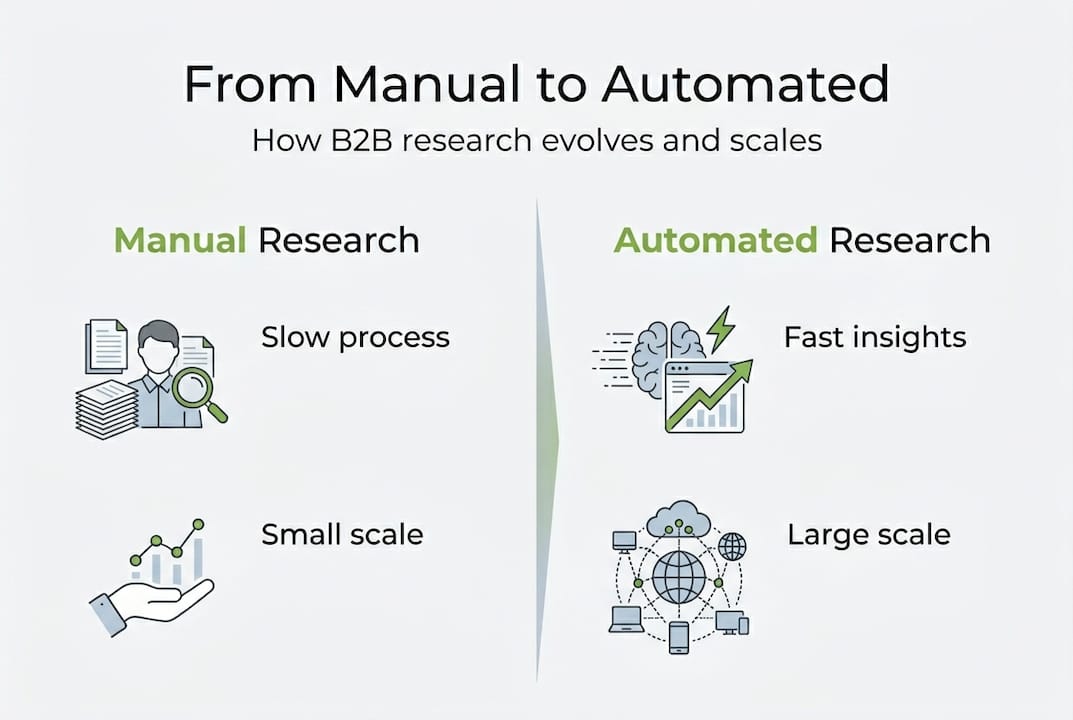
Not long ago, market research meant spreadsheets, cold calls to verify contact data, and analysts spending days compiling industry reports. A single account list could take a week to build. Firmographic data went stale before the sales team even touched it. The process was slow, expensive, and heavily dependent on individual skill.
Digital tools changed the first layer of this problem. CRM platforms, LinkedIn Sales Navigator, and intent data providers gave teams faster access to structured information. But these tools still required significant human effort to interpret, prioritize, and act on. They accelerated data collection without truly automating the research process.
Then came the AI wave. Automation now handles tasks that once required entire research teams:
- Continuous monitoring of target accounts for buying signals
- Real-time data enrichment across thousands of contacts simultaneously
- Automated segmentation based on firmographic and behavioral criteria
- Pattern recognition across massive datasets to surface high-intent prospects
- Competitive intelligence aggregation from public sources
The numbers behind this shift are striking. 86% of marketers now use AI in some form, and firms with the deepest adoption report 2.3x higher conversion rates and 73% gains in lead quality. These are not marginal improvements. They represent a compounding advantage that widens every quarter.
“The gap between AI-enabled B2B teams and those still relying on manual research is not closing. It is accelerating.”
What makes this evolution particularly important for sales leaders is the shift from periodic research to continuous intelligence. Manual research produced snapshots. Automation produces a live feed. When a target account hires a new VP of Sales, changes its tech stack, or raises a funding round, an automated system flags it immediately. Your team reaches out while the opportunity is warm, not three months later when a competitor already owns the conversation.
Understanding how AI transforms B2B market research at a technical level helps you make smarter decisions about which capabilities to prioritize when building your own stack.
Key benefits of automating market research for B2B outreach
With this evolution in mind, let’s break down the concrete advantages automation brings to B2B market research and outreach.
Speed is the most obvious benefit, but scale is where the real leverage lives. A human analyst can monitor a few dozen accounts. An automated system monitors thousands, simultaneously, around the clock. That scale changes what is possible in your go-to-market strategy.

| Metric | Manual research | Automated research |
|---|---|---|
| Accounts monitored per week | 20 to 50 | 5,000 or more |
| Lead enrichment time | 2 to 4 hours per batch | Near real-time |
| Conversion rate improvement | Baseline | Up to 2.3x higher |
| Lead quality gains | Baseline | Up to 73% improvement |
| Revenue growth (top adopters) | Baseline | 11% annually |
The quality improvements are just as significant as the speed gains. Automated enrichment pulls in technographic data, hiring signals, funding events, and intent scores that a human researcher would never have time to compile consistently. That richer profile means your AI-powered B2B messaging can be genuinely personalized rather than surface-level.
Here is what the best-performing B2B teams gain from automating their research:
- Precision targeting: Automated segmentation identifies accounts that match your ideal customer profile with far greater accuracy than manual filtering.
- Timing advantage: Trigger-based outreach fires when a prospect shows buying intent, not on an arbitrary cadence.
- Consistent pipeline: Automation removes the feast-or-famine cycle that plagues teams relying on manual prospecting bursts.
- Lower cost per lead: Fewer hours spent on research means your team focuses on selling, not data entry.
Pro Tip: Start by automating one specific research task, such as account monitoring for job change signals, before scaling to full workflow automation. Teams that try to automate everything at once often end up with messy data and low adoption.
Automating B2B prospecting at scale also creates a feedback loop. The more data your system processes, the better it gets at predicting which accounts are likely to convert, which means your targeting improves continuously without additional human effort.
Leading B2B marketers using AI extensively outperform peers in both revenue growth and profit margins, which confirms that this is not just an efficiency story. It is a competitive positioning story.
Pitfalls and limitations: what automation can and can’t do
However, not every task can or should be automated. Let’s clarify where automation shines and where it hits the wall.
Automation is only as good as the data it trains on and the guardrails humans put around it. Without oversight, automated systems introduce bias, produce stale outputs, and miss the contextual judgment that complex B2B sales require. These are not edge cases. They are predictable failure points that every team needs to plan for.
Here is where automation consistently struggles in B2B contexts:
- Relationship nuance: AI cannot replicate the trust built over years of human interaction with a key account. Automated outreach that ignores relationship history can damage deals that were already warm.
- Niche market complexity: In highly specialized industries, AI models often lack sufficient training data, leading to generic outreach and hallucinations in prospect profiling.
- Contextual judgment: When a prospect’s response is ambiguous, a human reads between the lines. Automation often cannot.
- Rapid market shifts: Automated systems trained on historical patterns can lag when markets change quickly, surfacing outdated signals.
- Executive-level rapport: C-suite conversations require emotional intelligence and adaptability that no current automation tool can replicate.
| Task | Best handled by AI | Best handled by humans |
|---|---|---|
| Data enrichment at scale | Yes | No |
| Intent signal detection | Yes | No |
| Executive relationship building | No | Yes |
| Ambiguous reply interpretation | No | Yes |
| Niche industry analysis | Partial | Yes |
Pro Tip: Before automating any research workflow, map out the decisions that require contextual judgment. Those are the checkpoints where human review must be built in, not added as an afterthought.
The solution is not to avoid automation. It is to design for its limits. AI-driven B2B sales trends consistently show that hybrid teams outperform both fully automated and fully manual approaches. The research also makes clear that AI cannot replace expert interviews when deep qualitative insight is needed, particularly for understanding buyer psychology in complex, long-cycle deals.
Building an effective human-AI workflow in your market research
So, what does a successful hybrid really look like? Here’s how to combine automated research with human oversight for real-world results.
The most effective B2B teams treat automation as a force multiplier, not a replacement. The AI handles volume and pattern recognition. Humans handle judgment and relationship management. Here is a practical workflow that reflects this balance:
- Define your ideal customer profile (ICP) with human expertise. AI cannot set strategy. Your team must define the firmographic, technographic, and behavioral attributes that signal a strong fit.
- Deploy AI for continuous account monitoring. Let automation track thousands of accounts for trigger events: funding rounds, leadership changes, technology adoption, and hiring patterns.
- Use automated enrichment to build prospect profiles. Pull in contact data, intent scores, and company intelligence without manual effort.
- Apply human review at the segmentation stage. Before any outreach fires, a human should validate that the flagged accounts genuinely fit the ICP and that the timing makes sense.
- Personalize outreach with AI assistance, human approval. AI drafts the messaging based on the enriched profile. A human reviews and refines before it goes out.
- Route qualified replies to human sales reps immediately. Automation handles the top of the funnel. Humans own the conversation once a prospect engages.
Pro Tip: The handoff between AI and human is the most critical point in the workflow. Define clear criteria for what constitutes a qualified reply before you launch any automated sequence.
This structure reflects what hybrid workflows consistently deliver in complex B2B environments: the efficiency of automation combined with the judgment of experienced professionals. Review AI sales success tips to sharpen how your team manages these handoffs. For teams targeting enterprise accounts, AI targeting of B2B decision makers adds another layer of precision to the ICP definition step.
Our perspective: the real reason automation wins in B2B market research
Having explored workflows and risks, here’s our take on the big picture for B2B leaders.
Most B2B leaders frame automation as a cost-cutting move. Fewer research hours, lower headcount, faster output. That framing is not wrong, but it misses the deeper advantage. Automation changes the quality of decisions your team can make, not just the speed at which they make them.
When your research runs continuously, you stop reacting and start anticipating. You reach accounts before they issue an RFP. You identify churn risk before a competitor does. You spot a new market segment before your rivals even know it exists. That is not efficiency. That is a structural competitive advantage.
The teams we see pulling ahead are not the ones who automated the most tasks. They are the ones who understood where human judgment creates irreplaceable value and built their automation around those moments. AI-driven lead generation works best when it amplifies what skilled people do, not when it tries to replace them entirely.
The companies that master this balance will not just grow faster. They will be genuinely harder to compete against.
Accelerate your B2B research transformation with experts
Ready to unlock the benefits of automated market research for your B2B outreach? Here’s how we can help.
At Lickfold Digital, we build AI-powered market research and outbound sales workflows specifically for B2B teams that need to scale without sacrificing quality. Our approach combines dedicated AI agents for prospect identification and enrichment with human qualification at every critical handoff point.
We handle the infrastructure, the data sourcing, the outreach sequencing, and the reply qualification so your sales team focuses on closing, not researching. If you want to see how this works in practice for your specific market and ICP, reach out to our team and let’s map out what a deployment would look like for your organization.
Frequently asked questions
What types of market research automation are best for B2B?
AI-enhanced data enrichment, automated prospect monitoring, and intent signal detection deliver the most value for B2B market research, as they generate insights at scale that manual methods simply cannot match.
Is full automation of B2B market research risky?
Yes. Automation works best with human oversight to prevent bias, generic output, and missed nuance. Human review is essential in complex B2B sales contexts where context and relationship history matter.
How quickly can B2B leaders see results from automating market research?
Most B2B teams see faster lead generation and higher prospect quality within the first quarter of deployment. Firms with deeper AI adoption report profits doubling alongside consistent annual revenue growth.
What’s an example of a hybrid human-AI research process?
Use AI to surface insights and flag high-intent prospects, then have humans validate, interpret, and personalize the outreach before it goes out. Hybrid workflows consistently outperform fully automated or fully manual approaches in complex B2B environments.