
AI-driven outbound sales to boost B2B lead generation
AI-driven outbound sales to boost B2B lead generation
B2B sales teams waste hours researching prospects manually while reply rates stagnate below 20%. AI-driven personalization improves reply rates from around 18% to over 40%, transforming how teams generate qualified leads. This guide explains what AI-driven outbound sales is, how it automates prospecting workflows, and practical steps to implement these systems for predictable pipeline growth.
Table of Contents
- What Is AI-Driven Outbound Sales?
- How AI Transforms Outbound Prospecting
- Benefits Of AI-Driven Outbound Sales
- Integrating Buyer Intent Signals For Precise Targeting
- Advanced Personalization Strategies With AI
- Technical Infrastructure And Deliverability For AI-Powered Outbound
- Common Misconceptions About AI Outbound Sales
- Comparing AI-Driven Outbound Platforms For Your Sales Team
- Implementing AI-Driven Outbound In Your Sales Workflow
- Summary: AI-Driven Outbound Sales For Scalable Growth
- How Lickfold Digital Can Help Accelerate Your AI-Driven Outbound Sales
- Frequently Asked Questions
Key takeaways
| Point | Details |
|---|---|
| AI-driven outbound integrates automation, personalization, and intent signals to transform B2B prospecting | Modern platforms automate research, score leads dynamically, and generate personalized outreach at scale |
| Teams using AI report 83% revenue growth versus 66% for non-AI teams with 47% higher productivity | Reps spend double the time actively selling instead of manually researching prospects |
| Real-time buyer intent signals enable precise targeting and optimal timing for outreach campaigns | Intent data like job changes and funding events improve lead qualification by up to 30% |
| Technical infrastructure including email warm-up and reputation management is critical for deliverability | Automated warm-up reduces spam flags by up to 50% while maintaining sender reputation |
| Platform evaluation criteria include personalization depth, CRM integration, and scalability features | Matching tool strengths to your sales model optimizes ROI from AI investments |
What is AI-driven outbound sales?
AI-driven outbound sales combines artificial intelligence, automation, and dynamic personalization to identify and engage ideal B2B prospects at scale. Unlike manual prospecting where reps spend hours researching companies and crafting individual emails, AI-powered data enrichment, lead scoring, and dynamic messaging enable sales teams to target decision-makers with precision and relevance.
The core components work together seamlessly. AI agents perform continuous market research, enriching prospect data with firmographics, technographics, and behavioral signals. Lead scoring algorithms analyze fit and intent in real time, prioritizing outreach to prospects most likely to convert. Message generation engines create personalized content that references specific company details, recent events, and pain points without generic templates.
This approach contrasts sharply with traditional methods. Modern AI tools enable outbound sales teams to focus on right prospects at the right time by automating repetitive tasks and personalizing multi-channel outreach. Sales reps reclaim hours previously lost to manual research and low-value administrative work.
The result is a scalable prospecting engine that operates continuously across markets and industries. Your team reaches more qualified prospects with relevant messaging while maintaining high deliverability and sender reputation. Conversion rates improve because outreach timing and content align with buyer readiness.
Pro Tip: Start by identifying your top 3 time-consuming prospecting tasks. These are prime candidates for AI automation, delivering immediate productivity gains while your team adjusts to new workflows.
How AI transforms outbound prospecting
AI fundamentally changes how sales teams execute prospecting workflows by automating research-intensive tasks that previously consumed entire workdays. The transformation begins with automated prospect research where AI enriches basic contact data with hundreds of data points including tech stack, recent hires, funding rounds, and competitive movements.

Lead scoring happens dynamically rather than as a one-time exercise. AI-driven outbound sales platforms automate prospect research, lead scoring based on intent signals, and generate personalized outreach at scale, doubling active selling time. Algorithms continuously update scores as new behavioral signals emerge, ensuring your team always contacts the warmest prospects first.
Personalized messaging generation represents the biggest efficiency leap. AI analyzes company data, recent news, social media activity, and industry trends to craft unique outreach for each prospect. This goes far beyond inserting names and company fields into templates. Messages reference specific challenges, recent achievements, or market conditions relevant to that exact buyer.
Multi-channel deployment happens automatically across email, LinkedIn, and phone touchpoints. AI manages cadence timing, channel selection, and follow-up sequences based on engagement patterns. When a prospect opens an email but doesn’t reply, the system might trigger a LinkedIn connection request two days later.
The productivity impact is measurable. Sales reps who previously spent 6 hours daily on research and administrative tasks now dedicate 4 hours to actual selling activities. That doubling of active selling time directly correlates with pipeline growth and revenue increases.
Pro Tip: Track time allocation before and after AI implementation. Document hours saved per rep weekly to quantify ROI and justify expanded AI investments to leadership.
Benefits of AI-driven outbound sales
The quantitative benefits of AI-driven outbound sales extend well beyond time savings. Teams using AI-driven outbound report 83% revenue growth versus 66% for non-AI teams, with 47% higher productivity and around 12 hours weekly saved per sales representative. These gains compound as teams scale operations without proportional headcount increases.
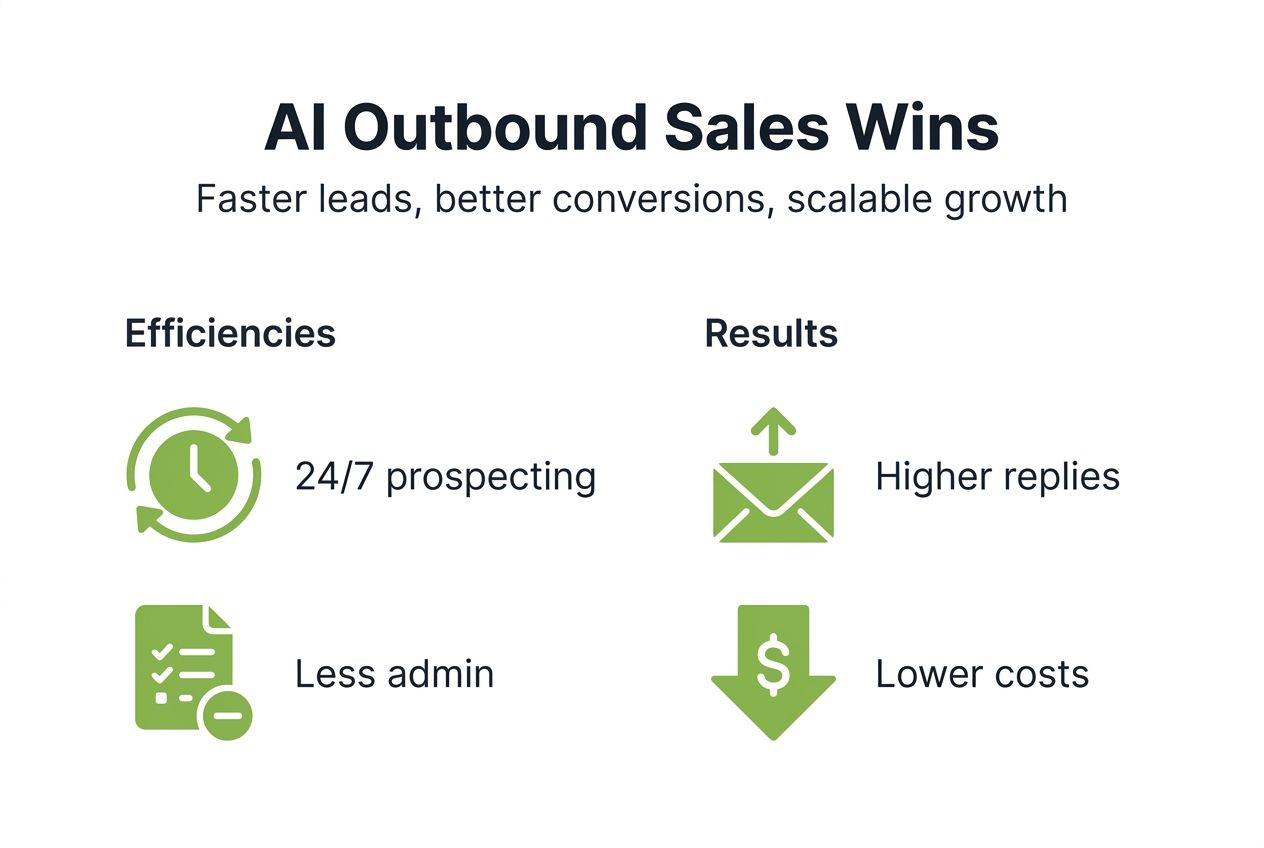
Reply and conversion rates improve dramatically when AI personalizes outreach based on real-time data. Generic cold emails typically achieve 1-3% reply rates. AI-driven campaigns routinely exceed 20-40% positive response rates because messaging aligns with prospect needs and timing. Each conversation that begins represents a qualified opportunity rather than a cold interruption.
Pipeline predictability transforms from guesswork into data-driven forecasting. Automated lead scoring and intent monitoring create consistent qualification criteria across your entire prospect universe. You know exactly how many leads enter the pipeline weekly, their quality scores, and historical conversion rates at each stage. This predictability enables accurate revenue forecasting and capacity planning.
Cost per acquisition drops significantly as efficiency gains compound. When each rep generates 2-3x more qualified conversations without additional headcount, your customer acquisition costs decrease while maintaining or improving lead quality. The conversion benefits flow directly to bottom-line profitability.
83% revenue growth for AI-driven teams versus 66% for traditional outbound approaches demonstrates the competitive advantage of early adoption.
Integrating buyer intent signals for precise targeting
Buyer intent signals provide real-time intelligence about prospect readiness that static databases cannot capture. These signals include behavioral data like website visits to pricing pages, downloads of comparison guides, attendance at industry webinars, and engagement with competitor content. AI systems monitor these activities across dozens of data sources simultaneously.
Job movements represent powerful intent indicators. When a VP of Sales joins a new company, they typically evaluate vendors within 90 days. Funding announcements signal budget availability and growth initiatives requiring new solutions. Technology adoption patterns reveal gaps in current toolsets. AI tools leverage signals like job changes and funding events to improve lead qualification by up to 30%, capturing early buying intent missed by static databases.
Continuous incorporation of these signals into lead scoring ensures prioritization stays current. A prospect with a low fit score might jump to the top of your outreach list when their company announces Series B funding and posts job openings for roles that use your solution. The AI recognizes this confluence of positive signals and adjusts priority automatically.
Timing outreach around intent signals dramatically increases engagement rates. Contacting a prospect within 48 hours of a relevant trigger event creates natural conversation context. Your message arrives when they’re actively thinking about the problem your solution solves. This relevance differentiates your outreach from noise and establishes immediate credibility.
The competitive advantage is substantial. While competitors wait for prospects to raise hands through inbound channels, your team engages during early research phases. You shape buying criteria and build relationships before formal RFPs begin.
Advanced personalization strategies with AI
AI-driven personalization extends far beyond inserting prospect names and company names into email templates. Modern systems analyze hundreds of data points to generate truly unique outreach that demonstrates genuine understanding of each prospect’s specific situation. This depth of personalization drives engagement rates that generic campaigns cannot achieve.
Dynamic message generation uses live company data, buyer behavior patterns, and industry context to craft relevant content. If a prospect’s company just announced expansion into European markets, AI references this growth and positions your solution’s international capabilities. When a prospect downloads a competitor comparison guide, messaging pivots to address specific differentiators they’re evaluating.
Contextual relevance comes from connecting multiple data signals into coherent narratives. AI might notice a prospect attended a conference where a speaker discussed a specific challenge your solution addresses. The outreach message references that conference, the speaker’s key points, and how your approach solves the exact problem discussed. This level of specificity is impossible to achieve manually at scale.
The anti-spam effect is substantial. When prospects receive messages demonstrating real knowledge of their business challenges and current situation, they perceive value rather than interruption. Reply rates improve because recipients recognize genuine relevance. Your sender reputation strengthens as engagement increases and spam complaints decrease.
Avoiding generic outreach matters more than ever. Buyers receive hundreds of templated sales emails weekly. Messages that read like mass blasts get ignored or trigger spam filters. Personalized AI-generated content breaks through this noise by treating each prospect as a unique opportunity rather than a database record.
Pro Tip: Review AI-generated messages for the first two weeks to ensure quality and brand voice alignment. Once confident in output, gradually increase automation while spot-checking samples weekly.
Technical infrastructure and deliverability for AI-powered outbound
Email deliverability represents the foundation of successful AI-driven outbound campaigns. Even perfectly personalized messages fail if they land in spam folders. Technical infrastructure setup determines whether your outreach reaches inboxes or gets filtered before prospects ever see it.
Dedicated warm-up email accounts build sender reputation gradually through simulated real interactions. Automated email warm-up simulating real interactions reduces spam flags by up to 50%, maintaining sender reputation in AI-driven campaigns. New email addresses with zero sending history trigger spam filters immediately. Warm-up services send and receive messages from your addresses over weeks, establishing positive reputation scores before campaign launch.
Automated reputation management monitors deliverability metrics continuously and adjusts sending patterns when issues emerge. Systems track inbox placement rates, spam complaint rates, bounce rates, and engagement metrics across email service providers. When Gmail starts filtering messages to spam, the platform automatically reduces sending volume to that domain while investigating root causes.
Proactive infrastructure maintenance prevents deliverability problems before they impact campaigns. This includes:
- Regular SPF, DKIM, and DMARC record audits to ensure authentication passes
- IP address reputation monitoring with immediate remediation for blacklisting
- Sending pattern analysis to avoid sudden volume spikes that trigger filters
- Domain health checks across major email providers weekly
- List hygiene to remove invalid addresses and reduce hard bounces
The ROI of proper technical infrastructure is straightforward. A campaign with 95% inbox placement generates 19x more replies than one with 5% placement. Infrastructure investments pay for themselves within weeks through improved campaign performance.
Key metrics requiring continuous monitoring include inbox placement rate (target 95%+), spam complaint rate (keep below 0.1%), hard bounce rate (under 2%), and reply rate trends indicating engagement quality.
Common misconceptions about AI outbound sales
Several misconceptions prevent sales teams from adopting AI-driven outbound despite clear benefits. Addressing these misunderstandings directly helps organizations make informed decisions about technology investments.
The biggest myth frames AI-driven outbound as automated cold spamming. Reality differs fundamentally. Effective AI systems use precision targeting based on fit criteria and intent signals. They engage prospects showing genuine buying indicators with personalized, relevant messaging. This targeted approach achieves reply rates 10-20x higher than spray-and-pray cold email blasts.
Personalization skepticism assumes AI merely inserts names into templates. Modern platforms analyze dozens of data points to generate unique content referencing specific company situations, recent events, and relevant pain points. The depth of personalization rivals what top-performing sales reps create manually but operates at scale impossible for human teams.
Sender reputation concerns suggest AI campaigns damage email deliverability. Properly implemented systems with dedicated infrastructure, gradual warm-up, and engagement-based sending actually improve reputation over time. High reply rates and low spam complaints signal email providers that recipients value your messages. Poor deliverability stems from bad implementation, not AI itself.
The “AI replaces salespeople” fear misunderstands AI’s role. Systems automate research, data enrichment, and initial outreach. Human reps handle qualification conversations, demos, and closing. AI amplifies rep productivity rather than replacing relationship-building skills. Teams using AI still need talented closers but free them from tedious prospecting tasks.
Comparing AI-driven outbound platforms for your sales team
Selecting the right AI-driven outbound platform requires evaluating capabilities against your specific sales model and volume needs. Key criteria include personalization depth, CRM integration quality, intent signal detection, deliverability features, and scalability to handle growth.
| Platform Type | Personalization Strength | Best For | Key Differentiator |
|---|---|---|---|
| Technical Intent Platforms | Deep technographic data | B2B tech sales | Tracks software adoption and tech stack changes |
| Conversation AI Tools | Call scaling and analysis | High-volume phone outreach | Real-time call guidance and sentiment analysis |
| Deliverability Systems | Email infrastructure | Teams with deliverability issues | Automated warm-up and reputation management |
| All-in-One Platforms | Multi-channel automation | Mid-market B2B teams | Integrated research, outreach, and analytics |
Onfire specializes in technical buying signals, tracking when prospects adopt complementary technologies or experience technical events indicating readiness for your solution. This works exceptionally well for B2B software companies selling to technical buyers.
Trellus.ai focuses on AI call scaling, providing real-time guidance during sales calls and automating call analysis. Teams making hundreds of outbound calls daily benefit from conversation intelligence that improves rep performance systematically.
Warmy.io addresses the deliverability challenge with sophisticated email warm-up and reputation management. If your team struggles with spam filtering or needs to scale sending volume safely, deliverability-focused platforms become essential infrastructure.
Matching tool strengths to your sales motion optimizes results. Enterprise sales cycles benefit from deep research and intent monitoring. Transactional sales prioritize volume and multi-touch automation. Your platform evaluation should align features with your buyer’s journey and team structure.
Integration capabilities matter significantly. Platforms connecting seamlessly with your existing CRM, data warehouse, and communication tools reduce friction and improve adoption. Native integrations beat point solutions requiring manual data transfers.
Implementing AI-driven outbound in your sales workflow
Successful implementation balances technology capabilities with change management to ensure adoption and maximize results. The process requires careful planning, phased rollout, and continuous optimization based on performance data.
Begin with tight CRM integration so AI-generated leads flow automatically into existing workflows. Sales reps should see enriched prospect data, intent signals, and AI-generated talking points directly in their familiar CRM interface. Forcing context switching between multiple tools kills adoption.
Training sales reps on AI workflows goes beyond basic platform tutorials. Explain how AI scoring works so reps understand why certain prospects receive priority. Demonstrate how to leverage AI-generated insights during conversations. Address concerns about AI replacing human judgment by emphasizing augmentation over automation.
Managing change carefully prevents resistance. Start with a pilot group of early adopters who provide feedback before full rollout. Share success stories and productivity gains from pilot participants to build broader team enthusiasm. Implement gradually rather than forcing overnight workflow transformations.
Monitor KPIs rigorously to validate AI impact and identify optimization opportunities:
- Track qualified lead generation rates weekly to measure top-of-funnel improvements
- Monitor reply rates and meeting booking rates across AI-generated campaigns
- Measure time saved per rep through activity tracking and self-reporting
- Analyze pipeline velocity changes from first touch to closed-won
- Calculate cost per qualified opportunity to demonstrate ROI
Continuous optimization based on data feedback ensures results improve over time. Review low-performing message templates monthly and A/B test variations. Adjust lead scoring models when conversion analysis reveals gaps. Expand successful campaigns while pausing underperformers.
Pro Tip: Establish a bi-weekly optimization cadence where marketing and sales review AI performance data together. Cross-functional collaboration uncovers insights individual teams miss and aligns everyone on improvement priorities.
Summary: AI-driven outbound sales for scalable growth
AI-driven outbound sales transforms manual prospecting into scalable automation that generates predictable pipeline growth. By integrating artificial intelligence, dynamic personalization, and real-time intent signals, B2B sales teams achieve reply rates exceeding 40% while doubling the time reps spend actively selling.
The core transformation happens through automated prospect research, continuous lead scoring based on fit and intent, and personalized multi-channel outreach generated at scale. Technical infrastructure including email warm-up and reputation management ensures high deliverability while maintaining sender reputation. Teams report 83% revenue growth compared to 66% for traditional approaches.
Successful implementation requires careful platform selection based on your sales model, tight CRM integration, comprehensive rep training, and continuous optimization driven by performance data. Common misconceptions about spam and impersonalization dissolve when teams experience AI’s precision targeting and deep personalization capabilities firsthand.
The competitive advantage compounds over time. Early adopters build efficient prospecting engines that generate qualified conversations continuously while competitors struggle with manual research bottlenecks. Your team engages prospects during early buying stages with relevant messaging that establishes credibility and shapes purchase criteria.
How Lickfold Digital can help accelerate your AI-driven outbound sales
Implementing AI-driven outbound sales effectively requires expertise in both technology and B2B sales strategy. Lickfold Digital specializes in deploying AI agents that automate prospecting workflows while maintaining the personalization and deliverability standards that drive results. Our team handles technical infrastructure setup, lead scoring model development, and message personalization frameworks tailored to your ideal customer profile.
We’ve helped B2B companies achieve 65% cost reductions in lead generation while improving lead quality through systematic AI implementation. Our approach includes dedicated email infrastructure, ongoing reputation management, and human qualification of AI-generated opportunities before passing them to your sales team. Book a free consultation to explore how AI-driven outbound can transform your pipeline predictability and accelerate revenue growth.
Frequently asked questions
What is the difference between AI-driven outbound and traditional outbound sales?
AI-driven outbound uses automation, dynamic personalization, and real-time intent data to identify and engage prospects. Traditional methods rely on manual research, static lists, and generic outreach templates. This leads to higher efficiency, better engagement rates, and more predictable pipeline growth with AI.
How can sales teams ensure high email deliverability when using AI-powered outreach?
Use dedicated email warm-up accounts that gradually build sender reputation through simulated interactions. Implement automated reputation management tools that monitor inbox placement rates and adjust sending patterns based on engagement feedback. Regular infrastructure audits of SPF, DKIM, and DMARC records prevent authentication failures.
What metrics should teams monitor to measure success with AI-driven outbound sales?
Track qualified lead generation rates, reply rates, meeting booking rates, and pipeline velocity from first touch to closed-won. Monitor time saved per rep through activity tracking and calculate cost per qualified opportunity to demonstrate ROI. Review these KPIs weekly during initial implementation and bi-weekly once workflows stabilize.
How do I choose the best AI-driven outbound platform for my B2B sales team?
Assess platforms based on personalization capabilities, CRM integration quality, intent signal detection features, deliverability infrastructure, and scalability to handle growth. Match tool strengths to your specific sales motion and buyer profiles. Enterprise sales benefit from deep research capabilities while transactional sales prioritize volume automation.
Is AI-driven outbound just automated cold spamming?
No. Effective AI-driven systems use precision targeting based on fit criteria and buyer intent signals to engage relevant prospects with personalized messaging. This targeted approach achieves 20-40% reply rates compared to 1-3% for generic cold email blasts. Proper infrastructure and engagement-based sending improve sender reputation rather than damaging it.