
Sales opportunity qualification: smarter, faster B2B wins
Sales opportunity qualification: smarter, faster B2B wins
Poor qualification is the root cause of 67% of lost deals, yet most B2B sales teams still treat lead qualification and opportunity qualification as the same thing. They are not. Lead qualification filters who might be interested. Opportunity qualification determines whether a specific deal is worth your team’s time, energy, and resources. Getting this distinction right is the difference between a pipeline full of noise and one that actually closes. This guide breaks down the frameworks, pitfalls, and AI-powered methods that top-performing sales teams use to qualify faster and win more.
Table of Contents
- What is sales opportunity qualification?
- Key frameworks: BANT, MEDDIC, and CHAMP explained
- Expert nuances: Common pitfalls and advanced tactics
- How AI transforms sales opportunity qualification
- Step-by-step: Building an efficient, AI-powered qualification process
- Measuring and optimizing qualification success
- Ready to transform your sales qualification?
- Frequently asked questions
Key Takeaways
| Point | Details |
|---|---|
| Qualification beats guessing | Applying structured criteria to sales deals prevents wasted effort and lost revenue. |
| Frameworks have fit | Choose BANT, MEDDIC, or CHAMP based on your deal’s size and complexity for best results. |
| AI accelerates qualification | Automation and data-driven insights double speed and boost qualification accuracy. |
| Continuous review wins | Top teams re-qualify deals and study stage conversions to keep improving outcomes. |
| Start with small AI steps | You can meaningfully improve qualification with gradual automation—no overhaul required. |
What is sales opportunity qualification?
Sales opportunity qualification is the structured process of evaluating an active prospect against a defined set of criteria before committing significant sales resources to it. It happens after initial lead qualification, once a prospect has shown genuine interest or entered your pipeline.
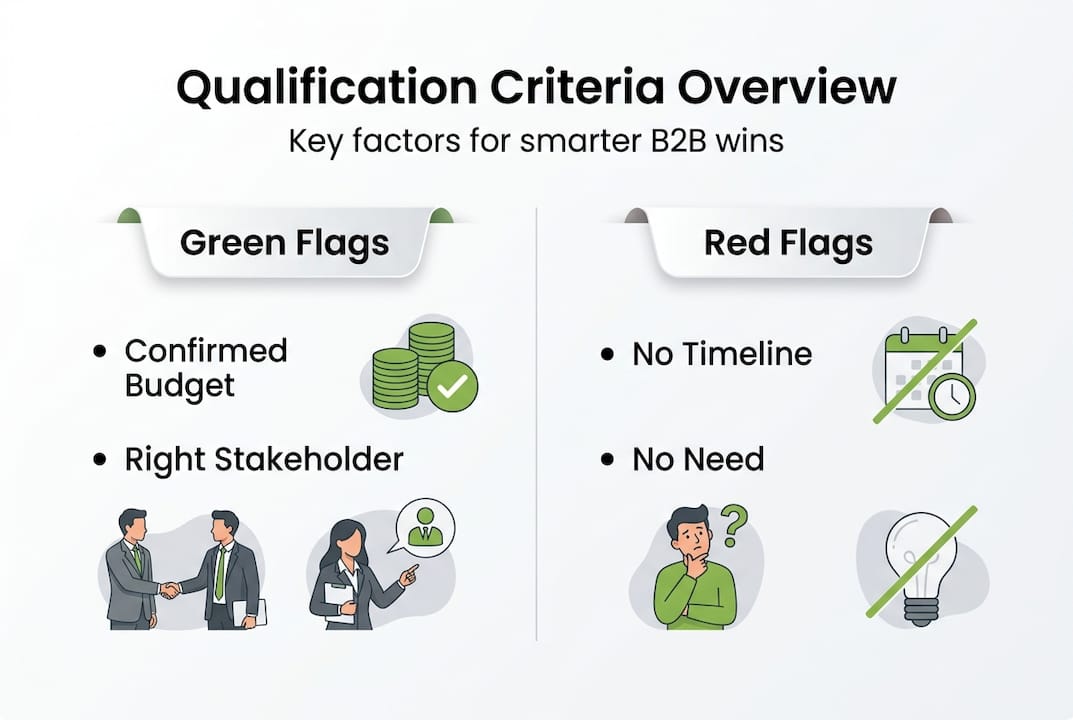
Opportunity qualification evaluates prospects against criteria like budget, authority, need, timeline, and decision process. These five dimensions give your team a clear picture of whether a deal is real, winnable, and worth pursuing right now. Without this structure, reps chase gut feelings instead of evidence.
Why does this matter for resource allocation? B2B sales cycles are long and expensive. Every hour a rep spends on a low-probability deal is an hour not spent on a high-probability one. Qualification forces a discipline that protects your team’s time and your company’s revenue.
Here is a practical qualification checklist your team can use:
| Criterion | Key question | Green flag | Red flag |
|---|---|---|---|
| Budget | Is there confirmed funding? | Budget approved or allocated | Vague or unconfirmed |
| Authority | Are you talking to a decision-maker? | Economic buyer engaged | Only speaking to an influencer |
| Need | Is there a real, urgent pain? | Pain clearly articulated | Problem is nice-to-solve only |
| Timeline | Is there a defined purchase window? | Deadline tied to business event | No urgency or timeline stated |
| Decision process | Do you understand how they buy? | Process mapped and steps known | Unknown stakeholders or steps |
Pairing this checklist with AI-driven outbound sales tools means your team enters every qualification conversation already armed with research, not starting from scratch.
Key frameworks: BANT, MEDDIC, and CHAMP explained
With the basic criteria in mind, it is important to see how leading frameworks bring these principles to life and where each one shines.
BANT, MEDDIC, and CHAMP each suit different deal complexities. BANT is simple and fast but can feel outdated for complex enterprise deals. MEDDIC is thorough and rigorous but can slow down smaller, faster-moving opportunities. CHAMP flips the script by putting the buyer’s challenges first, making it more flexible and buyer-centric.
Here is a quick comparison:
| Framework | Best for | Core focus | Weakness |
|---|---|---|---|
| BANT | SMB, transactional deals | Budget and timeline first | Misses buyer complexity |
| MEDDIC | Enterprise, long-cycle deals | Metrics, economic buyer, decision criteria | Can be rigid and slow |
| CHAMP | Mid-market, consultative sales | Challenges, authority, money, prioritization | Requires skilled reps to execute |
Key takeaways for each:
- BANT works well when deals are straightforward and speed matters more than depth.
- MEDDIC shines when multiple stakeholders, long timelines, and large contract values are involved.
- CHAMP is ideal when you want to lead with the buyer’s pain before discussing budget.
“Consistency in execution matters more than finding the perfect framework. A team that applies BANT rigorously will outperform one that switches frameworks every quarter.”
The best teams using AI prospecting steps do not pick one framework and lock in forever. They adapt based on deal size and complexity.
Pro Tip: For deals under $20,000, start with BANT to qualify fast. For deals over $100,000, layer in MEDDIC elements to map the full buying committee and decision criteria before investing heavily.
Expert nuances: Common pitfalls and advanced tactics
Choosing a framework is just the start. Executing qualification well requires nuanced judgment and ongoing discipline.
Over-qualification slows pipelines, while under-qualification floods them with junk. The best teams use hybrid approaches that match qualification depth to deal complexity. A $5,000 deal does not need the same scrutiny as a $500,000 one.
Here are five pitfalls that derail even experienced sales teams, and how to avoid them:
- Assuming one decision-maker. Most B2B purchases involve 6 to 10 stakeholders. Map the full buying committee early or risk a late-stage surprise veto.
- Skipping technical feasibility. In manufacturing, healthcare, or SaaS, a prospect may have budget and authority but face integration or compliance blockers. Qualify for fit, not just intent.
- Locking in early assumptions. Information changes. A champion leaves, a budget gets cut, a competitor enters. Treat your qualification data as live, not static.
- Over-qualifying small deals. Applying enterprise-level scrutiny to transactional deals kills velocity. Match your process to the deal size.
- Ignoring stage conversion data. If deals consistently stall at the same stage, that is a qualification problem, not a closing problem.
Qualification is a continuous process and should be measured using CRM fields and stage conversions. This is not a one-time checkbox. It is an ongoing discipline that the best teams build into every deal review.
“The reps who win consistently are the ones who requalify at every stage gate, not just at the top of the funnel.”
Pro Tip: Set a calendar reminder to requalify every open opportunity every 30 days. If key criteria have changed and you have not updated your CRM, your forecast is already wrong.
Staying current on AI-driven sales trends can also help your team spot new signals that trigger requalification automatically.
How AI transforms sales opportunity qualification
Equipped with best practices, the question becomes: how can technology, and specifically AI, take your qualification to the next level?
AI boosts MQL-to-SQL conversion rates to 39 to 40%, improves reply rates by 15 to 25%, and reduces manual qualification time by over 50%. Those are not marginal gains. They represent a fundamental shift in how fast and accurately your team can qualify.

Up to 81% of sales teams now use AI in some part of their qualification process. The ones seeing the biggest gains are using it across the full workflow, not just for lead scoring.
Here is what pre- and post-AI qualification looks like in practice:
| Metric | Before AI | After AI |
|---|---|---|
| MQL-to-SQL conversion | 20 to 25% | 39 to 40% |
| Manual research time per lead | 45 to 60 minutes | Under 15 minutes |
| Reply rate on outreach | 8 to 12% | 20 to 30% |
| Requalification frequency | Quarterly or ad hoc | Continuous and automated |
Top AI features that directly improve qualification include:
- Behavioral scoring that ranks prospects by engagement signals, not just demographic fit.
- Dynamic requalification that updates opportunity scores as new data comes in.
- Engagement tracking across email, calls, and social to surface warm signals automatically.
- Automated research that pulls firmographic and technographic data before the first call.
- Personalized multi-touch outreach that adapts messaging based on prospect behavior.
Teams that automate B2B prospecting with AI are not replacing human judgment. They are giving their reps better information, faster, so every qualification conversation starts from a position of strength. Pairing this with a well-designed AI-driven sales workflow creates a system that compounds over time.
For teams evaluating whether AI is right for them, AI-driven sales prospecting resources can help frame the business case clearly.
Step-by-step: Building an efficient, AI-powered qualification process
To turn these AI benefits into repeatable wins, here is a step-by-step process any team can follow and adapt.
AI reduces manual qualification time by 50% or more and improves lead-to-opportunity rates significantly. But the technology only works if the process behind it is solid.
Here is a six-step workflow:
- Define your ideal customer profile (ICP). Before AI can find the right prospects, your team needs to agree on what a qualified opportunity looks like. Document firmographic, technographic, and behavioral criteria.
- Deploy AI for signal gathering. Use AI tools to monitor buying signals such as job postings, funding announcements, technology changes, and content engagement. These signals trigger outreach at the right moment.
- Run personalized multi-touch outreach. AI executes sequenced, personalized outreach across email and LinkedIn. Messaging adapts based on prospect behavior, not generic templates.
- Score and prioritize inbound responses. When prospects reply, AI scores the response based on intent signals and routes high-priority leads to reps immediately. Human review confirms qualification before the deal enters the pipeline.
- Update CRM fields at every stage gate. Require reps to update qualification fields before moving a deal forward. This creates the data foundation for accurate forecasting and coaching.
- Track stage conversions and feed insights back. Review conversion rates between stages weekly. Where deals stall, investigate whether it is a qualification gap or an execution gap.
Pro Tip: Link stage conversion rates directly to rep coaching sessions. If a rep’s deals consistently stall at the proposal stage, the problem often traces back to incomplete qualification earlier in the cycle.
Building AI pipeline predictability into your process means your forecast becomes a reliable management tool, not a weekly guessing game.
Measuring and optimizing qualification success
With your qualification workflow live, it is essential to keep tuning it for maximum impact on revenue and resource use.
Measuring conversion rates between stages helps identify friction and boost close rates. This is the single most actionable metric for diagnosing qualification health. If your stage-to-stage conversion drops sharply at one point, that is where your qualification process is breaking down.
Four improvement levers that consistently move the needle:
- Audit your ICP quarterly. Markets shift. The profile that worked last year may not reflect your best customers today. Update it based on closed-won data.
- Review disqualified deals. Understand why deals were disqualified and at what stage. Patterns reveal systemic gaps in your qualification criteria.
- Calibrate AI scoring models. Feed closed-won and closed-lost data back into your AI tools so scoring improves over time.
- Run win/loss interviews. Talking to buyers who chose you or a competitor reveals qualification blind spots that data alone cannot surface.
“Winners audit and adapt their qualification process relentlessly. Losers set it once and assume it still works six months later.”
Using a well-configured AI-driven sales workflow makes this kind of continuous improvement systematic rather than reactive. The goal is a qualification process that gets smarter every quarter, not one that stays static while your market evolves.
Ready to transform your sales qualification?
Setting up a smart, dynamic qualification process is achievable, especially with the right tools and guidance.
At Lickfold Digital, we build AI-powered outbound systems that do the heavy lifting of research, outreach, and initial qualification so your sales team only engages with opportunities that are already warm and pre-qualified. Our AI agents identify decision-makers, execute personalized multi-touch campaigns, and pass human-reviewed opportunities directly to your reps. The result is a predictable pipeline of high-quality B2B leads without the manual grind. If you want to see what this looks like for your specific market and ICP, schedule a free consultation and we will map out a qualification system built around your goals.
Frequently asked questions
What is the difference between lead qualification and opportunity qualification?
Lead qualification sorts broad prospects by fit, while opportunity qualification applies structured criteria to active deals to decide exactly where to invest your sales team’s time and resources.
How does AI improve the qualification process?
AI automates research, scoring, and outreach personalization, and reduces manual qualification time by over 50% while improving reply rates and MQL-to-SQL conversion significantly.
Which qualification framework is best for B2B sales?
BANT, MEDDIC, and CHAMP suit different deal complexities. Use BANT for simple deals, MEDDIC for enterprise, and CHAMP for consultative mid-market sales. Consistent execution matters more than the framework you pick.
Should sales teams re-qualify opportunities as deals progress?
Absolutely. Dynamic requalification catches changes in budget, stakeholders, or timeline that can derail a deal, ensuring your team focuses on high-probability wins at every stage.
How do you measure sales opportunity qualification success?
Track stage conversion rates between each pipeline stage and use CRM fields to identify where deals stall and fix the underlying qualification gaps driving that friction.