
What is an AI-driven sales workflow: boost leads in 2026
What is an AI-driven sales workflow: boost leads in 2026
You’ve heard AI will automate your entire sales process. That’s wrong. True AI-driven sales workflows don’t replace your team, they amplify what your best reps already do. For mid-sized B2B companies, this means turning routine tasks over to intelligent systems while your salespeople focus on building relationships and closing deals. The result? More qualified leads, shorter sales cycles, and predictable revenue growth. This guide shows you exactly how to design, deploy, and optimize AI-driven workflows that deliver measurable results without losing the human touch that wins enterprise deals.
Table of Contents
- What Is An AI-Driven Sales Workflow? Core Components And Benefits
- How To Master AI-Driven Sales Workflows In Mid-Sized B2B Companies
- Challenges And Best Practices: Balancing AI Automation And Human Oversight
- Real-World Impact: AI Augmentation Vs Full Automation In Sales Workflows
- Unlock AI-Driven Sales Success With Expert Support
Key takeaways
| Point | Details |
|---|---|
| AI augments, not replaces | AI-driven workflows combine automation with human expertise to boost precision and efficiency in B2B sales. |
| Core functions matter | Essential AI capabilities include list building, lead scoring, multi-channel outreach, and automated CRM updates. |
| Phased deployment wins | Successful AI adoption requires workflow redesign and gradual implementation, starting with automation before prediction. |
| Human oversight essential | Full automation erodes trust in complex sales; judgment calls and relationship building still need people. |
| Efficiency gains proven | Mid-sized B2B companies achieve 15-50% task efficiency improvements through AI-powered workflows. |
What is an AI-driven sales workflow? Core components and benefits
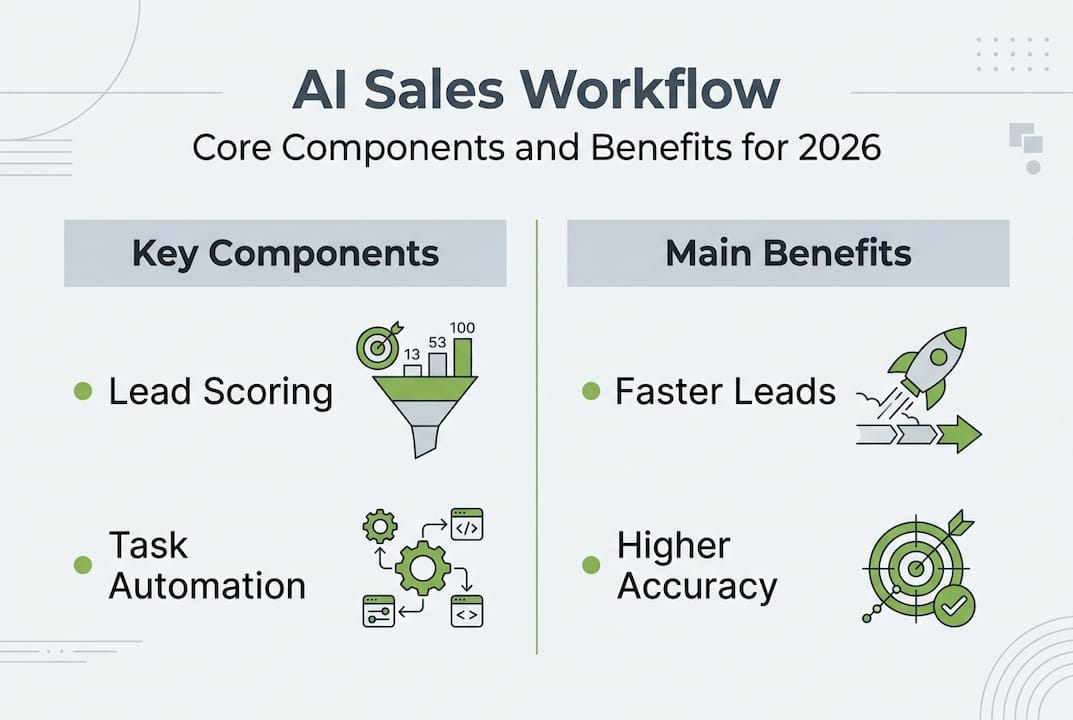
An AI-driven sales workflow integrates artificial intelligence tools into your sequential sales tasks, from prospect identification through deal closure. Unlike simple automation that follows rigid rules, these workflows learn from data patterns and adapt their actions based on real-time signals. Think of it as having a tireless research assistant who never forgets a follow-up and gets smarter with every interaction.
The core components work together as an intelligent system. ICP-matched list building uses AI to scan millions of company records and identify prospects matching your ideal customer profile with precision traditional methods can’t match. Intent lead scoring analyzes behavioral signals across web activity, content engagement, and firmographic changes to improve precision from 52% to 78%. Hyper-personalized multi-channel sequences deploy coordinated touchpoints across email, LinkedIn, and phone without generic templates. Autonomous qualification reviews prospect responses and routes qualified opportunities to your sales team. Automated CRM updates eliminate manual data entry, keeping your pipeline current without rep effort. Next-best-action recommendations guide reps on optimal timing and messaging for each prospect stage.
The benefits translate directly to revenue impact. Your reps spend more time selling and less time on administrative tasks. AI workflows maintain 8+ touch cadences across channels while reps shift from spending 64% of their time on manual tasks to 36% time selling with AI support. Lead conversion improves because prospects receive timely, relevant outreach based on their actual behavior rather than arbitrary schedules. Multi-channel engagement becomes manageable at scale, allowing mid-sized teams to compete with enterprise sales organizations.
“AI-powered workflows transform how sales teams operate, enabling sophisticated cadences that would require armies of coordinators to execute manually while maintaining the personalization that drives response rates.”
Pro Tip: Focus your initial AI deployment on the most data-intensive, repetitive tasks in your workflow. This frees your best reps to spend more time on the consultative conversations that actually close deals, while AI handles the research and coordination that bogs down productivity.
Partnering with Lickfold Digital AI Experts helps you identify which workflow components deliver the fastest ROI for your specific sales motion and market.
How to master AI-driven sales workflows in mid-sized B2B companies
Mid-sized B2B firms face a unique challenge: you need enterprise-level sales efficiency without enterprise budgets or headcount. Mastering AI-driven workflows requires a practical, phased approach that builds capability without disrupting your current pipeline.
Start with a systematic audit of your existing processes. Map every step from prospect identification through closed-won deals, noting time spent and friction points. Create a simple matrix plotting each task by time investment versus frequency. The high-frequency, high-time-investment tasks are your prime AI candidates. Assess your data readiness by checking CRM completeness, integration capabilities, and whether your team actually uses the systems you’ve deployed. Broken processes amplified by AI create bigger problems, not solutions.
Deploy AI in three distinct phases to build trust and competence:
- Automation phase: Implement AI for routine tasks like data entry, meeting scheduling, email sequencing, and list building. This delivers immediate time savings and gets your team comfortable with AI assistance.
- Predictive phase: Add lead scoring, next-best-action recommendations, and deal risk analysis once your data quality improves and reps trust the automation layer.
- Generative phase: Introduce AI-generated personalization, dynamic content creation, and conversational AI only after the foundation proves reliable.
Integrate AI-native tools that work together rather than bolting AI features onto legacy systems. Modern AI CRMs automatically capture interaction data and surface insights without manual logging. Conversation intelligence platforms analyze calls and emails to identify winning patterns and coach reps in real time. These tools create a data flywheel where each interaction improves future recommendations.
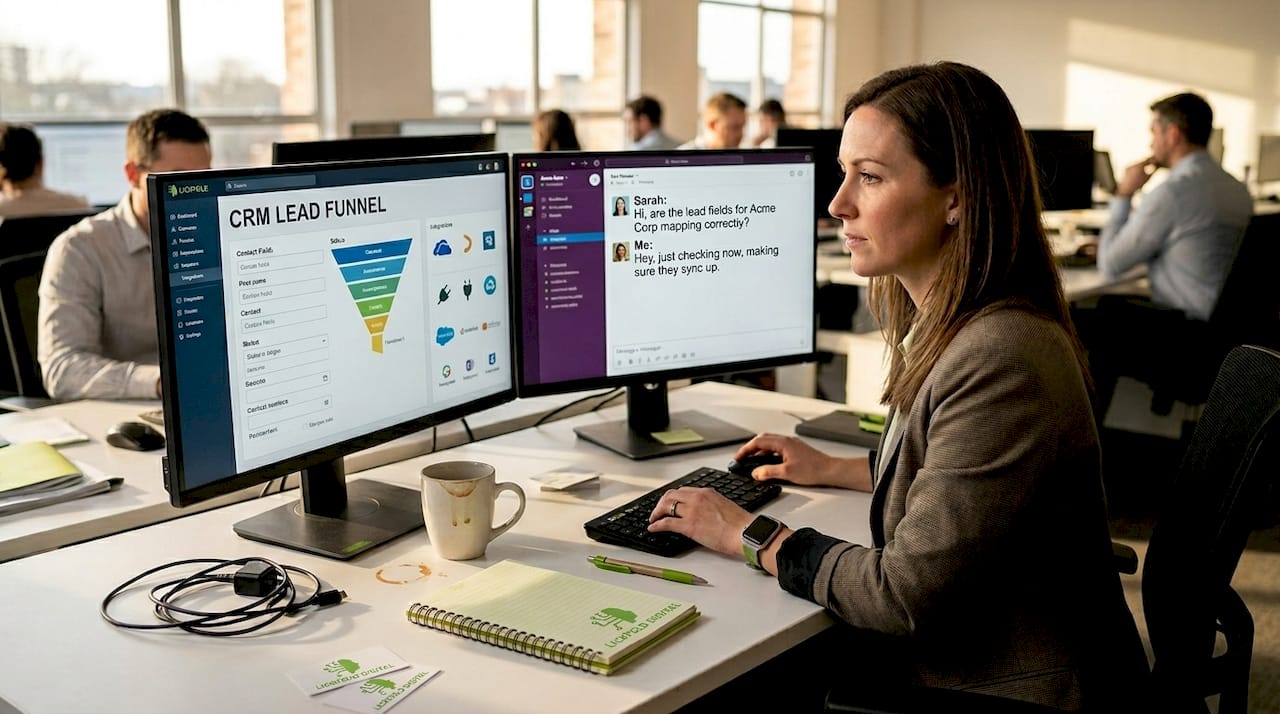
Measure and optimize continuously through AI-enhanced evaluations. Track not just activity metrics but outcome quality: are AI-sourced leads converting at the same rate as manually sourced ones? Are reps following AI recommendations, and what happens when they don’t? Use these insights to refine your models and workflows.
| Deployment Stage | Primary Focus | Expected Impact | Timeline |
|---|---|---|---|
| Automation | Eliminate manual tasks | 20-30% time savings | 1-3 months |
| Predictive | Improve targeting precision | 15-25% conversion lift | 3-6 months |
| Generative | Scale personalization | 30-40% capacity increase | 6-12 months |
Pro Tip: Start with one sales team or segment as your AI pilot group. Let them prove the value and work out the kinks before rolling out company-wide. Early wins from a focused group build momentum and internal champions.
Explore proven frameworks for lead generation with AI that show exactly how phased deployment works in practice.
Challenges and best practices: balancing AI automation and human oversight
AI doesn’t fix broken sales processes, it exposes them. If your workflows lack clarity, consistency, or measurement before AI, automation will simply execute chaos faster. AI fails without process rigor, amplifying existing flaws rather than correcting them.
The biggest risk is over-automation that strips away the human judgment B2B buyers expect. When AI generates every message, schedules every touchpoint, and responds to every inquiry without human review, your outreach becomes indistinguishable from spam. Trust erodes quickly when prospects realize they’re interacting with a machine pretending to be a person. Over-automation diminishes trust in complex sales where relationships determine outcomes.
Human oversight remains essential for judgment calls that AI can’t handle reliably. Anomalies in prospect behavior, sudden organizational changes, nuanced objections, and strategic account decisions all require human interpretation. Enterprise sales involve multiple stakeholders with competing priorities, political dynamics, and unspoken concerns that no algorithm can fully decode. Your best reps bring pattern recognition from hundreds of deals, emotional intelligence, and the ability to pivot strategy mid-conversation.
Implement these best practices to balance automation with augmentation:
- Redesign your workflows before deploying AI, eliminating unnecessary steps and clarifying decision points so AI has a solid foundation.
- Codify what your top performers do differently by documenting their research methods, messaging frameworks, and qualification criteria for AI to replicate.
- Build clear human-AI handoffs where AI handles research and coordination while humans own relationship building and strategic decisions.
- Set review thresholds that flag high-value opportunities, unusual patterns, or low-confidence AI recommendations for human evaluation before action.
- Train your team on AI capabilities and limitations so they know when to trust recommendations and when to override them.
“AI is a mirror. It reflects the quality of your sales processes back at you with brutal clarity. Companies with disciplined workflows see AI amplify their strengths. Those with ad hoc approaches watch AI expose every gap and inconsistency.”
The goal isn’t maximum automation, it’s optimal augmentation. AI should make your salespeople more effective at the parts of selling that require human skills, not replace those skills entirely. When you get the balance right, AI handles the 70% of sales work that’s research and coordination, freeing your team for the 30% that’s persuasion and problem solving.
Stay current with evolving best practices through resources like the Lickfold Digital Blog, which covers practical AI implementation strategies for B2B sales teams.
Real-world impact: AI augmentation vs full automation in sales workflows
The strategic choice between AI augmentation and full automation determines whether your workflows enhance or undermine sales effectiveness. In complex B2B sales, augmentation outperforms full automation because it scales expert judgment rather than replacing it with rigid rules.
Augmentation works by amplifying what your best reps already do well. AI handles the time-consuming research to identify decision-makers, their priorities, and optimal outreach timing. It drafts initial message frameworks based on successful patterns. It monitors engagement signals and suggests next steps. But humans make the final call on messaging tone, decide when to pivot strategy, and build the trust that closes deals. This approach preserves the tacit knowledge and relationship skills that separate top performers from average ones.
Full automation attempts to remove humans from the process entirely. While this works for simple, transactional sales with short cycles and single decision-makers, it fails in mid-market and enterprise B2B. Trust building requires authentic human interaction. Multi-stakeholder buying processes involve political dynamics and competing priorities that demand real-time adaptation. The nuanced objection handling and consultative problem solving that win complex deals can’t be scripted.
Adoption patterns reveal a significant gap. SMEs adopt AI at one-third the rate of large enterprises, often because they lack dedicated resources to implement and optimize AI systems. Mid-sized B2B companies sit in the middle, with enough scale to justify investment but not enough buffer to absorb failed experiments. This makes the augmentation approach particularly valuable as it delivers results with lower implementation risk.
| Approach | Best For | Key Advantage | Primary Risk |
|---|---|---|---|
| AI Augmentation | Complex B2B sales, enterprise accounts | Scales expertise while preserving trust | Requires ongoing human training and AI refinement |
| Full Automation | Transactional sales, high-volume low-touch | Maximum efficiency and cost reduction | Erodes relationships in consultative sales |
Consider these nuances when choosing your approach:
- Trust building in B2B sales requires repeated authentic interactions that prospects can’t get from automated systems alone.
- Multi-stakeholder processes involve internal champions, economic buyers, and technical evaluators with different priorities requiring adaptive messaging.
- Tacit knowledge from experienced reps includes reading prospect hesitation, knowing when to push and when to back off, and creative problem solving.
- Market positioning and competitive differentiation often hinge on consultative expertise that prospects can’t find elsewhere.
Pro Tip: Prioritize AI augmentation that makes your existing team more productive before considering automation that reduces headcount. The former builds capability and confidence, the latter often backfires by eliminating the expertise you need to win complex deals.
Mid-sized B2B leaders can benchmark their progress against empirical evidence of AI adoption to identify gaps and opportunities for competitive advantage through smarter implementation.
Unlock AI-driven sales success with expert support
Mastering AI-driven sales workflows requires more than tools, it demands strategic design tailored to your specific sales motion, market, and team capabilities. Lickfold Digital specializes in helping mid-sized B2B companies deploy AI-powered prospecting and outbound automation that delivers qualified leads without sacrificing the human touch that closes deals.
Our approach starts with understanding your current workflows, identifying bottlenecks, and designing phased AI implementation that builds on your strengths. We handle the technical infrastructure including dedicated email accounts, reputation management, and CRM integration while training your team to leverage AI recommendations effectively. The result is a scalable pipeline of high-quality leads with predictable conversion rates.
Ready to transform your sales workflows? Schedule a free consultation to discuss your specific challenges and opportunities. Or explore our AI lead generation case study showing exactly how we helped a mid-sized B2B company reduce acquisition costs by 65% while increasing lead quality.
What is AI-driven sales workflow FAQ
What tasks can AI automate in sales workflows?
AI handles list building by scanning company databases to identify ICP matches, lead scoring using behavioral signals and intent data, multi-channel outreach coordination across email and LinkedIn, and automated CRM updates that eliminate manual data entry. However, humans still manage judgment calls on messaging strategy, relationship building with key stakeholders, and complex negotiation that requires reading prospect concerns and adapting in real time.
How can mid-sized B2B companies begin adopting AI responsibly?
Start by auditing your existing workflows to identify high-frequency, time-intensive tasks that bog down productivity. Implement automation first for routine activities like data entry and meeting scheduling to build team confidence and prove value. Then expand gradually into predictive capabilities like lead scoring and next-best-action recommendations once your data quality improves and processes stabilize.
What are common pitfalls to avoid in AI-driven sales workflows?
Over-automation that removes human judgment from complex sales interactions erodes trust and reduces conversion rates. Neglecting human oversight for anomalies, high-value opportunities, and strategic decisions leads to missed signals and poor outcomes. Deploying AI before redesigning broken workflows simply amplifies existing problems faster, creating chaos rather than efficiency.
How does AI improve lead scoring accuracy?
AI analyzes real-time behavioral signals including website visits, content downloads, email engagement, and firmographic changes to identify prospects showing genuine buying intent. This data-driven approach improves precision from traditional methods’ 52% accuracy to 78% by incorporating dozens of signals that humans can’t track manually at scale.
Why is human oversight still necessary with AI workflows?
Complex B2B sales involve exceptions that don’t fit standard patterns, requiring experienced judgment to interpret and respond appropriately. Trust building with enterprise buyers demands authentic human interaction that prospects can verify through conversation and relationship development. Multi-stakeholder buying processes include political dynamics, competing priorities, and nuanced objections that AI can’t navigate without human strategic guidance.
Explore more resources and AI sales solutions designed specifically for mid-sized B2B companies looking to scale their outbound efforts without losing the consultative approach that wins deals.