
AI in pipeline predictability: A B2B sales guide
AI in pipeline predictability: A B2B sales guide
Unpredictable pipelines plague B2B sales leaders. You invest in outreach, nurture leads, and watch deals stall without warning. Revenue forecasts become guesswork, making planning nearly impossible. AI offers a solution by analyzing patterns, automating data capture, and delivering real-time insights that transform how you manage opportunities. This guide explores how artificial intelligence enhances pipeline predictability, helping you build reliable revenue streams through smarter forecasting, targeted prospecting, and data-driven decision-making that eliminates the uncertainty holding your growth back.
Table of Contents
- Key takeaways
- The challenges of pipeline predictability in B2B sales
- How AI enhances pipeline predictability: key technologies and methods
- Comparing traditional and AI-powered pipeline management approaches
- Implementing AI for pipeline predictability: practical steps and integration tips
- Enhance your sales pipeline predictability with expert AI solutions
- Frequently asked questions
Key Takeaways
| Point | Details |
|---|---|
| Real time insights | AI delivers real time insights that help you monitor deals and adjust strategies as conditions change. |
| Smarter forecasting | Machine learning analyzes historical and current data to produce more accurate revenue forecasts than traditional methods. |
| Automated lead qualification | Natural language processing automatically evaluates emails, transcripts, and chats to flag high intent signals and qualify leads. |
| Sales and marketing alignment | Integrated AI tools provide a unified view of pipeline health that aligns definitions and measurements across teams. |
| Strategic adoption | Adopting AI requires strategic planning to unlock significant ROI and sustainable gains. |
The challenges of pipeline predictability in B2B sales
B2B sales pipelines suffer from systemic issues that make accurate forecasting nearly impossible. Your reps enter data inconsistently, deals move through stages at wildly different speeds, and marketing hands off leads without clear qualification criteria. Pipeline unpredictability is often caused by fragmented data and manual forecasting methods leading to revenue volatility, creating a cycle where leadership loses confidence in projections.

Manual processes introduce forecasting inaccuracies at every stage. Reps forget to update CRM records after calls, leading to stale opportunity data. They apply subjective judgment when moving deals between stages, creating inconsistency across the team. Without standardized qualification frameworks, what counts as a qualified lead varies by individual, polluting your pipeline with opportunities that never had real potential.
Long B2B sales cycles increase uncertainty about deal closure timing. Enterprise deals stretch across quarters, involving multiple stakeholders and approval layers. External factors like budget freezes, organizational changes, or competitive pressures can derail opportunities at any moment. You cannot predict when a champion leaves the company or when a procurement committee decides to delay decisions by six months.
Misalignment between sales and marketing impacts data quality throughout the funnel. Marketing generates leads based on engagement metrics while sales qualifies based on budget and authority. This disconnect means your pipeline fills with contacts who clicked an ad but lack purchasing power. When teams operate from different definitions of pipeline health, forecasts reflect assumptions rather than reality.
Lack of real-time insights hampers proactive adjustments to pipeline strategy. Traditional reporting shows what happened last week or last month, not what is happening right now. By the time you spot a trend in your quarterly business review, market conditions have shifted. You need immediate visibility into which deals are advancing, which are stalling, and why patterns are emerging across your pipeline.
Key challenges include:
- Inconsistent data capture across sales teams creating unreliable forecasts
- Subjective stage progression criteria leading to inflated pipeline values
- Limited visibility into early warning signs of deal risk
- Disconnected tools preventing unified pipeline analysis
- Reactive rather than proactive pipeline management approaches
How AI enhances pipeline predictability: key technologies and methods
AI tools leverage machine learning and predictive analytics to analyze historical and real-time data for more accurate pipeline forecasts. Machine learning models identify patterns from past deals to forecast outcomes with precision that exceeds human intuition. These systems analyze thousands of variables, from email response times to meeting frequency, discovering which behaviors correlate with closed deals versus those that signal risk.
Natural language processing helps qualify leads from communication data automatically. AI reads emails, call transcripts, and chat logs to detect buying signals, objections, and engagement levels. When a prospect mentions budget approval or asks about implementation timelines, NLP flags these as high-intent signals. This technology eliminates the need for reps to manually score every interaction, ensuring no opportunity slips through due to oversight.
Automation streamlines data entry, reducing errors and delays that corrupt pipeline accuracy. AI captures meeting notes, updates opportunity stages based on activity patterns, and logs touchpoints without human intervention. Your CRM stays current because the system tracks every interaction automatically. This real-time data capture means forecasts reflect actual pipeline state rather than outdated snapshots.
AI-driven insights enable prioritization of high-potential opportunities based on conversion probability. Predictive scoring ranks deals by likelihood to close, helping reps focus energy where it matters most. Instead of treating all opportunities equally, your team concentrates on the 20% of deals that represent 80% of potential revenue. This targeted approach shortens sales cycles and improves win rates simultaneously.
Predictive analytics monitors pipeline changes for early risk detection before deals derail. AI spots patterns like decreased engagement, longer response times, or stalled progression that indicate trouble. You receive alerts when key stakeholders go silent or when deals sit in a stage beyond typical duration. These early warnings let you intervene before opportunities become lost causes.
Core AI capabilities transforming pipeline management:
- Pattern recognition across thousands of historical deals revealing success factors
- Sentiment analysis detecting prospect enthusiasm or hesitation in communications
- Automated lead scoring eliminating manual qualification bottlenecks
- Real-time pipeline health monitoring with instant risk alerts
- Predictive close date estimation based on similar deal progression patterns
Pro Tip: Start by feeding your AI system at least 12 months of historical deal data to establish accurate baseline patterns before relying on its predictions for critical forecasting decisions.
Comparing traditional and AI-powered pipeline management approaches
Traditional methods rely heavily on manual data entry and intuition from experienced reps. Your team updates CRM fields after calls, estimates close dates based on gut feel, and forecasts revenue using spreadsheet models. Sales managers review pipelines in weekly meetings, asking reps to justify their projections. This approach works when you have a small team and simple sales motion, but it breaks down at scale.
AI-powered systems automate data aggregation and use advanced analytics to surface insights impossible for humans to spot. These platforms continuously ingest activity data, external signals, and historical patterns to generate forecasts. Companies using AI in pipeline management report higher accuracy and reduced sales cycle variability compared to traditional approaches, with some organizations seeing forecast accuracy improve by 25% or more within the first year.
| Aspect | Traditional Approach | AI-Powered Approach |
|---|---|---|
| Data entry | Manual CRM updates by reps | Automated capture from all touchpoints |
| Forecast accuracy | 60-70% on average | 80-90% with mature AI systems |
| Lead qualification | Subjective rep judgment | Objective scoring based on conversion patterns |
| Risk detection | Reactive during pipeline reviews | Proactive alerts before deals stall |
| Scalability | Limited by team capacity | Scales infinitely with data volume |
| Insight generation | Quarterly business reviews | Real-time dashboards and alerts |
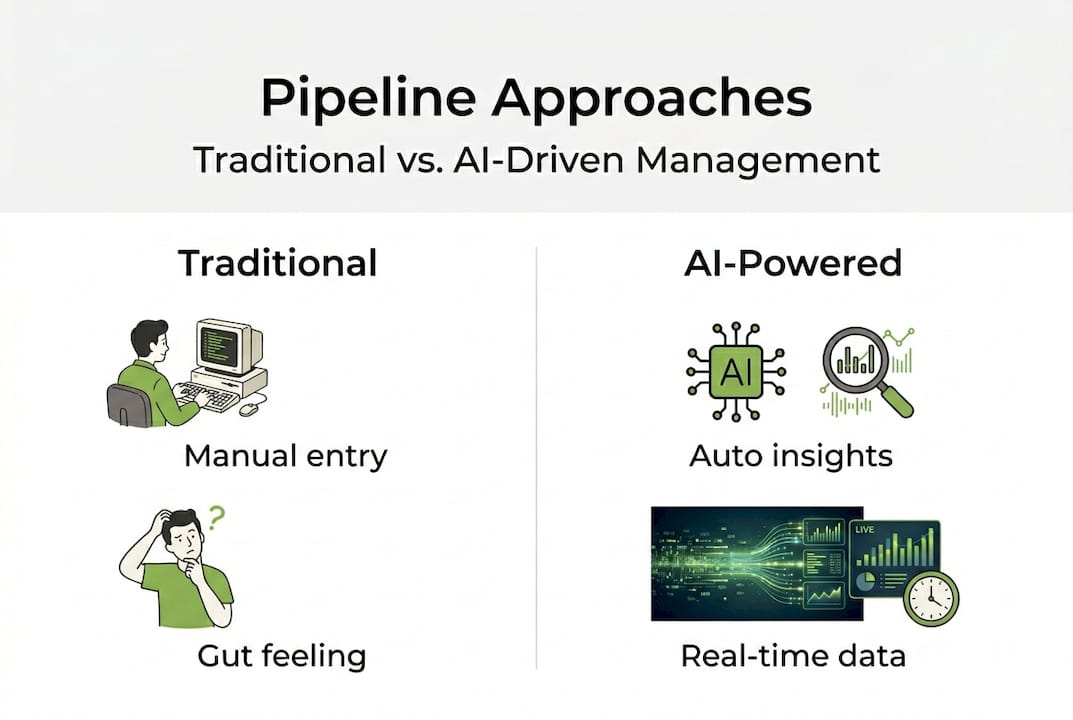
AI enables ongoing learning and adaptation improving long-term results as your system processes more deals. Early predictions might miss nuances, but the model refines itself with every closed opportunity. After analyzing hundreds of deals, AI recognizes that prospects who engage with specific content types or respond within certain timeframes convert at higher rates. This continuous improvement means your forecasting gets more accurate over time without additional manual effort.
Adoption considerations include integration complexity and staff training requirements. You cannot simply turn on AI and expect immediate results. Your team needs to understand how the system generates predictions, when to trust its recommendations, and how to provide feedback that improves model accuracy. Technical integration with existing CRM, marketing automation, and communication platforms requires planning and often custom development work.
Key differences in operational impact:
- Traditional methods require constant manual oversight while AI operates autonomously
- AI surfaces hidden patterns that human analysis misses in complex datasets
- Automation frees reps from administrative tasks to focus on relationship building
- AI provides consistent evaluation criteria eliminating individual bias
- Traditional approaches struggle with remote or distributed teams while AI works across locations
Pro Tip: Run AI predictions in parallel with your traditional forecasting for at least one quarter to build confidence in the system before making it your primary forecasting method.
Implementing AI for pipeline predictability: practical steps and integration tips
Successful AI adoption in sales pipelines combines technology with process redesign and stakeholder training. You cannot bolt AI onto broken processes and expect transformation. Start by assessing your current pipeline data quality and infrastructure to identify gaps that need addressing before implementation.
-
Audit your existing data quality and identify gaps in historical deal information. Check CRM completeness, verify stage definitions are consistent, and clean up duplicate or outdated records. AI models trained on poor data produce unreliable predictions, so invest time in data hygiene before deploying any tools.
-
Choose AI tools compatible with your CRM and marketing stack to ensure seamless data flow. Evaluate platforms based on integration capabilities, not just features. The best AI system is worthless if it cannot access your opportunity data or push insights back into tools your team uses daily.
-
Train sales and marketing teams on AI-driven workflows emphasizing how technology augments rather than replaces their expertise. Address concerns about job security directly and demonstrate how AI handles repetitive tasks while humans focus on strategy and relationship building. When teams understand AI as a tool that makes their jobs easier, adoption accelerates.
-
Start with pilot projects to measure impact and refine usage before full rollout. Select a single team or product line to test AI-powered forecasting. Track metrics like forecast accuracy, time spent on pipeline management, and rep satisfaction. Use pilot results to build internal case studies that convince skeptics.
-
Continuously monitor AI model performance and update processes as you learn what works. Schedule monthly reviews of prediction accuracy, investigate cases where AI missed significantly, and adjust inputs or parameters accordingly. AI is not set-and-forget technology; it requires ongoing optimization.
Integration extends beyond technical connections to include workflow redesign. Map how reps currently manage opportunities, then identify where AI can automate B2B prospecting tasks or provide decision support. Replace manual pipeline reviews with AI-generated risk reports. Shift forecast meetings from data collection to strategic discussion of how to address AI-identified risks.
Change management determines whether AI adoption succeeds or becomes shelfware. Create champions within each team who advocate for the technology and help peers navigate new workflows. Celebrate early wins publicly to build momentum. Share specific examples of how AI helped close deals or prevented losses to make benefits tangible.
Common implementation mistakes to avoid:
- Deploying AI without cleaning historical data first
- Choosing tools based on features rather than integration capabilities
- Failing to establish clear success metrics before launch
- Neglecting ongoing model training and optimization
- Implementing AI without redesigning underlying processes
Pro Tip: Document your AI prospecting step-by-step workflows with screenshots and videos so new team members can onboard quickly and existing reps have reference materials when questions arise.
Enhance your sales pipeline predictability with expert AI solutions
Transforming pipeline predictability requires more than software; it demands strategic expertise in AI implementation tailored to B2B sales contexts. Partnering with specialists who understand both the technology and the sales challenges you face accelerates results while avoiding costly missteps. Lickfold Digital AI Experts combine cutting-edge AI capabilities with deep B2B sales knowledge to deliver solutions that integrate seamlessly into your existing operations.
You gain access to AI agents that identify high-fit prospects, execute personalized outreach at scale, and qualify opportunities before they reach your sales team. This approach fills your pipeline with better-quality leads while providing the data foundation AI forecasting systems need to generate accurate predictions. When prospecting, outreach, and qualification all operate through AI-driven workflows, your entire pipeline becomes more predictable. Ready to transform uncertainty into reliable growth? Contact Lickfold Digital to explore how AI can revolutionize your pipeline management.
Frequently asked questions
What types of AI technologies are most effective for pipeline predictability?
Machine learning, predictive analytics, and natural language processing are the core AI technologies improving pipeline forecasts. Machine learning analyzes historical deal patterns to predict outcomes, predictive analytics monitors real-time changes to detect risks early, and NLP qualifies leads by understanding communication content. These technologies work together to automate data capture, score opportunities objectively, and surface insights that manual analysis misses.
How can sales and marketing teams best collaborate using AI to improve pipeline accuracy?
Shared AI dashboards displaying unified pipeline metrics foster collaboration by giving both teams visibility into lead quality and conversion patterns. Establishing common data standards ensures marketing-generated leads meet sales qualification criteria, while joint training on AI tools helps teams understand how their activities impact pipeline health. Regular cross-functional reviews of AI insights identify misalignment early and create opportunities to refine targeting and messaging strategies collaboratively.
What are common pitfalls to avoid when integrating AI into pipeline management?
Ignoring data hygiene before AI deployment produces unreliable predictions because models learn from flawed historical patterns. Lack of clear change management leads to low adoption as teams resist new workflows without understanding their benefits. Over-reliance on AI without human judgment causes errors when the system encounters situations outside its training data. Successful implementations balance automation with human expertise, maintain clean data continuously, and invest in comprehensive training programs.
Can AI replace sales teams entirely for pipeline management?
AI supports decision-making and automates repetitive tasks but cannot replace the human relationships essential to complex B2B sales. Technology excels at data analysis, pattern recognition, and administrative work, while humans provide strategic thinking, emotional intelligence, and trust-building that close deals. Best results come from combining AI insights with sales expertise, where technology handles forecasting and qualification while reps focus on consultative selling and relationship development that AI cannot replicate.