
What Is a B2B Sales Handoff Process? A Practical Guide
What Is a B2B Sales Handoff Process? A Practical Guide
TL;DR:
- A B2B sales handoff process is a documented, trigger-based transfer of prospect ownership with clear criteria, context, and acceptance SLAs. Poor handoffs cause deal stalls, wasted time, and lost momentum, especially with AI-qualified leads, unless they include structured signals and human verification. Implementing a standardized, documented process with KPIs and phased training minimizes failures and maintains pipeline consistency.
A B2B sales handoff process is a documented, trigger-based transfer of prospect ownership and context from one revenue role to another — marketing to SDR, SDR to AE, or AE to customer success — with three non-negotiable elements: explicit trigger criteria that define when the transfer happens, required context fields that define what transfers, and an acceptance action with an SLA that defines who owns the lead until the receiver confirms it. A handoff is working when it preserves deal momentum, eliminates repeated discovery, and produces a confirmed prospect acknowledgement before the next rep touches the account.
For teams using AI to qualify leads, this matters even more. AI adds structured signals — confidence scores, provenance links, classifier tags — which must map to human-readable handoff fields or they disappear into the CRM and the AE starts cold anyway.
Three core elements every handoff must include:
- Trigger criteria: The specific condition that initiates the transfer (lead score threshold, meeting booked, qualification call completed)
- Required context fields: The five minimum fields the receiver needs to act without re-discovery (meeting details, stakeholders, pain/situation, timeline and budget signals, objections or competitors noted)
- Acceptance SLA: A defined window for the receiver to confirm ownership, plus an escalation path when they miss it
Table of Contents
- Why do weak handoffs kill pipeline and waste AI-qualified leads?
- What goes in the handoff checklist, roles matrix, and SLA template?
- How does the step-by-step handoff flow work in practice?
- How do AI-qualified leads change the handoff?
- What are the most common handoff failure modes and how do you fix them?
- What KPIs and SLA targets should you track?
- How do you implement this in phases if you are an early-stage team?
- Key Takeaways
- The part most guides skip
- How Lickfold removes the ops burden from your handoff process
- Useful sources and further reading
Why do weak handoffs kill pipeline and waste AI-qualified leads?
Poor handoffs are one of the primary sources of revenue leakage and stalled deals in B2B sales. When the transfer is ad hoc, the AE inherits a CRM record with no context, the buyer repeats themselves, and the deal loses the momentum the SDR spent weeks building. For AI-sourced leads, the damage compounds: the AI did the work of identifying and qualifying the prospect, but if the handoff is a raw data dump, that work remains invisible to the AE.
What actually breaks when handoffs are weak:
- Lost deal momentum as the AE spends the first meeting re-qualifying
- Damaged buyer trust when they have to repeat pain points they already shared
- Wasted SDR and AE time on back-and-forth that documentation would have prevented
- Early churn when customer success inherits accounts without knowing what was promised
Documented SLAs alone solve most handoff problems by removing ambiguity about who owns the lead and when the clock starts. That is a low bar to clear, and most teams still miss it.
What goes in the handoff checklist, roles matrix, and SLA template?

A minimal handoff record needs five fields to transfer institutional knowledge without a live sync. Here is the compact checklist:
Trigger conditions (document before anything else):
- Qualification call completed with a decision-maker confirmed
- Lead score or AI confidence above the defined threshold
- Meeting booked or explicit buying signal recorded
Five required context fields:
- Meeting details (date, attendees, format)
- Stakeholders identified (names, titles, decision-maker roles)
- Current situation and primary pain
- Timeline and budget signals (even rough ones)
- Objections raised and competitors mentioned
CRM field names to standardize:
| CRM Field | Owner | Example Value |
|---|---|---|
handoff_status |
RevOps | Pending / Accepted / Escalated |
handoff_date |
SDR / AI system | — |
handoff_summary |
SDR | structured summary |
AI_confidence |
AI system | 0.87 |
provenance_link |
AI system | URL to source signal |
Roles matrix: Marketing or AI fills confidence and provenance. The SDR writes the handoff summary and triggers the transfer. The AE accepts ownership within the SLA window. Sales manager escalates when SLAs are missed. RevOps audits field completion weekly.
SLA template: The SDR owns the lead until the AE sends a written acceptance (CRM status update or reply email). AE acceptance window: one business day for standard leads, four hours for high-confidence AI-sourced leads. Missed SLA triggers an automatic notification to the sales manager.
How does the step-by-step handoff flow work in practice?
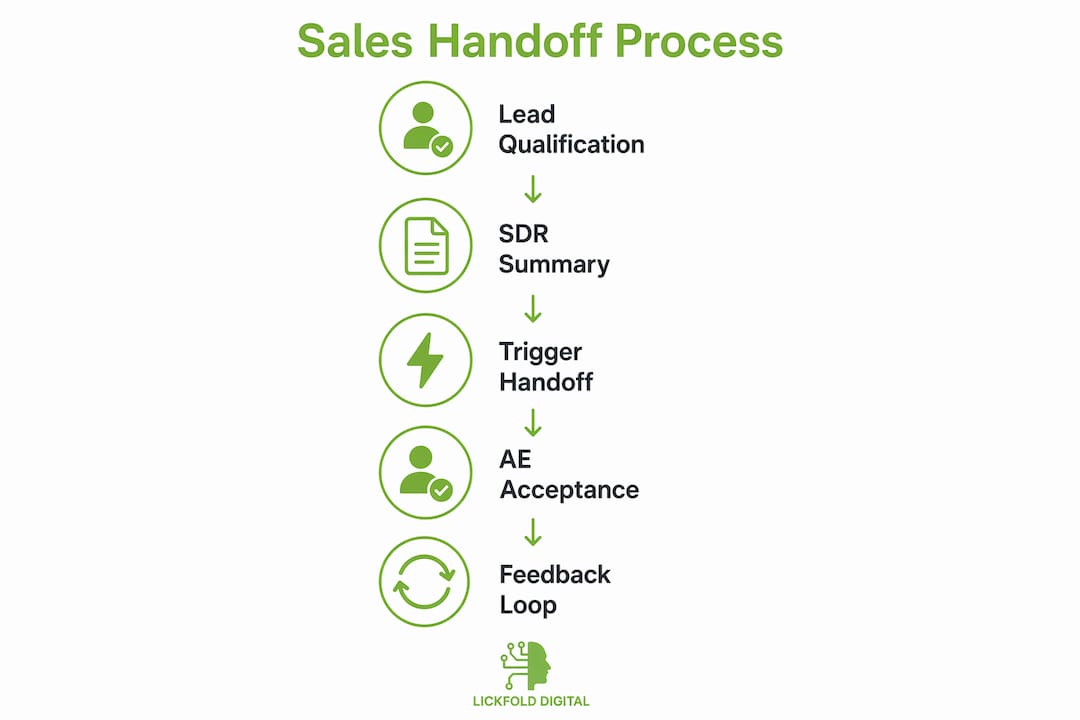
The sequence runs from trigger to feedback loop in five steps.
- Trigger fires. Qualification criteria met; SDR updates
handoff_statusto Pending and completes all five context fields in CRM. - Warm intro email sent. SDR sends a three-party email introducing the AE to the prospect. Structure: one sentence on why the prospect is a fit, one sentence on the AE’s relevant experience, one sentence on the proposed next step. The AE replies within the same thread to confirm the meeting.
- AE accepts ownership. AE updates
handoff_statusto Accepted, reads the handoff summary, and reviews the provenance link before the first call. A prospect-confirmed summary email sent after the SDR’s qualification call becomes the canonical record — it prevents the buyer from repeating themselves and gives the AE a pre-read. - First AE meeting. Agenda: (a) confirm the situation summary from the handoff record, (b) deepen on timeline and budget, © introduce the proposed solution path, (d) agree on next steps. The AE should not re-ask questions already answered in the handoff summary.
- Feedback loop. Within 24 hours of the first meeting, the AE logs a brief qualification accuracy note in CRM. The SDR reviews it weekly to calibrate future handoffs.
Automation snippet: Map AI outputs to CRM fields with a simple workflow. When an AI agent marks a lead as qualified, trigger a Zapier or HubSpot workflow that (a) populates AI_confidence, provenance_link, and model_used from the AI payload, (b) sets handoff_status to Pending, and © sends a Slack notification to the assigned AE with a direct CRM link. For a full B2B outbound workflow that maps these steps end-to-end, the Lickfold guide covers the automation layer in detail.
How do AI-qualified leads change the handoff?
AI adds structured signals that a standard handoff record was not built to carry. Confidence scores, provenance URLs, and classifier labels are precise — but they are meaningless to an AE unless they are translated into human-readable context.
New or adjusted required fields for AI-sourced leads:
AI_confidence(numeric score, e.g., 0.87)provenance_link(URL to the signal source: LinkedIn post, intent data event, web visit)model_used(which AI agent or classifier produced the score)top_intent_phrases(the two or three phrases that drove the classification)last_human_touch(timestamp of the last human review before handoff)
Human verification rule: Require a human review before handoff when AI_confidence is below 0.75 or when provenance_link is partial or missing. Above 0.85 with a complete provenance link, the handoff can proceed automatically with a four-hour AE acceptance SLA. This threshold preserves scale without automating errors into the sales motion.
Pro Tip: Set a lightweight verification step: the SDR reads the AI summary and the provenance link, then adds one sentence of personal context before sending the warm intro. This takes under two minutes and catches misclassifications before they reach the AE.
SLA adjustment: High-confidence AI leads (above 0.85) get a four-hour acceptance window because the signal is fresh and the buyer’s intent is time-sensitive. Standard or human-sourced leads stay on the one-business-day SLA.
What are the most common handoff failure modes and how do you fix them?
Vague triggers. “When the lead is ready” is not a trigger. Fix: define the exact condition in writing (e.g., “qualification call completed with a VP or above, budget confirmed, timeline within six months”).
Data dumps instead of context. An AE who opens a CRM record with 40 activity log entries and no summary starts the meeting cold — and the prospect notices. Fix: require the five-field handoff summary as a mandatory CRM field; block the status change to Pending until it is complete.
Missing acceptance ownership. When no one defines who owns the lead between SDR send and AE accept, leads sit in limbo. Fix: the SDR retains ownership until handoff_status changes to Accepted; the SLA clock is visible to both parties.
AI lead sent as-is. AI flags a lead at 0.78 confidence with a partial provenance link; SDR forwards it directly to AE without a human summary. AE starts cold, prospect repeats themselves, deal stalls. Fix: enforce the human-verification threshold and require a warm intro email regardless of AI confidence.
Founder-transition mistakes. Founders who skip codifying the motion before stepping back create a gap no new hire can fill from intuition alone. The fix is a phased transition, not a binary exit.
What KPIs and SLA targets should you track?
| KPI | Target | Reporting Cadence |
|---|---|---|
| Handoff acceptance rate | High | Weekly |
| Time to first AE touch | Within SLA window | Daily (SLA miss alerts) |
| Meeting-to-opportunity conversion | Track baseline, improve quarterly | Monthly |
| Post-handoff churn at 30 days | Below team baseline | Monthly |
| SDR-to-AE qualification accuracy | AE feedback loop, weekly calibration | Weekly |
Reporting cadence: Daily automated alerts for SLA misses. Weekly quality review between SDR lead and AE lead covering acceptance rate and qualification accuracy feedback. Monthly RevOps trend report covering conversion and churn metrics.
On founder transitions: codifying the motion typically takes 12–24 months, and entering the fully independent phase should depend on repeatable deal closure without the founder present, not on a revenue milestone alone.
How do you implement this in phases if you are an early-stage team?
The costliest mistake is hiring before codifying. Do the documentation first.
- Phase 0 (weeks 1–2): Write the trigger definition, the five required fields, and the warm intro email template. These three artifacts are the minimum viable handoff process.
- Phase 1 (weeks 3–6): Require SDR shadowing of AE calls for the first 30 days. The SDR learns what the AE actually needs; the AE learns what the SDR’s qualification looks like. Run a weekly calibration session to close the loop.
- Phase 2 — founder-coached (months 2–6): The founder stays involved in deals, runs joint calls, and codifies objection handling and qualification judgment into documented playbooks. Founders should not fully exit sales for at least six months after hiring a salesperson — the relationship graph and trust transfer take time.
- Phase 3 (months 7+): The rep leads independently. The founder reviews pipeline weekly and joins only strategic or enterprise deals. The transition to this phase should be data-gated: the rep should have closed deals independently before the founder steps back.
Pro Tip: Start with the three lowest-effort wins: the warm intro email template, the acceptance action in CRM, and the 24-hour feedback loop. These three changes alone will surface most of your handoff problems within two weeks.
For dedicated sales outreach teams making this transition, the founder-coached phase is where the playbook gets built — not before, not after.
Key Takeaways
A repeatable B2B sales handoff process requires documented triggers, five required context fields, a defined SLA, and a human verification step for every AI-qualified lead before it reaches an AE.
| Point | Details |
|---|---|
| Document triggers first | Define the exact condition that fires the handoff before building anything else. |
| Require five context fields | Meeting details, stakeholders, pain, timeline/budget, and objections must transfer with every lead. |
| Verify AI leads before handoff | Require human review when AI confidence is below 0.75 or provenance is incomplete. |
| Measure acceptance and first touch | Track acceptance rate and first AE touch within the defined SLA window. |
| Lickfold handles the AI-to-handoff layer | Lickfold maps AI outputs to CRM handoff fields and qualifies replies before passing leads to sales. |
The part most guides skip
The framing of “handoff process” implies a moment. It is not a moment — it is a system with inputs, outputs, and failure modes, and the failure modes are almost never about technology. They are about the absence of a written sentence that says “this lead is ready when X is true.”
Teams that use AI for prospecting face a specific version of this problem. The AI produces a confidence score, but confidence is not context. An AE who sees a 0.87 score and a provenance link still does not know what the prospect said on the qualification call, what objection they raised, or whether the budget conversation happened. The score tells you the lead is worth pursuing. The handoff record tells you how to pursue it. Both are required, and conflating them is where AI-sourced pipeline goes to stall.
The other thing most guides miss: the feedback loop is not optional. Without it, the SDR has no signal on whether their qualification judgment is accurate, and the AI model has no human correction layer. A 24-hour feedback note from the AE after the first meeting is the cheapest quality control mechanism in the entire sales process.
How Lickfold removes the ops burden from your handoff process
Running AI-driven prospecting at scale means your handoff checklist has to work automatically, not manually. Lickfold’s managed AI prospecting service maps AI outputs directly to your CRM handoff fields — confidence scores, provenance links, intent phrases — so your AEs receive a complete, human-verified record, not a raw data export.
Every lead Lickfold delivers goes through human qualification of replies before it reaches your sales team. That means the last_human_touch field is always populated, the warm intro is already drafted, and your AE’s SLA clock starts with full context in place. The infrastructure layer — dedicated warm-up email accounts, reputation management, multi-touch sequencing — runs continuously so your pipeline stays full without your team managing the ops.
If you want a prospecting system that hands off leads your AEs can actually work, see how Lickfold works and request a walkthrough of the handoff workflow.
Useful sources and further reading
The claims in this article draw from the following primary sources. Use these for in-line citation and further reading.
- Definition and SLA guidance: RevOps Dictionary — Sales Handoff — use for the BLUF definition, the 80% SLA claim, and documentation necessity.
- Process templates and warm intro: JB Sales — How to Run a Sales Handoff — use for the prospect-confirmed summary email and failure mode examples.
- Five required fields and SDR→AE checklist: Rework — SDR to AE Handoff — use for the minimal handoff record and repeatability claim.
- Founder transition phasing and timelines: Dave Rubinstein — Founder-Led Sales Transition Framework — use for the three-phase model and 12–24 month codification timeline.
- Six-month overlap recommendation: GetBoomerang.ai — Founder to VP Sales Handoff — use for the six-month founder involvement guidance.
- B2B sales process context: Leadfeeder — B2B Sales Process — use for the seven-stage process overview and qualification stage framing.
- Lead nurturing and handoff continuity: BabyLove Growth — Lead Nurturing Explained — recommended further reading on maintaining momentum through the handoff into nurture sequences.
- Internal Lickfold resources: Sales opportunity handoff guide, step-by-step lead qualification, and closing B2B service deals for implementation depth.