
Benefits of Dedicated Sales Outreach for B2B Teams
Benefits of Dedicated Sales Outreach for B2B Teams
TL;DR:
- Most B2B sales teams treat outreach as a numbers game, leading to low reply rates and unpredictable revenue. Dedicated outreach transforms prospecting into a disciplined, systematic process that improves lead quality, scalability, and pipeline predictability. Using multichannel strategies, AI-driven personalization, and accurate data, teams can generate qualified opportunities efficiently while avoiding common pitfalls like generic messaging and data hygiene issues.
Most B2B sales teams treat outreach as a numbers game. Send enough emails, connect with enough people on LinkedIn, and eventually the pipeline fills itself. That thinking is exactly why so many teams struggle with low reply rates, poor lead quality, and unpredictable revenue. The real benefits of dedicated sales outreach only show up when you stop treating prospecting as a side task and start treating it as a discipline. This article breaks down what dedicated outreach actually means, why it outperforms generic prospecting, and how to build a system that generates qualified opportunities at scale.
Table of Contents
- Key takeaways
- What dedicated sales outreach actually means
- Core benefits for pipeline quality and efficiency
- Technologies and strategies powering effective outreach
- Common pitfalls in dedicated sales outreach
- Applying dedicated outreach to your B2B sales process
- My honest take on dedicated outreach
- How Lickfold builds this system for you
- FAQ
Key takeaways
| Point | Details |
|---|---|
| Dedicated outreach beats generic prospecting | Focused, persona-driven sequences consistently produce higher reply rates and better-qualified leads than mass messaging. |
| AI enables scale without sacrificing relevance | AI outreach agents can personalize hundreds of messages daily at a quality level that matches human reps. |
| Multichannel sequences multiply results | Coordinating email, LinkedIn, and phone in one sequence produces far stronger conversion rates than any single channel alone. |
| Data quality determines outreach outcomes | Accurate firmographics and verified contacts are the foundation of any outreach program that performs consistently. |
| Human judgment is still non-negotiable | Automation handles volume and timing, but humans must qualify replies and manage relationship-critical conversations. |
What dedicated sales outreach actually means
The term “sales outreach” gets used loosely. Most people use it to describe any activity where a rep contacts a prospect. Dedicated sales outreach is something more specific and more intentional.
It means building a structured, repeatable system where the sole purpose is identifying, contacting, and advancing the right prospects through a defined sequence. No improvising. No one-off cold calls that go nowhere. No spray-and-pray email blasts to a list someone bought last year.
In practice, dedicated outreach involves several distinct components:
- Ideal Customer Profile (ICP) mapping: Knowing exactly which companies, industries, and decision-makers you target, down to firmographic detail
- Verified contact sourcing: Building or buying prospect lists with up-to-date, validated contact information
- Multi-touch sequences: Designing coordinated sequences that reach the same prospect across multiple channels over days or weeks
- Response management: Having a clear process for routing replies to the right human at the right time
- Performance tracking: Measuring every step of the sequence to know what works and what needs adjustment
This is fundamentally different from inbound marketing, where the prospect comes to you. Dedicated outreach goes to the prospect with a specific message, at a specific time, for a specific reason. And that specificity is where the advantages of sales outreach come from.
Pro Tip: Before building your outreach sequences, document your ICP with at least six firmographic attributes: industry, company size, geography, tech stack, growth stage, and the specific trigger that makes them a good prospect right now. Sequences built on vague targeting waste everyone’s time.
Core benefits for pipeline quality and efficiency
Here is where the argument for dedicated sales outreach gets concrete. When outreach is treated as its own discipline with its own resources and workflows, the impact on pipeline quality is significant and measurable.
The first benefit is volume without chaos. A single outreach agent supports as much volume as three to five full-time SDRs at a fraction of the cost. That ratio matters enormously for B2B teams that need to cover large addressable markets without building massive headcounts.
The second benefit is better lead prioritization. When your outreach system tracks opens, clicks, reply intent, and engagement timing, you stop guessing about who is warm. You work a list ranked by actual behavioral signals, not gut feel. AI-powered outreach platforms increase reply rates to seven to fifteen percent, which is a meaningful lift over the baseline performance of manual, unstructured prospecting.
The third benefit is pipeline predictability. Ad hoc outreach produces random results. A systematic program with defined sequences, consistent volume, and measured conversion rates gives your sales leadership data to forecast from. You know that X touches generate Y meetings, and Y meetings convert to Z pipeline. That clarity is worth more than most teams realize until they have it.
The fourth benefit is time reclaimed. Teams using AI outreach automation reduce manual research from roughly twenty hours per week to two, freeing reps to spend that time on calls and deals instead of building prospect lists in spreadsheets. That shift alone changes what a sales rep can accomplish in a week.

There is also a fifth benefit that rarely gets discussed: the feedback loop. When outreach is dedicated and tracked, every message becomes data. Which subject lines generate replies? Which value propositions resonate with CTOs versus VP of Sales? That learning compounds over time and sharpens your entire go-to-market messaging.
Technologies and strategies powering effective outreach
The right technology stack does not replace good outreach judgment. It amplifies it. Here is how the key elements work together.
Multichannel coordination
Running email alone leaves significant engagement on the table. Multichannel sequences combining email, LinkedIn, and phone produce 287% higher conversions than email alone. The reason is simple: decision-makers have different communication habits. Some respond to LinkedIn because it feels less intrusive. Others respond to a direct email because it lands in the tool they live in. A well-designed sequence covers all three touch points without feeling like harassment.
The key is coordination, not repetition. Each touch should build on the previous one. Your LinkedIn connection request references the email you sent. Your follow-up email acknowledges their LinkedIn activity. The sequence feels like a conversation, not a campaign.
AI-driven personalization at scale
The conventional belief is that you must choose between scale and personalization. That is wrong. AI agents can personalize 500+ messages daily with relevance comparable to human reps handling twenty to thirty emails. The system pulls firmographic data, recent company news, role-specific pain points, and behavioral signals to construct messages that feel written for one person, even when thousands go out simultaneously.
This is what separates modern AI-powered B2B prospecting from the template-blasting tools that gave outreach automation a bad reputation in the early 2010s.
Signal-based outreach timing
One of the most underused strategies in B2B outreach is timing messages around trigger events. Messages timed with triggers like funding announcements, leadership changes, or product launches outperform random outbound by large margins because the context makes your message immediately relevant. A prospect who just closed a Series B round has new budget, new priorities, and new pressure to show results. That is a far better moment to reach them than a random Tuesday in February.
Pro Tip: Set up alerts for your ICP companies using Google Alerts, LinkedIn notifications, and funding databases. Feeding trigger events into your outreach sequences is one of the fastest ways to lift reply rates without changing a word of your copy.
Common pitfalls in dedicated sales outreach
Even well-resourced teams make predictable mistakes. Knowing them in advance saves months of wasted effort.
-
Stopping sequences too early. 80% of deals require five or more touches before engagement, yet many teams build sequences that stop at three or four. The prospect who did not reply to your first three emails may absolutely reply to your sixth. Persistence combined with quality messaging matters more than most teams expect.
-
Generic bulk messaging. Sending the same email to five hundred people with only the first name swapped is not personalization. It is personalization theater. Prospects recognize it immediately, and it destroys the sender reputation you worked to build.
-
The automated handoff problem. This is a specific failure mode worth naming directly. Automated outreach stops after a reply, and no human picks up the conversation fast enough. The prospect goes cold. Successful teams use unified inbox systems that alert humans the moment a prospect engages, so the warm conversation gets human attention within minutes, not hours.
-
Dirty data. Poor data quality and inaccurate targeting waste sales team hours and damage email sender reputation. Bounced emails and messages to wrong contacts erode deliverability over time. Treat your prospect database as a living asset that needs regular cleaning and enrichment.
-
Over-automating relationship-critical conversations. Automation is excellent at generating interest. It is terrible at managing nuance. The moment a prospect shows real buying intent, a human needs to own that relationship. Machines do not pick up on tone, hesitation, or the unstated concern buried in a three-line reply.
For a deeper look at how AI agents support lead qualification while keeping humans in the loop at the right moments, the overlap between automation and human judgment is worth studying carefully.
Applying dedicated outreach to your B2B sales process
Knowing the theory is one thing. Actually changing how your team operates is another. Here is a practical comparison of where most teams start versus where a mature outreach program operates.
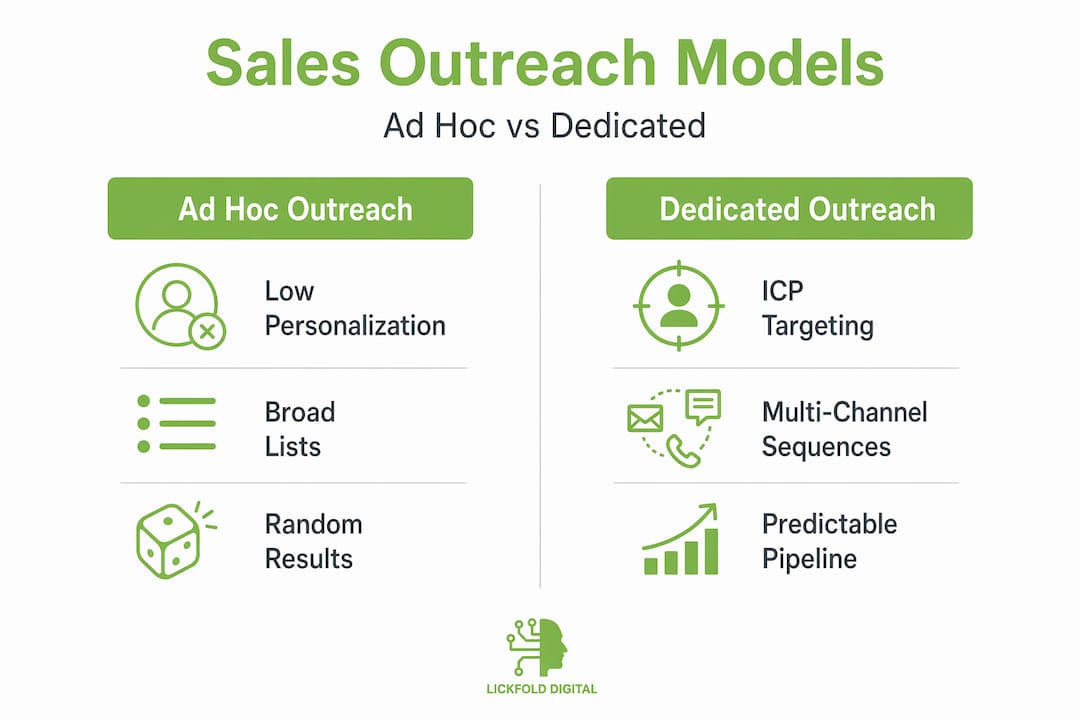
| Capability area | Ad hoc outreach | Dedicated outreach program |
|---|---|---|
| ICP definition | Broad, loosely defined | Specific, regularly updated with data |
| Contact sourcing | Manual searches, varied quality | Verified data with ongoing enrichment |
| Sequence design | Single-channel, inconsistent | Multichannel, tested, documented |
| Personalization | First name only, generic copy | Role, trigger, and intent-based messaging |
| Reply management | Handled whenever reps have time | Unified inbox with instant human alerts |
| Performance tracking | Open rate only | Full funnel metrics from touch to meeting |
The gap between these two states is not primarily a technology problem. It is a process and accountability problem. Choosing the right tools matters, but AI sales workflow tools only deliver results when the process underneath them is sound.
Start by auditing your current state honestly. Map every step of your outreach from ICP definition to booked meeting and identify where prospects fall out. Then prioritize fixing the highest-attrition step before adding new tools. Technology on top of a broken process accelerates the wrong outcomes.
Assign clear ownership. Someone on your team needs to own outreach performance the same way someone owns closing performance. Without that accountability, dedicated outreach programs drift back toward ad hoc behavior within weeks. The best prospecting tips for B2B teams consistently point to process ownership as the make-or-break factor.
My honest take on dedicated outreach
I have watched B2B sales teams approach outreach the same way they approach social media. They treat it as something that should work without a system behind it, as if good intentions and a decent product are enough to get decision-makers to respond. They are not.
What I have found repeatedly is that the teams generating the most consistent pipeline are not the ones with the biggest budgets or the most aggressive reps. They are the ones who treat outreach as an engineering problem. They define inputs, measure outputs, and iterate on what the data tells them. The “spray and pray” model is not just ineffective. It is actively harmful because it trains your team to expect low results and burns your sender reputation in the process.
The part that surprises most people when they move to a dedicated outreach model is how much time they get back. Hybrid human-AI outreach teams where automation handles high-volume tasks and humans focus on qualification change what a small team can accomplish. I have seen a team of three generate the meeting volume of a team of twelve once the right infrastructure was in place.
The contrarian point I keep coming back to is this: more personalization is not always the answer. The right personalization at the right moment, triggered by the right signal, sent at the right time, beats hyper-crafted messages sent with no timing logic. Timing and relevance matter more than eloquence.
— Duarte
How Lickfold builds this system for you
Lickfold specializes in exactly what this article describes: building dedicated outreach infrastructure for B2B companies that cannot afford to wait for pipeline to happen organically.
The Lickfold platform deploys AI agents that identify decision-makers within your ICP, execute personalized multi-touch sequences across email and LinkedIn, and hand off warm, human-qualified leads directly to your sales team. No generic templates. No unmanaged reply queues. No burnt sender reputation from bulk blasting. The infrastructure includes dedicated warm-up email accounts, ongoing deliverability management, and a qualification layer so your reps only spend time on prospects who have already shown real interest. If you want to see what a predictable outreach pipeline looks like for your specific market, start the conversation with Lickfold and get a clear picture of what is possible.
FAQ
What are the main benefits of dedicated sales outreach?
Dedicated sales outreach improves pipeline predictability, increases lead quality through structured targeting, and reduces manual prospecting time. Teams using systematic outreach programs consistently book more meetings with better-fit prospects than those relying on ad hoc efforts.
How is dedicated outreach different from general cold outreach?
General cold outreach typically involves low-personalization messages sent to broad lists. Dedicated sales outreach uses specific ICP targeting, multi-touch sequences across channels, and behavioral data to reach the right prospect with a relevant message at the right time.
How many touches does B2B outreach typically require?
80% of B2B deals require five or more touches before a prospect engages. Most teams stop at three to four touches, which means they abandon prospects who would have converted with one or two more well-timed contacts.
Can automation handle the full outreach process?
Automation excels at volume, sequencing, and personalization at scale, but LinkedIn outreach reply rates and conversion momentum drop sharply when humans do not take over immediately after a prospect replies. The most effective programs use automation for top-of-funnel activity and humans for qualification and relationship development.
What role does data quality play in outreach success?
Data quality is foundational. Inaccurate contact data drives up bounce rates, damages sender reputation, and wastes rep time on prospects who do not match your ICP. Effective outreach teams treat prospect data as a continuously updated asset, not a static list built once and used until it breaks.