
Higher sales through strategic follow-up campaigns
Higher sales through strategic follow-up campaigns
TL;DR:
- Most B2B sales require five or more follow-ups to close deals.
- Multi-channel follow-up strategies significantly increase response and conversion rates.
- Personalization and timing are critical to maintaining engagement and avoiding overreach.
Higher sales through strategic follow-up campaigns
Most sales teams pour their best energy into the first outreach and then quietly move on when no one replies right away. The numbers tell a different story. 80% of sales require five or more follow-ups before a deal closes, yet the majority of reps stop after one or two attempts. That gap between what sales teams do and what actually drives revenue is where follow-up campaigns come in. This guide breaks down exactly why persistent, well-crafted follow-up sequences are among the highest-leverage tools in any B2B playbook, and how to build one that converts.
Table of Contents
- Why follow-up campaigns matter in B2B sales
- Core elements of effective sales follow-up campaigns
- Multi-channel approaches: Email, phone, and beyond
- Personalization and value-add: The secret to higher engagement
- The uncomfortable truth: When follow-up hurts more than it helps
- Supercharge your sales with expert follow-up solutions
- Frequently asked questions
Key Takeaways
| Point | Details |
|---|---|
| Persistence drives results | Most B2B sales require five or more follow-ups to win the deal. |
| Multi-channel is essential | Using email, phone, and LinkedIn boosts your chance of converting leads. |
| Personalization pays off | Personalized follow-ups can deliver up to 142% higher reply rates. |
| Process consistency matters | Standardized, well-timed follow-ups earn much higher conversion rates. |
| Avoid overdoing it | Too many follow-ups can harm your relationships and results. |
Why follow-up campaigns matter in B2B sales
With the surprising reality that multiple follow-ups are needed for sales success, it is important to understand why these campaigns are especially impactful in B2B environments. The sales cycle in B2B is rarely a straight line. Decision-makers juggle competing priorities, budgets require sign-off from multiple stakeholders, and a single email or call almost never captures enough attention to move someone from cold to committed. Follow-up campaigns bridge that gap systematically.
Here is the part that should concern every sales leader: 48% of salespeople never attempt a second follow-up after initial contact, which means they are walking away from 92% of potential deals still on the table. These are not cold, uninterested prospects. Many of them simply got busy, forgot to reply, or needed a second touchpoint before they were ready to engage. Abandoning them after one contact is not efficiency; it is leaving revenue behind.
Persistence, when done right, pays off measurably. Teams that maintain consistent follow-up cadences see 34 to 47% higher win rates compared to those relying on one-time outreach. That is not a marginal improvement; it is the difference between a pipeline that converts and one that stagnates. The research confirms what top sales professionals have known intuitively for years: showing up more than once is not annoying, it is necessary.
“The fortune is in the follow-up” is not just a motivational poster quote. It is backed by data that most sales teams ignore at their own expense.
Why do B2B follow-ups matter so much more than in consumer sales? Several reasons:
- Complex buying committees: In B2B, the average deal involves six or more decision-makers, each needing different information at different stages.
- Longer sales cycles: B2B purchases can take weeks or months, and follow-ups keep your solution top-of-mind throughout that window.
- Low urgency at first contact: Prospects rarely feel urgency on the first call or email. Repeated, value-adding contact creates that urgency naturally.
- Signal building: Each follow-up that gets a reply or a click tells you something useful about where the prospect is in their buying journey.
Building effective sales campaigns that capitalize on these dynamics requires more than good intentions. It requires a structured approach to what you send, when you send it, and how you adapt based on behavior.
Core elements of effective sales follow-up campaigns
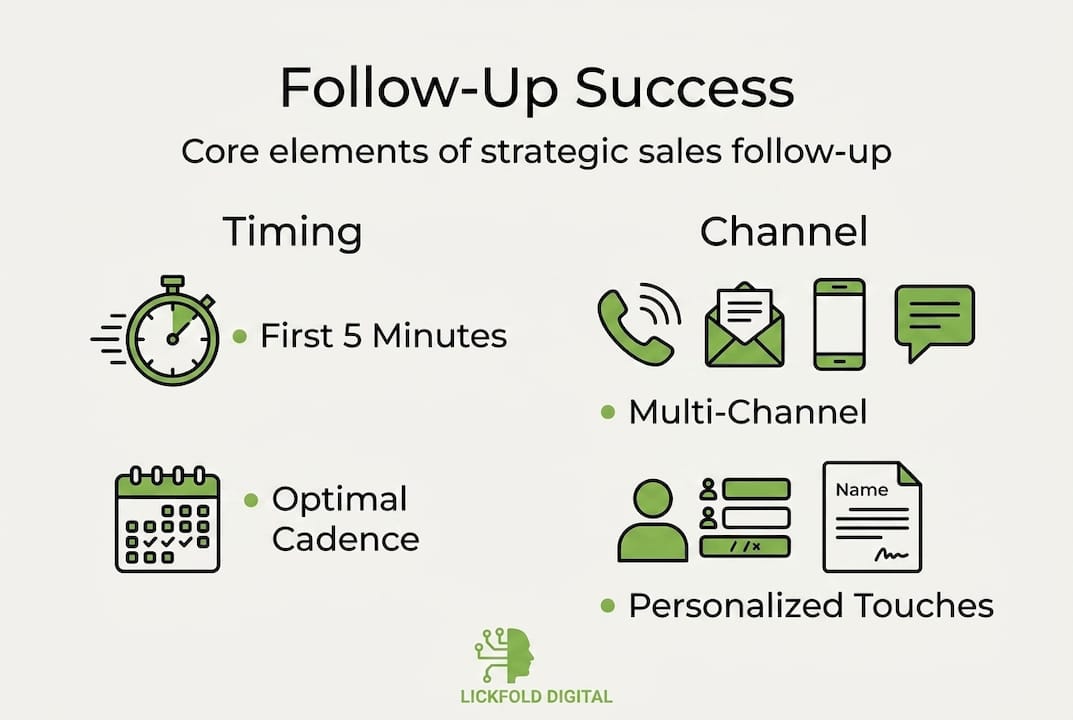
To build on why follow-ups are non-negotiable, it helps to know exactly what makes a follow-up campaign genuinely effective. There are three pillars that separate high-performing sequences from random outreach: timing, cadence, and structure.
Timing is everything. Studies show the first follow-up within 5 minutes of an inquiry increases conversion rates by nine times compared to waiting even 30 minutes. Most teams respond within hours or days. The teams that move within minutes win disproportionately. Speed signals seriousness, and in competitive B2B markets, that matters.

Cadence determines results. Research points to an optimal cadence of 5 to 8 touches spread across two to four weeks as the sweet spot for most B2B follow-up campaigns. Fewer touches underperform because they abandon prospects too early. More touches with poor spacing risk becoming noise. The right cadence creates enough frequency to stay visible without tipping into irritation.
Here is a blueprint for a high-performing follow-up campaign:
| Touch | Timing | Format | Purpose |
|---|---|---|---|
| Touch 1 | Day 0 | Initial value offer | |
| Touch 2 | Day 2 | Quick follow-up, add new insight | |
| Touch 3 | Day 4 | Phone call | Personalized outreach |
| Touch 4 | Day 7 | LinkedIn message | Social proof or case study |
| Touch 5 | Day 10 | Address common objection | |
| Touch 6 | Day 14 | Phone call | Direct ask for meeting |
| Touch 7 | Day 21 | Breakup message or pivot offer |
This table is not a script; it is a framework. Adjust the channels and content based on your industry, target persona, and the signals each prospect sends you.
Here are the steps for planning your own sequence:
- Define your ideal customer profile and map what concerns they have at each buying stage.
- Choose the right mix of channels for your audience (email, phone, LinkedIn, SMS).
- Write each touchpoint with a single, clear purpose rather than trying to cover everything in one message.
- Space your touches to allow response time without losing momentum.
- Review reply rates and adjust timing or messaging after your first 20 to 30 sequences.
Pro Tip: Use automation for sales follow-up to guarantee consistent execution across your entire pipeline, but always make each message feel written for that specific person. Automation should handle the scheduling and delivery, not replace the human thinking behind each touchpoint.
Multi-channel approaches: Email, phone, and beyond
With the core campaign framework in place, the choice of communication channel can further amplify results. Relying on a single channel, usually email, is one of the most common mistakes B2B sales teams make. Prospects live across multiple platforms, and meeting them where they are dramatically increases your chances of getting a response.
Data confirms this clearly: multi-channel follow-ups boost conversions by 27 to 30% compared to single-channel sequences. That lift alone justifies the added complexity of managing multiple outreach formats.
Here is a breakdown of the most common channels and when to use each:
| Channel | Best for | Conversion strength | Key risk |
|---|---|---|---|
| Detailed content, nurturing | High for warm leads | Low open rates if list is cold | |
| Phone | Urgent outreach, late-stage | Highest for qualified leads | Easy to ignore or block |
| Awareness, social proof | Medium for cold outreach | Slower response times | |
| SMS | Quick reminders, confirmations | High for opted-in lists | Invasive if overused |
Each channel has its role in a well-designed sequence:
- Email works best for sharing content, case studies, and structured value propositions. It is easy for prospects to read on their own time and archive for reference.
- Phone calls are most powerful for late-stage follow-up when you already have some engagement or name recognition from earlier touches. A cold call after two warm emails lands very differently than a completely cold dial.
- LinkedIn is underused by most sales teams beyond basic connection requests. Sending a relevant article, commenting on a prospect’s post before reaching out, or sharing a quick insight creates social familiarity that makes other outreach feel far less intrusive.
- SMS should be reserved for prospects who have opted in or already responded to other outreach. It is the most personal channel and the easiest to abuse.
For practical AI-powered sales tips on structuring these channels together, the key principle is sequencing. Do not blast all channels simultaneously. Layer them so each new channel feels like a natural next step in a conversation, not a mass-broadcast escalation. For a deeper look at how to structure the mechanics behind this, the outbound workflow guide covers the process end to end.
Personalization and value-add: The secret to higher engagement
Choosing the right channels is only half the battle. What you say matters just as much. In a world where every professional’s inbox is flooded with templated pitches, the only way to stand out is to make each touchpoint feel relevant and useful to that specific person.
Personalization is not just a nice-to-have. Personalized follow-ups increase reply rates by anywhere from 15 to 142%, depending on the level of specificity and relevance. That is a staggering range, and it underscores that there is no ceiling to what personalization can do when it is done well. The bottom of that range, a 15% lift, comes from basic name and company insertion. The top of that range comes from messages that reference specific triggers, behaviors, or challenges unique to that prospect.
Personalization is not mentioning someone’s first name. It is showing them you understand their actual situation well enough to say something worth reading.
What does value-adding personalization look like in practice?
- Trigger-based outreach: If a prospect just announced a new product launch or a funding round, your follow-up references that event and connects it directly to how your solution is relevant right now.
- Role-specific messaging: A CFO cares about cost savings and risk. A VP of Sales cares about pipeline velocity and quota attainment. The same product pitch reframed for each role performs dramatically better.
- Sharing relevant resources: Sending a specific case study, benchmark report, or industry insight that directly addresses a known pain point gives the prospect a reason to engage even if they are not yet ready to buy.
- Behavioral follow-up: If someone opened your email three times but did not reply, your next message can acknowledge that your content may have been useful and offer to answer questions directly. This is where personalized email outreach becomes a systematic competitive advantage rather than a one-off effort.
Standardized processes yield 78% higher conversion rates than ad hoc outreach, which resolves the apparent tension between personalization and scale. You do not have to choose between personalized and efficient; you need a system that makes personalization repeatable. Templates are fine as starting frameworks, but every message should have at least one element customized to that person’s role, industry, company context, or recent behavior.
Pro Tip: Build a simple enrichment step into your workflow where you pull three data points about each prospect before sending: their title, a recent company news item, and one pain point common to their role. Use these three inputs to customize the opening line and the value proposition in every follow-up. This takes about two minutes per prospect and consistently outperforms generic sequences.
The uncomfortable truth: When follow-up hurts more than it helps
Even with the best practices above, it is possible to overstep, and here is what the data and real-world experience reveal about where persistence crosses into pressure.
Conventional sales wisdom champions relentless follow-up. Call until they pick up. Email until they reply. The problem is that advice ignores the prospect’s experience entirely. We have seen campaigns where sequences that worked beautifully at six touches started producing unsubscribe spikes at touch seven and beyond. The reply rate did not just flatten; it went negative, with opt-outs erasing earlier goodwill.
Over-following up beyond 7 touches risks marking your domain as spam and permanently closing the door with prospects who might have converted with better timing. The top-performing teams we have studied do not just track reply rates. They watch opt-out trends, spam complaint rates, and engagement scores across their entire sequence. When those metrics shift, they adjust immediately.
This is exactly where AI earns its place in outbound sales. Reviewing sales automation trends shows that the smartest teams use AI not just to send more follow-ups, but to decide when to stop, pause, or switch channels. The goal is not maximum volume; it is maximum relevance. Quality beats quantity in every sequence we have ever run, and the metrics always confirm it.
Supercharge your sales with expert follow-up solutions
Ready to put these strategies to work and see a measurable lift in conversions? Building a high-converting follow-up system from scratch takes time, testing, and the right infrastructure. That is exactly what Lickfold Digital is built for.
Our AI sales experts design and deploy multi-touch, multi-channel follow-up campaigns tailored to your ideal customer profile. From sequence architecture and channel selection to personalization at scale and reply qualification, we handle the full workflow so your team closes more deals without burning more hours on manual outreach. If you want to see where your current follow-up process is leaving revenue behind, contact our team for a personalized lead conversion audit.
Frequently asked questions
How many follow-ups does it typically take to close a sale?
It often takes five or more follow-ups to close most B2B sales. 80% of closed deals required at least that many touchpoints before the prospect committed.
What’s the ideal timing for the first sales follow-up?
Responding within five minutes of an inquiry can increase conversions by 9x compared to slower response windows. Speed signals prioritization and professionalism to the prospect.
Which channels work best for sales follow-up campaigns?
A multi-channel strategy using email, phone, and LinkedIn consistently outperforms any single channel. Multi-channel approaches lift conversions by 27 to 30% on average.
How can I personalize follow-up messages to stand out?
Reference a specific trigger, pain point, or behavior tied to that prospect’s role or company. Personalized follow-ups boost replies by up to 142% when the message reflects genuine understanding of the prospect’s situation.
What’s the main pitfall to avoid with follow-up campaigns?
Sending too many touches without monitoring opt-out rates can damage your sender reputation and close the door permanently. Over seven follow-up touches risks triggering spam filters and alienating prospects who might have converted with better-timed outreach.