
B2B outbound workflow: a complete guide for 2026
B2B outbound workflow: a complete guide for 2026
TL;DR:
- Modern outbound sales is a data-driven, multi-channel, systematic process focused on targeting high-fit prospects.
- Building and maintaining a clean, enriched prospect list and continuously measuring performance are key to success.
- Rapid iteration, discipline, and cross-team feedback are essential to optimize outbound workflows effectively.
Most sales and marketing teams still picture outbound as a rep dialing down a list of cold numbers, hoping someone picks up. That picture is about 15 years out of date. Today’s B2B outbound workflow is a systematic, data-driven process that combines precise targeting, multi-channel engagement, and signal-based prioritization to book meetings with the right people at the right time. This guide breaks down every layer of that process, from defining your Ideal Customer Profile (ICP) to measuring what actually works, so you can build or sharpen an outbound engine that consistently fills your pipeline.
Table of Contents
- Understanding the B2B outbound workflow
- Core steps of an effective workflow
- Choosing channels and tools for outbound efficiency
- Benchmarks, metrics, and workflow optimization
- A practical perspective: What most guides get wrong about outbound workflows
- Next steps: Ready to optimize your outbound workflow?
- Frequently asked questions
Key Takeaways
| Point | Details |
|---|---|
| Define ICP precisely | Accurate ICP targeting ensures your outreach connects with high-fit prospects. |
| Leverage multi-channel sequences | Mixing email, phone, and social touches over 14-25 days boosts conversion. |
| Use the right sales tools | Workflow platforms like HubSpot or Salesforce streamline automation and reporting. |
| Track and optimize metrics | Regularly measure response and meeting rates to improve workflow effectiveness. |
Understanding the B2B outbound workflow
Outbound and inbound are often treated as opposites, but they serve different purposes. Inbound pulls prospects to you through content and search. Outbound puts you in front of the right decision-makers before they ever search for a solution. When built correctly, outbound does not feel like interruption. It feels like relevance.
A modern outbound workflow is a systematic, proactive process where sales teams identify high-fit prospects matching a defined ICP, prioritize them based on buying signals, and engage them over a structured 14 to 25 day cadence to book qualified meetings. That definition matters because every word in it is doing work. Systematic means repeatable. Proactive means you are not waiting. Signal-based means you are acting on real data, not guesses.
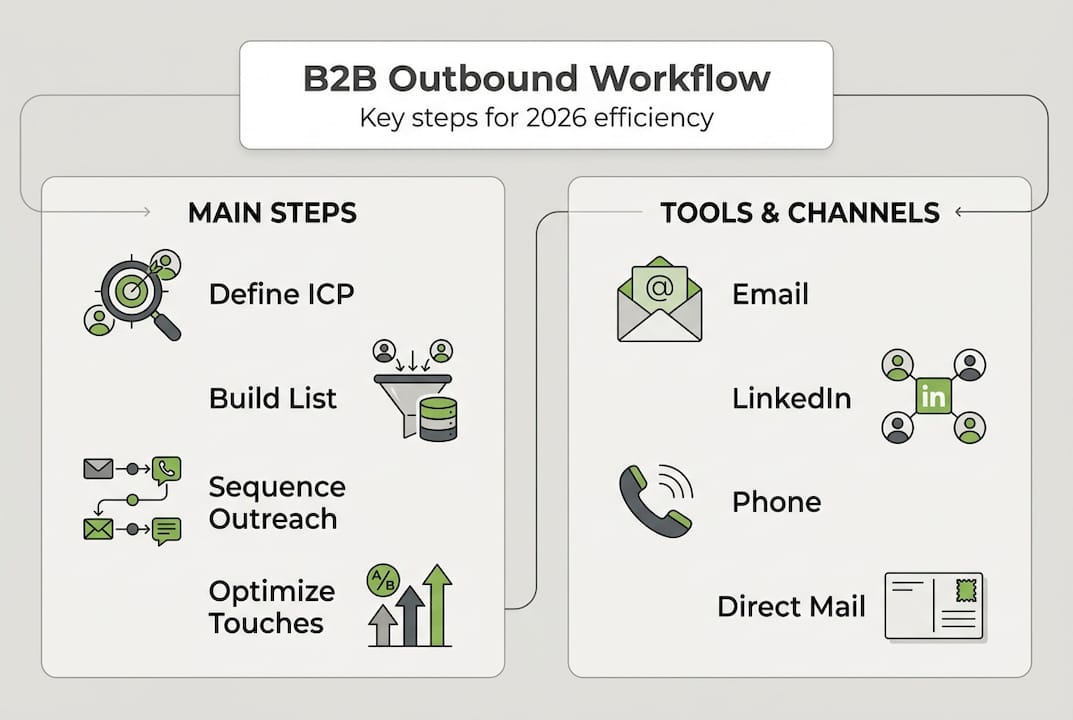
Here is why a structured workflow beats ad hoc outreach every time. When reps operate without a defined process, they default to whatever feels comfortable, usually one or two channels, inconsistent follow-up, and no clear handoff criteria. A workflow removes that variability. It standardizes the best behaviors across the whole team.
The key components of a high-performing outbound workflow include:
- ICP targeting: Defining who you want to reach using firmographic, technographic, and behavioral data
- Signal-based prioritization: Ranking prospects by buying intent, recent funding, hiring activity, or tech stack changes
- Structured sequences: A planned series of touches across email, phone, and LinkedIn
- Multi-channel outreach: Reaching prospects where they actually spend time
- Measurement and iteration: Tracking what works and adjusting fast
A typical high-performing sequence runs 8 to 12 touches over 14 to 25 days. That mix usually includes email as the backbone, phone calls for high-priority accounts, and LinkedIn for social proof and warm connection requests. Explore how AI-driven sales workflow design can accelerate this process significantly.
| Workflow component | Typical range | Purpose |
|---|---|---|
| Total touches per prospect | 8 to 12 | Maximize response without burning goodwill |
| Cadence duration | 14 to 25 days | Stay top of mind across a buying cycle |
| Channels used | 2 to 3 | Email, phone, LinkedIn |
| ICP fit score threshold | 70 to 100 | Focus effort on highest-fit accounts |
Teams with a clearly defined workflow consistently book more qualified meetings than those relying on gut feel and volume alone.
Core steps of an effective workflow
Knowing what outbound workflow includes is one thing. Knowing how to build one step by step is where most teams struggle. Here is the sequence that actually works.
- Define a layered ICP. Go beyond job title and company size. Layer in technographics (what tools they use), firmographics (industry, revenue, headcount), and behavioral signals (hiring trends, funding rounds, content engagement). Strong layered ICP development is the foundation everything else rests on.
- Build and enrich your prospect list. Pull contacts from data providers, then verify and enrich them. Stale or inaccurate data is the single biggest silent killer of outbound programs.
- Score and prioritize. Not every ICP-fit prospect is ready to buy. Use scoring to rank by signal strength and recency. Focus your best reps on the top tier.
- Execute a multi-channel cadence. Day 1: personalized email. Day 3: phone call. Days 5 to 7: LinkedIn connection and message. Day 10: value-add touch (a relevant case study or insight). Day 14 to 25: final follow-up and close-out.
- Qualify responses using BANT. BANT stands for Budget, Authority, Need, and Timeline. Before any handoff, confirm the prospect meets your minimum qualification threshold. This protects your Account Executives (AEs) from wasting time on dead ends.
- Hand off to AE. Pass only qualified opportunities with full context: what the prospect responded to, what pain they mentioned, and what next step was agreed.
- Measure and iterate. Review reply rates, meeting rates, and sequence performance weekly. Kill what is not working. Double down on what is.
You can also learn how to properly segment B2B audiences to make each step of this sequence sharper and more targeted.
“The core steps of outbound follow a clear arc: define your ICP, build and enrich lists, score and prioritize, execute a multi-channel cadence, qualify with BANT, hand off to AE, then measure and iterate.”
Pro Tip: Poor data hygiene is the root cause of failure in more than 80% of underperforming outbound campaigns. Before you launch any sequence, audit your contact data for accuracy, completeness, and recency. One hour of data cleanup saves weeks of wasted outreach.
Choosing channels and tools for outbound efficiency
Even a perfect workflow falls apart if you are using the wrong channels or tools to execute it. Channel selection is not about personal preference. It is about where your buyers actually pay attention.

Email remains the highest-volume channel for B2B outbound. It is scalable, trackable, and works well for personalized, text-based messaging. Use it as your primary touch and the backbone of every sequence.
Phone works best for senior decision-makers and high-value accounts. A well-timed call after an email open can dramatically increase response rates. Do not skip it just because it feels uncomfortable.
LinkedIn adds a social layer that email cannot replicate. A connection request after an email creates familiarity. A message referencing shared content builds credibility. It is especially powerful in industries where buyers are active on the platform.
Direct mail is the dark horse. For top-tier accounts, a physical piece of mail cuts through digital noise in a way no email ever will. Reserve it for your highest-priority targets.
On the tools side, AI sales workflow tools like HubSpot, Outreach, and Salesforce each offer sequence automation, CRM integration, and reporting. Here is how they compare:
| Tool | Best for | AI features | Integration depth |
|---|---|---|---|
| HubSpot | SMB and mid-market teams | Predictive lead scoring | Native CRM, strong ecosystem |
| Outreach | Enterprise sales teams | Sequence optimization, sentiment | Deep CRM and LinkedIn sync |
| Salesforce | Large, complex sales orgs | Einstein AI, forecasting | Widest enterprise integration |
That said, HubSpot, Outreach, and Salesforce only enable great workflows when your data is clean and your integrations are properly configured. Poor data or broken integrations are responsible for killing 80% of outbound programs before they ever get traction.
The most common pitfalls with outbound tool setups include:
- Importing unverified or outdated contact lists
- Running sequences without proper email warm-up infrastructure
- Failing to connect your sequencing tool to your CRM, creating data silos
- Over-automating to the point where messages lose all personalization
- Ignoring deliverability metrics until your domain reputation is already damaged
Explore AI-driven prospecting approaches that solve these infrastructure problems before they derail your pipeline.
Benchmarks, metrics, and workflow optimization
You cannot improve what you do not measure. The teams that consistently outperform their peers are not necessarily running better sequences. They are reviewing performance data more often and acting on it faster.
The core metrics every outbound team should track include reply rate, qualified meeting rate, channel-level conversion, sequence completion rate, and touch frequency by stage. Tracking reply rates, meetings booked, touch frequency, and channel conversion rates gives you the full picture of where your workflow is strong and where it leaks.
Here are realistic benchmarks for a well-run B2B outbound workflow in 2026:
| Metric | Benchmark range | What it tells you |
|---|---|---|
| Email reply rate | 5% to 15% | Message relevance and targeting quality |
| Qualified meeting rate | 2% to 5% of contacted | ICP fit and qualification rigor |
| LinkedIn response rate | 10% to 25% | Social channel effectiveness |
| Sequence completion rate | 60% to 80% | Data quality and contact accuracy |
| Meeting to opportunity rate | 30% to 50% | AE qualification and handoff quality |
Optimization is not a quarterly activity. It is weekly. Test one variable at a time: subject line, opening sentence, call-to-action, or send time. Change one thing, run it for two weeks, and compare. Review AI-driven growth benchmarks to understand how AI-assisted teams are pushing these numbers higher.
Pro Tip: The highest-performing outbound teams hold a 30-minute weekly metrics review. They look at which sequences are generating replies, which are going dark, and which channels are converting. Then they act on it immediately, not next quarter.
For teams focused on AI-driven B2B efficiency, the optimization loop becomes even tighter because AI surfaces patterns in data that humans would take weeks to spot manually. Pair that with strong decision maker targeting practices and your qualified meeting rate climbs fast.
A practical perspective: What most guides get wrong about outbound workflows
Here is the uncomfortable truth most outbound guides will not tell you. The framework is not the hard part. Execution discipline and rapid iteration are.
We see this pattern constantly. A team reads every best practice article, builds a technically correct workflow, launches it, and then leaves it untouched for three months. When results disappoint, they blame the channel or the tools. The real problem is that they treated the workflow as a finished product instead of a living system.
Copying someone else’s playbook fails when you ignore your own data. Your buyers are not identical to another company’s buyers. Your message, timing, and channel mix need to be calibrated to your specific market. The only way to find that calibration is to test, measure, and adjust monthly, not annually.
Cross-functional feedback is also massively underrated. The best insights about why prospects respond or go cold often come from customer success, product, and marketing, not just the sales team. Pulling those perspectives into your AI sales tips and workflow reviews creates a feedback loop that compounds over time.
Teams that evolve their playbook every month consistently outperform those that set it and forget it. That is not a technology advantage. It is a discipline advantage.
Next steps: Ready to optimize your outbound workflow?
Building a high-performing outbound workflow takes more than a good framework. It takes the right infrastructure, clean data, personalized messaging at scale, and a team that knows how to iterate fast.
Lickfold Digital helps B2B sales and marketing teams do exactly that. Our AI-powered platform identifies high-fit prospects, executes personalized multi-touch campaigns, and delivers human-qualified leads directly to your pipeline. No generic templates. No wasted outreach. Just a scalable, automated system that works like a disciplined outbound team running 24 hours a day. Ready to see what that looks like for your business? Contact Lickfold Digital and let’s build your outbound engine together.
Frequently asked questions
How many touchpoints are ideal in a B2B outbound workflow?
Eight to twelve touchpoints spread over two to three weeks are optimal for most B2B outbound workflows, giving you enough contact frequency without overwhelming prospects.
Which sales tools support B2B outbound workflows?
HubSpot, Outreach, and Salesforce are the most widely used platforms, each offering sequence automation, CRM integration, and reporting features suited to different team sizes.
What is the role of ICP in outbound?
The ICP guides every targeting decision by defining the firmographic, technographic, and behavioral traits of your best-fit prospects, ensuring your outreach focuses on accounts most likely to convert. A layered ICP definition that includes behavioral signals is far more powerful than one based on company size alone.
How do you measure outbound workflow effectiveness?
Track reply rates, meetings booked, and qualified opportunity rate as your core indicators, reviewing them weekly so you can act on trends before they compound into bigger problems.