
Closing B2B Service Deals Consistently: A 2026 Guide
Closing B2B Service Deals Consistently: A 2026 Guide
Closing B2B service deals consistently comes down to one thing most reps get wrong: they treat the close as an event rather than the natural result of a well-run process. The research backs this up. Over 67% of B2B salespeople struggle with closing because they focus on the final moment instead of the conditions that make a yes inevitable. Fix the process, and the close takes care of itself.
Here is what that process actually looks like in practice:
- Run discovery continuously. Don’t stop at the first call. Discovery should run through demos, proposals, and every stakeholder conversation.
- Multi-thread from day one. Map every relevant stakeholder early and build relationships before you need them.
- Secure small commitments at each stage. Each “yes” to a next step makes the final ask feel like a formality, not a leap.
- Quantify the cost of inaction. Natural urgency built around the buyer’s own business calendar closes deals. Artificial pressure kills them.
- Enable your internal champion. Arm them with a decision brief, an internal FAQ, and a risk mitigation plan so they can sell without you in the room.
- Use social proof at the right moments. Timing matters. Deploy case studies during discovery, after objections, and at final validation.
- Track leading indicators, not just outcomes. Discovery completion rate, objection resolution rate, and next-step commitment rate predict your close rate before it shows up in the numbers.
How multi-threading wins complex B2B service deals
The buying committee has grown. Decision groups now include multiple stakeholders per deal, reflecting increased decision complexity compared to previous years. Your champion can love you, but if they can’t sell you internally, you lose. Multi-threading is the practice of building active relationships with multiple stakeholders simultaneously rather than relying on a single contact to carry the deal forward.
The first step is mapping the committee before you invest heavily in the opportunity. For each stakeholder, you need to understand their role in the decision, their primary concern, and their relationship to the champion. A simple stakeholder map with four columns (name, role, priority, relationship to champion) gives your team a shared view of the deal’s internal politics.
Communication tailored to each stakeholder’s actual concerns moves deals faster than a one-size pitch. The CFO wants ROI and risk mitigation. The operations lead wants implementation clarity. The end users want to know their workflow won’t break. Sending the same deck to all three is a fast way to lose the room.
Field research shows deals improve 41% when the buying committee is fully mapped early. The practical implication: ask your champion in the second or third meeting, “Who else in the organization might raise concerns about moving forward?” Champions know the blockers. They just won’t volunteer that information unless you ask directly.
Pro Tip: Schedule introductions with the technical evaluator and economic buyer within the first 30–45 days. Frame it around their perspective, not your pitch. “I’d love to understand what success looks like from your team’s standpoint” gets you in the room without triggering a defensive posture.
Building long-term B2B client relationships across multiple stakeholders also creates resilience. If your only contact leaves, gets promoted, or goes on leave during a nine-month cycle, a single-threaded deal is effectively dead.
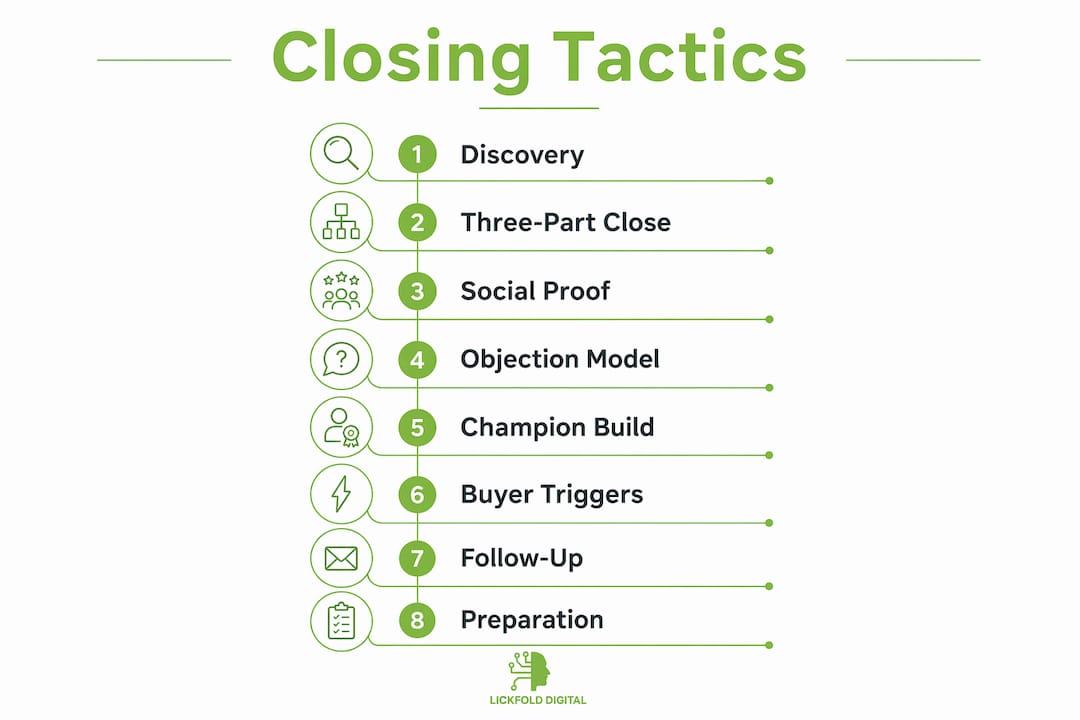
8 proven tactics for closing B2B service deals
1. Treat discovery as the entire process, not a call stage
Reps who spend a significant portion of call time on discovery increase close rates compared to those who rush to pitch. The reason is simple: discovery surfaces the cost of inaction, clarifies the decision process, and builds the emotional connection that makes a yes feel obvious. Stop treating discovery as a checklist you complete before the demo. Run it through every stage.
2. Use the three-part closing sequence
Most reps ask for the sale once. Top performers use a structured sequence: an assumptive close (“Based on everything we’ve discussed, when would you like to get started?”), a trial close if there’s resistance (“What questions do you have about moving forward?”), and a direct close (“I’ve addressed your concerns. Are you ready to move forward today?”). Analysis of a large number of sales calls shows reps using this approach achieve notably higher win rates compared to average reps.

3. Deploy social proof at the right moment
Timing matters more than the proof itself. Incorrect timing of social proof negatively affects a substantial portion of deals. Use industry references during discovery to establish credibility, case studies after objections to provide evidence, and final validation stories right before the close. A story about a similar company that saw measurable results in 90 days lands very differently at the close than it does in the first five minutes of a call.
4. Handle objections with the acknowledge-clarify-address-confirm model
Price objections are almost never about price. They’re about perceived risk or unclear value. The acknowledge-clarify-address-confirm framework effectively resolves most initial resistance by reframing the conversation around the cost of inaction rather than the cost of your solution. When someone says “it’s too expensive,” pause, ask what they’re comparing it to, then quantify what the problem is costing them monthly. The math usually does the rest.
5. Build and enable your internal champion
Deals stall due to lack of internal champion enablement, not product fit. Equipping your champion with a one-page decision brief, an internal FAQ, and a risk mitigation plan can significantly improve final-stage win rates. Your champion is doing the real selling. Your job is to make that as easy as possible for them.
6. Create urgency through buyer-owned triggers
Artificial urgency often backfires and should be avoided. Real urgency comes from connecting the deal to something the buyer already owns: a fiscal deadline, a product launch, a board commitment. Ask your champion, “If this doesn’t get done this quarter, what would that be about?” That question surfaces blockers and creates a shared timeline that makes the close feel inevitable rather than pressured.
7. Follow up with discipline and purpose
Most deals don’t close on the pitch. A structured follow-up sequence that recaps the meeting on day one, shares a relevant case study on day three, provides useful content on day seven, and makes a direct call on day fourteen keeps momentum alive between conversations. Consistent outreach is what separates a closed deal from a lost one when the buyer goes quiet.

8. Prepare specifically for every meeting
Before the closing call, write out who needs to say yes, what their main concerns are, your response to each concern, and the specific ask you’ll make at the end. Reps who improvise under pressure default to pitching features. Reps who prepare specifically ask better questions, handle objections more cleanly, and ask for the business with confidence.
The table below maps each tactic to its primary impact area and the pipeline stage where it matters most.
| Tactic | Primary impact | Best pipeline stage |
|---|---|---|
| Continuous discovery | Value clarity, urgency | All stages |
| Three-part closing sequence | Win rate | Final close |
| Timed social proof | Objection resolution | Post-objection, final close |
| Acknowledge-clarify-address-confirm | Objection handling | Mid-cycle, final close |
| Champion enablement | Internal selling | Proposal through close |
| Buyer-owned urgency | Deal momentum | Late cycle |
| Disciplined follow-up | Deal retention | Post-meeting |
| Pre-call preparation | Execution quality | Every meeting |
Why B2B deals stall and how to fix each one
Most deal stalls are diagnosable. They fall into a handful of patterns, and each has a specific fix.
- Ignoring stakeholder complexity. Single-threaded deals are fragile. If your champion leaves or loses internal credibility, the deal dies with them. Map the committee early and build at least two or three meaningful relationships before the evaluation is complete.
- Rushing discovery. Reps who treat discovery as a stage rather than a process miss unstated concerns that surface later as fatal objections. Keep asking questions through the demo and proposal phases.
- Using artificial urgency. “This offer expires Friday” destroys trust. Connect urgency to the buyer’s own calendar and business priorities instead.
- Neglecting systematic follow-up. Sporadic check-ins signal low commitment. A structured follow-up sequence with specific value at each touchpoint keeps you present without being annoying.
- Mismanaging handoff gaps. Deals stall when context gets lost between marketing, sales, and customer success. Defined exit criteria for each pipeline stage and documented handoffs prevent this. The sales opportunity handoff process deserves as much attention as the close itself.
- Skipping champion enablement. Sending a proposal and waiting is not a strategy. Your champion needs materials they can use in conversations you’ll never be part of: an ROI model, a risk mitigation plan, answers to the questions their CFO will ask.
The pattern across all of these is the same: deals break when process discipline breaks. The fix is almost always upstream, not at the close.
How to build a pipeline that closes B2B deals at scale
Consistent results come from consistent process. The teams that hit quota every quarter aren’t necessarily the ones with the best individual reps. They’re the ones with the best-defined stages, the clearest exit criteria, and the metrics that tell them where deals are breaking before it shows up in the revenue numbers.
Define exit criteria for every stage. “Prospect expressed interest” is not a stage definition. “Prospect confirmed budget, authority, and timeline in discovery call” is. Without objective criteria, reps guess when to advance deals, pipelines fill with wishful thinking, and forecasts become unreliable.
Track leading indicators, not just close rates. Firms that monitor discovery completion rate, objection resolution rate, and next-step commitment rate improve close rates by over 30% faster than those tracking only final outcomes. These metrics tell you where the process is breaking while you still have time to fix it. AI-driven pipeline predictability tools make this kind of tracking practical at scale.
Manage the handoff gap. The space between marketing, sales, and customer success is where deals quietly die. Document customer goals before the deal closes, automate handoff notifications to legal and finance, and make sure customer success has full context from day one. A poor handoff leads to confusion, unmet expectations, and early churn.
Pro Tip: Before every pipeline review, ask: does the buyer clearly recognize the problem in their own words? Have you reduced the risk enough that moving forward feels safe? Any “no” tells you exactly where the next conversation needs to focus.
Review and refine quarterly. Small, iterative process changes produce more consistent improvements than big overhauls. Track whether each adjustment moves the metrics you care about before making it permanent. The teams that close B2B service deals consistently aren’t running the same playbook they built three years ago. They’re running a process they’ve refined based on what the data actually shows.
Key Takeaways
Closing B2B service deals consistently requires process discipline across every stage, not a better closing line at the final call.
| Point | Details |
|---|---|
| Multi-thread early | Decision committees average 6.8 stakeholders; map them and build relationships before the evaluation ends. |
| Run discovery through every stage | Reps spending 40–60% of call time on discovery increase close rates by 34%. |
| Use the three-part closing sequence | Win rates exceed 30% for reps using the assumptive-trial-direct sequence, versus 12–18% for average reps. |
| Enable your champion | Providing a decision brief and internal FAQ can lift final-stage win rates from below 50% to over 80%. |
| Track leading indicators | Monitoring discovery completion, objection resolution, and next-step commitment rates improves close rates by over 30%. |
Lickfold fills your pipeline before the close process begins
Every tactic in this guide assumes one thing: you have qualified prospects in your pipeline to begin with. That’s where most B2B service teams hit a wall. The process is sound, the reps are skilled, but the top of the funnel is thin.
Lickfold deploys AI agents that identify decision-makers matching your ideal customer profile, execute personalized multi-touch outreach campaigns, and hand off human-qualified opportunities directly to your sales team. No generic templates. No cold lists. Just a steady flow of warm, relevant conversations for your reps to close.
If your team is ready to close more deals, the first step is having more of the right ones to work. Start that conversation with Lickfold today.