
Cross-Border B2B Selling: Your 2026 Strategy Guide
Cross-Border B2B Selling: Your 2026 Strategy Guide
TL;DR:
- Cross-border B2B selling involves conducting international sales with business buyers, requiring compliance and multi-currency payments. Successful expansion depends on validating demand, localizing pricing, automating compliance, and leveraging AI-driven pipeline tools. Building robust payment, compliance, and data systems before hiring is essential for sustainable global growth.
Cross-border B2B selling is defined as the process of companies conducting sales transactions with business buyers in other countries, requiring specialized infrastructure for compliance, multi-currency payments, and supply chain coordination. The industry term for this practice is international B2B trade, and the scale is striking. Global cross-border B2B spending is projected to grow from nearly $195 trillion in 2024 to $320 trillion by 2032. That trajectory makes international expansion one of the highest-leverage moves a B2B company can make right now. Tools like Avalara, Shopify B2B, and Stripe have lowered the barrier to entry, but the operational complexity remains real and underestimated by most teams.
What is cross-border B2B selling and how does it differ from domestic sales?
Cross-border B2B selling differs from domestic sales in three concrete ways: longer sales cycles, layered regulatory requirements, and payment infrastructure that spans multiple jurisdictions. A domestic deal might close in weeks. An international deal involving a buyer in Germany, a seller in the United States, and a logistics partner in Singapore can take months to finalize due to compliance checks alone.

The financial scale separating B2B from B2C cross-border trade is also significant. The B2B cross-border payments market is expected to reach $50 trillion by 2032, up from $31.6 trillion in 2024. That growth reflects corporate procurement shifting online and buyers expecting the same digital experience they get in consumer markets.
Unlike B2C, B2B transactions typically involve negotiated pricing, purchase orders, net payment terms, and multi-stakeholder approval chains. Each of those elements adds friction when you cross a border. The companies that succeed internationally treat this friction as a solvable engineering problem, not a reason to stay domestic.
What are the key operational and financial complexities in cross-border B2B selling?
Cross-border B2B trade carries a distinct set of operational burdens that domestic sales teams rarely encounter. Understanding them before you expand prevents costly surprises.
Financial complexities include:
- Multi-currency accounts and real-time FX rate management
- Payment method preferences that vary by region (wire transfers dominate in Europe, while ACH and local rails are preferred in North America)
- Settlement delays caused by correspondent banking chains
- Hidden fees from currency conversion and intermediary banks
Regulatory and compliance challenges include:
- Tariffs and import/export duties that change with trade policy
- Value-added tax (VAT) and goods and services tax (GST) obligations in buyer countries
- Export control regulations that restrict certain products or technologies
- Data privacy laws like GDPR in the European Union
Automation tools like Avalara and Vertex help companies manage tariffs, import/export regulations, and tax compliance to avoid fines and shipment delays. Both platforms integrate directly with ERP and CRM systems, which means compliance checks happen inside your existing workflow rather than as a separate manual step.
Supply chain coordination adds another layer. Platforms like E2open connect procurement, logistics, and supplier data across regions, giving operations teams visibility into where inventory is and what customs clearance looks like in real time. Without that visibility, cross-border orders stall at the border and damage buyer trust.
Pro Tip: When choosing a payment platform for cross-border B2B, prioritize providers that offer local collection accounts in your target markets. This bypasses correspondent banking fees and cuts settlement time from days to hours.
How do digital platforms and technology enable successful cross-border B2B selling?
Digital platforms are the infrastructure layer that makes B2B e-commerce internationally viable at scale. Without them, the compliance, payment, and logistics complexity described above would require a dedicated team in every market.
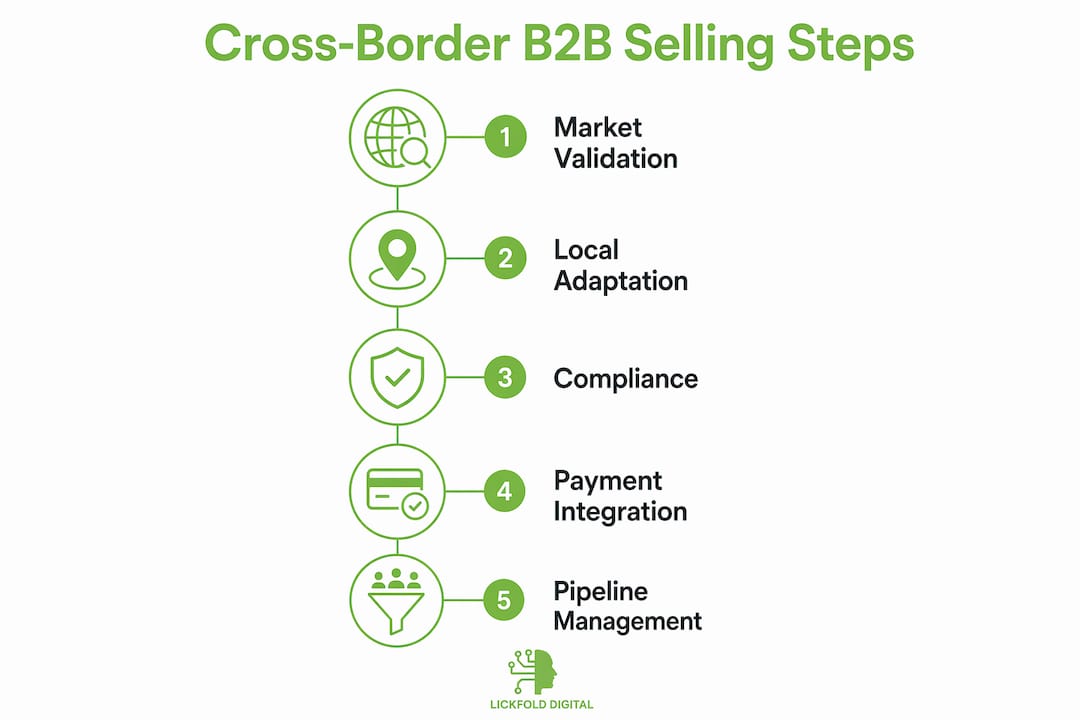
Platforms like Alibaba, Amazon Business, and Shopify B2B enable companies to reach international buyers with integrated tools for listings, payments, and logistics. Shopify B2B specifically offers customizable catalogs, country-specific pricing, and localized payment methods built into a single dashboard. Amazon Business gives sellers access to procurement teams at enterprises already buying on the platform. Alibaba connects manufacturers and distributors with buyers across Asia, the Middle East, and Africa through a vetted supplier ecosystem.
| Platform | Primary use case | Cross-border B2B features |
|---|---|---|
| Alibaba | Manufacturer-to-buyer sourcing | Verified supplier badges, trade assurance, multi-currency checkout |
| Amazon Business | Enterprise procurement | Purchase order support, quantity pricing, tax-exempt purchasing |
| Shopify B2B | Direct seller storefronts | Country-specific catalogs, net payment terms, localized pricing |
| Global Sources | Asia-Pacific sourcing | Verified supplier audits, trade show integration, RFQ tools |
| PayPal Commerce | Payment processing | Multi-currency payouts, buyer protection, 200+ market coverage |
Beyond marketplaces, AI-powered sales tools are changing how teams manage pipeline visibility across borders. When your sales team operates across five time zones and three languages, a human manager cannot monitor every deal in real time. AI tools built for pipeline predictability in B2B sales fill that gap by flagging stalled deals, scoring prospects by buying intent, and surfacing the next best action for each rep.
The integration between ERP, CRM, and payment systems is what ties all of this together. A buyer in Japan placing a purchase order should trigger automatic credit checks, tax calculations, inventory allocation, and payment routing without manual intervention. Companies that build this integration early scale faster and with fewer errors than those who bolt it on later.
What strategic approaches should companies take when expanding into international B2B markets?
Successful international B2B sales expansion follows a phased, evidence-based sequence. Companies that skip validation and go straight to full market launches consistently overspend and underperform.
-
Run a market validation sprint. Companies should conduct market validation sprints of 30–45 days to test messaging, channel fit, and buying intent before committing to local operations. This means running targeted outbound campaigns in the target market, measuring reply rates and meeting conversion, and deciding whether demand justifies investment.
-
Sequence your regional expansion. Start with markets that share language, legal frameworks, or existing trade relationships with your home market. A U.S. company typically finds Canada, the United Kingdom, and Australia easier first moves than Southeast Asia or the Middle East.
-
Hire at least two local representatives before declaring a market open. Sales leaders recommend a minimum of two local reps per market, paired with marketing support and AI tools for real-time visibility. One rep creates a single point of failure. Two creates a feedback loop and a competitive dynamic.
-
Adapt pricing to cultural context. Research from the American Marketing Association shows communal cultures react more sensitively to price increases than individualist ones. Applying a uniform global price list ignores this dynamic and costs revenue. Localized pricing models, even simple ones, outperform one-size-fits-all approaches.
-
Align sales and marketing around localized content. Messaging that converts in Chicago rarely converts in Seoul without adaptation. Translate not just language but context: case studies, references, and proof points should reflect the buyer’s industry and region.
Pro Tip: Balance local adaptation with global standardization by localizing your value proposition and pricing while keeping your sales process, CRM structure, and reporting metrics consistent across all markets. This gives regional teams autonomy without creating data silos.
How can companies overcome cross-border payment and operational friction?
Payment friction is the most underestimated barrier in international B2B sales. Most companies discover the problem only after a deal closes and the money takes two weeks to arrive.
Traditional correspondent banking can force payments through 3–5 intermediaries in different time zones, causing delays, opaque FX rates, and lost transaction data. Each intermediary adds a fee and a potential point of failure. A payment sent from a buyer in Brazil to a seller in Germany might touch banks in New York and London before arriving, with each leg adding cost and time.
Modern fintech solutions solve this by using local collection accounts and payout networks in each market. Instead of routing money through a chain of correspondent banks, the payment enters the local banking system in the buyer’s country and exits through a local account in the seller’s country. The result is faster settlement, lower fees, and full transaction transparency.
Steps to implement efficient payment and operational workflows:
- Open local currency accounts in your top three target markets before launching sales there
- Use a payment provider that supports real-time payment rails where available (nearly 80 countries have adopted real-time payment networks as of 2026)
- Automate tax calculation and invoice generation at the point of sale using Avalara or Vertex
- Connect your payment platform to your ERP so cash flow data updates in real time
- Establish clear payment terms in buyer contracts that account for local banking holidays and settlement windows
Operational friction beyond payments includes customs documentation, product classification codes, and certificate of origin requirements. Automating these through a trade compliance platform prevents shipment holds that damage buyer relationships and delay revenue recognition.
Key Takeaways
Cross-border B2B selling requires validated demand, localized pricing, compliant payment infrastructure, and AI-powered pipeline visibility to succeed at scale across international markets.
| Point | Details |
|---|---|
| Define the market before entering | Run 30–45 day validation sprints to confirm demand before committing resources to a new country. |
| Localize pricing by culture | Communal cultures react more to price changes; uniform global pricing loses revenue in sensitive markets. |
| Fix payment infrastructure first | Use local collection accounts and real-time rails to cut settlement time and eliminate correspondent banking fees. |
| Use AI for cross-border pipeline visibility | AI tools flag stalled deals and score prospects across time zones where human managers cannot monitor in real time. |
| Automate compliance from day one | Tools like Avalara and Vertex integrate with ERP systems to handle tariffs, VAT, and export controls automatically. |
What I’ve learned from watching companies expand internationally
Most companies treat international expansion as a sales problem. It is actually an infrastructure problem with a sales component. The teams that succeed internationally build their payment, compliance, and data systems before they hire their first overseas rep. The teams that fail do it in reverse.
The cultural pricing insight from the American Marketing Association research is one I see ignored constantly. Companies spend months localizing their website copy and then apply a single global price list. That contradiction undermines the entire localization effort. Pricing is part of the message.
AI-powered outbound prospecting tools have changed what is possible for lean teams entering new markets. A two-person team with the right AI infrastructure can run the outbound volume of a ten-person team, which makes the 30–45 day validation sprint genuinely affordable. You no longer need to hire locally to test a market. You test first, then hire.
The companies I respect most in this space treat every new market as a hypothesis. They define what success looks like at 45 days, measure it honestly, and either commit or move on. That discipline is rare, and it is the single biggest predictor of whether international expansion creates value or destroys it.
— Duarte
How Lickfold helps B2B teams build international pipelines
Expanding into new markets without a reliable pipeline is the fastest way to burn budget and lose confidence in the strategy. Lickfold builds AI-driven outbound systems that identify decision-makers in your target markets, run personalized multi-touch outreach campaigns, and deliver qualified opportunities directly to your sales team.
Lickfold’s AI agents conduct market research, locate relevant buyers, and execute outreach across regions and time zones continuously. The system handles email infrastructure, warm-up, and reputation management so your team focuses on closing, not prospecting. If you are planning a cross-border expansion and need a predictable pipeline before you commit to local hires, reach out to Lickfold to discuss what an AI-powered outbound system looks like for your target markets.
FAQ
What is cross-border B2B selling?
Cross-border B2B selling is the process of companies selling products or services to business buyers in other countries, requiring compliance with international trade regulations, multi-currency payment systems, and cross-border logistics coordination.
How large is the cross-border B2B market?
The global B2B cross-border payments market is expected to reach $50 trillion by 2032, up from $31.6 trillion in 2024, reflecting rapid growth in international digital commerce.
What are the biggest challenges in cross-border B2B selling?
The three biggest challenges are payment friction from correspondent banking chains, tax and regulatory compliance across multiple jurisdictions, and cultural differences that affect pricing tolerance and negotiation style.
Which platforms support B2B e-commerce internationally?
Alibaba, Amazon Business, Shopify B2B, and Global Sources each offer integrated tools for international listings, localized pricing, and cross-border payment processing suited to B2B buyers.
How do companies validate a new international market before expanding?
Companies should run 30–45 day market validation sprints using targeted outbound campaigns to test messaging, channel fit, and buying intent before committing to local hires or full market operations.