
What Is Sales Opportunity Handoff: 2026 Guide
What Is Sales Opportunity Handoff: 2026 Guide
TL;DR:
- A sales opportunity handoff is a formal process that transfers ownership of qualified leads or customers to maintain deal momentum and customer relationships. Implementing standardized procedures, complete documentation, and enforced SLAs significantly improve conversion rates and customer experiences. High-quality handoffs reduce deal stalls, enhance forecast accuracy, and build a scalable sales pipeline across teams.
A sales opportunity handoff is the structured transfer of ownership of a qualified lead or customer from one sales team to another, designed to preserve deal momentum and protect the buyer relationship. Without a formal process, deals stall, customers feel abandoned, and revenue leaks between teams. The three most common transitions are marketing to sales, Sales Development Representative (SDR) to Account Executive (AE), and AE to Customer Success (CS). Each requires distinct trigger criteria, documentation, and communication protocols. This guide breaks down every stage, the components that make transfers work, and the exact practices that separate high-converting teams from those that lose deals at the finish line.
What is a sales opportunity handoff and why does it matter?
A sales opportunity handoff is defined as the formal process of transferring a qualified sales opportunity between revenue teams at a defined stage in the buyer journey. The word “formal” carries real weight here. Informal handoffs, where an SDR sends a Slack message to an AE and considers the job done, are the single most common cause of deal stagnation in B2B sales organizations.

To define a sales opportunity correctly, you need to separate it from a contact or a lead. Confusing a contact with a sales opportunity produces inaccurate forecasts and misallocates AE time. A true sales opportunity has verified deal intent, documented pain points, and a credible path to purchase. That distinction determines whether a handoff is even warranted.
The importance of sales handoff processes compounds as organizations scale. A two-person sales team can manage transitions through conversation. A team of 20 cannot. When the process lives in people’s heads rather than in a CRM, every departure or promotion creates a knowledge gap that costs pipeline.
What are the key stages and types of sales opportunity handoff?
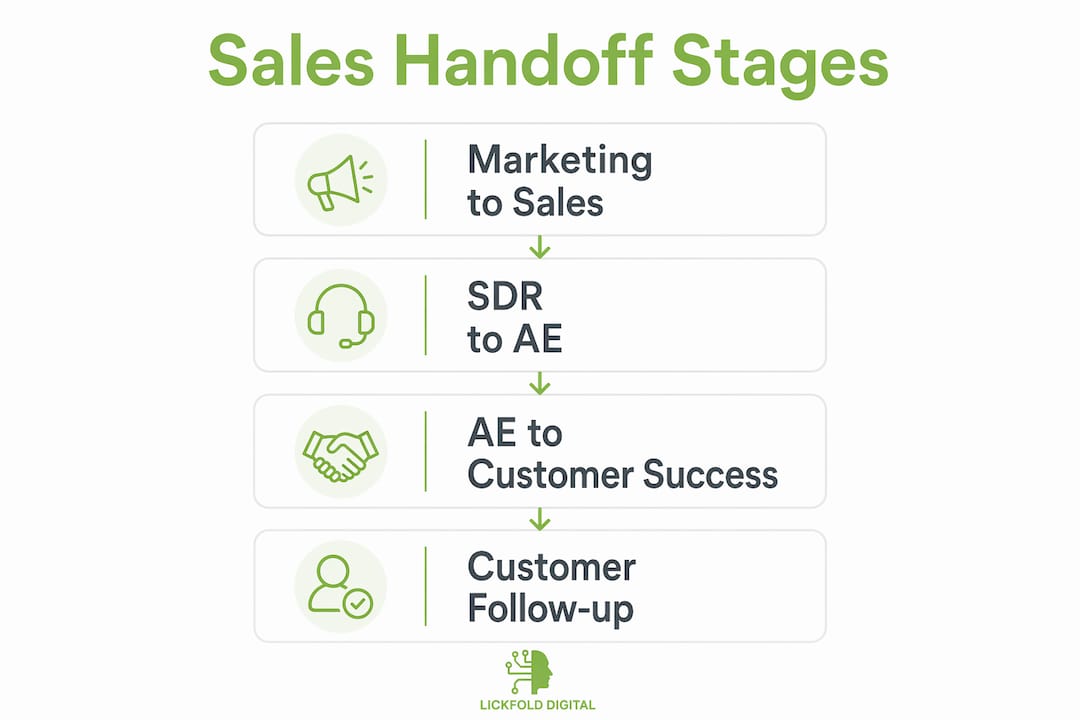
Three distinct handoff types govern most B2B sales cycles. Each has different inputs, outputs, and timing requirements.
Marketing to sales: the MQL to SQL transition
The marketing-to-sales handoff transfers a Marketing Qualified Lead (MQL) to the SDR team once a lead meets predefined engagement thresholds. These thresholds typically include content downloads, demo requests, or intent signals from platforms like G2 or Bombora. The handoff record at this stage should capture lead source, engagement history, company firmographics, and the specific trigger that qualified the lead.
SDR to AE: the core opportunity transfer
The SDR-to-AE handoff is where most revenue is won or lost. Predefined trigger criteria for this transfer include calendar invite confirmation, Ideal Customer Profile (ICP) validation, and qualification scores from frameworks like MEDDIC or BANT. Service Level Agreements (SLAs) enforce a time-based AE follow-up after the handoff to keep leads from going cold. Top-performing teams convert 59% of Sales Qualified Leads into actual opportunities by enforcing these qualification standards consistently.
AE to Customer Success: the post-sale transition
The AE-to-CS handoff begins at contract signature and determines whether the customer experiences a relationship continuation or a frustrating restart. Best practice for this transition involves a multi-step sequence: a completed handoff document, an internal alignment call within 24 hours, a warm introduction email, and a kickoff call led by the Customer Success Manager. The 24-hour window matters because deal context degrades quickly after close.
The table below compares the three handoff types across key dimensions:
| Handoff type | Trigger criteria | Key documentation | SLA window |
|---|---|---|---|
| Marketing to Sales | MQL score, intent signal | Lead source, engagement history | 4 hours to SDR contact |
| SDR to AE | ICP match, calendar confirmed | Qualification notes, MEDDIC fields | 24 hours to AE outreach |
| AE to Customer Success | Contract signed | Deal summary, commitments, red flags | 24 hours to internal call |
Key documentation requirements across all three types include:
- Company and contact details with verified decision-maker names
- Pain points and business objectives discussed during discovery
- Commitments made during the sales process
- Known risks or red flags the receiving team must address
- Agreed next steps with dates and owners
What components make a successful sales handoff process?
A written, standardized handoff process is the foundation of every effective sales transition strategy. Without it, ownership gaps emerge as organizations scale, and teams blame individuals for structural failures. The fix is treating the handoff as a system with measurable inputs and outputs, not as a courtesy conversation.
The core components of a high-quality handoff record include:
- Trigger criteria: The specific conditions that must be met before a handoff is initiated. These prevent premature transfers that waste AE time on unqualified leads.
- Handoff document fields: Company name, deal size, key stakeholders, pain points, objections raised, commitments made, and red flags. Every field should be mandatory, not optional.
- SLA definitions: Time limits for each action after the handoff. If an AE must follow up within 24 hours, that expectation must be written into the process and tracked in the CRM.
- Warm introduction email: Sent by the outgoing rep to the customer, naming the new owner, referencing specific conversations, and setting clear next steps. Customized introduction emails improve customer confidence and reduce the perception of being passed off to a stranger.
- Internal alignment call: A focused meeting between the outgoing and incoming rep. Limit this call to 15 to 45 minutes and structure it around four pillars: why the customer bought, commitments made, stakeholder details, and known red flags.
- Feedback loops: Scheduled reviews where receiving teams report back on lead quality, documentation completeness, and SLA adherence. This data improves the process over time.
Pro Tip: Complete the handoff document before the internal alignment call, not during it. When reps fill in fields live on the call, the meeting becomes a data entry session instead of a strategic conversation about how to win or retain the account.
Building a high-performing sales pipeline depends on this kind of process discipline at every transition point. The handoff document is not paperwork. It is the institutional memory of the deal.
How do sales handoffs impact conversion rates and customer experience?
The business case for investing in sales transition strategies is direct. Top teams convert 59% of Sales Qualified Leads into opportunities when they enforce proper qualification and handoff standards. Teams without formal processes typically see conversion rates well below that benchmark, with the gap widening as deal complexity increases.
Customer experience takes an equally measurable hit when handoffs fail. The most damaging failure mode is the “cold restart,” where a new rep contacts the customer with no knowledge of prior conversations. The customer repeats their situation from scratch, trust erodes, and the deal often stalls or dies. Effective AE-to-CS handoffs are specifically designed to prevent this by ensuring the customer feels a relationship continuation, not a department transfer.
Three failure patterns account for most handoff breakdowns:
- Ownership gaps: No one knows who is responsible for the next action after the transfer.
- Incomplete documentation: The receiving rep lacks the context needed to continue the conversation intelligently.
- Missed SLAs: Leads go cold because follow-up windows are not enforced.
Handoff quality also directly affects sales forecasting accuracy. When AEs inherit poorly qualified leads, they inflate pipeline with deals that will never close. Distinguishing contacts from qualified opportunities is the first step toward a forecast you can actually trust. A pipeline full of real opportunities, each with a documented handoff, gives leadership a reliable view of revenue.
What are common challenges in managing handoffs and how to solve them?
The most persistent challenge in sales opportunity management is the informal handoff. Verbal transfers feel efficient in the moment but create accountability vacuums. When a deal stalls two weeks later, no one can reconstruct what was agreed or who was responsible. The solution is a non-negotiable rule: no handoff without a completed document in the CRM.
Misaligned qualification criteria between marketing, SDR, and AE teams generate a second category of problems. If marketing defines an MQL by email opens while the SDR team qualifies by ICP fit and budget confirmation, the two teams will constantly argue about lead quality rather than closing deals. Quarterly alignment sessions where all three teams review and agree on qualification definitions prevent this drift.
Missed SLAs are the third major failure point. An SLA without enforcement is just a suggestion. CRM automation can flag overdue handoffs and escalate to managers automatically, removing the need for manual oversight. Tools like Salesforce, HubSpot, and Pipedrive all support workflow rules that trigger alerts when a handoff stage exceeds its time limit.
Pro Tip: Link handoff SLA compliance to rep performance metrics and compensation reviews. When reps understand that missed handoff windows affect their numbers, adherence improves without requiring constant management intervention.
Team buy-in is the final barrier. Reps who view handoff documentation as administrative overhead will cut corners under quota pressure. Framing the handoff record as a tool that protects their commission, by ensuring the receiving team does not lose the deal they worked to close, changes the incentive structure. Connecting strategic follow-up practices to handoff quality reinforces this message with data.
How to implement and scale a sales handoff system
Building a scalable handoff system requires a structured rollout, not a policy memo. Follow these steps to move from ad hoc transfers to a repeatable process:
- Audit recent handoffs: Pull the last 20 to 30 deals and map what actually happened at each transition point. Identify where documentation was missing, where SLAs were missed, and where deals stalled after transfer.
- Define input and output criteria: For each handoff type, specify exactly what must be true before a transfer is initiated and what the receiving team must receive. Write these as checklists, not paragraphs.
- Build the handoff record template: Create a CRM template with mandatory fields for each handoff type. Make free-form notes a supplement, not the primary record.
- Train teams on SLAs and expectations: Run a joint session with all teams involved in each handoff type. Walk through the template, the SLA windows, and the escalation path for missed deadlines.
- Configure CRM automation: Set up workflow rules to notify receiving reps when a handoff is initiated, flag overdue actions, and generate reports on SLA compliance by rep and team.
- Schedule quarterly reviews: Treat the handoff process as a living system. Review SLA data, collect feedback from receiving teams on documentation quality, and update criteria as your ICP or sales motion evolves.
The audit in step one consistently reveals the same finding: most handoff failures are structural, not personal. Once teams see the data, resistance to process change drops significantly.
Key takeaways
A structured sales opportunity handoff is the single most controllable lever for improving conversion rates and customer retention between revenue teams.
| Point | Details |
|---|---|
| Define before you transfer | A true sales opportunity requires verified intent, pain points, and a path to purchase before any handoff is initiated. |
| Three handoff types, three workflows | Marketing to Sales, SDR to AE, and AE to CS each require distinct trigger criteria, documentation, and SLA windows. |
| Documentation drives outcomes | Completing the handoff record before internal calls keeps meetings focused on strategy, not data entry. |
| SLAs need enforcement | CRM automation in tools like Salesforce and HubSpot turns SLA windows from guidelines into accountable deadlines. |
| Conversion rates reflect process quality | Top teams convert 59% of Sales Qualified Leads into opportunities by enforcing consistent qualification and handoff standards. |
Why I think most teams are solving the wrong handoff problem
After working with dozens of B2B sales organizations, the pattern I see most often is this: teams invest heavily in fixing the handoff meeting while ignoring the handoff document. They run training sessions on how to run a better internal call, but the CRM record the call is supposed to be based on is still a mess of free-form notes and half-filled fields.
The meeting is not the problem. The meeting is a symptom. When the document is incomplete, the call becomes a reconstruction exercise. The AE or CS rep spends 30 minutes extracting information that should have been captured weeks earlier, and the customer-facing follow-up gets delayed as a result.
The organizations that get this right treat the handoff record as a first-class deliverable, with the same rigor they apply to a proposal or a contract. They audit it before the call, not during it. They measure its completeness as a team metric, not an individual one. And they update it after onboarding to reflect what actually happened, creating a living record that improves every future handoff.
The other thing I have observed is that handoff quality is a leading indicator of forecast accuracy. When I see a pipeline full of opportunities with thin handoff documentation, I know the forecast is going to miss. The two are directly connected. Fix the handoff process, and the forecast becomes something leadership can actually rely on.
— Duarte
How Lickfold can strengthen your sales handoff pipeline
The handoff process only works when the opportunities entering it are genuinely qualified. Lickfold builds the front end of that system for B2B companies. Using AI agents, Lickfold identifies decision-makers within your ideal customer profile, executes personalized multi-touch outreach campaigns, and qualifies replies before passing warm opportunities to your sales team. Every lead that reaches your SDR or AE arrives with documented context, verified intent, and a clear next step. That is the input quality your handoff process needs to perform at the conversion rates this guide describes. To see how Lickfold fits your sales motion, visit Lickfold Digital or reach out directly to start a conversation.
FAQ
What is a sales opportunity handoff?
A sales opportunity handoff is the structured transfer of ownership of a qualified lead or customer between revenue teams, such as SDR to AE or AE to Customer Success, at a defined stage in the sales cycle. The process includes trigger criteria, a completed handoff document, SLA-bound follow-up actions, and a warm introduction to the customer.
Why do sales handoffs fail?
Most handoffs fail because of incomplete documentation, missed SLA windows, or misaligned qualification criteria between teams. Verbal or informal transfers create accountability gaps that cause deals to stall and customers to feel neglected.
What should a handoff document include?
A handoff document should include the company and contact details, verified pain points, commitments made during the sales process, known risks or red flags, and agreed next steps with owners and dates. All fields should be mandatory in the CRM, not optional.
How long should an internal handoff call take?
Internal handoff calls should run 15 to 45 minutes and focus on four pillars: why the customer bought, commitments made, key stakeholder information, and red flags. The handoff document should be completed before the call so the meeting focuses on strategy rather than data collection.
How do handoffs affect sales forecasting?
Poor handoff quality inflates pipeline with unqualified or poorly documented opportunities, making forecasts unreliable. Teams that enforce clear qualification criteria and complete handoff records consistently produce more accurate revenue forecasts because each opportunity in the pipeline has verified intent and documented context.