
Step-by-step guide to building high-performing sales pipelines
Step-by-step guide to building high-performing sales pipelines
TL;DR:
- Clear, calibrated pipeline stages improve forecast accuracy and prevent deal stagnation.
- AI tools enhance prospecting, automate research, and increase sales team quota achievement.
- Data quality and regular pipeline reviews are essential for sustained sales success.
Many B2B sales teams generate a steady stream of leads yet consistently fall short on revenue. The bottleneck is rarely the top of the funnel. It’s the pipeline itself. Inefficient stage management, missing automation, and generic outreach quietly drain conversion rates and extend deal cycles. AI adoption rates in sales prospecting now range from 25% to 75% across platforms, cutting research time by up to 50% and measurably improving pipeline quality. In this guide, you’ll get a practical framework to structure your pipeline, choose the right tools, build it step by step, avoid common mistakes, and track what actually matters.
Table of Contents
- Understanding the sales pipeline stages
- Essential tools and AI technologies for building pipelines
- Step-by-step process for building and optimizing your pipeline
- Avoiding common pitfalls and measuring pipeline success
- What most sales pipeline ‘best practices’ miss
- Ready to transform your sales pipeline?
- Frequently asked questions
Key Takeaways
| Point | Details |
|---|---|
| Define clear pipeline stages | Standardized stages help you track and optimize every deal more effectively. |
| Leverage AI for efficiency | AI cuts research time in half and boosts your team’s quota attainment. |
| Keep data ‘AI-ready’ | Clean, unified data is crucial for taking full advantage of AI technologies. |
| Measure and adapt often | Frequent metric tracking ensures your pipeline stays on course and competitive. |
Understanding the sales pipeline stages
A well-defined pipeline is the backbone of predictable revenue. Without clear stages, deals drift, data goes stale, and forecasting becomes guesswork. The good news: you don’t have to invent your structure from scratch.
The HubSpot pipeline model outlines seven core stages: Lead Generation, Nurturing, Marketing Qualified Lead (MQL), Sales Accepted Lead (SAL), Sales Qualified Lead (SQL), Closed, and Post-Sales. Each stage represents a distinct handoff or commitment in the buyer journey. MQL means marketing believes the lead is worth pursuing. SAL means sales agrees and takes ownership. SQL means the lead is actively moving toward a deal.
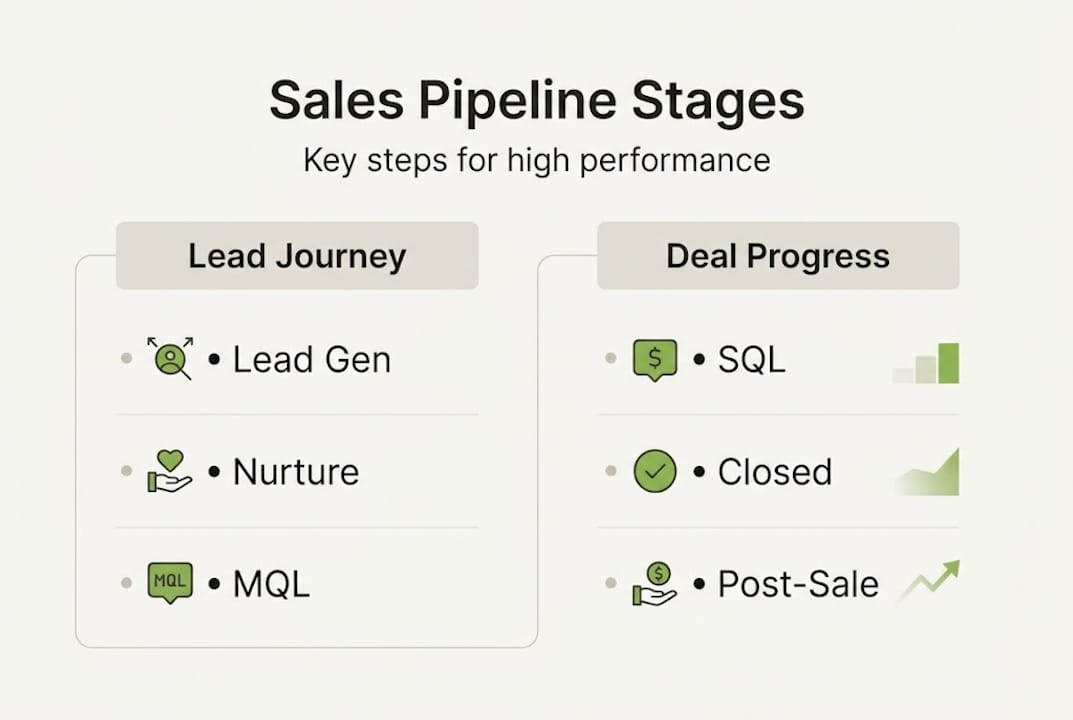
Where most mid-sized B2B teams go wrong is treating these labels as generic checkboxes rather than calibrated milestones. A stage should only advance when a specific, agreed-upon condition is met. Without that discipline, your CRM fills up with stale deals that inflate your pipeline and distort your win rate.
Customizing your stage names and entry criteria to match your actual sales motion isn’t cosmetic. It directly improves reporting accuracy and makes it far easier to spot where deals stall. This is also foundational to AI pipeline predictability, since AI tools can only learn from clean, consistently defined data.
Signs your pipeline stages need updating:
- Deals sit in the same stage for weeks without a clear next step
- Your team disagrees on what qualifies as an SQL
- Win rate looks healthy, but average deal size is shrinking
- Forecasts rarely match closed revenue
- Post-sales activity isn’t tracked as a growth lever
| Feature | Standard pipeline model | Advanced pipeline model |
|---|---|---|
| Stage definitions | Broad, generic | Role-specific, criteria-driven |
| MQL to SAL handoff | Manual, informal | Automated with scoring thresholds |
| Data quality | Depends on rep discipline | Enforced by CRM rules and AI |
| Reporting | Lagging indicators only | Real-time with predictive signals |
| Post-sales tracking | Often absent | Integrated for expansion revenue |
“A pipeline is only as useful as the clarity behind each stage. When everyone defines ‘qualified’ differently, no tool can save you.”
Start by auditing your current stages against actual deal behavior. Then rebuild with specific entry and exit criteria for each. That single improvement will make every other tactic in this guide more effective.
Essential tools and AI technologies for building pipelines
With a clear pipeline structure in mind, the next step is choosing the right technologies to support it. The market is full of options, and it’s easy to over-invest in tools that duplicate each other or don’t connect cleanly.
Think in three categories: CRM (your system of record), sales enablement (content, sequencing, and training), and AI prospecting (identification, research, and outreach automation). Each category solves a different problem. A CRM without AI prospecting leaves your reps doing manual research. AI prospecting without a solid CRM creates data chaos.
AI adoption rates in prospecting now reduce research time by up to 50%, meaning your team can focus on conversations instead of data gathering. That shift alone changes the economics of outbound sales.
| Tool type | Core purpose | Key AI features |
|---|---|---|
| CRM | Track deals, contacts, pipeline stages | Predictive lead scoring, deal health alerts |
| Sales engagement | Automate sequences, track opens and replies | AI-generated follow-up suggestions |
| AI prospecting | Identify and engage decision-makers | ICP matching, personalized message generation |
| Data enrichment | Keep contact records accurate | Auto-update firmographics and intent signals |
| Analytics | Measure pipeline performance | Revenue forecasting, conversion modeling |
Criteria for selecting pipeline tools:
- Native integration with your existing CRM
- Support for custom pipeline stage logic
- AI features that operate on your data, not generic models
- Transparent data sourcing and compliance documentation
- Scalability without per-seat costs that erode ROI
For teams evaluating their infrastructure, AI sales workflow tools purpose-built for B2B pipelines offer a practical starting point. On the hardware side, if your team is running local AI models or large datasets, AI-ready computers can make a meaningful difference in processing speed and reliability.
Pro Tip: Before you onboard any AI tool, audit your CRM data first. Remove duplicates, standardize field formats, and fill critical gaps like company size and industry. AI amplifies what’s already in your data. Dirty data means bad outputs, no matter how sophisticated the tool.
Step-by-step process for building and optimizing your pipeline
Armed with the right tools, it’s time to build a pipeline that’s ready for today’s market and tomorrow’s. The process below is designed for mid-sized B2B teams that want structure without bureaucracy.
- Define your ICP and segment your market. Start with your ideal customer profile (ICP). Be specific: industry, company size, tech stack, buying signals, and decision-maker titles. Segmentation at this stage determines the quality of every lead downstream.
- Map and document each pipeline stage. Assign clear entry criteria, exit criteria, and ownership for every stage. Write it down and get alignment across marketing and sales before configuring anything in your CRM.
- Integrate your tool stack. Connect your CRM, sales engagement platform, and AI prospecting system. Ensure data flows in both directions so no activity is lost and no lead is double-contacted.
- Set baseline metrics. Before you change anything, document your current conversion rates, average deal velocity, and win rate by segment. You need a baseline to prove improvement.
- Automate outreach with personalization. Use AI to generate personalized first touches based on firmographic and behavioral data. Avoid generic templates. Prospecting tips for sales teams that drive results emphasize relevance over volume every time.
- Monitor, adjust, and iterate. Review pipeline health weekly. Flag deals that haven’t advanced in seven or more days. Use your AI tools to surface patterns in what’s working and what’s stalling.
For a deeper breakdown of the outreach component, AI prospecting steps built specifically for B2B sales in 2026 can help you operationalize each phase.
60% of B2B sales teams now use AI in their sales process, and those teams are 3.7x more likely to meet quota than teams relying on manual methods.
Pro Tip: Don’t try to overhaul everything at once. Pick one pipeline stage where deals stall most often and apply AI-driven improvements there first. Small, targeted wins build momentum and give you data to justify broader changes.

Avoiding common pitfalls and measuring pipeline success
Building a pipeline is just the start. Ongoing measurement and proactive troubleshooting are essential for lasting success. Most teams that invest in pipeline improvement plateau within six months because they stop diagnosing problems and start assuming the process is working.
Most common pipeline mistakes in B2B sales:
- Over-complicating stages so that reps can’t remember the criteria
- Letting deals sit without a defined next action or owner
- Using generic outreach templates that get ignored or flagged as spam
- Skipping the SAL step, which creates friction between marketing and sales
- Failing to track post-sales as a revenue expansion channel
- Ignoring data quality until it’s too late to fix cleanly
According to the research, data readiness is the single biggest constraint on AI adoption in sales pipelines. Teams that invest in clean, unified data before deploying AI see dramatically faster results than those who try to automate a broken data foundation.
Understanding why AI improves sales starts with recognizing that it multiplies whatever you already have. If your data is solid, AI makes your team more precise. If it’s messy, AI makes your problems worse faster.
| Metric | Manual tracking | AI-powered tracking |
|---|---|---|
| Conversion rate | Reported monthly, often inaccurate | Real-time, stage-level visibility |
| Pipeline velocity | Estimated by manager intuition | Calculated automatically per segment |
| Win rate | Aggregated, no context | Segmented by rep, ICP, and channel |
| AI adoption rate | Not tracked | Built-in usage analytics |
| Forecast accuracy | Plus or minus 20-30% | Within 5-10% with mature models |
Stat callout: Over 60% of teams using AI report measurably improved pipeline predictability, according to AI-driven sales trends research.
Set a quarterly rhythm for reviewing your pipeline metrics, not just your numbers but the reasons behind them. When velocity drops, investigate stage by stage. When win rate shifts, look at ICP match quality and outreach personalization before blaming market conditions.
What most sales pipeline ‘best practices’ miss
Here’s the uncomfortable truth: most pipeline advice is designed for the average team. Follow it precisely and you’ll get average results.
The leaders we see breaking quota consistently don’t treat their pipeline as a static process. They treat it as a living system that reflects what their buyers are actually doing right now, not what a framework from three years ago assumed they would do. Generic best practices tell you to define your stages and set your metrics. They rarely tell you to question whether those stages still match your buyer’s actual journey as markets shift.
AI gives you a significant edge here because it surfaces behavioral patterns at a scale no human team can match. But AI won’t tell you when your ICP has fundamentally changed, or when a competitor has shifted pricing in a way that changes how buyers evaluate you. That takes human listening. Use AI-driven prospecting tips to automate the research, then spend the time you save on deeper buyer conversations.
Pro Tip: Run a full pipeline review every quarter, not just annually. Markets shift fast in 2026. Quarterly reviews let you catch drift before it becomes a crisis and keep your pipeline logic aligned with how buyers are actually deciding.
Ready to transform your sales pipeline?
Turning insight into action is what sets high-performing teams apart. If you’ve followed this guide, you now have a clear view of how to structure your pipeline, select the right tools, automate without losing the personal touch, and measure what matters.
The teams generating predictable, scalable revenue in 2026 are the ones that combine disciplined pipeline architecture with AI-powered prospecting and genuine personalization. Lickfold Digital works with mid-sized B2B companies to build exactly that: automated outreach systems that identify decision-makers, personalize at scale, and hand your sales team qualified opportunities instead of raw leads. If you’re ready to stop chasing volume and start building a pipeline that converts, contact our team and let’s map out what an optimized system looks like for your market.
Frequently asked questions
What are the standard stages of a B2B sales pipeline?
The standard pipeline stages include Lead Generation, Nurturing, MQL, SAL, SQL, Closed, and Post-Sales. Each stage represents a specific buyer commitment or internal handoff point.
How does AI improve sales pipeline performance?
AI-enabled teams are 3.7x more likely to meet quota by automating research, improving lead scoring, and enabling faster, more personalized outreach at scale.
What is the biggest challenge to adopting AI in pipeline building?
Data readiness is the primary constraint. AI tools require clean, unified, consistently formatted data to produce reliable outputs and accurate predictions.
How should pipeline success be measured?
Track conversion rate, pipeline velocity, win rate, and AI adoption metrics by stage and segment. Review these quarterly to catch drift early and validate that your pipeline logic still matches buyer behavior.