
Unlock pipeline growth with effective sales targeting strategies
Unlock pipeline growth with effective sales targeting strategies
TL;DR:
- Misaligned sales and marketing efforts lead to wasted resources and lower revenue.
- Building a shared, precise ICP and implementing AI-driven targeting improves deal quality.
- Small, iterative changes and strong team alignment are key to effective B2B sales targeting.
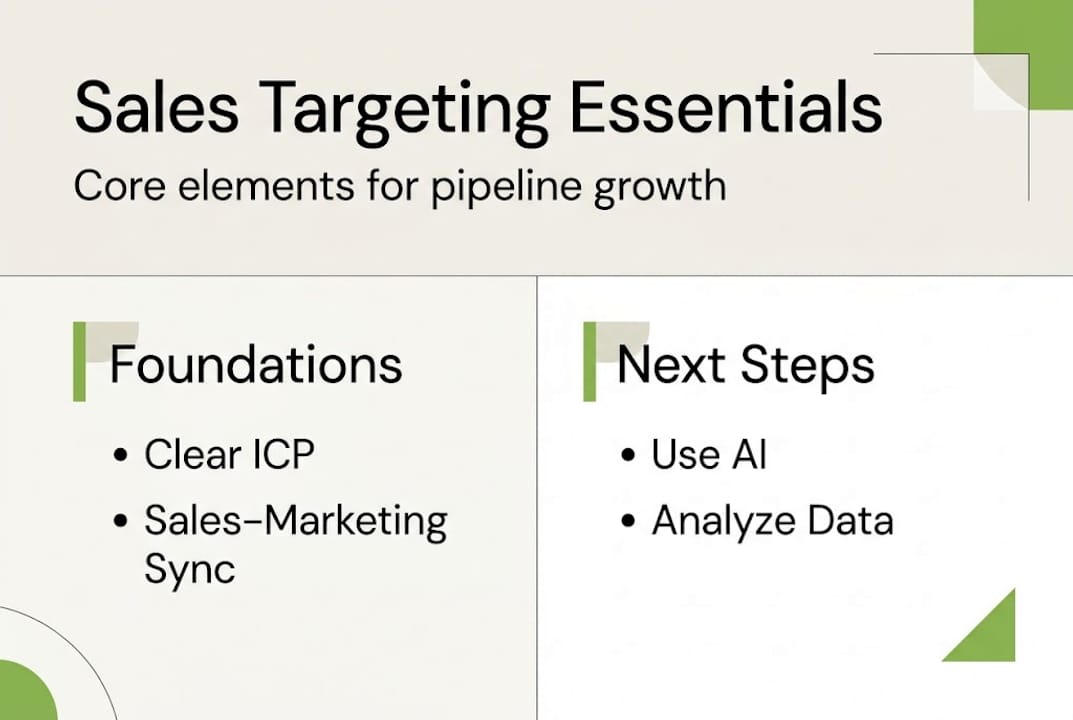
Most B2B sales teams are working harder than they need to because they’re aiming at the wrong accounts. When sales and marketing define their ideal customer differently, the pipeline fills with noise instead of opportunity. 68% misalignment is the documented result of poor sales and marketing alignment on ideal customer profiles (ICP), and that gap quietly drains revenue, morale, and momentum. This guide breaks down the real mechanics of sales targeting, from building a sharp ICP to deploying AI tools that surface the right buyers, so your team stops chasing the wrong deals and starts closing the right ones.
Table of Contents
- Why targeting strategies matter: The true cost of misalignment
- Core components of effective sales targeting
- The role of sales and marketing alignment in targeting success
- Applying AI and customer insights for next-level targeting
- Why most sales targeting advice overlooks your pipeline reality
- Take your targeting strategy to the next level with expert support
- Frequently asked questions
Key Takeaways
| Point | Details |
|---|---|
| Clarity prevents waste | A clear and unified ICP between sales and marketing eliminates wasted effort and boosts conversion rates. |
| Reverse ICP reduces churn | Excluding poor-fit accounts proactively leads to more loyal customers and fewer lost resources. |
| AI drives targeting excellence | Teams that blend AI with customer insight outperform peers and grow revenue faster. |
| Start small, scale smart | Launching with focused, unified targeting increases the chances of success before wide rollout. |
Why targeting strategies matter: The true cost of misalignment
Misalignment between sales and marketing is not just an internal friction problem. It directly erodes revenue. When two teams operate with different definitions of who the ideal customer is, every campaign, every outreach sequence, and every demo call is calibrated to a slightly different target. The compounding effect is brutal.
Consider what happens when a rep spends three weeks nurturing an account that marketing never qualified properly. That time is gone. The opportunity cost is real, and it scales with team size. Gray-area accounts waste time when the ICP lacks clarity, pulling reps into edge cases that rarely convert and inflate cycle times.
| Targeting scenario | Likely outcome |
|---|---|
| Clear, shared ICP across teams | Faster cycles, higher close rates |
| Vague or conflicting ICP | Wasted effort, bloated pipeline |
| No reverse ICP defined | High churn, poor customer fit |
| ICP built from assumptions only | Low conversion, misaligned messaging |
The numbers tell a stark story. Companies with poor alignment see pipeline stall, forecast accuracy drop, and reps burn out chasing unwinnable deals. A few patterns consistently show up:
- Sales pursues volume while marketing optimizes for engagement metrics
- Qualification criteria shift between teams without formal updates
- Edge cases get escalated and consume disproportionate resources
- Win rates stay flat despite increased activity
“When sales and marketing can’t agree on who they’re selling to, they’re essentially running two separate businesses with one budget.”
The fix starts with recognizing that targeting is a shared strategic asset, not a departmental preference. If you want a practical framework for structuring this work, the account-based marketing checklist is a useful starting point for getting both teams on the same page before any outreach begins.
Core components of effective sales targeting
Effective targeting is not about casting a wider net. It is about knowing exactly who you are fishing for and why. The ICP is the foundation, and most teams underinvest in building it with precision.

An ICP defines the firmographic, technographic, and behavioral characteristics of accounts most likely to buy, stay, and grow with you. But there is a second layer that most guides skip: the reverse ICP. Excluding bad-fit accounts through a reverse ICP reduces churn and protects your team from wasting cycles on customers who will never see full value.
| Effective targeting criteria | Ineffective targeting criteria |
|---|---|
| Firmographic fit (size, industry, revenue) | “Anyone who might be interested” |
| Verified buying intent signals | General website traffic |
| Decision-maker identified and reachable | Job title only, no context |
| Defined pain points matching your solution | Broad category match |
Here is a practical sequence for building and maintaining a strong ICP:
- Audit your best customers. Pull your top 20% by revenue and retention. What do they share in terms of size, industry, tech stack, and growth stage?
- Define exclusion criteria. Identify the accounts that churned or never converted. What patterns do they share? These become your reverse ICP.
- Validate with both teams. Sales and marketing must agree on the criteria. If they don’t, the ICP is just a document, not a shared standard.
- Set a review cadence. Markets shift. Review your ICP quarterly and update it based on win and loss data.
- Apply it to every campaign. No outreach should go out without filtering against the ICP first.
For teams using decision-maker targeting with AI, a well-defined ICP dramatically improves the quality of the contacts surfaced. The AI is only as precise as the criteria you feed it.
Pro Tip: Run a quarterly “ICP audit” by comparing your last 10 closed-won deals against your last 10 churned accounts. The patterns you find will sharpen your targeting faster than any framework.
For a step-by-step walkthrough of how to operationalize this, the AI prospecting steps guide covers how to translate ICP criteria into actual outreach workflows.
The role of sales and marketing alignment in targeting success
Once you understand what effective targeting looks like, the next challenge is making sure both teams are executing against the same definition. Misalignment is the single biggest root cause of wasted pipeline effort, and it is almost always a process problem, not a people problem.
Leading B2B marketers who achieve 11% revenue growth consistently emphasize customer insights, AI personalization, and tight sales alignment. Their underperforming peers, averaging just 1% growth, tend to operate in silos. The gap between those two outcomes is largely structural.
Here are proven tactics that drive real alignment:
- Build the ICP together, not in separate rooms
- Use shared dashboards so both teams see the same pipeline data
- Define and agree on lead qualification criteria in writing
- Hold joint pipeline reviews weekly, not monthly
- Create a feedback loop where sales reports back on lead quality from marketing campaigns
“Alignment is not a meeting. It is a system of shared definitions, shared data, and shared accountability.”
The impact of getting this right is not marginal. Teams that align on ICP and qualification criteria see shorter sales cycles, higher average deal values, and better forecast accuracy. The pipeline becomes a reflection of real opportunity, not wishful thinking.
Pro Tip: Before launching any new campaign, run a 30-minute alignment check with both teams. Confirm the ICP criteria, agree on what a qualified lead looks like, and decide how results will be measured. This single habit prevents weeks of misdirected effort.
For practical guidance on how AI tools can support this alignment work, the AI sales tips resource covers how automation can reinforce, not replace, the human alignment process.
Applying AI and customer insights for next-level targeting
With the fundamentals in place, the teams seeing the biggest targeting gains are the ones using AI and deep customer data to go further. This is not about replacing judgment. It is about giving your team better information, faster.
AI personalization alongside customer insights is a defining trait of B2B marketers achieving 11% revenue growth. The technology surfaces patterns in your customer data that humans simply cannot process at scale, and it does so continuously.
| Targeting approach | Avg. conversion rate | Time to qualify lead |
|---|---|---|
| Manual research and outreach | 2 to 4% | 3 to 5 days |
| AI-assisted targeting and outreach | 8 to 14% | Under 24 hours |
Here is how to deploy AI effectively for targeting:
- Feed your ICP into the AI system. The quality of output depends on the quality of input. Use your refined ICP as the filter.
- Layer in intent data. Tools that track buying signals (content consumption, job postings, tech stack changes) help prioritize accounts showing active interest.
- Segment by fit and timing. Not all ICP-matching accounts are ready to buy. AI helps you separate high-fit, high-intent prospects from those who need longer nurturing.
- Personalize at scale. Use customer data to tailor messaging by industry, role, and pain point without writing every email from scratch.
- Review and adjust monthly. AI models improve with feedback. Track which segments convert and update your targeting criteria accordingly.
Pro Tip: Start with one AI tool focused on a single use case, such as prospect identification, before layering in more complexity. Teams that try to automate everything at once often end up with a system no one trusts.
For a deeper look at how AI reshapes the prospecting process from the ground up, AI for B2B prospecting explains the mechanics clearly. And if you want to see how personalization connects to conversion, the personalized email outreach guide is worth reading alongside this section.
Why most sales targeting advice overlooks your pipeline reality
Here is the uncomfortable truth: most targeting frameworks are written for companies that already have clean data, aligned teams, and a stable ICP. That is not most small to mid-sized B2B companies. The real world is messier, and rigid frameworks often stall in organizations where sales reps have strong opinions, marketing owns the CRM, and leadership wants results yesterday.
The advice to “align your teams” sounds simple. In practice, it requires navigating entrenched habits, competing priorities, and tools that don’t talk to each other. Sweeping strategic overhauls rarely stick. What actually works is small, iterative change with real feedback loops.
Start with one segment. Run one campaign. Measure what happens. Adjust the ICP based on what you learn, not what a framework says you should see. This approach builds organizational muscle over time, and it builds trust between teams because everyone can see the data.
Conventional targeting advice also underestimates how much pipeline reality shapes strategy. If your reps are already deep in a vertical that doesn’t match your ICP, you don’t throw that away overnight. You build a transition plan. For teams navigating this kind of complexity, prospecting tips for sales teams offers grounded, practical guidance that respects where you actually are.
Take your targeting strategy to the next level with expert support
The strategies covered here, from building a sharp ICP and reverse ICP to deploying AI for precision targeting, represent the difference between a pipeline full of noise and one full of real opportunity. Knowing the framework is one thing. Executing it consistently across a real team is another.
At Lickfold Digital, we work with B2B sales and marketing leaders who are ready to stop guessing and start building a predictable pipeline. Our AI sales targeting experts deploy dedicated AI agents to identify, qualify, and engage the right decision-makers at scale, so your team focuses on closing, not chasing. If you want to see what a well-targeted outbound system looks like in practice, book a strategy session and we’ll map it out together.
Frequently asked questions
What is a reverse ICP, and why is it important?
A reverse ICP defines who is not an ideal customer, helping sales teams avoid wasting time on poor-fit leads. Excluding bad-fit accounts through this process directly reduces churn and improves overall pipeline quality.
How does AI improve B2B sales targeting?
AI analyzes customer data patterns to identify high-probability prospects, enabling faster and more precise targeting. Leading marketers using AI personalization alongside customer insights achieve 11% revenue growth compared to peers who don’t.
What’s the first step if my sales and marketing teams aren’t aligned on targeting?
Start by building a unified ICP with both teams in the room, agreeing on the criteria together in writing. 68% misalignment stems from poor ICP alignment, so this single step removes the root cause of most pipeline waste.
How should small teams start with account-based marketing (ABM)?
Focus on a small, testable segment first and use unified reporting so both teams can see the same results. Starting ABM small with unified reporting lets you validate your ICP before committing to a larger rollout.