
Unlock Sales Opportunity Scoring: Qualify More Leads with AI
Unlock Sales Opportunity Scoring: Qualify More Leads with AI
TL;DR:
- AI-driven opportunity scoring prioritizes high-potential deals using predictive machine learning models.
- Successful implementation requires clean data, proper change management, and team buy-in.
- Regular data hygiene and starting with pilot segments build trust and improve scoring accuracy.
Most B2B sales reps spend nearly two-thirds of their time on deals that never close. That’s not a motivation problem or a pitch problem. It’s a prioritization problem. Sales opportunity scoring helps sales teams prioritize efforts on high-potential opportunities through predictive machine learning, shifting your team’s energy toward deals that actually move. In this article, we break down exactly how AI-driven scoring works, what it delivers, where it fails, and how to implement it inside your existing sales motion so you stop guessing and start winning.
Table of Contents
- Defining sales opportunity scoring
- How AI-powered scoring works in practice
- Benefits and pitfalls of opportunity scoring
- Executing opportunity scoring in your sales process
- What most sales teams miss about opportunity scoring
- Accelerate your sales with AI-powered opportunity scoring
- Frequently asked questions
Key Takeaways
| Point | Details |
|---|---|
| Predictive lead prioritization | AI-powered scoring helps sales teams focus only on leads most likely to convert. |
| Needs clean, ample data | A reliable model depends on at least 40 won and 40 lost deals with regular upkeep. |
| Maximizes sales effectiveness | Teams adopting scoring see faster cycle times and improved pipeline management. |
| Requires sales buy-in | Success hinges on team adoption, transparency, and ongoing process refinement. |
Defining sales opportunity scoring
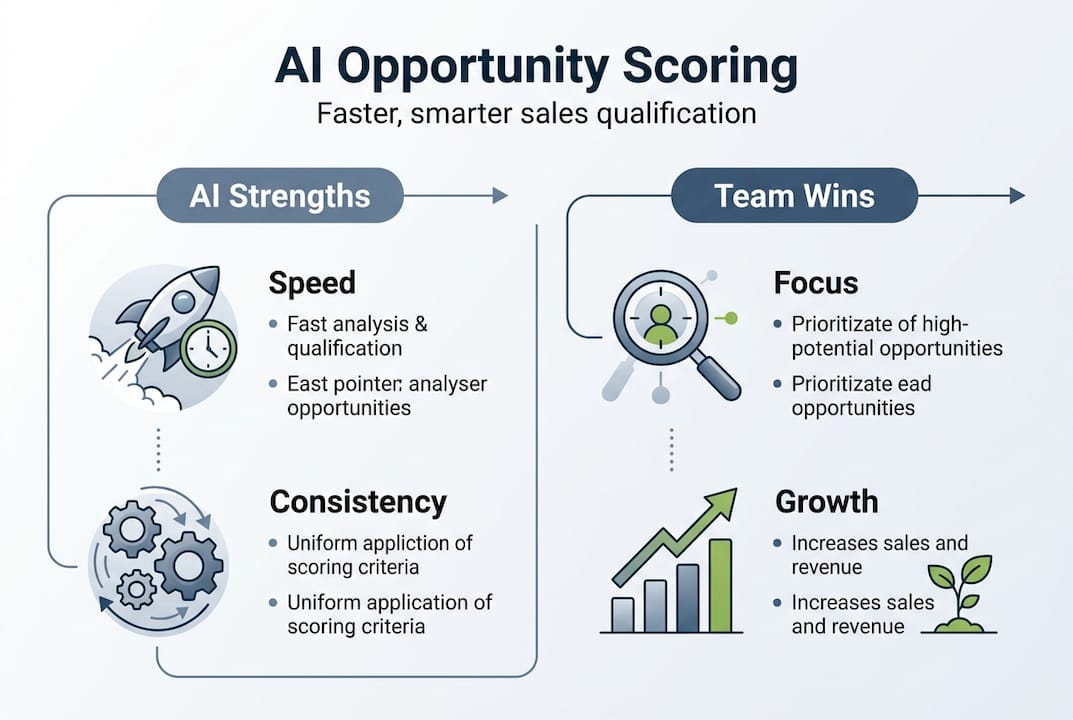
At its core, sales opportunity scoring is a predictive method using machine learning to assign a numerical value, typically between 0 and 100, to every open deal in your pipeline. The higher the score, the more likely that deal is to close. Simple concept. Powerful execution.
Think of it like a credit score for your pipeline. Just as a bank uses financial history to predict whether you’ll repay a loan, a scoring model uses your historical sales data to predict which opportunities will convert. It analyzes patterns across won and lost deals, then applies those patterns to your current pipeline in real time.
Here’s what makes modern AI-driven scoring different from traditional qualification frameworks like BANT or MEDDIC:
- Automation: Scores are calculated continuously without manual input from reps
- Transparency: Each score comes with factors explaining why it’s high or low
- Prioritization: Reps see a ranked view of their pipeline, not a flat list
- Efficiency: Time spent on low-probability deals drops significantly
“Opportunity scoring doesn’t just tell you what to work on. It tells you what to stop working on. That’s where the real time savings happen.”
Traditional qualification relies on a rep’s instinct and a checklist. AI scoring relies on patterns from hundreds or thousands of past deals. One is subjective and inconsistent. The other learns and improves with every new data point.
For B2B sales teams, this matters because cycles are long, deals are complex, and the cost of chasing the wrong opportunity is high. When your team focuses on faster B2B wins, the entire revenue engine speeds up. Quota attainment improves. Forecast accuracy climbs. And reps spend less time on deals that were never going to close in the first place.
Scoring also creates a shared language across your team. Instead of debating whether a deal “feels” strong, you’re discussing a score, the factors behind it, and what actions could move it up. That’s a fundamentally more productive conversation.
How AI-powered scoring works in practice
Knowing what it is, let’s look at how these systems actually function day-to-day.
The mechanics involve training ML models on historical data and analyzing signals from various sales entities including contacts, accounts, activities, and deal attributes. Here’s a simplified step-by-step of how a typical implementation flows:
- Historical data ingestion: Your CRM feeds past won and lost opportunities into the model
- Feature extraction: The system identifies which variables (deal size, industry, activity frequency, stage duration) correlate with wins
- Model training: The ML algorithm learns the patterns that separate closed-won from closed-lost
- Score assignment: Every open opportunity receives a score based on how closely it matches winning patterns
- Daily refresh: Models update scores approximately every 24 hours as new activity data comes in
- Per-stage modeling: Some systems build separate models for each pipeline stage, making scores more contextually accurate
One detail that surprises most teams: you need a minimum of 40 won and 40 lost opportunities before the model can be trained reliably. If your CRM data is thin, the model simply won’t have enough signal to work with.
| Factor | AI-powered scoring | Gut-feel qualification |
|---|---|---|
| Consistency | High, model-driven | Low, rep-dependent |
| Speed | Instant, automated | Slow, manual |
| Accuracy over time | Improves with data | Stagnates or drifts |
| Bias | Minimal | High |
| Scalability | Unlimited | Limited by headcount |
Building pipeline predictability with AI starts with trusting the model enough to act on its outputs. That trust is earned through clean data and consistent use.
Pro Tip: Run a monthly data hygiene audit on your CRM before scores are recalculated. Duplicate records, missing fields, and stale contacts all degrade model accuracy faster than most teams realize.

Benefits and pitfalls of opportunity scoring
With clear mechanics in mind, it’s critical to weigh the real impact, both positive and cautionary.
The benefits are real and measurable. AI-driven opportunity scoring enhances B2B lead generation and qualification by focusing reps on winnable deals, but it demands quality data and genuine adoption effort. Here are the three benefits that show up most consistently:
- Focus on best leads: Reps stop spreading effort across 30 mediocre deals and go deep on the 10 that matter most
- Reduced cycle time: When reps prioritize high-score deals, they close faster because they’re not distracted by noise
- Improved forecasting: Sales leaders can build revenue projections based on score distributions rather than rep optimism
But the pitfalls are just as real. The biggest one is the black-box problem. Reps see a number and don’t know why it’s there. Without explanation, they distrust it. Without trust, they ignore it. And when they ignore it, the whole investment collapses.
“The most common reason scoring initiatives fail isn’t the technology. It’s that no one explained to the sales team what the score means or how to act on it.”
Other common failure points include underestimating change management, where teams expect the tool to do the work without training anyone on how to interpret or act on scores. Poor data hygiene is another silent killer. If your historical data is full of incorrectly labeled outcomes or missing fields, the model learns the wrong patterns and produces scores that actively mislead your team.
Explore AI sales tips for B2B success to see how top-performing teams pair scoring with smarter outreach strategies. The combination is where real revenue acceleration happens.
Executing opportunity scoring in your sales process
Understanding the stakes, the next question is how to actually embed opportunity scoring into your daily motion.
The right CRM matters. Microsoft Dynamics 365, Salesforce Einstein, and Clari all offer built-in scoring capabilities with varying levels of customization. Your choice should depend on your existing stack, your data volume, and how much control you want over model configuration.
Here’s a practical implementation sequence:
- Select your CRM and scoring module: Confirm it supports predictive scoring natively or through integration
- Audit historical data: Ensure you have at least 40 won and 40 lost opportunities with complete fields
- Configure the model: Set the scoring criteria and define which pipeline stages get their own model
- Align your team: Train reps on how to read scores, what factors drive them, and how to act on them
- Launch with one segment: Start with one product line or territory before rolling out company-wide
- Iterate monthly: Review score accuracy against actual outcomes and adjust model inputs accordingly
| CRM platform | Scoring feature | Monthly scored records | Custom model support |
|---|---|---|---|
| Microsoft Dynamics 365 | Predictive opportunity scoring | Up to 1,500 | Yes |
| Salesforce Einstein | Opportunity scoring | Varies by tier | Yes |
| Clari | Revenue intelligence scoring | Unlimited | Limited |
| HubSpot | Deal scoring | Tier-dependent | Basic |
For most B2B teams, implement via CRM like Dynamics or Salesforce, start with 1,500 scored records per month, and prioritize hygiene and cross-team alignment before expecting ROI.
Pro Tip: Build a feedback loop where sales reps flag scores they disagree with. That disagreement data is gold. It helps you identify model blind spots and improves accuracy over time.
Pair scoring with strong prospecting tips to fill your pipeline with the right raw material. And if you want a deeper view of where automation fits, the predictive sales automation guide covers the broader framework.
What most sales teams miss about opportunity scoring
While those steps cover technical execution, the greatest challenges and opportunities are often human.
Here’s the uncomfortable truth: most AI scoring rollouts fail not because the technology is bad, but because the people using it never bought in. Reps are skeptical of black-box numbers. Managers don’t reinforce score-based decisions. And the tool quietly becomes shelfware while the team goes back to gut feel.
The fix isn’t a better algorithm. It’s better change management. Start with one segment, one team, one quarter. Show them a concrete win. A rep who closed two high-score deals faster than usual is more persuasive than any internal presentation.
Clean data is the other hidden lever. We’ve seen teams with excellent scoring tools produce garbage outputs because their CRM was full of half-completed records and mislabeled outcomes. Garbage in, garbage out is not a cliché here. It’s a revenue risk.
The teams that win with AI for sales in 2026 treat scoring as a team sport. They share wins publicly, train reps on what the scores mean, and treat every disagreement as a model improvement opportunity.
Pro Tip: Start with one segment and share regular scoring wins across the team. Visibility builds trust faster than any training session.
Accelerate your sales with AI-powered opportunity scoring
If reading this made you realize your team is still qualifying deals on instinct alone, you’re not behind. You’re just at the starting line. Smarter scoring is within reach, and the results compound quickly once the system is running.
At Lickfold Digital, we help B2B sales teams implement AI-driven scoring, outbound automation, and lead qualification systems that actually get used. From data readiness assessments to full CRM configuration and rep training, our team guides you through every step. You get faster pipeline movement, cleaner forecasts, and a team that knows exactly where to focus. If you’re ready to stop guessing and start closing, we’re ready to help you build the system that makes it happen.
Frequently asked questions
What data is needed to start sales opportunity scoring?
You need a minimum of 40 won and 40 lost opportunities in your CRM for the model to train effectively. Incomplete or mislabeled records will reduce accuracy even if you meet the minimum threshold.
How often are sales opportunity scores updated?
Scores update every 24 hours to reflect new activity data and shifting pipeline signals. This means a deal that goes cold overnight will show a lower score by the next morning.
Does opportunity scoring work for all sales pipelines?
Scoring works best with clean, rich data and consistent pipeline hygiene. Abandoned business process flows are excluded from model training, and pipelines with limited history will produce unreliable scores.
Which CRMs support AI-driven opportunity scoring?
Popular CRMs like Microsoft Dynamics 365, Salesforce, and Clari offer built-in opportunity scoring features with varying levels of customization and data volume support.