
Building Long-Term B2B Client Relationships That Last
Building Long-Term B2B Client Relationships That Last
TL;DR:
- Building long-term B2B relationships depends on consistent value, trust, and proactive engagement. Companies that master relationship management experience better growth, reduced churn, and stronger competitive advantage.
Long-term B2B client relationships are defined by consistent value delivery, mutual trust, and proactive partnership rather than transactional exchanges. Companies that master building long-term B2B client relationships grow revenue more predictably, spend less on acquisition, and create competitive advantages that are genuinely hard to copy. The industry term for this discipline is B2B relationship management, and it encompasses structured programs like Key Account Management (KAM), multi-threaded stakeholder engagement, and deliberate communication strategies. Shifting from reactive vendor to proactive advisor is not a soft skill. It is a measurable business strategy with direct impact on retention and lifetime value.
What are the critical components of effective B2B relationship management?

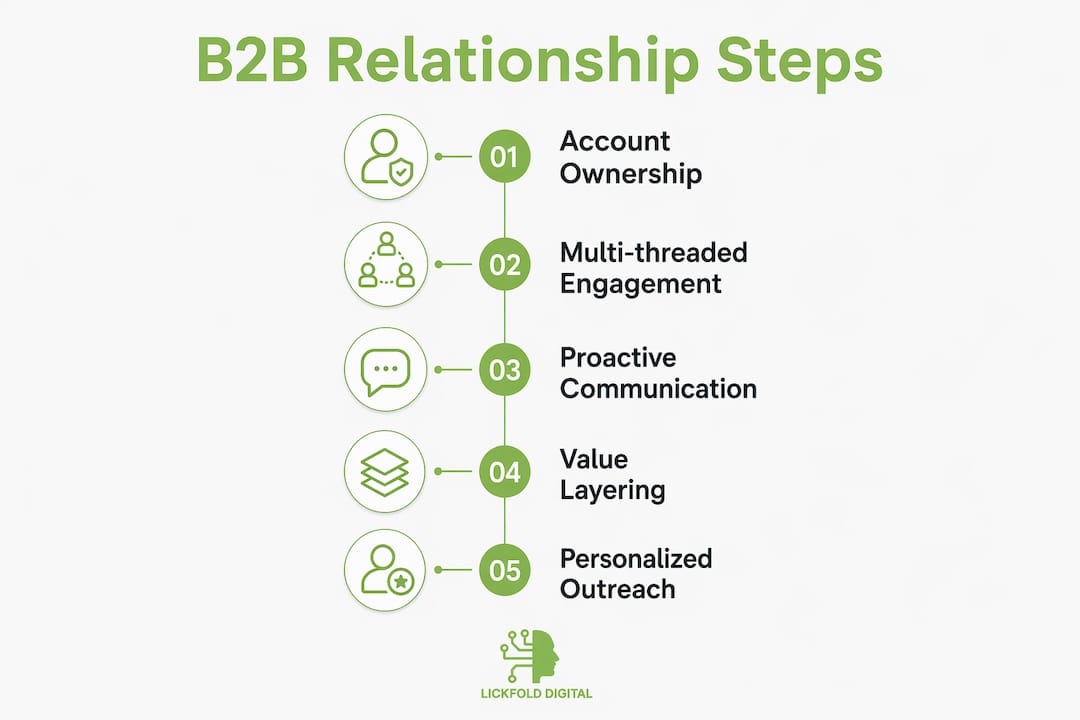
B2B relationship management rests on three structural pillars: named account ownership, multi-threaded engagement, and a formal account plan. Without all three, even strong relationships become fragile when a single contact leaves or a competitor makes a move.
Key Account Management (KAM) is the most widely adopted framework for structuring these relationships. KAM assigns a dedicated owner to each high-value account, defines growth objectives, and maps stakeholders across the client organization. Multi-threaded client relationships that include executive sponsors, day-to-day contacts, and end users significantly reduce churn risk. When your only relationship is with one buyer and that buyer leaves, you lose the account.
Continuous business research on your clients is equally critical. Knowing a client’s quarterly earnings, strategic priorities, and competitive pressures lets you show up with relevant ideas rather than generic check-ins. Client advisory boards take this further by creating a structured forum where your best clients share feedback, network with peers, and feel invested in your product roadmap.
The blend of automation and human interaction matters more than most teams realize. Automation handles routine tasks like scheduling, reporting, and follow-up sequences efficiently. Human judgment handles escalations, sensitive conversations, and moments where trust is on the line. Getting that balance wrong in either direction costs you accounts.
| Relationship model | Strengths | Weaknesses |
|---|---|---|
| Transactional vendor | Low overhead, fast to scale | No loyalty, high churn risk |
| Dedicated account manager | Personal touch, strong trust | Hard to scale, single point of failure |
| KAM with multi-threading | Resilient, growth-oriented | Requires process discipline |
| Automated CRM only | Consistent, data-rich | Impersonal, misses emotional signals |
Pro Tip: Build a one-page account plan for every client above a defined revenue threshold. Include their top three business goals, your key contacts at each level, and one upsell opportunity you plan to pursue in the next 90 days.
How can proactive communication prevent client churn in B2B environments?
Clients leave providers who become invisible between deliverables, not necessarily because of specific errors. This is the most underappreciated cause of B2B churn. A client who hears from you only when an invoice is due or a contract renewal approaches will eventually wonder whether you actually care about their success.
Proactive communication means scheduling regular touchpoints with no sales agenda. A monthly 30-minute call to share an industry insight, flag a risk you noticed, or simply ask what is keeping them up at night signals that you are invested. Top sales performers act as advisors who deliver benchmarking data and market intelligence, not just product updates. That advisory posture builds the kind of loyalty that survives competitive pricing pressure.
Transparency about setbacks is equally powerful. Clients forgive mistakes but do not forgive surprises. Calling a client before they discover a problem, owning it clearly, and presenting a resolution plan transforms a potential trust-breaker into a trust-builder. Most account managers do the opposite, hoping the issue resolves before the client notices.
Here are the top proactive communication tactics that consistently reduce churn in B2B environments:
- Schedule quarterly business reviews (QBRs) with a structured agenda focused on client goals, not your product roadmap.
- Send a brief monthly value summary showing measurable outcomes your work has delivered.
- Share relevant industry reports or competitor intelligence with no strings attached.
- Create a dedicated Slack channel or shared workspace so clients can reach you without email friction.
- Flag risks or market changes that affect the client before they ask about them.
- Use multiple channels: email for formal updates, phone or video for sensitive conversations, and messaging tools for quick wins.
Pro Tip: Set a calendar rule: no client goes more than 21 days without a meaningful touchpoint from your team. “Meaningful” means something relevant to their business, not a generic newsletter.
What practical steps increase client retention through value layering and upselling?
Value layering is the practice of deepening a client’s integration with your services over time so that switching becomes genuinely costly. Clients using three or more services show 40–60% higher retention rates compared to single-service clients. That number reflects a structural reality: the more a client relies on your work across their operations, the harder it is to replace you with a competitor.
Upselling in B2B is most effective when it is framed around client success rather than revenue targets. The question is not “what else can we sell?” but “what problem does this client have that we are not yet solving?” That reframe changes the conversation from pressure to partnership. A client who sees an upsell as your recommendation for their benefit will accept it. A client who senses you are hitting a quota will resist.
Upselling multiple services also creates dependency and switching costs that protect your revenue without requiring aggressive retention tactics. When a client uses your analytics platform, your onboarding support, and your strategic consulting, replacing you means rebuilding three separate capabilities simultaneously.
Upselling do’s and don’ts for B2B account managers:
- Do tie every upsell to a specific client goal or pain point you have documented.
- Do introduce new services during QBRs when you have evidence of client success to reference.
- Do offer a pilot or trial period to reduce the perceived risk of expanding the relationship.
- Don’t introduce upsells during a service issue or contract renewal negotiation.
- Don’t pitch features. Pitch outcomes and name the business problem each outcome solves.
- Don’t rush the timeline. A well-timed upsell six months in outperforms a premature pitch at month two.
How to personalize and humanize B2B relationships beyond transactions?
The strongest B2B relationships are built between people, not companies. Knowing your client contacts as individuals, not just as job titles, is what separates a vendor from a trusted partner. This does not require elaborate gestures. It requires attention and consistency.
Here are four practical ways to humanize your client relationships:
- Track personal milestones. Note promotions, company anniversaries, and significant wins in your CRM. A short congratulatory message when a client’s company closes a funding round or wins an award costs nothing and signals that you pay attention.
- Engage in non-business conversation. The first five minutes of a client call should not be about deliverables. Ask about a conference they attended, a challenge they mentioned last month, or an industry trend they care about. These moments build rapport that survives difficult conversations later.
- Celebrate client wins publicly. Share client success stories on LinkedIn with their permission, feature them in case studies, or invite them to speak at your events. You are investing in their visibility, not just your own.
- Use client advisory boards strategically. Celebrating client wins and engaging personally strengthens emotional ties and loyalty. Advisory boards give your best clients a platform, a peer network, and a sense of ownership over your product direction. That combination creates advocates, not just buyers.
Personalized outreach that references specific client context consistently outperforms generic communication in both response rates and relationship depth. The investment in knowing your clients pays compounding returns over time.
What common pitfalls should B2B professionals avoid?
The most damaging mistakes in B2B relationship management are not dramatic failures. They are slow, invisible erosions of trust that accumulate until a client decides to look elsewhere.
Over-automating critical client touchpoints leads to churn because clients feel neglected and undervalued. An automated birthday email from a CRM is not a relationship. A personal note from their account manager is. Knowing which interactions require a human is a judgment call that no workflow can fully replace.
Treating relationships as purely transactional is the second major pitfall. Clients notice when every conversation circles back to a renewal, an upsell, or a deliverable. Consistency in communication and acting as an invested advisor rather than a vendor builds the trust that keeps clients through price increases and competitive offers.
| Common mistake | Corrective action |
|---|---|
| Disappearing between deliverables | Schedule recurring non-sales touchpoints every 3–4 weeks |
| Single-threaded relationships | Map and engage three or more stakeholders per account |
| Overpromising on scope or timeline | Set conservative expectations and exceed them consistently |
| Automating all communication | Reserve phone and video for sensitive or high-stakes moments |
| Ignoring client business changes | Monitor client news and update account plans quarterly |
Key takeaways
Building long-term B2B client relationships requires named account ownership, proactive communication, multi-threaded engagement, and deliberate value layering to reduce churn and drive sustainable growth.
| Point | Details |
|---|---|
| Use a KAM framework | Assign named account owners and map multiple stakeholders to reduce churn risk. |
| Communicate proactively | Schedule regular non-sales touchpoints so clients never feel ignored between deliverables. |
| Layer services to retain clients | Clients using three or more services show 40–60% higher retention rates. |
| Humanize every interaction | Track personal milestones and celebrate client wins to build loyalty beyond contracts. |
| Avoid over-automation | Reserve human judgment for high-stakes conversations where trust is on the line. |
What I have learned from watching B2B relationships succeed and fail
The most common mistake I see in B2B relationship management is confusing activity with connection. Teams send newsletters, log calls in their CRM, and hit their touchpoint quotas. Then a client leaves, and everyone is surprised. The activity was real. The connection was not.
The accounts I have seen retain clients through price increases, service hiccups, and competitive pressure all share one trait: the client felt genuinely known. Not just tracked in a system. Known. Their account manager understood their internal politics, remembered what kept them up at night, and showed up with relevant ideas before being asked.
The balance between automation and human touch is where most teams get it wrong in both directions. Some over-automate and lose the warmth that builds trust. Others resist all automation and burn out their best relationship managers on tasks a workflow could handle in seconds. The answer is deliberate design: automate the routine, protect the human moments.
One more thing I would push back on: the idea that upselling is somehow at odds with client-first thinking. Done right, upselling is client-first thinking. If you know a client’s goals and you have a service that moves them closer to those goals, not offering it is a failure of the relationship. The discomfort most account managers feel around upselling comes from pitching products they are not sure the client actually needs. Solve that problem first, and the conversation changes entirely.
— Duarte
How Lickfold can support your client retention strategy
Building strong client relationships starts before the first contract is signed. The quality of your initial outreach shapes how clients perceive you from day one.
Lickfold’s AI-driven prospecting platform identifies decision-makers who match your ideal customer profile and executes personalized, multi-touch outreach campaigns that feel nothing like generic cold email. Every lead that reaches your sales team has already been qualified by a human reviewer, so your account managers spend their time building relationships with the right people rather than sorting through noise. If you want a pipeline that sets your client relationships up for long-term success from the first interaction, reach out to Lickfold to see how the system works for your market.
FAQ
What is the most effective strategy for retaining B2B clients long-term?
Proactive communication combined with multi-threaded stakeholder engagement is the most effective retention strategy. Clients who feel consistently supported and known across multiple levels of your organization are significantly less likely to churn.
How does Key Account Management improve client loyalty?
KAM assigns named ownership to high-value accounts and creates structured engagement plans tied to client goals. This approach reduces single points of failure and gives clients a clear, consistent experience across every interaction.
How many services should a B2B client use to improve retention?
Clients using three or more services show 40–60% higher retention rates than single-service clients. Expanding a client’s use of your services deepens integration and raises the practical cost of switching to a competitor.
When is automation appropriate in B2B client relationships?
Automation works well for routine tasks like scheduling, reporting, and follow-up sequences. High-stakes interactions such as escalations, contract renewals, and sensitive conversations require human judgment to maintain trust and avoid perceived neglect.
How do you rebuild a B2B client relationship after a setback?
Own the problem immediately and transparently before the client discovers it themselves. Clients consistently forgive honest mistakes but rarely forgive surprises, so speed and clarity in communication are the fastest path back to trust.