
What Is Lead Nurturing in B2B: a 2026 Guide
What Is Lead Nurturing in B2B: a 2026 Guide
TL;DR:
- Most B2B marketers mistakenly view lead nurturing as just email sequences, but it involves personalized content across multiple channels at every buying stage.
- Effective nurturing requires segmentation, multi-channel coordination, and ongoing measurement to turn prospects into revenue-generating customers over extended decision cycles.
- Building a strategic, adaptable program involves mapping the buyer journey, aligning sales, creating relevant content, and leveraging AI for personalized outreach and continuous improvement.
Most B2B marketers think they already do lead nurturing. They set up a five-email drip sequence, call it a workflow, and move on. But understanding what is lead nurturing in B2B at a strategic level reveals something far more demanding. It is a purposeful, multi-stage process of engaging specific buyer groups with personalized content at every point in their decision journey. Done right, it transforms your pipeline from unpredictable to consistent. This guide covers the mechanics, the channels, the metrics, and the exact steps you need to build nurturing that actually converts.
Table of Contents
- Key Takeaways
- What lead nurturing in B2B actually means
- Segmentation and personalization at scale
- Multi-channel coordination that works
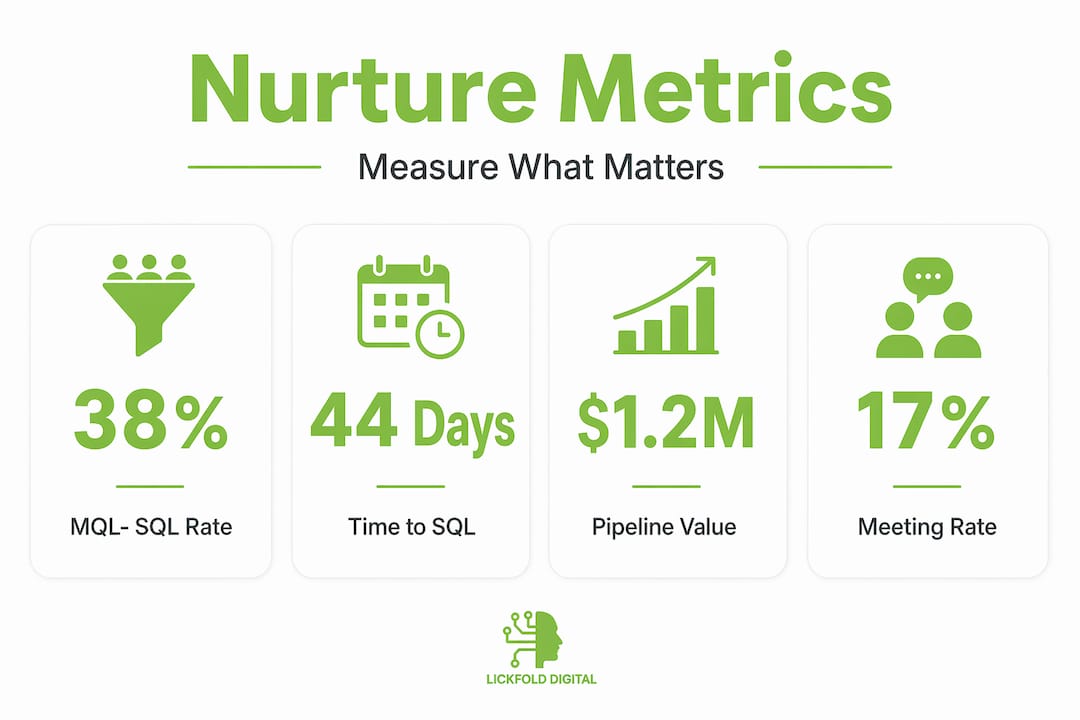
- Measuring what actually matters
- How to build and scale your nurturing program
- My take on what separates good nurturing from great
- Lickfold can take your nurturing further
- FAQ
Key Takeaways
| Point | Details |
|---|---|
| Not just email sequences | Lead nurturing spans multiple channels and buyer stages, not just automated drip campaigns. |
| Multi-stakeholder complexity | B2B purchases involve 22+ people on average, requiring messages tailored to different roles. |
| Revenue impact is proven | Nurtured leads produce 50% more sales-ready leads at 33% lower cost per lead. |
| Measure what moves pipeline | Track MQL-to-SQL rate and time-to-SQL, not just opens and clicks. |
| Coordination beats volume | Four to six coordinated channels outperform single-channel approaches in every measurable metric. |
What lead nurturing in B2B actually means
Lead nurturing is the deliberate process of engaging a defined group of buyers with relevant, personalized content at each stage of their journey, from first awareness through to a signed contract. HubSpot describes it as a four-stage process: educate, inform, engage, and convert. That framing matters because it signals something critical. Each stage has a different goal, and mixing them up is one of the most common reasons nurturing programs underperform.
IBM defines lead nurturing as relationship building through relevant resources and personalized content, designed to guide leads after initial generation so no revenue opportunity is missed. That last phrase is worth holding onto. Lead nurturing exists because most leads are not ready to buy when they first engage. In B2B, decision timelines run from 6 to 18 months depending on company size, which means your job is to stay relevant long after the first handshake.
Here is where many teams confuse lead generation with lead nurturing. Lead generation creates awareness and captures contact information. You can explore scalable lead generation strategies to bring prospects into your funnel. Lead nurturing is what happens after that. It is the work of turning a contact into a conversation, and a conversation into a qualified opportunity.
The core components of a working B2B lead nurturing program include:
- Segmentation: Grouping leads by industry, role, behavior, or buying stage so messaging stays relevant rather than generic.
- Multi-stage engagement: Creating specific content and touchpoints for awareness, consideration, and decision stages, not one-size-fits-all content sent to everyone.
- Personalization: Using behavioral data and firmographic signals to tailor subject lines, content offers, and calls to action to each segment.
- Measurement: Tracking progression metrics, not just activity metrics, so you know whether nurturing is moving leads closer to a sale.
These components work together. Segmentation without personalization produces slightly-less-generic emails. Personalization without measurement produces optimism without proof.
Segmentation and personalization at scale
In B2B, segmentation is more nuanced than in consumer marketing because buying groups are larger and more politically complex. Most B2B purchases involve an average of 22 people. That means your nurturing program needs to speak to a CFO differently than it speaks to an IT director, even when both are evaluating the same product.
IBM highlights segmentation by interests, behaviors, and demographics as the primary mechanism for addressing multiple stakeholders simultaneously. In practice, this means building separate content tracks for each persona rather than sending one weekly newsletter to your entire database.
Effective segmentation criteria for B2B include company size, industry vertical, job title and seniority, stage in the buying journey, content already consumed, and specific pain points indicated by form fills or behavior on your site. Each of these signals tells you something about what the lead needs to hear next. A director of operations who downloaded a case study on cost reduction needs different follow-up content than a VP of IT who watched a product demo.
Pro Tip: Build your nurturing tracks around the buyer’s question at each stage, not around your product features. Early-stage leads want to understand their problem better. Mid-stage leads want to evaluate solutions. Late-stage leads want proof that your solution is the right one for their specific context.
For personalized content, the highest-performing asset types in B2B nurturing include role-specific whitepapers, short video explainers, customer case studies segmented by industry, and targeted webinar invites. Combining segmentation with personalization in B2B outreach measurably accelerates pipeline velocity because prospects receive content that answers their exact current question rather than content written for everyone and relevant to no one.

Multi-channel coordination that works
Relying on email alone is the single most common structural flaw in B2B nurturing programs. Email is critical, but a prospect who receives only your emails is a prospect who can ignore your nurturing entirely by filtering one folder.
Programs using four to six coordinated channels consistently outperform single-channel approaches across conversion metrics. The operative word is coordinated. Throwing messages at prospects across every platform is not a strategy. It is noise. Coordination means each channel plays a specific role in a unified experience.
Here is how a practical multi-channel nurture sequence runs for a mid-market B2B prospect over six weeks:
- Week 1: Prospect downloads a whitepaper (entry trigger). An automated email delivers the content and offers a related webinar.
- Week 2: Retargeting ads on LinkedIn show a short customer testimonial video. The prospect sees social proof without being asked to take action yet.
- Week 3: A follow-up email with a role-specific case study lands. Subject line is personalized based on the prospect’s job title.
- Week 4: A LinkedIn connection request from a sales rep is sent, referencing the webinar topic the prospect attended.
- Week 5: SEO-driven blog content surfaces when the prospect searches a problem-related keyword. Your brand appears in organic search at the right moment.
- Week 6: A personalized outreach email from the sales rep moves the conversation toward a discovery call.
The table below illustrates the core channels and their role in a coordinated nurture program.
| Channel | Primary role | Best stage |
|---|---|---|
| Content delivery and progression | All stages | |
| Social proof and relationship building | Awareness, consideration | |
| Retargeting ads | Brand recall and re-engagement | Mid-funnel |
| SEO content | Organic discovery at moment of need | Awareness |
| Sales outreach | Conversation and qualification | Late-stage |
Strategic omnichannel coordination creates reinforcing experiences rather than disconnected touchpoints. When a prospect sees your brand across LinkedIn, organic search, and email in a coherent narrative, they develop trust faster than through any single channel alone.
Pro Tip: If you are working with a lean team, prioritize email plus one additional channel where your buyers actually spend time. For enterprise buyers, LinkedIn is almost always worth the investment. For SMB buyers, a well-timed retargeting ad on Google Display can be equally effective at a fraction of the cost.
Measuring what actually matters
Most nurturing programs drown in metrics that feel important but do not connect to revenue. Open rates and click rates tell you something about email performance. They tell you nothing about whether your program is generating pipeline.
Gartner research shows that B2B buyers spend only 17% of their purchase journey in direct contact with vendors. Nurturing influences the other 83%. That means the work you do while buyers are researching independently, reading your content, watching your ads, and comparing options is more commercially significant than most sales leaders realize.
The metrics worth tracking fall into two categories. Progression metrics tell you whether leads are moving toward a sale:
- MQL-to-SQL conversion rate: the share of marketing-qualified leads that become sales-qualified.
- Time-to-SQL: how long it takes a lead to reach sales qualification from first touch.
- Meeting rate: the percentage of nurtured leads that agree to a discovery call.
- Pipeline value influenced: the total deal value attributable to nurturing touchpoints.
Engagement metrics tell you which content and channels are working:
- Content consumption rate by asset and persona.
- Behavior-triggered email performance. HubSpot reports that behavior-triggered emails generate an 8% click-through rate versus 3% for standard drip emails.
- Lead score progression over time.
Connecting nurture touchpoints to commercial outcomes rather than vanity metrics is what separates programs that get budget cut from programs that get expanded. When you can show that nurtured leads closed at twice the rate of non-nurtured leads, the business case for investing in nurturing becomes self-evident.
How to build and scale your nurturing program
Building a program that holds up over time requires a clear sequence of decisions before you write a single email.
- Map your buyer journey. Document every stage from first awareness to signed contract, including the questions buyers ask and the objections they raise at each stage. This becomes the blueprint for your content plan. You can use a step-by-step lead qualification framework to align your stages with sales-readiness criteria.
- Segment your database. Group existing contacts by persona, buying stage, and engagement history before building any workflows. Sending the right message to the wrong segment is as ineffective as sending the wrong message to everyone.
- Build content for each stage and persona. You do not need 50 assets to start. Three to four pieces per stage, written for your two or three core personas, gives you enough to run a real program.
- Align marketing and sales. Define what an MQL looks like, agree on the handoff point, and establish a feedback loop so sales reps report back on lead quality. Without this alignment, even a technically perfect nurturing program fails at the handoff.
- Automate with intent. Marketing automation handles the sequencing. AI-powered tools handle the personalization at scale. Your strategy handles the thinking. Personalized email outreach powered by AI significantly reduces the time required to customize messaging across large contact lists without sacrificing relevance.
The most common pitfalls are predictable. Teams build nurturing programs once and never update the content. They track opens as a success metric and wonder why pipeline numbers do not improve. They hand off every lead at the same score threshold regardless of behavior. Avoiding these mistakes requires treating nurturing as a live program that gets reviewed quarterly, not a set-it-and-forget-it automation.
Pro Tip: Run a quarterly content audit on your nurturing tracks. If a piece of content is more than 18 months old, check whether the underlying claims, data, and context still apply. Outdated content erodes trust faster than no content at all.
My take on what separates good nurturing from great
I have seen marketing teams invest significant budget in automation platforms, build elaborate nurturing workflows, and still generate almost no measurable pipeline impact. The root cause is almost always the same. They built the infrastructure without answering the underlying question: what does this buyer actually need to hear right now?
What I have learned is that the teams who get lead nurturing right treat it like a conversation, not a broadcast. They spend more time on content strategy and persona research than on workflow configuration. The technical setup takes hours. The strategic clarity takes weeks, and it is worth every minute.
The multi-stakeholder complexity of B2B buying is genuinely underestimated. When 22 people are involved in a decision, a single content track sent to the primary contact misses most of the buying committee entirely. The companies I have seen win consistently are the ones who build specific messaging for finance, operations, IT, and the executive sponsor, all running in parallel, all reinforcing the same core value proposition from different angles.
The evolving role of AI in nurturing is real, but it is not magic. AI accelerates personalization and identifies behavioral patterns faster than any human team can. What it cannot do is replace the strategic judgment required to understand your buyer and build content that earns their trust over a 12-month cycle.
— Duarte
Lickfold can take your nurturing further
If you have read this far and recognized gaps in your current program, the next step is execution. Building and maintaining a multi-channel, multi-persona nurturing program requires consistent effort across content, segmentation, outreach, and measurement. Most B2B teams do not have the bandwidth to do all of it well simultaneously.
Lickfold deploys AI-powered outreach systems that identify decision-makers, segment them by role and intent signals, and execute personalized multi-touch campaigns designed to move prospects through your pipeline. The approach is built for the complexity of B2B buying cycles, where timing, relevance, and persistence determine whether a lead converts or goes cold. If you want to see what a properly structured outbound nurturing system looks like in practice, reach out to Lickfold and the team will walk you through exactly how it works for your market.
FAQ
What is lead nurturing in B2B?
Lead nurturing in B2B is the process of engaging defined buyer groups with relevant, personalized content at each stage of their purchase journey to build relationships and increase conversion. It is distinct from lead generation and operates across multiple channels and stakeholder groups throughout buying cycles that can last 6 to 18 months.
How is lead nurturing different from lead generation?
Lead generation captures contact information and creates initial awareness. Lead nurturing is the sustained engagement process that follows, guiding contacts from awareness through to sales readiness using staged content, behavioral triggers, and multi-channel touchpoints.
What metrics should I track for lead nurturing?
The most meaningful metrics are MQL-to-SQL conversion rate, time-to-SQL, meeting rate, and pipeline value influenced by nurturing. Behavior-triggered emails also provide reliable performance signals, generating significantly higher click-through rates than standard drip sequences.
Why does multi-channel nurturing outperform email alone?
Single-channel nurturing gives prospects one easy path to disengage. Coordinated programs across email, LinkedIn, retargeting, and SEO content maintain consistent brand presence and reinforce messaging across the independent research that dominates most B2B purchase decisions.
How long does it take to see results from lead nurturing?
Results depend on your sales cycle length. For mid-market B2B, meaningful pipeline movement from a structured nurturing program typically appears within 60 to 90 days. Enterprise cycles require a longer horizon, but early indicators like improved lead scoring progression and higher MQL rates should be visible within the first quarter.