
Scalable lead generation: Strategies for sustainable B2B growth
Scalable lead generation: Strategies for sustainable B2B growth
TL;DR:
- Scaling lead generation requires strong infrastructure and quality guardrails to prevent lead quality degradation.
- AI-driven outreach enables high-volume, personalized contact while maintaining sender reputation through proper monitoring.
- Successful scaling depends on aligned sales and marketing strategies, ongoing optimization, and regular process recalibration.
Most B2B marketing managers assume scaling lead generation is straightforward: send more emails, run more ads, hire more SDRs, and watch pipeline grow. But that logic breaks down fast. Teams that simply increase volume without first building the right systems often end up with lower quality leads, burned sender domains, frustrated sales reps, and a pipeline full of contacts that never convert. This guide cuts through that misconception and shows you how to scale lead generation the right way, using AI-driven systems, quality guardrails, and smart automation to grow your pipeline sustainably without sacrificing the lead quality your sales team depends on.
Table of Contents
- Understanding scalable lead generation
- Core components of scalable lead generation
- AI-driven outreach: Scaling with intelligence
- Guardrails and monitoring: Protecting quality at scale
- What most B2B teams miss about scaling lead generation
- Want to scale your B2B lead generation with confidence?
- Frequently asked questions
Key Takeaways
| Point | Details |
|---|---|
| Quality over quantity | Scaling lead generation only works if you maintain or improve lead quality, not just volume. |
| AI powers scalability | Automation and AI-driven targeting enable efficient, personalized outreach at scale. |
| Guardrails are critical | Real-time validation and feedback loops prevent low-quality leads from flooding your funnel. |
| Monitor deliverability risks | Protect sender reputation and infrastructure as your outreach volume increases. |
| Continuous improvement wins | Regularly recalibrate your systems—adaptability is key to scalable B2B success. |
Understanding scalable lead generation
With the core challenge introduced, let’s break down what it means to scale lead generation intelligently.
Scalability in B2B lead generation doesn’t mean “more of everything.” It means building a system where increasing output doesn’t proportionally increase cost, effort, or error rate. A truly scalable pipeline can double its volume without doubling its headcount, and it can do so without a noticeable drop in lead quality, conversion rate, or deliverability.
The problem most teams run into is conflating growth with scale. Growth is adding more. Scale is building smarter. When you add more outreach volume to a system without proper infrastructure, you’re not scaling. You’re amplifying whatever flaws already exist in your process.
Here’s what sustainable scaling actually requires:
- Lead validation at the point of capture to ensure contact data is accurate and current
- Deduplication logic to prevent the same prospect from receiving multiple conflicting touchpoints
- Volume monitoring to track input-to-output ratios as you grow
- Conversion lag tracking to account for the delay between when a lead enters your funnel and when it becomes a real opportunity
- Feedback loops that continuously send performance data back into your targeting and messaging strategy
As scaling lead volume without sacrificing quality makes clear, “a key scalability edge case is lead quality degradation as volume increases; you need quality guardrails (e.g., validation, duplicate rate, and tracking delays) before scaling production.” That’s not an afterthought. That’s the foundation.
“Quality guardrails aren’t optional features you add when things go wrong. They’re the infrastructure that makes scale possible in the first place.”
Pro Tip: Set up your quality guardrails before you ever increase volume. Most teams wait until they see the problem. By then, you’ve spent weeks generating leads your sales team can’t use, and repairing that trust internally takes longer than fixing the tech.
For deeper context on how AI fits into the front end of this process, the AI-driven prospecting tips at Lickfold Digital are worth reviewing before you design your targeting framework.
Core components of scalable lead generation
Now that you understand why quality matters, let’s look at how to design a scalable system from the ground up.

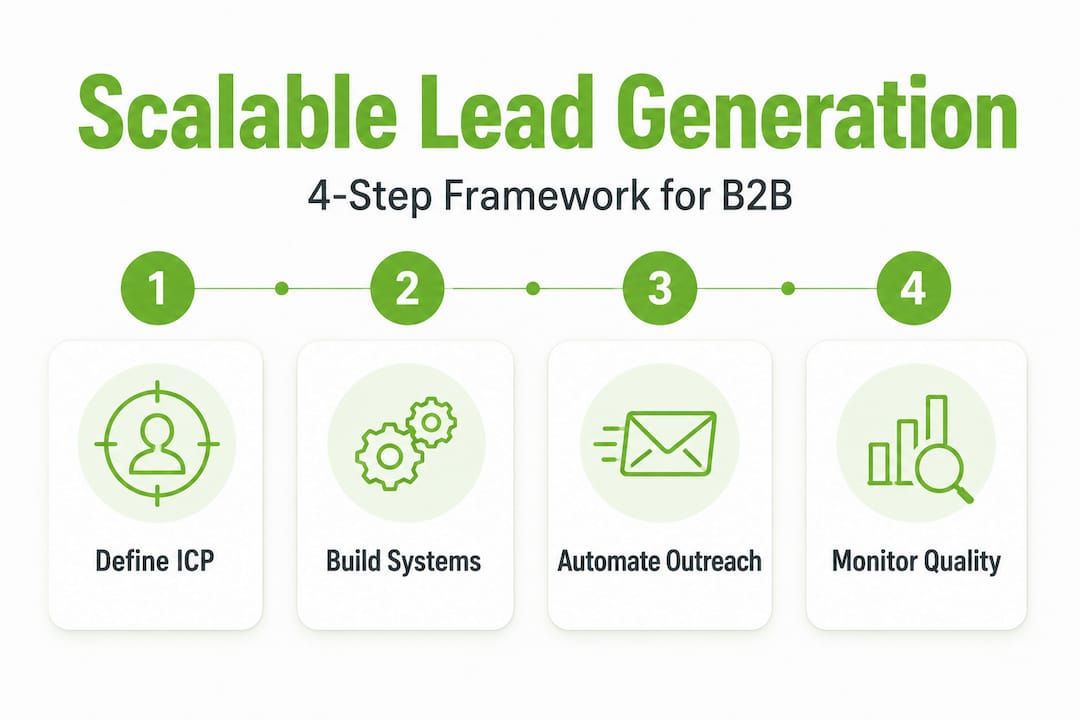
A scalable lead generation system has four core components working together: automation infrastructure, precise targeting, qualification logic, and real-time optimization. When any one of these breaks down, the others degrade with it.
The four-step framework for scalable lead generation
- Capture: Use AI agents or enrichment tools to identify and pull in prospects that match your ideal customer profile. This is where targeting precision matters most. Poor targeting at this stage makes every downstream step more expensive.
- Qualify: Apply scoring logic, validation rules, and firmographic filters to determine which leads deserve outreach. This is where deduplication and data verification sit.
- Nurture: Deploy personalized, multi-touch outreach sequences using automation tools that can manage cadence, timing, and message variation at scale.
- Optimize: Feed conversion data, engagement rates, and reply signals back into your targeting and messaging models to continuously improve performance.
Here’s a quick comparison of automation options to help you decide what belongs in your stack:
| Tool type | Best for | Scale potential | Quality risk |
|---|---|---|---|
| AI prospecting agents | ICP targeting and research | Very high | Low with guardrails |
| CRM automation | Lead routing and nurturing | High | Medium |
| Email sequencing tools | Outreach and follow-up | High | Medium to high |
| API-enrichment services | Data validation and deduplication | Very high | Low |
| Manual SDR outreach | Complex, high-value accounts | Low | Very low |
One of the most underappreciated risks in scaling is detection lag. Quality degradation can take 2 to 4 weeks to show up in conversion rates and up to 30 to 60 days before instability in lead quality becomes fully visible. That means a targeting change you made six weeks ago might just now be showing up as a drop in qualified opportunities. Without real-time monitoring, you’re flying blind.
Pro Tip: Set automated alerts for abnormal drops in open rates, validation failure rates, or stage-to-stage conversion rates. These early signals often appear 2 to 3 weeks before the problem hits your pipeline in a meaningful way.
To build personalized outreach into your scalable system, explore mastering AI email outreach as a tactical layer on top of this framework. And if you’re focused on driving measurable engagement, the personalized email outreach guide covers how to avoid generic templates while still operating at volume.
AI-driven outreach: Scaling with intelligence
With core systems in place, it’s time to talk about scalable outreach and where AI-driven tactics genuinely shine.
AI doesn’t just speed up outreach. It changes the nature of outreach entirely. Traditional manual outreach relies on SDRs writing individual emails, researching prospects one by one, and managing follow-up in a spreadsheet. That model caps out fast. One rep might manage 50 to 75 active prospects at a time. An AI-powered system can handle thousands simultaneously, with individualized messaging, without sending a single generic template.
Here’s where AI changes the game specifically:
- Personalization at volume: AI can pull in prospect-specific signals like recent company news, role changes, or industry developments and weave them into outreach messages automatically
- Send-time optimization: AI tools learn when individual contacts are most likely to open and respond, then schedule sends accordingly
- Sequence branching: Based on how a prospect behaves, AI can route them to a different message path automatically without manual intervention
- Intent signal detection: AI can identify when someone is researching solutions in your category and trigger outreach at the optimal moment
But scaling AI outreach without proper infrastructure causes serious problems. The biggest risk isn’t a bad message. It’s a collapsed sender reputation.
| Factor | Manual outreach | AI-driven outreach |
|---|---|---|
| Volume capacity | 50-75 prospects per rep | Thousands simultaneously |
| Personalization depth | High, but slow | High and fast |
| Domain reputation management | Manually monitored | Requires automated guardrails |
| Follow-up consistency | Variable | Systematic and reliable |
| Scalability ceiling | Limited by headcount | Limited by infrastructure |
| Cost per outreach | High | Low with volume |
As cold email deliverability at scale explains, “a major edge case is deliverability and infrastructure risk when scaling: reputation management (sender domains, validation policies) must scale with you, or performance collapses regardless of targeting quality.” That’s not a small caveat. That’s the core constraint of AI outreach at scale.
Key deliverability risks to avoid when scaling:
- Sending from a single domain at high volume without warm-up
- Using the same message template across all segments without variation
- Ignoring bounce rates until they trigger spam filters
- Failing to maintain separate sending domains for cold versus warm contacts
- Not rotating sending accounts to preserve deliverability across your pipeline
Teams that solve for personalization but ignore infrastructure often see a 30 to 40 percent drop in open rates within 60 days of scaling, simply because their sender domains get flagged. Fixing a blacklisted domain is slower and more painful than preventing the problem.
To understand how AI outreach drives revenue growth when done correctly, the numbers are compelling. But they only hold when the infrastructure matches the ambition.
Guardrails and monitoring: Protecting quality at scale
Even the smartest AI systems fail without ongoing quality control. Here’s how to protect your pipeline as you grow.
Scaling without monitoring is like driving on a highway without a speedometer. You might be going too fast to stop safely, but you won’t know it until something goes wrong. Real-time quality monitoring isn’t just a nice addition to your stack. It’s the mechanism that keeps scaling from becoming a liability.
Quality guardrails every B2B team should set up before scaling:
- Email validation: Verify contact emails in real time using tools like NeverBounce or ZeroBounce before sending anything
- Deduplication rules: Prevent the same lead from entering multiple sequences or being contacted by multiple team members
- Conversion rate tracking by segment: Monitor which lead sources and ICP segments are converting, not just which ones are responding
- Delay detection: Build logic that flags when the time between lead capture and first response lengthens beyond your baseline
- Sender domain health checks: Review SPF, DKIM, and DMARC settings weekly and monitor domain reputation scores continuously
The goal isn’t to create bureaucracy. It’s to catch problems before they cost you months of wasted outreach. You need quality guardrails including validation, duplicate rate checks, and tracking delays in place before scaling production. That’s the professional standard, not the cautious one.
Pro Tip: Use shadow campaigns to test any changes before rolling them out at scale. A shadow campaign runs a small parallel version of your new approach alongside your current one, so you can compare performance without risking your primary pipeline. It’s the fastest way to learn what works without betting your whole program on it.
One thing teams consistently underestimate is how long it takes to notice quality issues. Because B2B sales cycles are long, the feedback signal is slow. A lead that entered your funnel in poor shape might not reveal itself as unqualified until it reaches a demo stage five weeks later. That’s five weeks of nurturing spend you can’t recover.
The AI prospecting guide covers how to build a prospecting framework that includes these quality checks natively rather than bolting them on after problems appear.
What most B2B teams miss about scaling lead generation
Here’s something we’ve learned working with B2B teams across industries: the technical side of scaling is easier to fix than the organizational side. Marketing managers often come to us after investing in automation tools and AI platforms, frustrated that their pipeline still isn’t growing predictably. Nine times out of ten, the technology is working. The alignment isn’t.
Sustainable scale requires marketing, sales, and operations to agree on what a quality lead actually looks like. If your AI system is generating leads that meet marketing’s criteria but sales keeps rejecting them, no amount of automation fixes that. The problem isn’t the tool. It’s the definition. Both teams need to sit down, look at historical conversion data, and build a shared lead qualification rubric before scaling anything.
The second thing teams miss is letting technology drive strategy instead of the other way around. AI is a force multiplier. But a force multiplier on a flawed strategy just produces flawed results faster. Before you automate, you need to know which segments convert best, which messaging angles work, and which channels your best customers came from. Only then should you be asking AI to replicate and accelerate that.
The teams that scale most successfully treat their pipeline like a living system that needs regular recalibration. That means monthly reviews of every major variable: ICP definition, message angles, targeting sources, sequence length, and follow-up timing. The market changes. Buyer behavior shifts. What worked six months ago may be underperforming today.
Pro Tip: Block time monthly to audit your automation settings. It doesn’t take long, but most teams skip this and assume their AI is still calibrated to current conditions. It often isn’t.
When scaling prospecting with AI, the competitive advantage doesn’t come from having better tools than your competition. It comes from learning faster. Teams that build tight feedback loops, spot degradation early, and adapt quickly will consistently outperform teams that set up their automation and hope for the best. The technology creates the opportunity. The process captures it.
Real competitive advantage at scale comes from the discipline to monitor, question, and improve continuously, not from deploying the most sophisticated AI stack.
Want to scale your B2B lead generation with confidence?
Scaling a B2B pipeline without losing lead quality takes the right combination of strategy, infrastructure, and ongoing optimization. Most teams try to do this alone and run into the same preventable problems: deliverability collapses, quality degradation, and misaligned sales and marketing expectations.
At Lickfold Digital, we build AI-driven prospecting systems that handle all of this for you, from ICP research and decision-maker targeting to personalized outreach, sender domain warm-up, and human qualification of every reply before it reaches your sales team. Our approach is built around the exact guardrails and monitoring strategies covered in this guide, applied to your specific market and goals. If you’re ready to build a pipeline that scales predictably, book a free strategy call and let’s design a system that works for your business.
Frequently asked questions
What is the biggest risk when scaling lead generation with AI?
The biggest risk is a collapse in deliverability or lead quality due to poor sender domain reputation or late detection of quality drops. As deliverability risks at scale shows, infrastructure must scale alongside your outreach volume or performance collapses regardless of targeting quality.
How fast can lead quality degrade when increasing volume?
Lead quality can start degrading within 2 to 4 weeks for conversions, and up to 30 to 60 days before instability in lead sources is fully recognized across your pipeline.
What guardrails should I have in place before scaling?
Set up validation, deduplication, and real-time conversion monitoring before you scale. As quality guardrail research confirms, duplicate rate checks and tracking delay detection are essential to protect production quality as volume grows.
How does AI personalization help in lead generation at scale?
AI personalization lets you tailor outreach messages to individual prospects at high volume, improving engagement and conversion rates while dramatically reducing the manual work required from your sales development team.