
Maximize B2B Sales by Blending Human and AI Qualification
Maximize B2B Sales by Blending Human and AI Qualification
TL;DR:
- Human qualification adds essential context, rapport, and intuition AI cannot interpret alone.
- Combining AI scoring with human review significantly improves conversion rates and reduces wasted effort.
- Building a strategic qualification process fosters a culture that gives a competitive sales advantage.
AI is rewriting how B2B sales teams find and qualify leads, but a dangerous assumption has crept into many organizations: that automation alone can handle the full job. The reality is sharper. Teams that hand everything to AI often see promising deals slip through because no algorithm fully captures the weight of a hesitant tone, a shifting budget cycle, or a buyer who needs trust before they commit. This guide breaks down why human qualification is still the decisive edge in modern B2B pipelines, how to integrate it with AI-driven workflows, and what practical steps your team can take to convert more of the right opportunities in 2026.
Table of Contents
- Why human qualification still matters in B2B sales
- How AI and humans complement each other in qualification
- Skills and standards for high-performing sales qualification teams
- Real-world impact: Case studies and examples of human qualification
- Why the next sales advantage lies in qualification mindset
- Take your sales qualification to the next level with AI experts
- Frequently asked questions
Key Takeaways
| Point | Details |
|---|---|
| Humans add vital context | Even advanced AI needs experienced sales professionals to evaluate nuance and relationship factors. |
| AI boosts efficiency | AI can score and filter lead volume quickly, freeing up sales for deeper qualification work. |
| Best results blend both | Combining AI and human review leads to higher conversion rates and better deal outcomes. |
| Upskill qualification teams | Continuous training in both tech and sales skills is crucial for maximizing qualification performance. |
Why human qualification still matters in B2B sales
Human qualification in sales means trained professionals evaluate leads not just by data points, but by context, conversation, and judgment. It is the act of a skilled rep asking the right follow-up question, reading hesitation in a reply, or recognizing that a prospect’s company just went through a leadership change that makes them a far better fit than their job title suggests.
AI excels at processing volume. It can score thousands of leads overnight, flag accounts that match your ideal customer profile, and surface buying signals from behavioral data. What it cannot do is interpret the silence between the lines. A prospect who replies with “we’re evaluating options” might be a hot lead close to a decision or a polite brush-off. A human qualifier knows the difference because they ask, listen, and adapt in real time.
“Modern B2B pipelines need both AI and human input for optimal qualification.”
Here is what experienced sales professionals uniquely bring to the table:
- Context: Understanding why a company is looking now, not just that they are looking
- Rapport: Building enough trust in a short call that prospects share real objections
- Personalization: Tailoring qualification questions to the specific company’s situation
- Intuition: Sensing misalignment before it becomes a wasted proposal
- Strategic thinking: Identifying whether a deal fits your long-term client mix, not just your quota
Complex deals especially require human involvement. Enterprise sales cycles, multi-stakeholder decisions, and high-value contracts all carry nuances that AI scoring models simply are not built to resolve. When a deal involves a CFO who needs budget approval, a technical buyer who controls implementation, and a champion who needs internal political cover, a human qualifier threads that needle.
Pro Tip: Build a short checklist of “deal-maker signals” that your best closers recognize but your CRM cannot track. Things like urgency language, mentions of a competitor, or references to a failed past vendor. Train your whole team to flag these during qualification calls.
How AI and humans complement each other in qualification
AI qualification handles the front end of the funnel with speed and precision. It scores inbound leads based on firmographic data, engagement behavior, and intent signals. It filters out accounts that do not match your ideal customer profile before a human ever picks up the phone. This is where AI earns its place: removing noise so your team focuses on signal.

Human qualification picks up where AI leaves off. Once a lead clears the AI scoring threshold, a trained rep steps in to validate fit, assess readiness, and build the early relationship that makes closing possible. These are not competing functions. They are sequential steps in a smarter pipeline.
| AI capability | Human insight |
|---|---|
| Lead scoring at scale | Evaluating tone and intent in replies |
| Firmographic filtering | Assessing cultural and strategic fit |
| Behavioral intent tracking | Reading urgency and decision-maker dynamics |
| Automated follow-up sequencing | Personalizing the conversation based on context |
| CRM data enrichment | Identifying unstated objections or risks |
Here is a practical model for passing leads from AI to human review:
- AI scores all inbound and outbound leads against your ideal customer profile criteria
- Leads above the threshold move into a human review queue, flagged with key data points
- A qualifier reviews the AI notes, checks recent company activity, and crafts a personalized opening
- The qualifier conducts a short discovery call or sends a targeted message to validate budget, authority, need, and timeline
- Qualified opportunities are passed to account executives with a full context brief, not just a lead record
Teams that follow AI prospecting tips and apply structured human review after AI scoring report the highest conversion rates in their pipelines. The AI qualification workflow is not about replacing judgment. It is about making sure judgment is applied only where it creates the most value.
B2B teams that combine human review and AI see the highest opportunity conversion rates.
Skills and standards for high-performing sales qualification teams
Building a team that thrives in a hybrid AI-human qualification model requires more than hiring good talkers. The skills that matter most today sit at the intersection of technology literacy and interpersonal precision.
Top qualifiers in 2026 need to be comfortable reading AI-generated lead scores, interpreting intent data, and knowing when to override a recommendation based on what they hear in a call. They also need strong empathy, the ability to ask open questions without sounding scripted, and the critical thinking to connect a prospect’s stated problem to your actual solution.
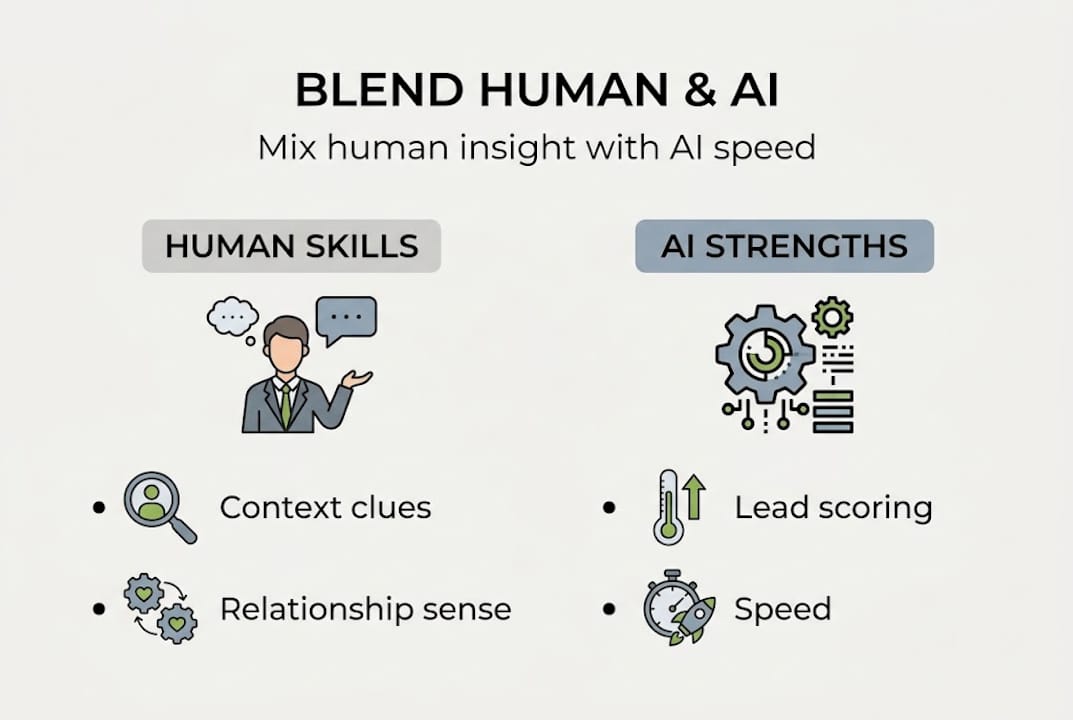
Top-performing B2B sales teams train staff to excel at AI-powered qualification while refining their interpersonal skills. That combination is what separates teams that hit quota from those that wonder why their pipeline looks full but their close rates are flat.
Here are five standards every qualification process should meet when combining AI insights with human review:
- Clear handoff criteria: Define exactly what score and signal combination triggers human review
- Documented qualification framework: Use a consistent method like BANT or MEDDIC, adapted for your market
- Regular calibration sessions: Weekly team reviews of borderline leads keep judgment sharp and consistent
- Feedback loops from closers: Account executives should report back on lead quality so qualifiers can adjust
- Ongoing training on AI tools: Teams need to understand what the AI is measuring and where it can be wrong
Pro Tip: Run a quarterly audit where your top qualifier and your AI scoring model evaluate the same batch of leads independently. Compare the results. The gaps will tell you exactly where to focus your training investment.
One pitfall many teams miss is assuming that AI in prospecting removes the need for qualification criteria altogether. It does not. AI amplifies your criteria. If your criteria are vague, the AI will surface vague leads at scale, and your human team will waste time sorting through them.
Real-world impact: Case studies and examples of human qualification
Let’s look at what actually changes when companies commit to a structured human qualification process alongside their AI tools.
A professional services firm running outbound campaigns with AI-only qualification saw a 22% meeting-to-close ratio. After introducing a human qualification layer where a trained rep reviewed every AI-scored lead before booking a meeting, that ratio climbed to 38% within two quarters. The reps were not generating more leads. They were generating better ones.
A B2B software consultancy used AI to identify 500 target accounts per month. Without human qualification, their sales team was spending roughly 40% of their time on deals that stalled in negotiation due to budget misalignment. After adding a qualification call before any demo was booked, that wasted time dropped by more than half. The pipeline got smaller but the revenue per closed deal went up by 31%.
Professional service firms improved sales results by combining human and AI qualification processes, and the pattern is consistent across industries: precision beats volume when it comes to closing.
| Metric | Before human qualification | After human qualification |
|---|---|---|
| Meeting-to-close rate | 22% | 38% |
| Time wasted on stalled deals | 40% of sales time | Under 20% of sales time |
| Revenue per closed deal | Baseline | Up 31% |
| Lead misfit rate | High | Significantly reduced |
You can find more human qualification examples from firms across professional services, SaaS, and consulting that have restructured their pipelines around this model. The common thread is not the industry. It is the decision to treat qualification as a strategic function, not an administrative one.
Why the next sales advantage lies in qualification mindset
Most sales leaders chase the next tool. A new AI platform, a better data provider, a smarter sequencing engine. And those things matter. But the teams we see consistently outperform their peers are not the ones with the most sophisticated tech stack. They are the ones who treat qualification as a deliberate, measurable strategy rather than a step between prospecting and pitching.
The mistake is framing this as a choice between people and technology. The real question is how you structure a process where both operate at their best. That means hiring qualifiers who are curious, not just persistent. It means training your team to use AI insights as a starting point for judgment, not a replacement for it. It means building a qualification process that is documented, reviewed, and improved on a regular cadence.
The teams winning in 2026 have made qualification a culture, not a checkbox. That shift in mindset is the actual competitive advantage.
Take your sales qualification to the next level with AI experts
If this article has surfaced gaps in how your team currently qualifies leads, you are already ahead of most. Knowing where the problem is, whether it is weak AI-to-human handoffs, undertrained qualifiers, or vague criteria, is the first step toward fixing it.
At Lickfold Digital, we work with B2B sales leaders to build qualification systems that combine AI-driven prospecting with structured human review. Our team helps you assess where your current process leaks revenue, integrate the right AI tools, and train your team to qualify with precision. If you are ready to build a pipeline that converts at a higher rate, book a qualification consultation and let’s map out what that looks like for your team.
Frequently asked questions
What does human qualification mean in B2B sales?
Human qualification in B2B sales means experienced sales professionals evaluate leads’ fit and readiness using context, conversation, and judgment that AI cannot replicate. Modern B2B pipelines need both AI and human input for optimal results.
Where does AI qualification typically fall short?
AI typically struggles with leads that require nuanced understanding of deal complexity, cultural fit, or unstated objections. B2B teams that combine human review and AI consistently see the highest conversion rates.
How can sales teams balance human and AI qualification?
Sales teams use AI for scoring and volume filtering, then apply targeted human review for top prospects and ambiguous deals. Professional service firms improved results significantly by building this two-stage model into their standard process.
What are signs your sales team needs stronger human qualification?
Warning signs include declining close rates, high lead misfit, and deals lost for reasons that do not show up in your CRM data. If your pipeline looks full but revenue is flat, qualification quality is usually the first place to investigate.