
The Role of Email in B2B Services: 2026 Guide
The Role of Email in B2B Services: 2026 Guide
TL;DR:
- Email provides the highest return on investment in B2B marketing by effectively driving pipeline and managing relationships.
- It uniquely reaches professionals in their primary work tools, making it the most natural platform for building organizational memory and continuous engagement.
Email is the highest-ROI channel in B2B marketing, delivering $36 for every $1 spent across industry benchmarks. That number alone explains why B2B marketers keep returning to email even as newer platforms compete for attention. The role of email in B2B services extends far beyond sending newsletters. It drives pipeline, manages client relationships, coordinates multi-stakeholder deals, and serves as the institutional memory of your organization. This guide breaks down exactly how email communication in B2B works, what metrics actually matter, and which practices separate high-performing programs from the ones that quietly underperform.
Why is email uniquely effective for B2B communication?
Email reaches professionals inside their primary work tool. 86% of business professionals prefer email as their primary channel for professional communication, which means your message lands where decisions already happen. Unlike social media posts or paid ads, email does not require your prospect to change context or visit a separate platform.
The operational reality reinforces this. Business professionals spend 28% of their workday managing email, according to McKinsey. That is not a distraction. It is a signal that email is where work gets done, which makes it the most natural place to introduce, nurture, and close a B2B relationship.
Email also functions as owned media. You control the list, the timing, and the message. A LinkedIn algorithm change does not erase your audience. A Google ad budget cut does not silence your outreach. That ownership matters in long B2B sales cycles where consistent, repeated contact across months is the norm, not the exception.
Here is what makes email structurally superior for B2B compared to other channels:
- Engagement metrics are precise. Open rates, click-through rates, reply rates, and time-on-email give you attribution data that phone calls and in-person meetings cannot match.
- Scalability is near-zero incremental cost. Sending to 500 prospects costs almost the same as sending to 5,000 once infrastructure is in place.
- Multi-stakeholder support is built in. A typical B2B deal involves 6 to 10 decision-makers, each with different priorities. Email lets you tailor messaging by role and send simultaneously without coordination overhead.
- Compliance and auditability. Every email creates a timestamped record, which matters for regulated industries and complex procurement processes.
- 78% of B2B organizations rank email as very or extremely important to overall success, confirming that this is not a niche preference but an industry-wide consensus.
Pro Tip: Set up dedicated sending domains for different email functions, such as marketing, transactional, and outreach. This protects your sender reputation across programs and keeps deliverability issues in one stream from contaminating the others. Lickfold covers this in detail in their guide on dedicated email accounts.
How do email types and strategies differ in B2B services?
B2B email communication is not a single category. Treating it as one is the fastest way to underperform. There are three distinct types, and each requires a different strategy.
Transactional emails include order confirmations, contract alerts, password resets, and invoice notifications. They carry the highest open rates of any email type because recipients expect and need them. 43% of organizations measure transactional email ROI specifically because these messages directly affect cost savings and risk mitigation. If your transactional emails are poorly formatted or slow to deliver, you are eroding client trust at the most critical touchpoints.
Marketing emails cover newsletters, lead nurture sequences, product announcements, and case study campaigns. These build awareness and move prospects through the funnel. The mistake most B2B teams make here is sending the same message to their entire list. Segmentation by lifecycle stage, industry vertical, and engagement history is what separates a 12% open rate from a 30% one.
Operational emails handle internal coordination, client status updates, and service delivery communication. These are often overlooked in strategy discussions, but they carry significant relationship weight. A well-structured client update email signals professionalism and reduces inbound support requests.
Here is a practical framework for structuring your B2B email strategy by type:
- Map your email types to business outcomes. Transactional emails protect revenue and trust. Marketing emails generate and nurture pipeline. Operational emails retain clients and reduce churn.
- Segment lists by firmographic and behavioral data. Company size, industry, job title, and past engagement all produce more relevant messages than first-name personalization alone.
- Build automation sequences tied to buyer behavior. A prospect who downloads a whitepaper should enter a different sequence than one who attended a webinar. Trigger-based automation outperforms scheduled blasts consistently.
- Align send cadence to sales cycle length. A six-month enterprise deal requires a different email rhythm than a 30-day SMB close. Mapping cadence to cycle length prevents both under-communication and fatigue.
- Test subject lines and preview text systematically. These two elements determine whether your email gets opened. A/B testing one variable at a time gives you clean data to act on.
Pro Tip: Use behavioral triggers, not just calendar triggers. When a prospect visits your pricing page twice in one week, that is a signal worth acting on immediately. Lickfold’s guide on strategic follow-up campaigns outlines exactly how to build these trigger-based sequences.
What metrics matter for measuring email impact in B2B?
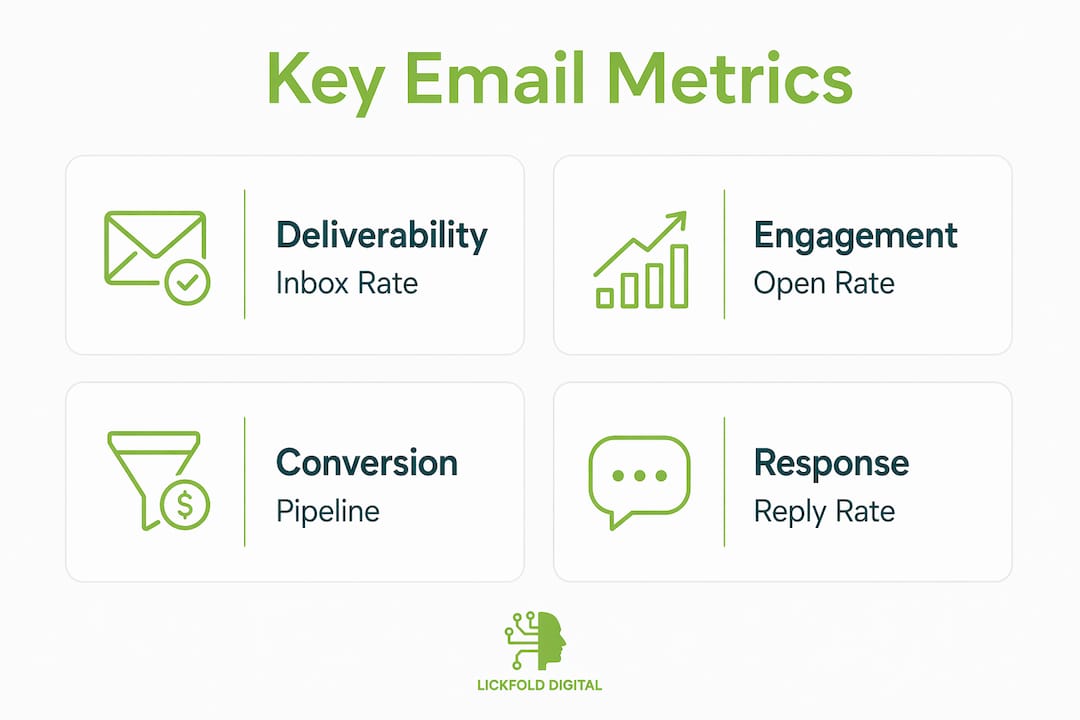
Most B2B teams track open rates and call it measurement. Open rates are a starting point, not a conclusion. The metrics that actually connect email activity to revenue require a four-tier framework.
| Tier | Metric | What it tells you |
|---|---|---|
| Deliverability | Inbox placement rate, bounce rate | Whether your emails are reaching recipients at all |
| Engagement | Open rate, click-through rate, reply rate | Whether your content is relevant and compelling |
| Conversion | Form fills, demo requests, pipeline created | Whether email is driving business outcomes |
| Revenue | Email-attributed revenue, revenue per email sent | Whether the program is generating measurable return |
The revenue tier is where most teams have gaps. Multi-touch B2B sales cycles make attribution genuinely difficult. A prospect might receive 12 emails over four months before converting. Assigning full credit to the last email before a meeting is booked misrepresents what actually moved the deal.
Time decay attribution models address this by giving more credit to recent touches while still acknowledging earlier ones. First-touch and last-touch models distort the picture. Integrating email engagement data directly into your CRM, whether that is Salesforce, HubSpot, or a similar platform, gives your sales team visibility into which prospects are warming up before they ever pick up the phone.
The most underused metric in B2B email programs is reply rate on cold outreach. A 3% reply rate on a cold sequence is not a failure. It is a signal about message relevance, list quality, and timing. Tracking reply rate alongside email deliverability gives you a complete picture of whether your outreach is reaching the right people with the right message.
What are the best practices for B2B email optimization?
The gap between average and high-performing B2B email programs comes down to a handful of specific decisions. Segmented, automated B2B email programs regularly exceed 25% open rates, according to Campaign Monitor’s 2025 benchmark data. That is not luck. It is the result of deliberate list management, technical setup, and message discipline.
List hygiene is non-negotiable. Sending to stale or unverified addresses damages your sender reputation and reduces inbox placement for everyone on your list. Remove hard bounces immediately. Suppress unengaged contacts after 90 days of no activity. Re-engagement campaigns can recover some of these contacts, but the default should be a clean, active list.

Technical authentication protects deliverability. SPF, DKIM, and DMARC records are the baseline. Without them, your emails are more likely to land in spam regardless of content quality. This is infrastructure work, not marketing work, but it directly determines whether your campaigns reach their audience. Lickfold’s step-by-step delivery guide walks through the full technical setup.
Cold email requires compliance and precision. CAN-SPAM in the US and GDPR in Europe set the legal floor. Personalization raises the ceiling. Generic templates sent to purchased lists produce poor results and carry legal risk. The most effective cold outreach uses AI-powered personalization based on company-specific research, not mail-merge first names.
Avoid the broadcast trap. The most common mistake in B2B email is treating it as a broadcast channel rather than a relationship-building one. A single mass email to 10,000 contacts is not a strategy. It is a shortcut that trains your audience to ignore you. Smaller, more targeted sends with relevant content outperform volume every time.
Pro Tip: Before launching any new email sequence, audit your current list segmentation. If you cannot describe the specific business problem each segment has, your personalization will not land. The targeted outreach guide from Lickfold provides a practical segmentation framework built for B2B service teams.
Key takeaways
Email in B2B services functions as both a revenue channel and an organizational asset, and treating it as only one of the two leaves significant value on the table.
| Point | Details |
|---|---|
| Email delivers the highest ROI | At $36 per $1 spent, no other B2B channel matches email’s return on investment. |
| Three email types require three strategies | Transactional, marketing, and operational emails each serve distinct goals and need separate management. |
| Metrics must connect to revenue | Track email-attributed pipeline and revenue per send, not just open rates. |
| Technical setup determines reach | SPF, DKIM, and DMARC authentication are prerequisites for inbox placement, not optional extras. |
| Segmentation drives performance | Automated, segmented programs consistently exceed 25% open rates versus unsegmented blasts. |
Email as organizational memory, not just outreach
Here is something most email strategy articles skip entirely: email is not just a marketing channel. It is where your organization’s institutional knowledge lives, and most companies are managing it dangerously.
As much as 75% of critical intellectual property resides within trapped email chains rather than central repositories. That means client agreements, project decisions, pricing negotiations, and relationship history are sitting in individual inboxes. When a senior account manager leaves, that knowledge walks out the door with them.
I have seen this play out in professional services firms that had years of client relationship data locked in personal email accounts. The sales team had no visibility into past conversations. New hires had no context. The CRM was populated with contact records but empty of the actual relationship history that determines how to approach a renewal or an upsell.
The Knowledgemill Email Trends Report 2026 frames this precisely: organizations treat email as personal productivity rather than organizational memory, and that creates real operational and compliance risk. Enterprise-grade email archiving is not a nice-to-have for complex B2B organizations. It is the infrastructure that makes your client relationships transferable and auditable.
My view is that the B2B teams who will win over the next five years are the ones who treat email as a strategic asset requiring active management, not a utility that runs in the background. That means investing in archiving, integrating email data into CRM, and building AI readiness by structuring the data you already have. The channel is mature. The management practices around it are not.
— Duarte
Take your B2B email communication further with Lickfold
If you are running B2B outreach and your email program is not generating the pipeline you expect, the problem is usually one of three things: deliverability, personalization, or sequence design. Lickfold specializes in exactly these areas. The platform deploys AI-driven outreach that identifies the right decision-makers, builds personalized multi-touch sequences, and maintains the sender reputation infrastructure that keeps your emails out of spam. Whether you are starting from scratch or fixing a program that has plateaued, the team at Lickfold can audit your current setup and build a system that produces qualified opportunities at scale. Reach out directly to get a personalized assessment of your B2B email strategy.
FAQ
What is the role of email in B2B services?
Email serves as the primary channel for professional communication, lead nurturing, client retention, and revenue generation in B2B services. It delivers $36 for every $1 spent, making it the highest-ROI channel available to B2B marketers.
How does email communication differ from B2C in a B2B context?
B2B email communication addresses multiple decision-makers with longer sales cycles, requiring segmentation by role and lifecycle stage rather than broad demographic targeting. A typical B2B deal involves 6 to 10 stakeholders, each needing tailored messaging.
What email metrics should B2B teams prioritize?
Beyond open rates, B2B teams should track email-attributed pipeline, revenue per email sent, and reply rates on cold outreach. These metrics connect email activity directly to business outcomes rather than vanity engagement numbers.
How do you improve B2B email deliverability?
Implement SPF, DKIM, and DMARC authentication on your sending domains, maintain clean lists by removing hard bounces and suppressing unengaged contacts, and use dedicated sending domains for different email functions to protect sender reputation.
Is cold email still effective for B2B outreach in 2026?
Cold email remains effective when built on precise targeting, company-specific personalization, and compliance with CAN-SPAM and GDPR requirements. Generic templates sent to unverified lists produce poor results. AI-driven personalization at the firmographic and behavioral level is what separates high-performing cold programs from low-response ones.