
Targeted Outreach Campaign Guide for B2B Teams
Targeted Outreach Campaign Guide for B2B Teams
TL;DR:
- Most B2B outreach fails early because of poor targeting, unready infrastructure, and borrowed sequences. Defining an ICP across four key dimensions and utilizing multi-channel, personalized messaging greatly improves response rates and campaign success. Proper infrastructure setup, warm-up, and ongoing optimization over 90 days are essential for sustained outreach effectiveness and pipeline growth.
Most B2B outreach fails before the first message is ever sent. Not because the copy is bad, but because the targeting is wrong, the infrastructure is unready, and the sequence is borrowed from someone else’s playbook. This targeted outreach campaign guide exists to fix that. You will get a structured, field-tested process for building campaigns that reach the right people, at the right time, with messaging that actually earns a reply. Every section covers a distinct phase of how to conduct outreach campaigns that convert, from ICP definition through performance optimization.
Table of Contents
- Key takeaways
- Your targeted outreach campaign guide starts here: planning and ICP
- Crafting message frameworks that actually get replies
- Executing and managing multi-channel campaigns
- Measuring and optimizing campaign performance
- My honest take on building outreach programs that last
- How Lickfold can run this for you
- FAQ
Key takeaways
| Point | Details |
|---|---|
| ICP precision before list building | Define your ideal customer across four dimensions before prospecting to avoid wasted contacts. |
| Warm-up timelines protect deliverability | Skipping the four-week email warm-up causes early account restrictions that are hard to reverse. |
| Multi-channel beats single-channel | Synchronizing email, LinkedIn, calls, and voicemail increases engagement by 287% versus one channel alone. |
| Personalization multiplies response | Messaging that references a prospect’s actual context lifts response rates 3-5x over generic templates. |
| Treat outreach as a system | Commit at least 90 days to any campaign before judging performance; early data is almost always misleading. |
Your targeted outreach campaign guide starts here: planning and ICP
The fastest way to kill an outreach campaign is to skip the planning phase. Sending messages without a defined ideal customer profile (ICP) is the operational equivalent of cold-calling a phone book. You burn contacts, damage domain reputation, and teach your team to accept low standards.
Defining your ICP across four dimensions
Effective campaigns define ICP across four dimensions before any list is built: role, company context, pain trigger, and situational trigger. Role is obvious (VP of Sales, Head of Marketing), but the other three dimensions are where most teams stop putting in the work. Company context includes firmographic signals like team size, growth stage, and tech stack. Pain triggers are the operational problems your solution addresses. Situational triggers are the real-time signals that indicate a prospect is actively looking for a solution right now, such as a recent funding round, a new hire in a relevant role, or a competitor departure.
Lickfold’s AI agents perform this four-dimension qualification at scale, which is a significant advantage when you are targeting thousands of accounts across multiple segments simultaneously.
Channel selection and KPI setting
Once your ICP is defined, choose your channels based on where your audience actually spends time, not where your team is most comfortable. For most B2B segments, LinkedIn and email remain the highest-performing channels. Calls and voicemail become relevant for higher-value enterprise targets where relationship-building carries more weight.
Set measurable goals before you launch. Useful KPIs include:
- Connection acceptance rate (LinkedIn): target 30% or above
- Email open rate: a proxy for subject line and deliverability quality
- Reply rate: industry baseline sits between 1-5% for cold email, but well-optimized campaigns outperform this significantly
- Positive reply rate: replies showing genuine interest, not just “remove me”
- Cost per qualified conversation: the metric that ties outreach directly to revenue
Pro Tip: Before selecting any outreach tool, check whether it supports randomized send delays, active-hours restrictions, and automatic stop-on-reply rules. If it does not, find a different tool. These features are not optional.
Crafting message frameworks that actually get replies
Generic templates are not just ineffective. They actively signal to recipients that you did not care enough to learn anything about them. Researched personalization increases response rates 3-5x compared to template-based outreach, which means the investment in better messaging pays back quickly.
Message variants you need to build
Every campaign needs at least four distinct message types:
- Initial outreach: short, specific, low-commitment ask. Reference something real about the prospect’s company or role.
- Value-add follow-up: share a relevant insight, case study, or data point. This is not a re-pitch. It is a demonstration of what working with you looks like.
- Social proof touchpoint: a customer result, a stat, or a third-party validation. Keep it to two sentences.
- Breakup message: the final touch. Light humor or honest directness works well here. “I will stop following up after this, but if the timing changes, here is my calendar link.”
Sequencing and timing strategy
The ideal outreach sequence runs 8-12 touchpoints over 2-4 weeks, with decreasing contact frequency as the sequence progresses. Day one gets the initial email. Day three gets the LinkedIn connection request. Day seven brings the first follow-up. From there, you space touches out to every four to five days. The drop-off in frequency mimics natural human behavior and avoids the “desperate salesperson” pattern that prospects recognize immediately.

Using AI for outreach personalization boosts user performance by 66%, with top performers creating 45% more opportunities and hitting quotas 51% more often. That gap is too large to ignore if you are competing against teams already using these tools.
Pro Tip: Write your initial message as if you are sending it to one person. Then use AI to scale that specificity across hundreds of contacts by pulling in dynamic fields tied to real prospect data, not just first name and company.
Common mistakes in this phase include opening with “I wanted to reach out about…” (passive and forgettable), leading with your company rather than their problem, and sending all touchpoints through one channel. Mix your channels deliberately, since the multi-channel synchronization of email, LinkedIn, calls, and voicemail is what separates campaigns that generate pipeline from those that generate unsubscribes.
Executing and managing multi-channel campaigns
Most outreach failures are not messaging failures. They are infrastructure failures. You can write the best email in your industry and still land in spam because your sending domain was not warmed up properly.
Account setup and warm-up
Rushing campaign setup leads directly to early account restrictions and long-term deliverability damage. The four-week warm-up timeline is not a bureaucratic obstacle. It is the foundation that determines whether your campaign scales or collapses in week two. During warm-up, your sending volume should increase gradually, starting from 5-10 emails per day and climbing to 50 or more over four weeks while maintaining high open and reply rates.
Here is a reference timeline for multi-channel campaign launch:
| Phase | Timeline | Activity |
|---|---|---|
| Infrastructure setup | Week 1 | Domain purchase, DNS configuration, warm-up tool activation |
| Warm-up period | Weeks 2-5 | Gradual volume increase, reputation building |
| Soft launch | Week 6 | First campaign batch at 30% of full volume |
| Full campaign launch | Week 7+ | Complete volume, all touchpoints active |
Tooling configuration for deliverability
Campaign tooling must be configured with daily send caps, randomized delays between messages, active hours restrictions, and stop-on-reply automation. Without these settings, even well-written campaigns trigger spam filters or violate platform terms of service.
Steps for solid execution:
- Set daily email caps at 50 or below per inbox until reputation is established.
- Add randomized delays of 3-7 minutes between individual sends to mimic human pacing.
- Restrict active sending hours to business hours in the prospect’s time zone.
- Configure automatic sequence termination the moment a prospect replies.
- Assign each LinkedIn account no more than 20 connection requests per day.
- Rotate multiple inboxes across a single campaign to distribute volume safely.
Pro Tip: Coordinate your LinkedIn touches and email touches around the same theme in the same week. When a prospect sees your LinkedIn connection request the day after receiving your email, your name becomes familiar. Familiarity reduces friction, and reduced friction increases replies.
Intent signals should also inform your launch timing. Prospects who just posted about a relevant pain point, promoted a new hire, or raised a funding round are dramatically more receptive than prospects contacted at random.
Measuring and optimizing campaign performance
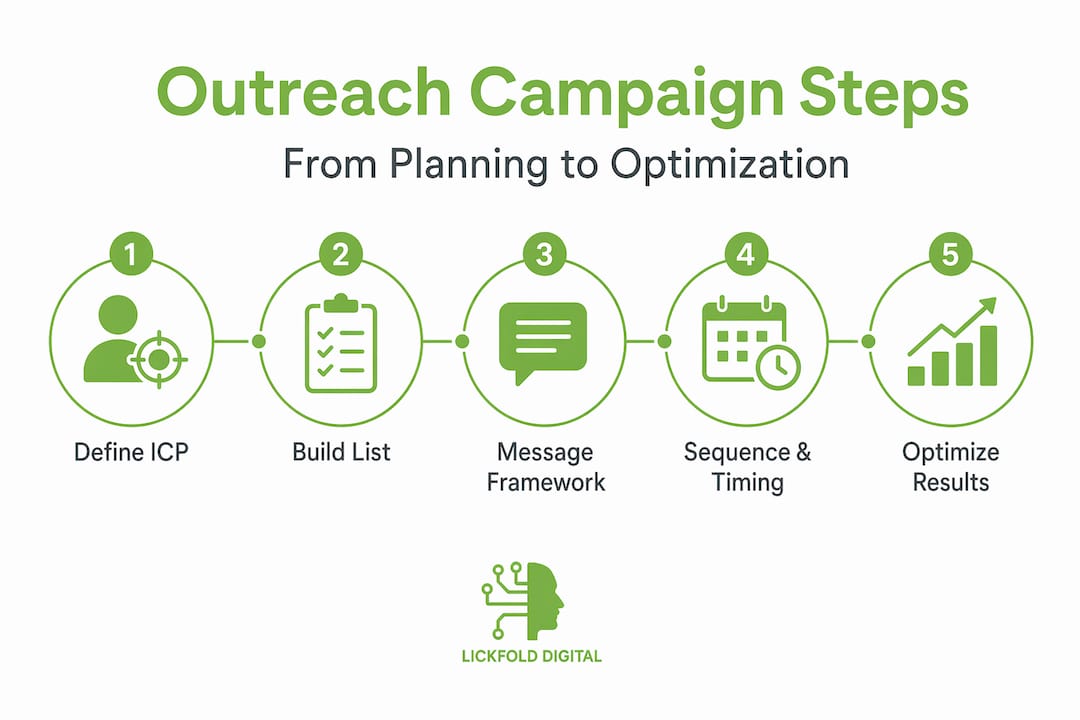
Outreach campaigns that are treated as one-off efforts almost always disappoint. The teams that build consistent pipeline from outreach commit to at least 90 days before drawing conclusions, because deliverability, message resonance, and prospect timing all improve with iteration.
The metrics that matter most
Track these KPIs by segment, not just in aggregate:
- Connection acceptance rate: tells you whether your profile and initial message match the ICP
- Open rate: signals subject line strength and domain deliverability
- Reply rate: the combined effect of targeting, messaging, and timing
- Positive reply rate: the clearest signal of ICP-message fit
- Cost per qualified conversation: ties campaign performance to business results
When you segment these metrics by ICP dimension, patterns emerge quickly. If one industry vertical shows a 12% reply rate and another shows 2%, you have just identified your highest-value audience and your most wasteful spend simultaneously.
A/B testing and refinement
Run one variable at a time. Test subject lines before testing body copy. Test send day and time before testing sequence length. Testing multiple variables simultaneously gives you data you cannot act on cleanly.
| Test Variable | What It Tells You | Recommended Sample Size |
|---|---|---|
| Subject line | Deliverability and first impression | 200+ per variant |
| Opening sentence | Hook effectiveness and relevance | 200+ per variant |
| Call to action | Conversion step clarity | 300+ per variant |
| Send timing | Prospect availability patterns | 400+ per variant |
AI-driven B2B prospecting tools can accelerate this cycle significantly by analyzing performance data across thousands of sends and surfacing patterns that manual review would miss in weeks of analysis. The goal of each optimization cycle is a narrower, more precise ICP and a message framework that speaks directly to the problems that segment actually cares about.
My honest take on building outreach programs that last
I have watched companies spend three months building what looks like a sophisticated outreach operation, only to tear it down and start over because they rushed the foundational work. The irony is painful. Slower setup genuinely produces faster results, and teams that skip warm-up timelines or skip ICP definition to “just get started” reliably pay for it later with a longer recovery process than the setup would have taken.
The tension between automation and personalization is real, but it is usually framed wrong. The question is not whether to automate. The question is what to automate. Automate volume, sequencing, and data enrichment. Never automate the judgment calls about which message angle matches which prospect type. That thinking is the part that produces results, and it cannot be offloaded entirely.
What I have also learned is that quality of targeting beats quantity of sends every single time. Sending 200 precisely targeted messages to a well-defined ICP consistently outperforms blasting 2,000 contacts with a broadly defined one. The personalization that drives results is not decoration on a generic template. It is the structural logic of the entire campaign, built in before the first message is ever written.
If your outreach program is not producing pipeline, the answer is almost never “send more.” It is usually “target better, message smarter, and give the system time to work.”
— Duarte
How Lickfold can run this for you
Building a targeted outreach campaign from scratch takes longer than most teams expect, and the margin for error in infrastructure and sequence design is thin. Lickfold’s AI-powered platform handles the pieces that most teams get wrong: precise ICP research, dedicated warm-up accounts, personalized multi-touch sequences across email and LinkedIn, and human qualification of replies before anything reaches your sales team.
If you want a pipeline that runs predictably without adding headcount, the Lickfold Digital team builds and manages that infrastructure for you. Every campaign is built around your specific ICP, not a recycled template from a previous client. You can also explore how AI outreach personalization has driven real revenue growth for B2B companies in your space. When you are ready to see what a properly built outreach system looks like for your pipeline, get in touch here.
FAQ
What is a targeted outreach campaign?
A targeted outreach campaign is a structured, multi-touch program that identifies specific decision-makers matching your ICP and contacts them through personalized, sequenced messages across one or more channels to generate qualified sales conversations.
How many touchpoints should a B2B outreach sequence include?
The ideal B2B sequence contains 8-12 touchpoints delivered over two to four weeks, with spacing between touches increasing as the sequence progresses to avoid oversaturation.
Why does email warm-up matter for outreach campaigns?
Sending cold email from a fresh domain without warm-up causes spam filter triggers and platform restrictions that damage your sender reputation long-term. A proper four-week warm-up builds the domain authority needed for consistent inbox delivery.
What reply rate should I expect from cold outreach?
Cold email reply rates average 1-5% across industries, but precise targeting and deliverability work can push well-optimized campaigns significantly above that baseline, particularly when ICP and messaging are tightly aligned.
How does AI improve outreach campaign performance?
Generative AI for personalization increases rep performance by 66%, with high performers creating 45% more pipeline opportunities and hitting quotas 51% more often than those using manual outreach methods alone.