
Why B2B Deals Stall in Pipeline: A 2026 Guide
Why B2B Deals Stall in Pipeline: A 2026 Guide
TL;DR:
- B2B deal stalls mainly result from structural failures like misaligned buying committees and undefined decision triggers.
- Effective pipeline management requires early discovery, clear decision triggers, and assessing internal risk perceptions to keep deals moving.
B2B deals stall in the pipeline primarily because of structural failures: missing decision triggers, misaligned buying committees, and unresolved buyer risk. These are not symptoms of a slow market. They are symptoms of a broken sales process. Average B2B sales cycles now run 134 days, and that number climbs to 180–365 days for deals above $250,000. The status quo, not a competitor, is the single biggest threat to your close rate. Understanding why b2b deals stall in pipeline is the first step toward fixing the structural problems that keep revenue locked in limbo.
Why B2B deals stall in pipeline: the buying committee problem
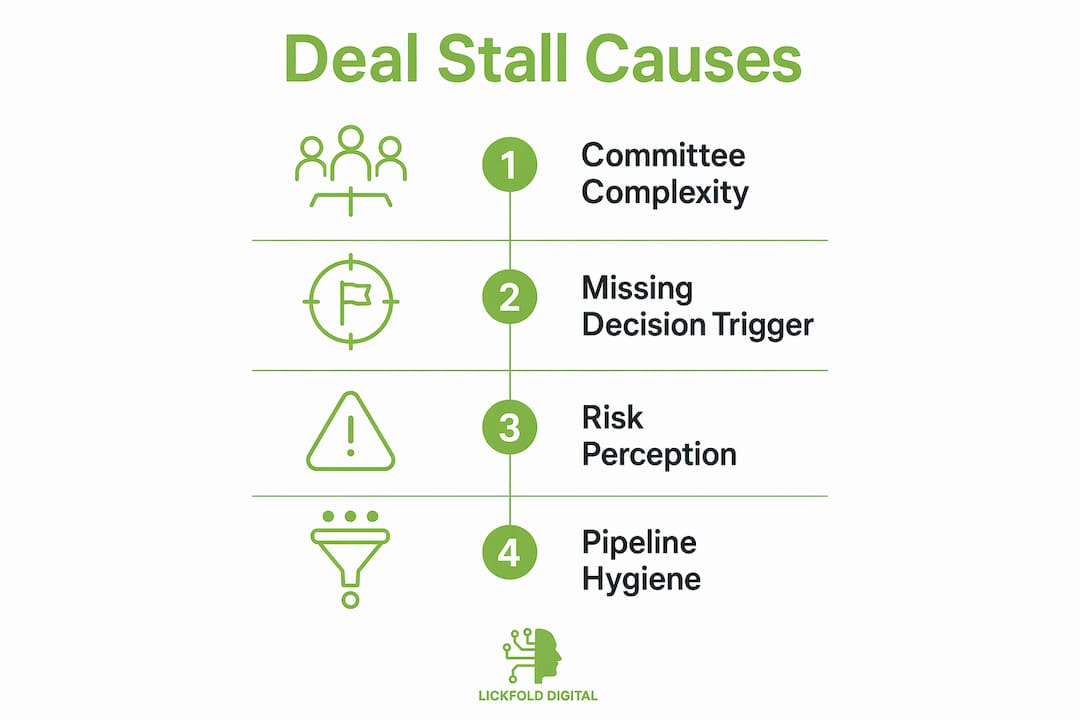
The most common cause of deal stagnation is internal misalignment inside the buyer’s organization. Buying groups now include 6–10 stakeholders, and each one arrives at the table with a different understanding of the problem. That gap is not a communication issue. It is a structural barrier to consensus.
The research is direct: 74% of buying committees experience what researchers call “unhealthy conflict,” driven by members who hold confidently misunderstood and incompatible views. Each stakeholder conducts independent research and builds a different mental model of the solution. When those models collide in a buying meeting, the result is paralysis, not a decision.
“Over 40% of B2B deals fail to progress due to internal misalignment within buying groups holding conflicting views on the problem. No-decision outcomes represent rational buyer survival tactics, not buyer inertia.”
82.4% of sales leaders identify losses to no-decision or status quo as a very or somewhat challenging issue. That statistic reveals something uncomfortable: most deal losses are self-inflicted by the buyer’s own internal dysfunction, not by a competitor winning on price or features.
The practical implication for sales leaders is clear. You cannot wait for the buyer’s committee to align on their own. You must facilitate that alignment early, before the proposal stage.
Common signs of buying committee misalignment:
- Different stakeholders cite different business problems when asked why they are evaluating your solution
- Legal, finance, and operations each raise objections that contradict each other
- The “champion” cannot articulate the internal consensus on what success looks like
- Meetings get rescheduled repeatedly without a clear reason
Knowing how to identify decision makers in a complex buying group is not optional. It is the prerequisite for any deal that has a realistic chance of closing.
What happens when deals have no clear decision trigger
Deals without a defined reason to decide stay open indefinitely. Deals stall because there is no decision condition forcing buyer commitment. Sales activity continues, emails go out, calls get logged, but none of it creates momentum because momentum requires a buyer commitment, not a rep action.
This is the core of what causes deal stagnation in complex B2B pipelines. Sales teams mistake activity for progress. A deal that has had three follow-up calls and two product demos in the last 30 days looks alive in the CRM. It is not. Progress is defined by what the buyer commits to, not by what the rep does.
The fix starts in discovery. Early framing must anchor your solution to an unavoidable consequence or a real organizational risk. A compelling event, a regulatory deadline, a contract renewal date, a board-level initiative, gives the buyer a reason to act by a specific date. Without that anchor, “we’ll circle back in Q3” becomes the default answer every quarter.
Steps to build a date-bound decision condition:
- Identify the business event that creates urgency: a fiscal year end, a compliance deadline, a leadership change, or a cost overrun that is already visible.
- Connect your solution directly to the consequence of missing that event.
- Confirm the economic buyer understands and owns that consequence.
- Set a mutual action plan with specific dates tied to the buyer’s internal milestones, not your sales calendar.
- Revisit the urgency anchor at every subsequent meeting to keep it alive.
Stalled deals originate from earlier phases lacking triggers for buyer action and insufficient discovery of economic buyers. Late-stage stalls are almost always early-stage discovery failures in disguise.
Pro Tip: If you cannot name the specific business event that will force your buyer to decide by a date, the deal has no decision trigger. Move it out of your forecast until you find one.
How buyer risk perception blocks deal advancement
Buyers stall deals when they cannot justify the risk internally. This is a different problem from product fit or pricing. A buyer who loves your solution will still delay if they cannot build a defensible internal case for the purchase. Price objections that surface late in a deal are almost always a proxy for earlier unresolved concerns: unclear problem ownership, undefined ROI, or a stakeholder who was never brought into the conversation.
The risk owner inside the buyer’s organization is often not the champion. It is the CFO who must sign off, the IT leader who owns implementation risk, or the legal team that sees liability in the contract terms. Sales teams that focus exclusively on the champion miss the people who can kill the deal without ever appearing on a call.
Signs that buyer risk perception is blocking your deal:
- The champion is enthusiastic but cannot get internal sign-off
- Procurement raises concerns that were never mentioned in earlier conversations
- The buyer asks for references, case studies, or pilot programs after the proposal stage
- ROI questions resurface even after you have presented a business case
Addressing risk early means mapping the internal stakeholders who carry risk responsibility, not just the ones who carry budget authority. A data-driven content strategy that delivers targeted ROI evidence to each stakeholder type reduces the justification gap before it becomes a deal blocker.
Building consensus around ROI requires more than a slide deck. It requires a conversation with each risk owner about their specific concern. The champion cannot do this alone. Your job is to equip them with the right materials and coach them on how to run that internal conversation.
Pro Tip: Ask your champion directly: “Who in your organization would be most concerned about this decision, and what would their objection be?” That answer tells you exactly where the deal will stall next.
How to diagnose and revive stalled deals with pipeline hygiene
Pipeline hygiene is the practice of keeping your forecast accurate by removing deals that are not progressing. Top sales organizations enforce a 14-day kill rule: any deal without meaningful buyer-committed progress in 14 days gets moved out of the forecast or marked closed-lost. That discipline feels harsh. It is also the only way to know what your pipeline actually contains.

Sales reps treat stalled deals as active by logging activity signals in CRM instead of tracking milestone progress. The result is a mid-pipeline graveyard: deals that look healthy in the forecast but have not had a buyer-committed next step in weeks. This distorts resource allocation and gives sales leaders false confidence in their numbers.
The distinction between activity and progress is the most important diagnostic tool a sales manager has.
| Signal type | Example | What it actually means |
|---|---|---|
| Activity (rep-driven) | Follow-up email sent, demo scheduled by rep | Rep is working; buyer may not be engaged |
| Progress (buyer-committed) | Buyer schedules internal review, shares org chart | Buyer is invested and moving internally |
| Stall indicator | No buyer response in 14+ days | Deal needs intervention or removal from forecast |
| False positive | Buyer replies “still interested, just busy” | Not a commitment; deal remains stalled |
Applying the 14-day timeframe for deal movement forces timely identification of stalled opportunities. It also frees your team to focus on deals that can actually close. A smaller, cleaner pipeline beats a bloated one every time.
For deals that are genuinely worth saving, a diagnostic framework helps. Ask three questions: What was the last buyer-committed action? What is the specific obstacle preventing the next step? Who inside the buyer’s organization has the authority and motivation to remove that obstacle? The answers tell you whether to invest in revival or cut the deal loose.
Pro Tip: Run a pipeline audit every two weeks. Any deal without a buyer-committed next step dated in the future gets flagged. Treat that flag as a management conversation, not a rep failure.
Connecting dedicated sales outreach to specific buyer milestones, rather than generic follow-up cadences, is what separates teams that close from teams that just stay busy.
Key Takeaways
B2B deals stall in the pipeline because of structural failures in discovery, committee alignment, and pipeline hygiene, not because buyers are simply slow or indifferent.
| Point | Details |
|---|---|
| Buying committee size drives stalls | Groups of 6–10 stakeholders create internal conflict that blocks consensus and delays decisions. |
| No decision trigger means no close | Deals without a date-bound, buyer-owned urgency anchor stay open indefinitely. |
| Risk perception blocks late-stage deals | Buyers who cannot justify risk internally default to no-decision, regardless of product fit. |
| Activity is not progress | Only buyer-committed milestones indicate real deal movement; rep activity does not. |
| Pipeline hygiene protects forecast accuracy | The 14-day kill rule removes stalled deals from forecasts and focuses teams on winnable opportunities. |
What I’ve learned from watching pipelines rot from the inside
The most persistent mistake I see sales leaders make is treating pipeline volume as a proxy for pipeline health. A full pipeline feels good. A full pipeline with 60% of deals showing no buyer-committed activity in three weeks is not a pipeline. It is a list of conversations that went nowhere.
The structural causes of deal stagnation rarely show up in the late stages where they become visible. They are planted in discovery, when reps fail to identify the economic buyer, skip the urgency anchor, or avoid the uncomfortable question of who inside the buyer’s organization will oppose the decision. By the time a deal stalls at proposal, the damage was done two months earlier.
What actually works is coaching reps to treat every deal as a hypothesis. The hypothesis is: “This buyer has a problem urgent enough to solve by this date, and I know who owns that urgency.” If a rep cannot state that hypothesis with confidence, the deal should not be in the forecast. That standard feels strict. It also produces forecasts you can actually trust.
Strategic pipeline pruning is not pessimism. It is the discipline that lets your team focus energy on deals with real momentum, rather than spreading effort across a graveyard of stalled opportunities. The teams I have seen close the most consistently are the ones willing to kill deals early and move on.
— Duarte
How Lickfold helps sales leaders build pipelines that actually move
Stalled deals are often a symptom of a pipeline that was built on weak foundations: the wrong prospects, the wrong contacts, and outreach that never reached a real decision-maker. Lickfold deploys AI agents that identify and engage the specific decision-makers inside your ideal accounts, before your sales team ever gets on a call.
The result is a pipeline built on qualified, buyer-committed conversations rather than cold activity. Lickfold’s system handles market research, multi-touch outreach, and human qualification of replies, so your team receives warm opportunities with real context. If your pipeline is stalling because the wrong people are entering it, that is the problem Lickfold is built to solve. Talk to the Lickfold team about building a pipeline that moves.
FAQ
Why do most B2B deals end in no-decision?
82.4% of sales leaders report no-decision losses as a significant challenge. Buyers default to the status quo when internal committees cannot align on the problem or when no stakeholder owns the urgency to act.
How long does a typical B2B sales cycle take in 2026?
Average B2B sales cycles run 134 days, extending to 180–365 days for deals above $250,000. Larger buying groups and longer legal review periods are the primary drivers of that extension.
What is the 14-day kill rule in B2B sales?
The 14-day kill rule is a pipeline hygiene practice where deals without buyer-committed progress in 14 days are removed from the active forecast or marked closed-lost. It prevents pipeline bloat and keeps forecast numbers accurate.
How do you identify a stalled deal vs. a slow-moving deal?
A slow-moving deal has a buyer-committed next step with a future date. A stalled deal has only rep-driven activity with no buyer commitment to a specific action. The absence of a buyer-committed milestone is the defining signal.
What causes late-stage price objections in B2B deals?
Late-stage price objections are almost always a proxy for earlier unresolved concerns, such as unclear ROI, undefined problem ownership, or a risk stakeholder who was never engaged. Addressing those concerns in discovery prevents price from becoming the final obstacle.